Fifty years ago, punk rock – noisy, anarchic, rude and dressed to shock – erupted on to Britain’s streets and stages
What happened in summer 1976?
There was a record-breaking heatwave, inflation and youth unemployment were worryingly high, a Labour prime minister had recently resigned – and a new subculture known as “punk” was spreading rapidly among the young. Its seed was the Sex Pistols, a band formed only the previous winter, who wouldn’t release their first single, “Anarchy in the UK”, until 26 November. But their early gigs inspired the formation of The Clash, The Damned, Buzzcocks and many other punk bands.
Plenty of adults were appalled, but punk had a powerful influence on fashion, filmmaking and graphic design as well as rock music – well beyond punk itself. Members of the tiny audiences at two shows the Pistols played that summer – in Manchester in June and July – went on to found The Fall, Joy Division, The Smiths, Simply Red and the Creation and Factory record labels.
What even is a punk?
In Shakespeare’s time, the word meant a prostitute. In American-English it became a put-down for an inept youngster and/or petty criminal, as in 1971’s “Dirty Harry”: “Well, do ya, punk?” At around the same time, US music critics were starting to use the term “punk rock” for the amateurish, shouty garage rock bands that appeared in the 1960s. It was also applied to various New York acts – the Ramones, the New York Dolls, Richard Hell – who experimented with outlandish outfits, back-to-basics songwriting, and themes of teenage alienation. But “punk rock” didn’t become a media phenomenon until it crossed the Atlantic.
Why did it take off in Britain?
Britain, at the time, had a hyperactive music press and an entertainment industry with an appetite for eccentricity and theatricality. As American record companies had long understood, these made London an ideal launchpad for pop-culture trends. (The Ramones, who drew crowds of about 150 in New York, were astonished to find themselves in front of thousands of people when they played in Camden Town in July 1976.)
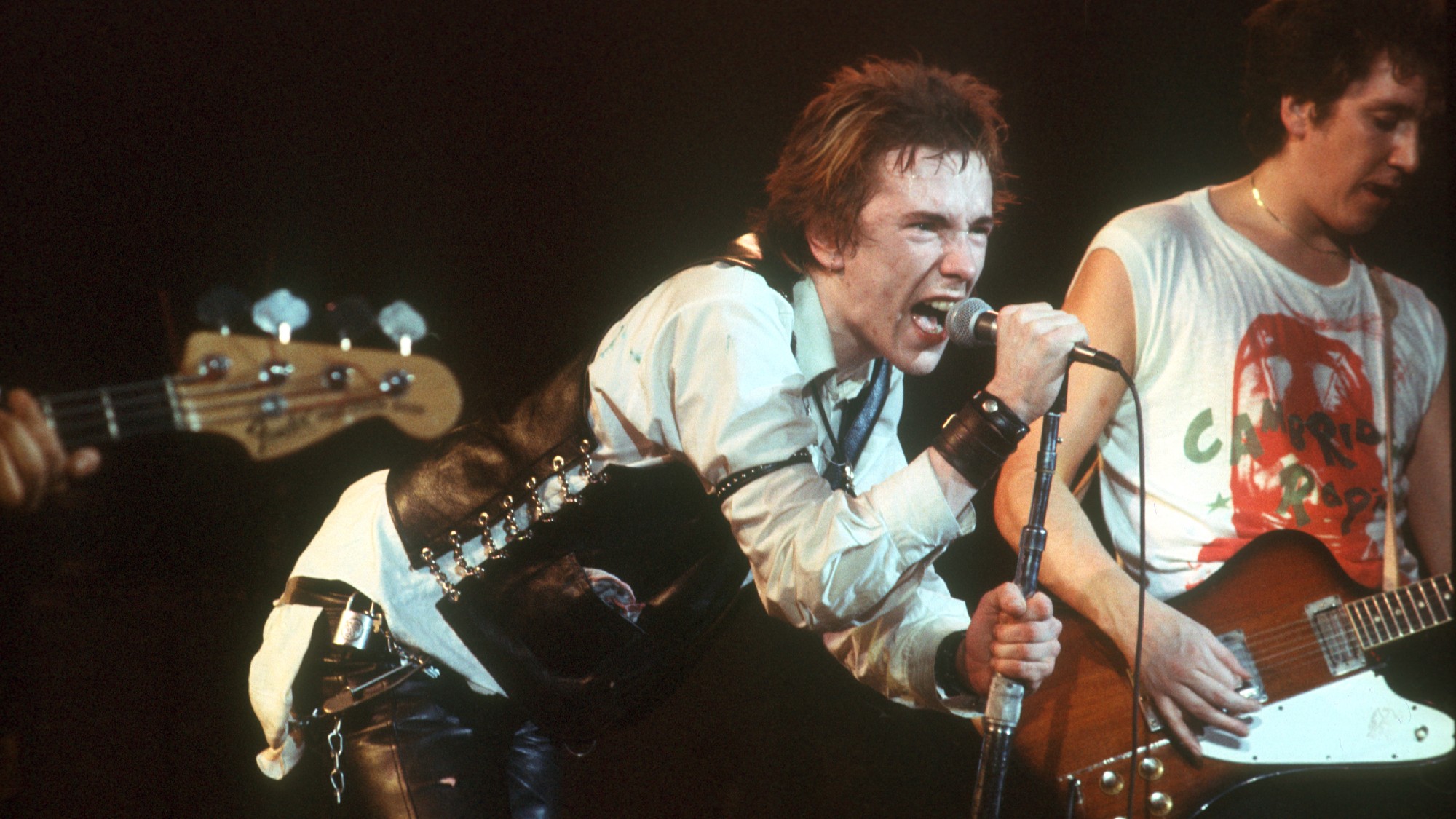
The Sex Pistols crystallised punk into an easily imitated package, striking every pop musician who encountered them as “shock troops from the future”, as one critic put it. “It just blew all the other rubbish away,” said Joe Strummer, who joined The Clash after seeing the Pistols play in April. They were the hottest band in London by March 1976, and by 2 December they were household names in the UK.
How did they manage that?
John Lydon (aka “Johnny Rotten”), Steve Jones, Paul Cook and Glen Matlock were bolshy, in their late teens or early 20s, and from deprived backgrounds. (Jones, the guitarist, was functionally illiterate until his 40s.) Lydon, the singer, was smart, gobby and gleefully provocative, which endeared him to the band’s manager, Malcolm McLaren, a fashion designer who’d briefly managed the New York Dolls. Armed with a look provided by McLaren and his then girlfriend, Vivienne Westwood – ripped clothes, safety pins, bondage gear, spiky, dyed hair – they swiftly outraged respectable opinion. People had used rude words on television before, but never in such uncouth tones as Lydon and Jones in a regional ITV interview on 1 December 1976. The next morning they were on the front page of every newspaper (“The FILTH and the FURY!” splashed the Daily Mirror).
Was that really ground-breaking?
The Pistols’ cartoon-yob image was an important part of their confrontational, anti-establishment appeal: spitting, pogoing, fighting and vandalism were rife at punk gigs. Their raw, confrontational attitude and do-it-yourself musicianship were a reaction against expensively produced “progressive” outfits such as Pink Floyd, “hippies” and over-dressed stadium rockers such as Elton John. “Up to that point, we’d all been singing about bowling along California highways,” one Northern Irish rocker recalled of punk’s impact. Many found it intensely liberating: female-fronted bands such as Siouxsie and the Banshees, The Slits and X-Ray Spex got a leg-up from the movement. Jamie Reid’s iconic cut-out designs for the Sex Pistols’ record covers, with their “ransom note” lettering, inspired countless posters and fanzines, helping to democratise graphic design. Westwood became one of the UK’s leading fashion designers.
How authentic was punk really?
McLaren, who’d been to art school, liked to say that the Pistols were “my sculpture, my painting, my little artful dodgers” – an artwork inspired by the French situationists, who aimed to shock people out of their complacency with unexpected spectacles. Lydon rejected this furiously, but McLaren certainly did mould the band. He chose their name (probably), selected band members and planned their media stunts; and they did record their only album, “Never Mind the Bollocks”, in a state-of-the-art studio with a producer who’d played keyboards on The Beatles’ “White Album”.
While The Clash later made it big in America, sales figures for 1976 suggest that punk was largely a hipster and media preoccupation. No punk single made the year’s UK top 50; Abba, Rod Stewart and Demis Roussos dominated the album charts.
What became of the first punks?
The Sex Pistols reached new heights of controversy by releasing “God Save the Queen” (“She ain’t no human bein’”) during the Silver Jubilee in 1977, then broke up in chaotic circumstances the following January. The Clash’s original line-up soldiered on until 1982, by which time punk rock had mutated into post-punk and new wave. Countless noisy American guitar bands with an outsider ethos have been inspired by punk, and more purist scenes still exist across the Americas, Europe, Asia and Australia. More importantly, whenever someone with no training or credentials picks up a guitar, a brush or a pen, the spirit of punk lives on.
Bill Grundy meets the Sex Pistols
Queen were meant to go on Thames Television’s “Today” to be interviewed by Bill Grundy early on the evening of 1 December 1976, but Freddie Mercury had an emergency dental appointment. The Sex Pistols, promoting “Anarchy in the UK”, were a last-minute replacement. Grundy – an affable presenter with old-fashioned elocution and, it later emerged, a serious drink problem – was visibly disconcerted by the four oddly barbered young men and their even more oddly dressed hangers-on (the “Bromley Contingent”), one of whom wore a swastika armband.
Under Grundy’s needling questioning, Johnny Rotten muttered the word “shit”, then repeated it like a naughty schoolboy when challenged to speak up. Next, Grundy tried to flirt with Siouxsie Sioux. Steve Jones responded as he would to a dirty old man in a pub, calling Grundy a “dirty sod”, a “dirty fucker” and “a fucking rotter”. Grundy visibly mouthed “Oh shit” as the credits rolled.
After a national outcry, “Today” was cancelled two months later, and Grundy’s career never recovered. (He died at 69 in 1993.) However, in 2008 Fremantle Media, which owns the rights to the Thames TV back catalogue, found that the Sex Pistols incident was the most-requested TV clip of all time in Britain up to that point.