The sculptor who turned caricature into art
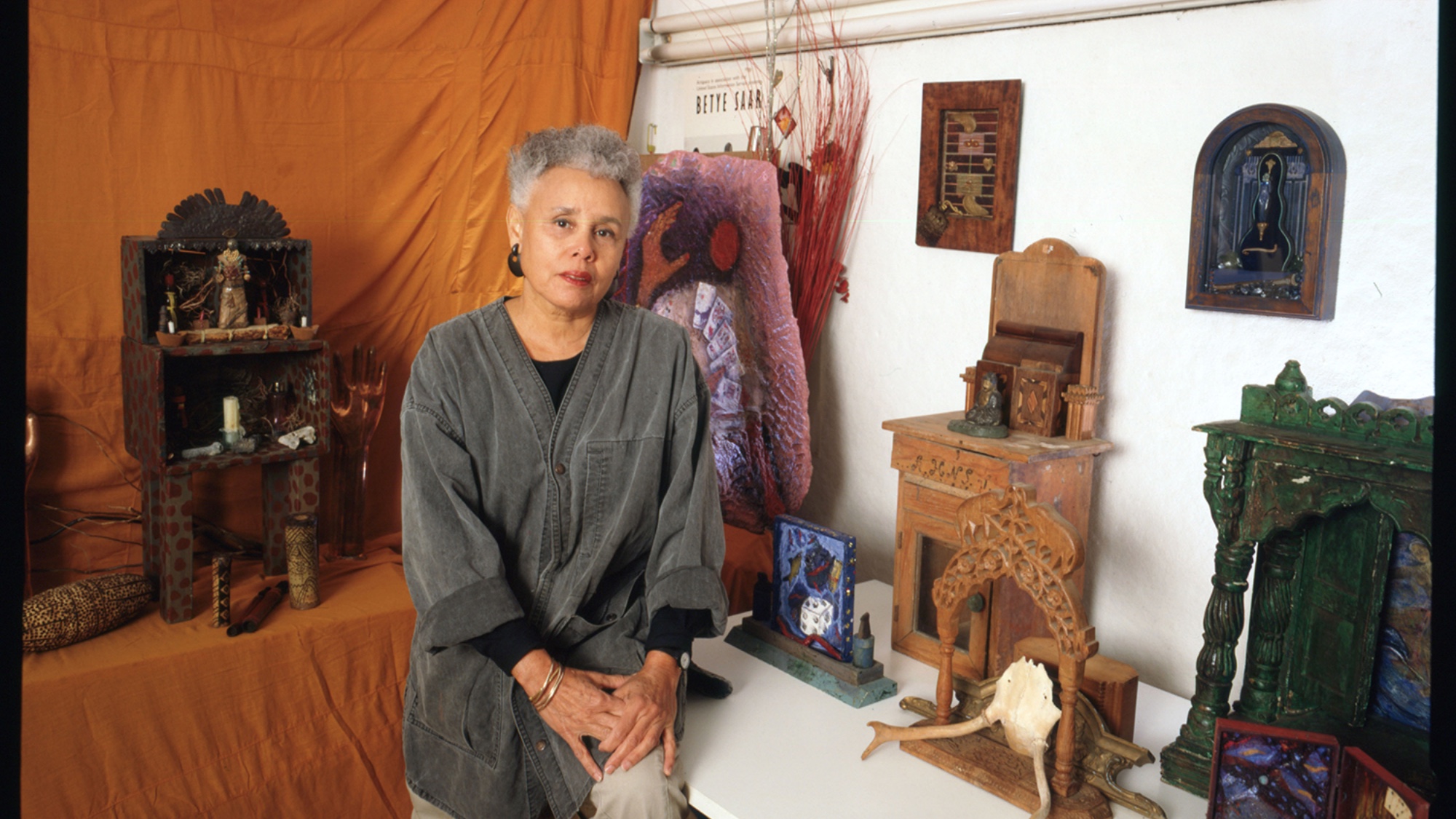
Betye Saar could make the humblest of objects sing and shout. The Los Angeles–based artist, an early leader in the Black Arts Movement, repurposed trash, heirlooms, and flea market finds into provocative sculptures and dioramas that exploded stereotypes of Black women. Many have a searching, mystical quality, informed by her mixed African American, Irish, and Choctaw ancestry and her trips to Africa and Haiti. Her work is now featured in at least 80 museums worldwide, but the best known may be her landmark 1972 assemblage The Liberation of Aunt Jemima. It featured a plastic, thick-lipped, “mammy” figurine holding a broom in one hand and a rifle in the other. “I wanted to put a rifle and a grenade under her skirts,” Saar said in 2016. “I wanted to empower her. I wanted to make her a warrior.”
Born in L.A., Betye Irene Brown grew up in Pasadena, where the family moved after her insurance salesman father died. “Art was in the air” throughout her childhood, said the Los Angeles Times. Her seamstress mother encouraged her in crafting projects, and she graduated from UCLA with a design degree. Brown became an interior decorator, marrying ceramicist Richard Saar and uncouth wild man” to “the series’ heart.” After the show ended, Jones went into politics. Though he joked he had “more skeletons in his closet than the Smithsonian,” he won his 1988 race to represent Georgia in the House in a landslide. A raconteur with perfect comic timing, he was popular with fellow lawmakers and the press. In Congress, Jones “kept his aw-shucks personality, but took the issues seriously,” said the Associated Press. Socially liberal and economically conservative, he served as Democratic whip but lost his seat to redistricting after two terms. Soon he turned Dukes of Hazzard booster, touring with Cooter’s Garage Band, opening museums in Virginia and Tennessee and hosting an annual festival that drew as many as 100,000 fans. He drew controversy for defending the Confederate flag—painted on the roof of the show’s famous car—as what he called a “symbol of non-racist Southern spirit,” and he insisted that “in Hazzard County, there was never any racism.” Even in the wake of the racially motivated Charleston church massacre, Jones refused to stop selling Confederate-themed merch. “I will fight these people until hell freezes over,” he said in 2015, “and then I will fight them on the ice.” bringing up three children in Laurel Canyon, “a hotbed of hippiedom.” Inspired by the radical politics around her, she started making prints and sculptures. “One of her most important” early works was a decorated windowpane called Black Girl’s Window, said The New York Times. In it the silhouette of a girl with her palms pressed against the window shares space with celestial bodies, astrological symbols, and a daguerreotype of her grandmother—a scene of “ancestral yearning.” She gained a measure of early recognition, winning a 1974 grant from the National Endowment for the Arts.
But it wasn’t until the 2010s, when she was in her 90s, that her fame reached “an international scale,” said ArtNews. Scholarly attention focused on overlooked Black artists, and in 2019 Saar had simultaneous retrospectives at New York City’s MoMA and the L.A. County Museum of Art. The artist was thrilled both by the new attention and by Quaker Oats’ decision to scrap the Aunt Jemima logo in 2020. “She’s liberated!” Saar posted online. She continued working until her death, days short of her 100th birthday. “Not everyone has a reason to get out of bed, something they love to do and that gives their life meaning,” she said. “I am so lucky that I have that.”