The Week The Week
flag of US
US
flag of UK
UK
https://cdn.mos.cms.futurecdn.net/flexiimages/jzblygzdxr1769609154.gif

SUBSCRIBE

Try 6 weeks free

Sign in
  • View Profile
  • Sign out
  • The Explainer
  • Talking Points
  • The Week Recommends
  • Podcasts
  • Newsletters
  • From the Magazine
  • The Week Junior
  • More
    • Politics
    • World News
    • Business
    • Health
    • Science
    • Food & Drink
    • Travel
    • Culture
    • History
    • Personal Finance
    • Puzzles
    • Photos
    • The Blend
    • All Categories
  • Newsletter sign up Newsletter
  • The Week’s Sunday Shortlist
    Catching predators in Primetime, an East of Eden TV series, and Emily St. John Mandel’s prophetic fiction

     
    FILM REVIEW

    Primetime

    ★★★ (out of 4)
    Rated R


    I’ve admired Robert Pattinson for years,” said Bilge Ebiri in NYMag.com. Still, “nothing quite prepared me” for his maniacal turn as Chris Hansen, host of the notorious 2000s network reality show To Catch a Predator. In Primetime, a movie “shot to look like something between an unearthed videotape and a bad nightmare,” we see Pattinson’s Hansen become increasingly obsessed with using the promise of sex with minors to lure pedophiles into home settings where they could be confronted on camera. As the TV host unravels, Pattinson shows such “stunning” range that “you can’t imagine any other performer of his generation pulling it off.” At the same time, “it’s not exactly clear what Primetime is aiming for,” said Stephanie Zacharek in Time. The despair conveyed by the actors who play the would-be sex offenders “underscores the show’s legally questionable entrapment methods,” but those characters are still terrible people, and the members of the TV team also come across as immoral and “all-round unpleasant.” Add in the film’s “grubby, grainy look,” and “you feel dirty watching it.” The screenplay’s omissions, inventions, and embellishments “might give viewers a misleading impression of what actually happened, and how,” said Matt Zoller Seitz in RogerEbert.com. But as director Lance Oppenheim advances toward a fatal climax, he’s “going for something stylized, bordering on operatic.” Meanwhile, as strong as Pattinson is, “the film’s secret engine is Skyler Gisondo,” portraying an unknown young actor enlisted to play one of the series’ underage decoys. We’re watching a nice young man lose his soul, and the experience “gets under your skin and stays there.” 


    tv review

    East of Eden

    This miniseries adaptation of John Steinbeck’s 1952 epic novel is something of a family affair for writer-producer Zoe Kazan. Her grandfather, Elia Kazan, built his classic 1955 big-screen version around James Dean’s performance as Cal Trask, a young man who clashes, Cain-vs.-Abel style, with his kindhearted brother. Zoe Kazan’s take on the Central California family instead centers Cal’s mother, Cathy, a figure Steinbeck referred to as a “psychotic monster.” Florence Pugh finds nuance and complexity in the character, and though fans of the novel may question the focus, the series stands on its own merits. 
    Thursday, Oct. 1, Netflix


    FOOD & DRINK

    Beer: Top Oktoberfests

    In Germany, only Munich breweries can produce an official Oktoberfest beer, said Dylan Garret in Food & Wine. But because the style has gone global, “we were curious to see how modern U.S. takes on the centuries-old-style stood up to the Bavarian originals.” The results, in a 10-beer blind tasting, were an October surprise.

    Shiner Oktoberfest
    An Oktoberfest from Texas? It’s true. Our Märzen-style top choice is easy-drinking, with “aromas of warm bread” and a “well-handled balance of hop and malt.”

    Weihenstephaner Festbier
    The world’s oldest brewery nails Germany’s lighter, sessionable festbier style. We loved this brew’s robust mouthfeel and how a “kiss of bitterness” offsets its honeyed notes.

    Paulaner Oktoberfest and Sam Adams Octoberfest
    We had a transatlantic tie for third: Paulaner’s offering favors spicy over sweet notes while Sam Adams’ is “heavier on the caramel notes,” but both have “a nice, round mouthfeel.”


    BOOK OF THE WEEK

    Exit Party

    by Emily St. John Mandel

    “Let’s hope that Emily St. John Mandel’s gift for writing prophetic fiction is overrated,” said Maureen Corrigan in NPR.org. Station Eleven, the Canadian novelist’s 2014 breakthrough, anticipated the outbreak of a worldwide pandemic. Unsettlingly, her “ingenious, eerie, and complex” new work opens in 2031 in the immediate wake of the collapse of the United States. Fighting by then has subsided enough that Ari Waker, a woman in Los Angeles who’s recently completed a well-earned 18-year prison stint, feels safe enough to attend a party. There, by some strange accident, two guests from an alternative world materialize while the host vanishes into that same other dimension, where the U.S. isn’t violently riven but is instead a placid authoritarian state with a citizenry under constant surveillance.

    Despite its science fiction framework, Exit Party, “like all the best stories,” is character driven, said Adam Begley in The Atlantic. In its first half, we follow Ari as she rapidly reinvents herself again and again, graduating from dishwasher to gunrunner, trophy wife, philanthropist, and Paris-based art collector. The second half throws us into the other timeline, where Ari’s doppelgänger, known as Ibari, is a high-ranking undercover operative willing to disappear fellow citizens that pose challenges to the authoritarian government. Though these twinned protagonists act immorally, Mandel makes both Ari and Ibari compelling and sympathetic. And as in her previous novels, “the underlying theme is irresistible: how shockingly little humanity understands about the sudden swerves and reversals that shape a life—or end it.”

    With its shifting time frames and stories nesting within stories, said Ron Charles in his Substack newsletter, “Exit Party sometimes feels dazzling and sometimes feels like it was composed by a squirrel with a Ph.D.” Still “it grows more satisfying with every page” as we follow Ari and Ibari’s misadventures. “The only worldbuilder more efficient than Mandel may be God,” because she sketches each of her parallel dystopias in “a few deft strokes,” then immerses us in individual lives made complex by the particular circumstances in which those lives unfold. It’s not always easy to understand exactly what’s happening in Exit Plan, and “anybody who promises you definitive clarity on this mind-bending story should be regarded with the suspicion reserved for Instagram health experts.” Ari struggles to understand how its two worlds connect, and as events in one world echo events in the other, so will many readers. “Mandel has engineered this uncanny novel to spark déjà vu, to send you flipping back to passages you read too quickly, to drive you mad. But what a way to go!”


    OBITUARY

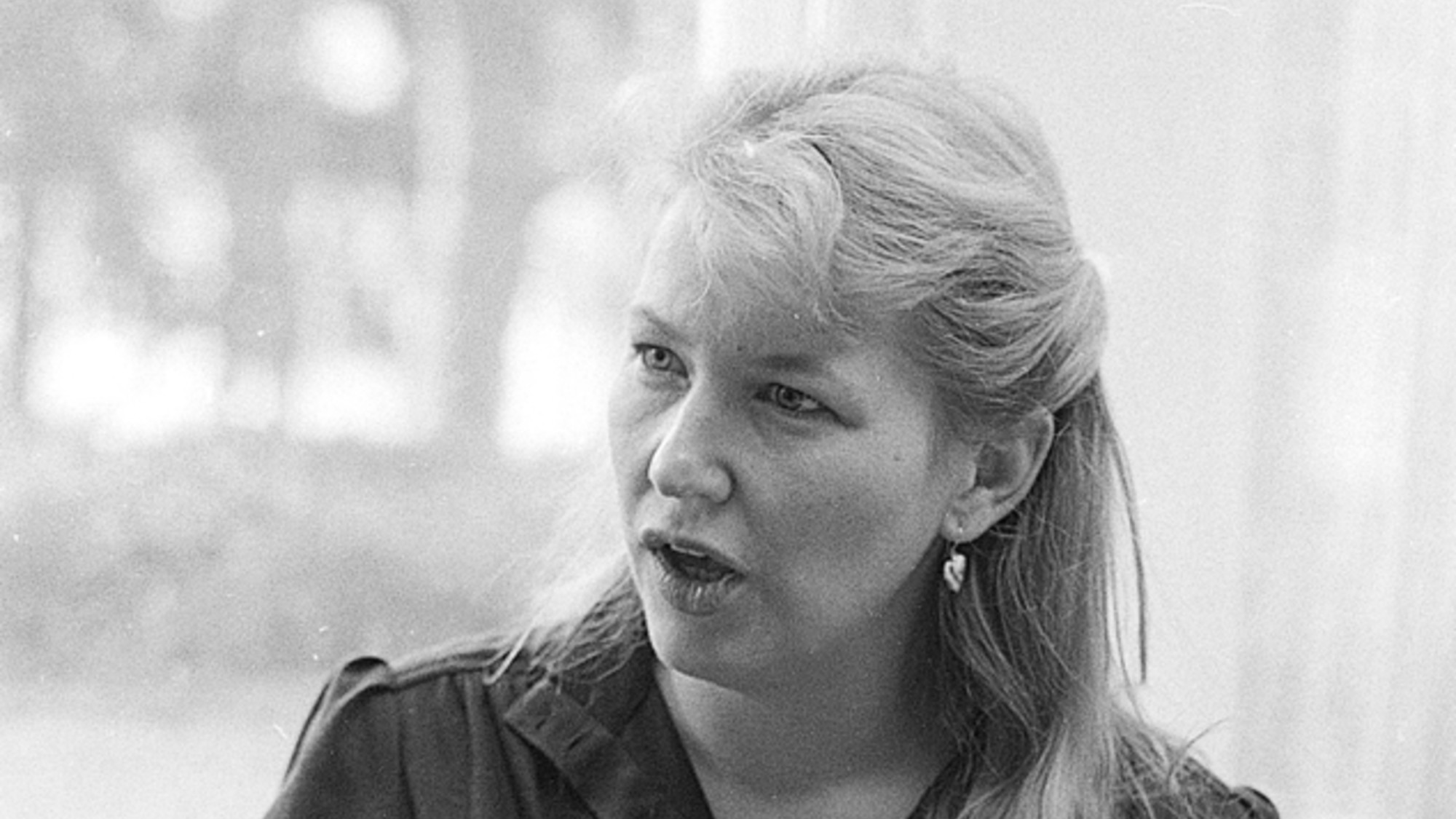
    Annie Dillard

    The writer who found the divine in nature

    Annie Dillard was just 28 when she published a collection of spare, meditative essays drawn from a year’s worth of wandering and watching in the wilds of Virginia’s Roanoke Valley. “A meteorological journal of the mind,” she called the book, in which she ruminated on plants, muskrats, butterflies, and the essential paradox of a natural world defined by beauty “tangled in a rapture with violence.” The 1974 book, Pilgrim at Tinker Creek, was a sensation, winning Dillard a Pulitzer and a reputation as one of her generation’s top literary voices. Other best sellers included the autobiography An American Childhood and The Writing Life, a discourse on creativity. While the natural world was her abiding theme, she rejected the tag “nature writer,” calling herself instead a theologian pondering the mysteries of God. “I walk out,” she wrote, “I see some event that would otherwise be utterly missed and lost, or something sees me, some enormous power brushes me with its clean wing, and I resound like a beaten bell.”

    Born Meta Ann Doak in Pittsburgh, she “grew up in affluent circumstances,” said The Washington Post. A devout reader, she was also “an admitted rebel,” suspended from her private school for smoking. To “smooth off her rough edges,” her parents sent her to what’s now Hollins University, a women’s college near Roanoke. There she married her creative-writing professor, and though the marriage would end, she kept his last name. She wrote a master’s thesis on Thoreau’s classic Walden, then began “exploring the nearby mountains and streams.” After Tinker’s success she was “overwhelmed” by attention, said The New York Times, some of it built on the allure of “a photogenic young woman” probing a subject previously the “province of men with beards.” Repelled, she fled to rural Washington state, then to Connecticut, where she spent 21 years teaching at Wesleyan University. 

    Over the years she became known “for her tremendous range,” said The Guardian, publishing poems, journalism, essays, and novels. In 2014, she was awarded the National Humanities Medal; soon after, she announced on her website that she could no longer travel and planned to “read and concentrate” at her home on Cape Cod. Her retreat was in line with a message she often told students: that the creative life was an all-or-nothing proposition. If you wish to be a writer, she said, “you can’t be anything else. You must go at your life with a broadax.”


    Sunday Shortlist was written and edited by Susan Caskie, Ryan Devlin, Chris Erikson, Chris Mitchell, and Matt Prigge.

    Image credits, from top: A24/Everett, Netflix, Getty, AP
     

    Recent editions

    • Saturday Wrap

      A mess of Ed Sheeran’s own making

    • Evening Review

      How will El Nino affect us?

    • Morning Report

      ‘Let’s not wrestle’, Xi tells Trump during US visit

    VIEW ALL
    TheWeek
    • About Us
    • Contact Future's experts
    • Terms and Conditions
    • Privacy Policy
    • Cookie Policy
    • Advertise With Us
    • FAQ
    Add as a preferred source on Google Add as a preferred source on Google

    The Week UK is part of Future plc, an international media group and leading digital publisher. Visit our corporate site.

    © Future Publishing Limited Quay House, The Ambury, Bath BA1 1UA. All rights reserved. England and Wales company registration number 2008885.