Sign up to get Today’s Best Articles in your inbox
Join 350,000+ subscribers and keep yourself informed with a selection of
The Week’s most interesting, enlightening and entertaining stories - plus daily puzzles.
You are now subscribed
Your newsletter sign-up was successful
Want to add more newsletters?
An account already exists for this email address, please log in.
Did Rand Paul make filibuster reform more likely?
The libertarian made the filibuster sexy again. But he may have also bolstered arguments that Republicans are abusing the Senate's rules
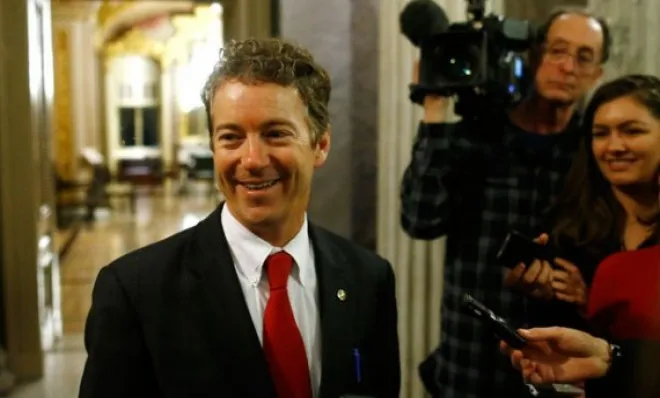
Sen. Rand Paul (R-Ky.) is getting mostly positive reviews for his quixotic, 13-hour filibuster, which delayed a confirmation vote on President Obama's nominee to head the CIA, John Brennan. Supporters in both parties praised Paul for calling attention to the administration's controversial use of armed drones to kill terrorist suspects, even if they're U.S. citizens. But not everyone was pleased. Sen. John McCain (R-Ariz.) on Thursday lambasted Paul, and argued that the high-profile use of the filibuster — a move the GOP minority has used frequently to block Democratic initiatives — would "give ammunition to those critics who say that the rules of the Senate are being abused."
Many agree with McCain, but for the opposite reason: Paul showed in dramatic fashion how the filibuster should be applied. "Rand Paul may be a flake," says Frank Rich at New York magazine. but "his all-too-short-lived piece of performance art" did the nation a valuable service.
If filibusters required those blocking Senate action to actually give old-school Jimmy Stewart-style speeches, they'd be few and far between, and we'd possibly have a less dysfunctional Senate. By ending his filibuster only when he finally had to take a leak, Paul made a powerful case for the proposition that our government might function far more smoothly if our elected representatives' bladders rather than their brains called the shots. [New York]
Paul's talkathon was "a welcome change from the current rules," says Glenn Church at Foolocracy, "which allow a senator to simply state that he or she wishes to filibuster." Then it takes 60 votes to move legislation forward. "That is why it takes a super majority (60 votes) instead of a simple majority (51 votes) to pass anything that is remotely controversial."
The Week
Escape your echo chamber. Get the facts behind the news, plus analysis from multiple perspectives.
Join more than 350,000 subscribers and keep yourself informed with a selection of The Week’s most interesting, enlightening and entertaining stories - plus daily puzzles.
Join more than 350,000 subscribers and keep yourself informed with a selection of The Week’s most interesting, enlightening and entertaining stories - plus daily puzzles.
The Senate needs filibuster reform. It needs to be changed to the way it was before a 1970s' rule change allowed filibustering to become so easy. [Foolocracy]
Some observers, however, say Paul's filibuster wasn't the kind that provides ammunition for advocates of filibuster reform. Why? The "dirty secret about talking filibusters" like Paul's, says David A. Graham at The Atlantic, is that "they almost always fail." In truth, it's the successful ones that spur calls for reform. Another filibuster — of the newfangled variety — took place just hours before Paul's, and it succeeded in blocking a vote on the nomination of Caitlin Halligan to the D.C. Circuit Court, which "has four open seats, but not a single Obama appointee, because of Republican obstruction."
The Senate's No. 2 Democrat, Dick Durbin, said yesterday: "If this is an indication of where we're headed, we need to revisit the rules again. We need to go back to it again. I'm sorry to say it because I was hopeful that a bipartisan approach to dealing with these issues would work." Harry Reid made a slightly more oblique threat. If the Halligan filibuster leads to serious filibuster reform, it could be a pivotal moment in Senate history. [The Atlantic]
Sign up to get Today’s Best Articles in your inbox
A free daily email with the day’s biggest news and analysis – and the best features from TheWeek.com
Harold Maass is a contributing editor at The Week. He has been writing for The Week since the 2001 debut of the U.S. print edition and served as editor of TheWeek.com when it launched in 2008. Harold started his career as a newspaper reporter in South Florida and Haiti. He has previously worked for a variety of news outlets, including The Miami Herald, ABC News and Fox News, and for several years wrote a daily roundup of financial news for The Week and Yahoo Finance.