The AI boom will require a massive physical infrastructure to sustain it, which is already proving hugely contentious
What is the industry planning?
The building projects envisaged by the tech industry are on a truly staggering scale. In 2025, Morgan Stanley estimated that $2.9 trillion (£2.1 trillion) would be spent on AI data centres worldwide between that year and 2028; McKinsey projects $5.2 trillion spending on AI by 2030. Specialised “hyperscale” data centres are already springing up across the developed world. As little as a year ago, many politicians were keen to attract such large investments. But in the US, public opinion has swung sharply against data centres. A recent Gallup poll suggests that they’re now facing more opposition than nuclear power stations: seven in 10 Americans don’t want them in their area. Scepticism is rising in Britain, too.
Aren’t they everywhere already?
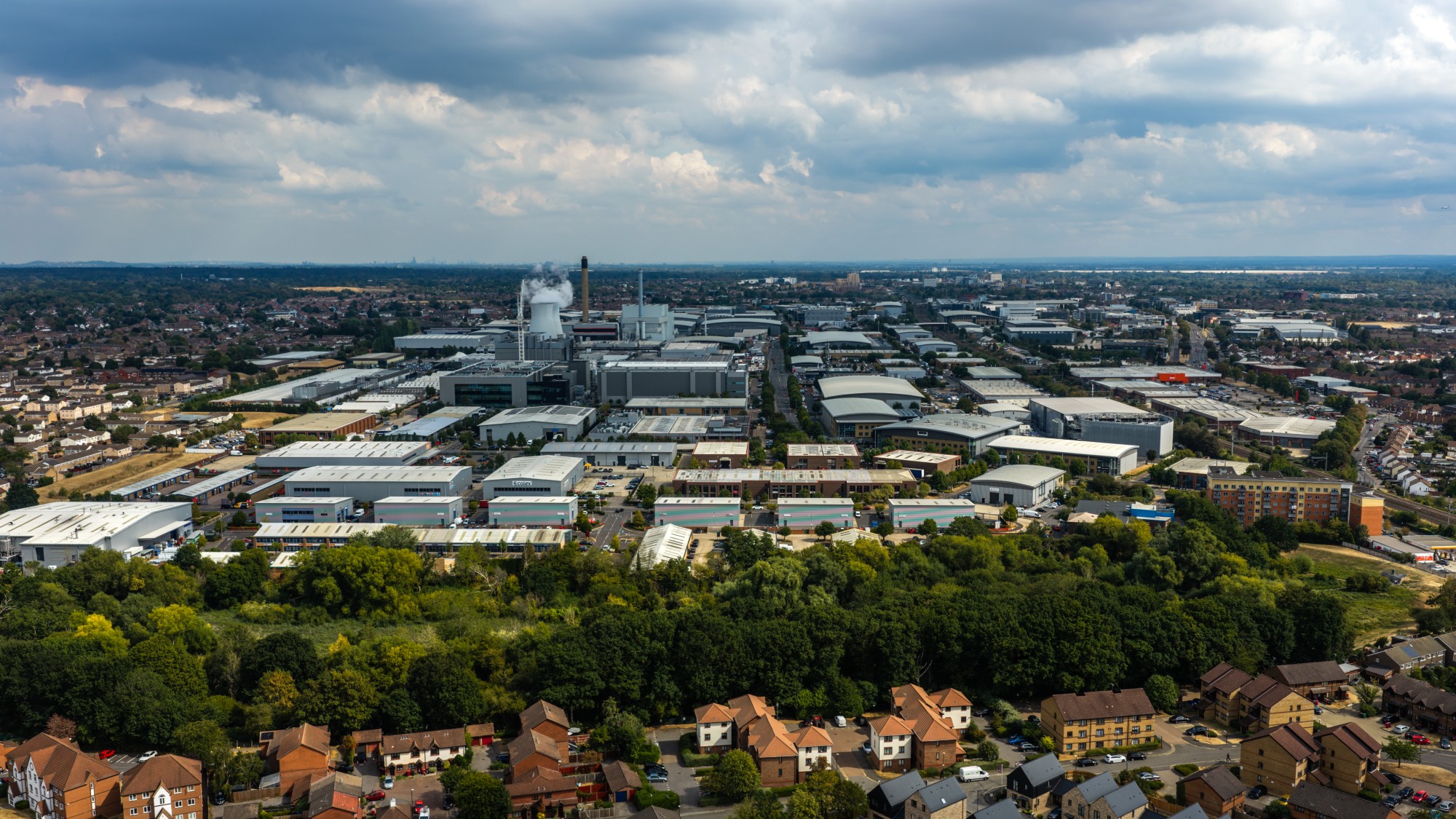
Regular data centres – warehouses where racks of computers store emails and photos, stream media, process credit card transactions and generally keep the internet running – have been a standard sight on the peripheries of large towns since the 1990s.
Nearly a quarter of the world’s internet traffic reportedly passes through northern Virginia; London is largely served by two hubs in the Docklands and Slough. There are more than 520 data centres in the UK – but some 100 more are planned, the majority designed to handle AI workloads, as use by business and consumers surges. Google’s new centre in Waltham Cross, Hertfordshire, sits on a 33-acre site. A £10 billion AI facility on the 130-acre site of a former power station is being built in Blyth, Northumberland. These are dwarfed by some in the US. Meta’s Hyperion centre in Louisiana, for example, will cover 4,000 acres, and is expected to use at least twice as much electricity as the entire city of New Orleans.
Why do people object to them?
The US seems to be experiencing a wide, bipartisan “AI revolt”, based on a series of linked factors. People don’t want huge, ugly, ominously humming industrial infrastructure in their backyard. They object to the massive water and electricity consumption (which, in some cases, has led to higher utility bills), and to the pollution: most rely on diesel back-up generators.
Opposition is fed by a deep distrust of corporate power, embodied by tech billionaires, and by a sense that ordinary people will gain little from AI; industry leaders tend to reinforce this message, often saying that their tech will lead to massive job losses and, quite possibly, the extinction of humanity. Once their construction is complete, data centres also provide surprisingly few jobs.
Why are they so big?
AI depends as much on brute-force computing power – raw “compute”, as it’s known – as it does on clever software. Massive groups of specialised computer chips must sit very close together to work at top speed. They use “parallel processing”: speeding things up by tackling lots of small mathematical tasks simultaneously, rather than one by one. Every metre between two chips adds a nanosecond to the processing time, so the idea is to pack as many as possible closely together. The chips are power-hungry (a ChatGPT AI query consumes about 10 times as much energy as a normal Google search) and also generate a lot of heat, which requires cooling systems.
How much water do they use?
UN researchers report that data centres used around 4.5 trillion litres last year – enough to meet the basic needs of some 600 million people – and they expect that figure to double. In Britain, clear figures are hard to come by: data centres are not required to report how much water they use. But consumption varies widely, depending on design.
Older centres use evaporative cooling systems. In Slough, one data centre has an abstraction licence for 1.7 million litres of water a day. A US expert has likened such facilities to “a giant soda straw sucking water” out of a basin.
Newer centres tend to have closed-loop cooling systems, recycling the same water, so their consumption is relatively negligible; or air-cooling systems, like Google’s in Waltham Cross, which use even less. A recent study found that data centres account for just 0.2% of all non-household drinking-water consumption in England.
What about energy?
That is a more intractable problem. AI computing, and its cooling systems, are unavoidably energy-intensive. According to UN figures, data centres across the world used more electricity than France did last year; and they’re projected to use more than Japan by 2030, with AI accounting for more than a third of that. Some of the biggest companies are trying to limit their carbon output: Microsoft and Google are investing in nuclear power, and hyperscale projects are gravitating to cold, clean energy-heavy countries such as Finland.
The UK’s National Energy System Operator estimated that data centres consumed 5.0 TWh of electricity in 2023 – equivalent to 2% of the total, or that of 1.8 million households. Today, the figure is 6%, and rising fast.
Where is all this leading?
Data centres are a campaign issue in November’s US midterm elections. Even Republican Texas has called a moratorium on new facilities; Donald Trump, however, has told Americans they’ll end up “backwards and poor”, and let China win the AI race, if they don’t accept data centres. In the UK, there have been protests against new centres from Leeds to Devon to Slough.
But the government, aiming to create growth and make Britain an AI power with a “sovereign AI ecosystem”, is actively pushing the development of data centres, in particular in “AI growth zones” such as Culham in Oxfordshire, Teesside and South Wales. It treats centres as “critical national infrastructure”, allowing local planners to be overruled. As for the economic effects of the vast AI investment boom now contorting the global economy, they have yet to be discerned.
GPUs, LLMs and RAMmageddon
The chipmaker Nvidia – currently the largest company in the world by market value, at over $5 trillion – started out in 1993, making specialised chips for the 3D graphics in video games. To keep ahead of the competition, it invented a “parallel processing” unit that could render the graphics in shoot-’em-up games at blistering speed. Then it cast around for other fields that might have a use for its graphics processing units (GPUs). One was neural networking, the basis of the large language models (LLMs) that power modern AI. In effect, video game fans subsidised the research behind the AI revolution. A “cabinet” of Nvidia’s top-end Blackwell GPU chips now costs more than $3 million.
The AI industry’s arms race has had dramatic knock-on effects, reducing the supply of everything from capital to electricity, from copper to memory chips. Since 2025 there has been a “global memory supply shortage”, also known as “RAMmageddon”, thanks to demand from AI data centres, which will likely buy around 70% of the computer memory products manufactured this year. As a result, a new iPhone now costs at least $100 more than last year’s model, without much in the way of hardware improvements. Computers and games consoles have been similarly affected.