As the Manchester City scandal reveals, Britain has become a magnet for investment from the United Arab Emirates
Why does the UAE invest abroad?
Abu Dhabi in the 1950s was a small coastal settlement of some 3,000 people with a stone fort; life revolved around fishing and pearl-diving. In 1958, oil was discovered. The first revenues came in the early 1960s. In 1973, two years after the seven United Arab Emirates, led by Abu Dhabi, became independent, the oil embargo quadrupled prices, and a tsunami of cash washed over the new nation. In 1976, the Abu Dhabi Investment Authority (ADIA) was set up to manage excess oil funds. Since then, the UAE has used investment to diversify its economy, secure a future beyond oil, and increase its diplomatic clout. The nation has some of the largest sovereign wealth funds in the world, with $2.7 trillion in assets in 2026 (compared with $1.3 trillion in Saudi Arabia). Most funds, such as ADIA, Mubadala and ADQ, are in Abu Dhabi, which has most of the UAE’s oil wealth. But Dubai owns large investment companies such as Dubai World; and a series of big private funds are held by the various Emirati royal families and other prominent dynasties.
Where do the funds invest?
Across the world. ADIA prefers quiet minority stakes in public stocks in North America, Europe and Asia. Mubadala owns significant stakes in cutting-edge chip companies such as GlobalFoundries and Arm Holdings, and in AI companies including Anthropic, OpenAI and Crusoe. It also has majority stakes in companies from the US asset manager Fortress Investment Group to the Brazilian refinery company Acelen, and the Spanish chemicals manufacturer Moeve. ADQ holds 45% of the vast agricultural conglomerate Louis Dreyfus Company. To take a fairly random sample, UAE funds hold significant chunks of Sotheby’s, Virgin Galactic and the Chinese electric carmaker Nio. Between 2019 and 2023, Emirati companies also announced $110 billion (£88 billion) of projects across Africa, making the UAE the largest backer of new business projects in the continent, bigger even than China. Britain is only part of a global web of holdings, though not an insignificant one.
Why is Britain attractive to them?
The Emiratis have long links to the former colonial, or quasi-colonial, power. The UAE’s president, Sheikh Mohamed bin Zayed Al Nahyan (MBZ), graduated from Sandhurst in 1979. London is a well-established site for summer holidays, shopping and education. Emiratis’ affinity for London led the capital’s then mayor, Boris Johnson, to joke that he ran the “eighth emirate”. But the UK’s historically welcoming attitude to inward investment, and its stable legal environment, are major attractions.
What do they own in the UK?
The UAE has invested huge amounts in everything from UK universities to electricity networks. Emirati funds hold big stakes in Gatwick Airport, the telecoms network CityFibre and troubled Thames Water (though ADIA has now written off its shares). DP World, owned by Dubai World, has invested at least £3 billion upgrading port infrastructure in Southampton and building the massive, deep-sea London Gateway port on the Thames; and Abu Dhabi’s state energy vehicle Masdar has poured money into wind farms. In 2020, The Guardian reported that the UAE’s then president, Sheikh Khalifa bin Zayed Al Nahyan, had acquired a real estate empire worth some £5.5 billion in London, including the Berkeley Square estate in Mayfair. A Sovereign Investment Partnership between the UK and the UAE was launched in 2021 with a £10 billion target over five years; by April, it had already clocked up £30 billion of Emirati investment pledges.
What about in Manchester?
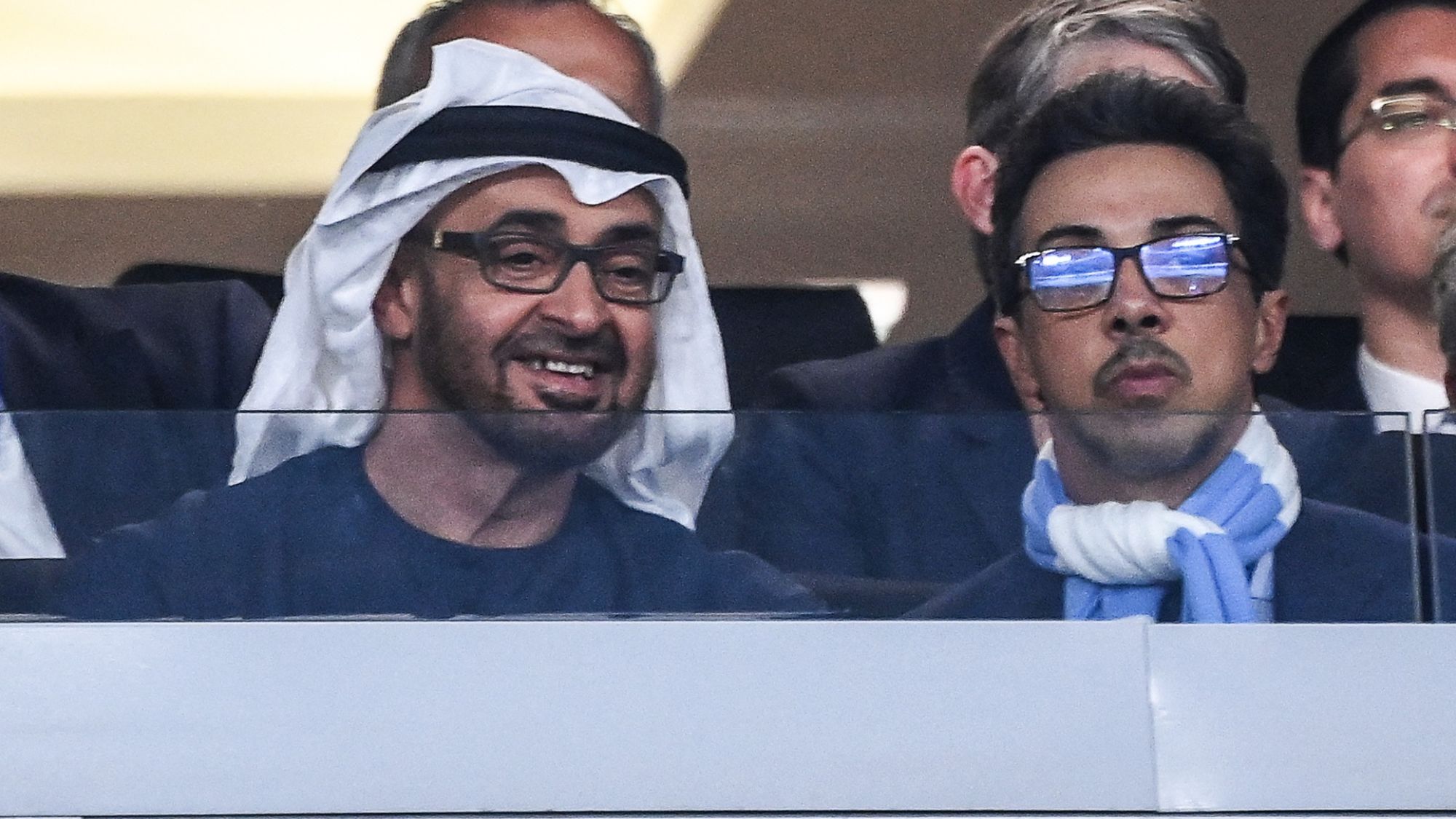
UAE cash has transformed central Manchester. Manchester City FC was bought by Abu Dhabi United Group (ADUG), a private equity firm owned by Mansour bin Zayed Al Nahyan, MBZ’s half brother, in 2008 for £200 million. Mansour’s City Football Group, which now controls the club, also owns nearly 50% of the Co-op Live arena. In 2014, Manchester City Council announced a “£1 billion deal” with ADUG to transform a large stretch of land between the Etihad Stadium and the city centre, in the Ancoats and New Islington areas. This Manchester Life scheme has been criticised for producing no social or affordable housing, and giving valuable 999-year leases at knock-down rates to ADUG. A 2022 University of Sheffield report found that the council had “sold the family silver too cheaply”. The council rejects this criticism, saying that it has been a highly successful regeneration project of land that previously had “zero market interest”, and that it has led to both greatly increased council tax revenue and profit-sharing deals.
Was Andy Burnham involved?
Close cooperation between Manchester’s political leaders and UAE financiers continued once Burnham became mayor in 2017: he oversaw £55 million in taxpayer-backed loans to Manchester Life. When, in September, Manchester City was found by an independent commission to have breached scores of fair-play rules, inflating its financial position by more than £900 million over nine years, to disguise owner funding, Burnham’s initial reaction was to say that he would be “really concerned to lose” City’s owners. He described them as “such a huge partner in the building of modern Manchester”.
Could UAE investors leave?
Emirati officials reportedly said after the ruling that “the Premier League’s actions” would “have an influence on the bilateral state relationship” and could affect investment. The UAE was said to be threatening to withdraw a multibillion-pound investment in a Silicon Valley-style Oxbridge tech hub. Manchester City’s punishment for its rule breaches is yet to be announced; the appeal will not be decided until early 2027. Depending on the outcome, we may then get a better sense of the costs of UK dependence on UAE largesse.
UAE foreign relations, at a glance
The UAE is a nation of 12 million people, of whom 88% are foreign citizens. With a series of powerful and potentially hostile near-neighbours – Iran, Iraq, Israel, Saudi Arabia – it kept a low diplomatic profile in its early decades, relying on Western security guarantees. After the Arab Spring, the UAE’s leaders became far more assertive. Seeing the Muslim Brotherhood and similar groups as a grave threat to its absolute monarchy, it supported the military counter-coup in Egypt in 2013, and intervened in Libya’s civil war. It had also built up one of the most capable militaries in the region, and joined the Saudi-led alliance fighting in Yemen. More recently, it has stepped back from such conflicts, and has sought peace between Iran and the US. However, there are grave concerns about its role in Sudan’s civil war: it is accused of arming the insurgent Rapid Support Forces, facilitating an illicit gold trade, and seeking control over Sudan’s Red Sea ports and farmland. (Emiratis import nearly 90% of their food.)
The UAE has strict censorship laws, and ruthlessly suppresses political dissent. When Abu Dhabi-backed RedBird IMI investment group launched a £600 million bid to take control of The Telegraph and The Spectator in 2023, it was rejected because of regulators’ concerns.