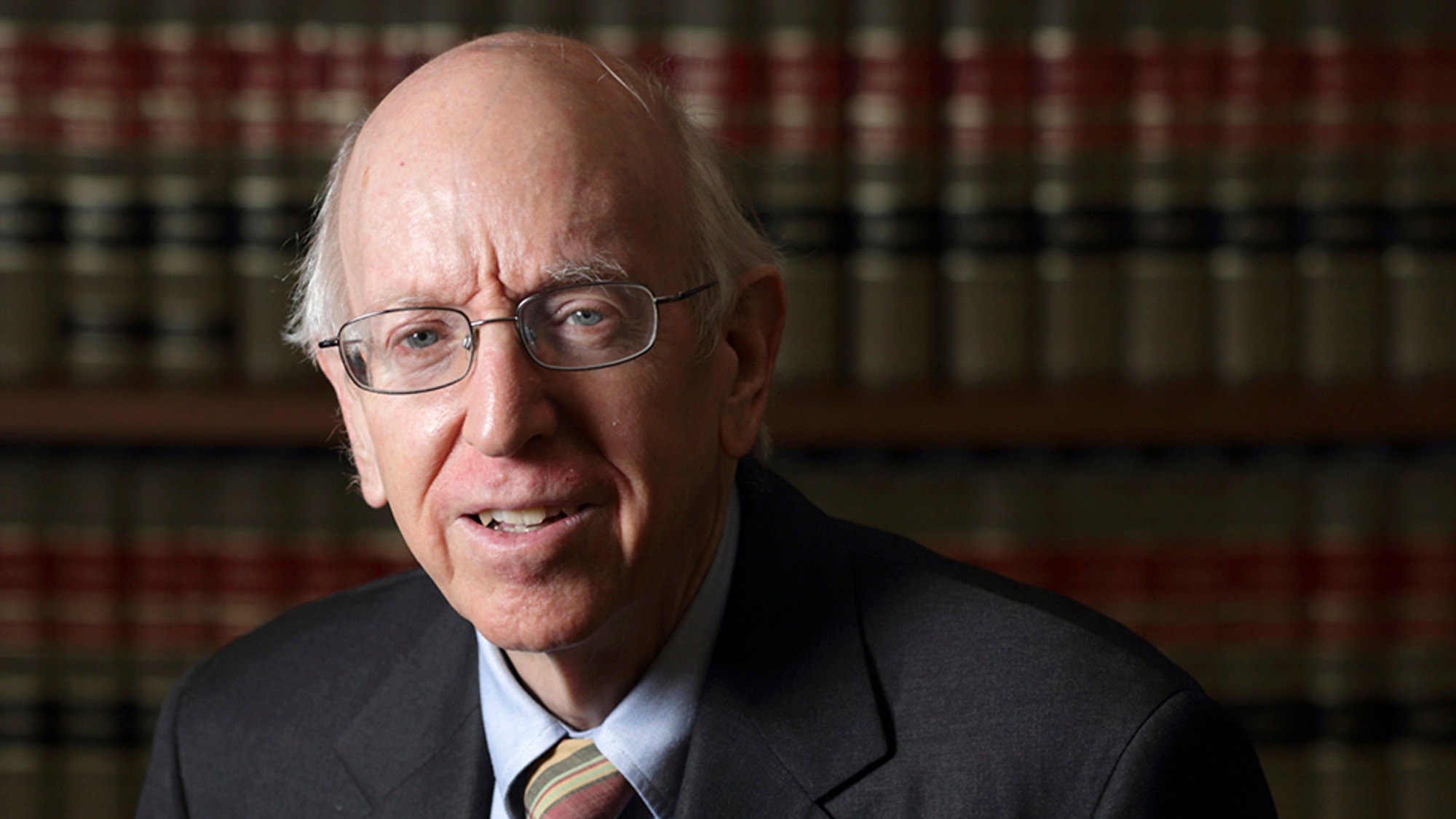
The judge who dominated legal scholarship
Few legal figures, apart from Supreme Court justices, can claim as seismic an impact on American law as federal judge Richard Posner. Described as “a one-man think tank,” Posner served for 36 years on the Court of Appeals for the 7th Circuit in Chicago. During his epochal legal career, he wrote thousands of opinions and authored over 50 books, becoming the most cited legal scholar of his day. A pioneer in applying economic principles like cost-benefit analysis to law, he was a fire hose of pragmatic pronouncements, in courtrooms and in his reams of writing. With no peer among his fellow jurists, he once compared himself to his pet. “I have exactly the same personality as my cat,” he said in 2001. “I am cold, furtive, callous, snobbish, selfish, and playful, but with a streak of cruelty.”
An only child born into a New York family of European immigrants, Posner “showed brilliance from a young age,” said The Wall Street Journal. He entered Yale University at age 16, earning a degree in English before enrolling in Harvard Law, where he was first in his class and president of the law review. After graduating in 1962, he clerked for the Supreme Court, worked as an assistant to future justice Thurgood Marshall, and taught at the University of Chicago, where he became a leader in the movement to encourage courts to consider practical, economic impacts of the law.
Nominated by President Reagan to the 7th Circuit in 1981, Posner “at times flustered lawyers with his hectoring manner,” said The Washington Post. In his writing, he “appeared blind to political correctness,” authoring a popular book that blasted President Clinton for “gaudy public and private lies” and arguing, after 9/11, that the Constitution was flexible enough to permit torture of suspected terrorists. “In later years, he drifted left,” said The New York Times. He was an outspoken critic of originalism and railed against same-sex marriage bans, calling LGBTQ people one of the most “discriminated-against minorities in the history of the world.” And in one of his final opinions, he excoriated fellow judges for dismissive treatment of those without legal representation. “I pay very little attention to legal rules, statutes, constitutional provisions,” Posner said upon his retirement in 2017. “A case is just a dispute. The first thing you do is ask yourself—forget about the law— ‘What is a sensible resolution of this dispute?’” |