The Week UK The Week UK
flag of US
US
flag of UK
UK
https://cdn.mos.cms.futurecdn.net/flexiimages/jzblygzdxr1769609154.gif

SUBSCRIBE

Start your trial today

Sign in
  • View Profile
  • Sign out
  • The Explainer
  • Talking Points
  • The Week Recommends
  • Podcasts
  • Newsletters
  • From the Magazine
  • The Week Junior
  • More
    • Politics
    • World News
    • Business
    • Health
    • Science
    • Food & Drink
    • Travel
    • Culture
    • History
    • Personal Finance
    • Puzzles
    • Photos
    • The Blend
    • All Categories
  • Newsletter sign up Newsletter
  • WeekDay AM: 10 Things you need to know this morning
    Starlink restrictions, 100,000 youth roles, and racial bias in ‘The Celebrity Traitors’

     
    today’s international story

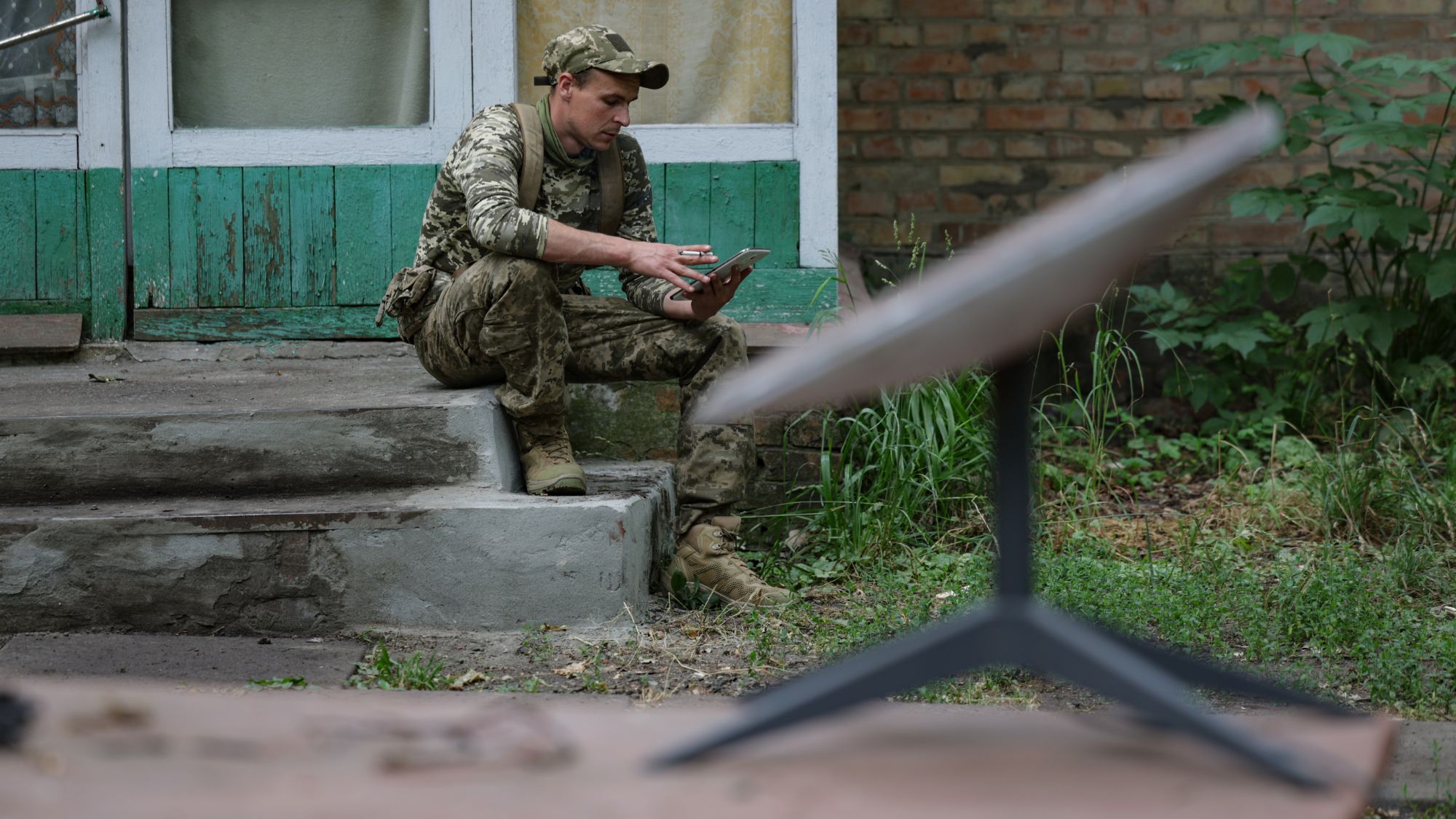
    Musk blames US for Ukraine Starlink slowdown

    What happened
    Elon Musk has suggested that the US government may be responsible for limits on the speed of Ukrainian weapons using SpaceX satellite communications after restrictions disrupted Kyiv’s battlefield operations. Starlink, which provides crucial connectivity for Ukrainian drones via its military-grade derivative Starshield, imposed a 100mph speed ceiling on Tuesday night, cutting off faster-moving weapons from the network. The disruption coincided with a major Russian assault that killed several people and left hundreds of thousands without electricity. Connectivity had been partly restored by yesterday evening.

    Who said what
    “Starshield systems are owned and controlled by the US government. Any limits on speed or usage are decided by the US military and ultimately POTUS (the president of the US),” Musk wrote on X.

    Volodymyr Zelenskyy feels that he’s been “betrayed” by Donald Trump over the limited Starlink access, said Sarah Davis on the US political website The Hill. This was a “gift for Vladimir Putin as fears grow that Trump is turning the screws on Ukraine”, said Nick Paton Walsh on CNN.

    Nearly five years into its “fight for national survival”, Ukraine has “entered a moment of intense vulnerability, under growing pressure not only from Russia, but also now from the US”, said Constant Méheut in The New York Times.

    What next?
    Ukraine is seeking the restoration of full connectivity as it continues to defend against Russian attacks. Andy Burnham has reaffirmed the UK’s support for Ukraine and announced faster deliveries of the missiles used to intercept Russian drones.


    today’s employment story

    Hospitality to offer 100,000 roles for young people

    What happened
    Pubs, restaurants, bars and hotels across Britain are to provide up to 100,000 work placements for young people not in employment, education or training over the next three years. The scheme – which was developed in conjunction with the Department for Work and Pensions and will be launched today by Andy Burnham – will offer 18- to 24-year-olds placements lasting up to four weeks to help them gain workplace experience. Participating businesses include Wagamama, Nando’s, Burger King, Premier Inn and pub groups Fuller’s and Mitchells & Butlers.

    Who said what
    Work and Pensions Secretary Pat McFadden said the initiative would help young people begin their careers by connecting them with employers. The announcement comes ahead of a review by former health secretary Alan Milburn, who has warned that the number of young people outside work and education could reach 1.25 million within five years without government intervention.

    Kemi Badenoch has demanded that the prime minister cut welfare payments in order to fund higher defence spending. But Labour will likely move cautiously and “hope to avoid a repeat of the welfare rebellion that forced Keir Starmer and Rachel Reeves into an embarrassing and costly U-turn”, said Alexandra Topping in The Guardian.

    What next?
    Milburn’s recommendations are expected to be delivered after the autumn budget on 28 October as government ministers face pressure to reduce benefit spending while helping more young people into work.


    Today’s culture story

    Myha’la: racial bias played a part in Traitors banishment

    What happened
    “Celebrity Traitors” star Myha’la has suggested that “unconscious racial and cultural bias” may have contributed to her being voted off the BBC show. However, the American actor defended her co-stars, who “in no way consciously put bias” on her “because of my race”.

    Who said what
    Responding to comments from a former contestant that suggested she was banished for being black, Myha’la (pictured above) said “I sealed my own fate” and had given others “a lot” of reasons to eliminate her. But she said biases did exist in the game, where her “authenticity or honesty” could “look suspicious to people who are unfamiliar with people like me”.

    “The Traitors” is a “game of social judgements, and so our socialisation comes into gameplay”, said Micha Frazer-Carroll in The Independent. “Players are asked to assess abstract traits like trustworthiness and untrustworthiness – at times, purely based on vibes.” In a game of suspicion, “internalised biases will inform group consensus on who is ‘shifty’ or ‘just a bit off’”.

    What next?
    Myha’la said she hoped that games like this would allow “more conversation around unconscious bias and how, when under pressure, people (society) gravitate towards things they know and understand”.


    It’s not all bad

    Scientists have identified a new species of dinosaur from a fossil that lay overlooked in London’s Natural History Museum for nearly 100 years. Invictibellatrix amberina, a relative of Tyrannosaurus rex, lived 120 million years ago, was about the size of a tiger and boasted long, curved claws. The fossil was discovered on the Isle of Wight in 1924. Its identification marks the first evidence of megaraptoran dinosaurs in Europe, helping researchers to understand how the predators spread across ancient continents.


    under the radar

    The new expedition to find Earhart’s plane

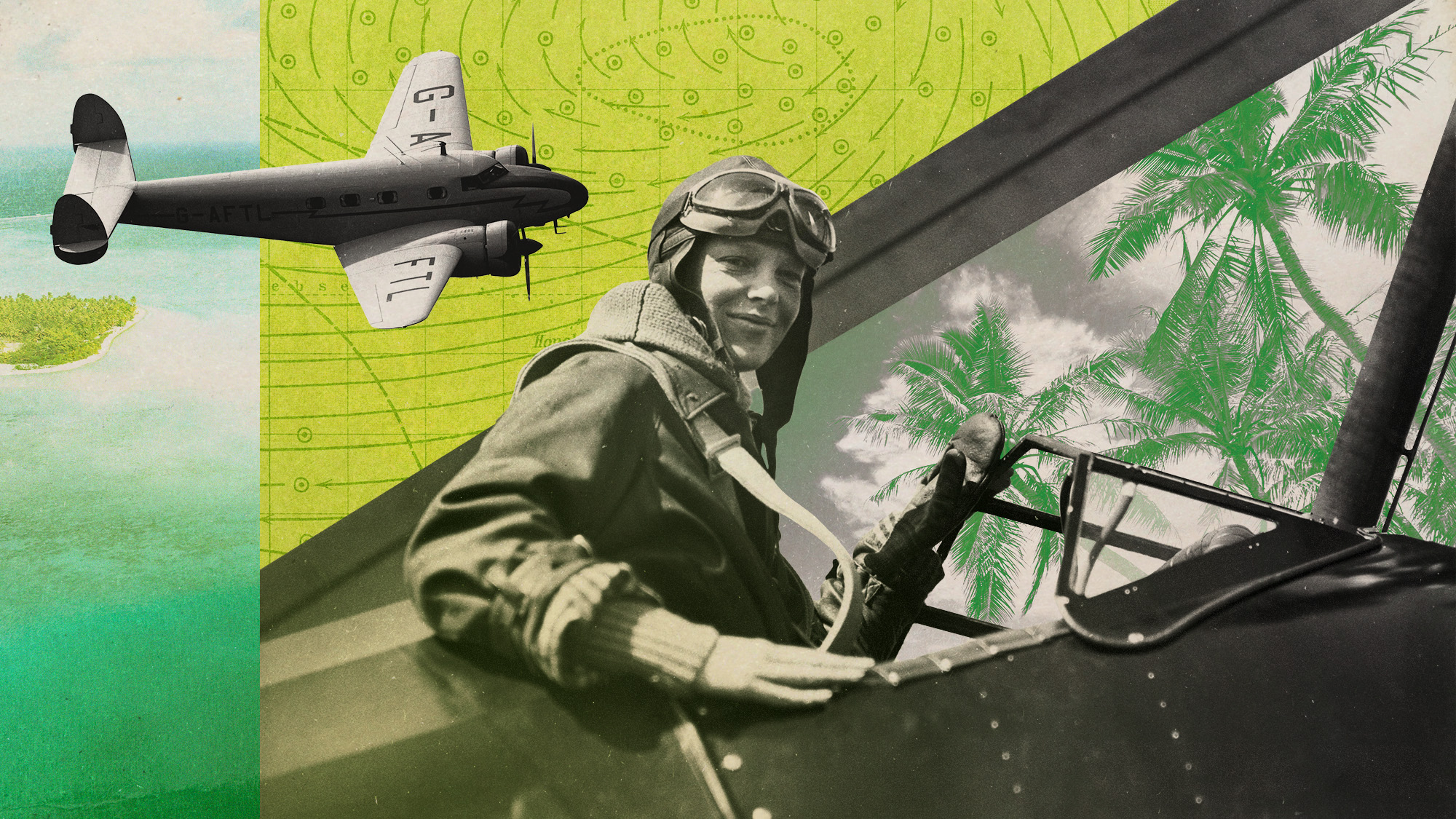
    A team of researchers has arrived at a remote, crab-infested island to inspect possible wreckage of the plane flown by famed aviator Amelia Earhart, who vanished in 1937.

    The “mystery of what happened” to the pioneering Earhart has “captivated historians and conspiracy theorists for nearly 90 years”, said The Telegraph. Now, nearly 90 years later, one of aviation’s greatest mysteries might finally be solved.

    Born in 1897, Earhart became passionate about flying and was determined to prove that women could achieve great things in aviation. In 1928 she became the first woman to cross the Atlantic by air as a passenger and in 1932 was the first woman (and just the second person) to make the journey solo and non-stop, completing the trip from Newfoundland to Ireland in 14 hours and 56 minutes.

    Then, in 1937, she attempted to fly around the world with navigator Fred Noonan, but on 2 July they disappeared over the Pacific Ocean while travelling towards Howland Island. Despite extensive searches, neither they, nor their aircraft, were ever found.

    The official explanation is that the plane suffered communication problems and ran out of fuel before crashing into the ocean, but some think that Earhart and Noonan “crash-landed on or near” a coral-ringed atoll and “perished as castaways there, hundreds of miles from their intended refuelling stop”, said Reuters. It is there that the new searches will be focused.

    The researchers will work to locate an item that’s been named the Taraia Object, which some think may be the wreckage of Earhart’s twin-engine Lockheed Electra 10-E aeroplane. Yet sceptics doubt that it is an aircraft at all, with some believing that it’s simply a fallen tree.

    Two previous attempts to locate the plane’s wreckage ‌in the surrounding ⁠ocean “proved fruitless”, added Reuters. Whether this one is a success remains to be seen, but Earhart’s place in aviation history remains secure.


    on this day

    15 October 1973

    American country singer-songwriter Dolly Parton released her single “Jolene”. A Welsh language cover of the song was released last Friday, including parts by Parton (recorded last year), her niece Jada Star and Welsh singer-songwriter Bronwen Lewis.


    Today’s newspapers

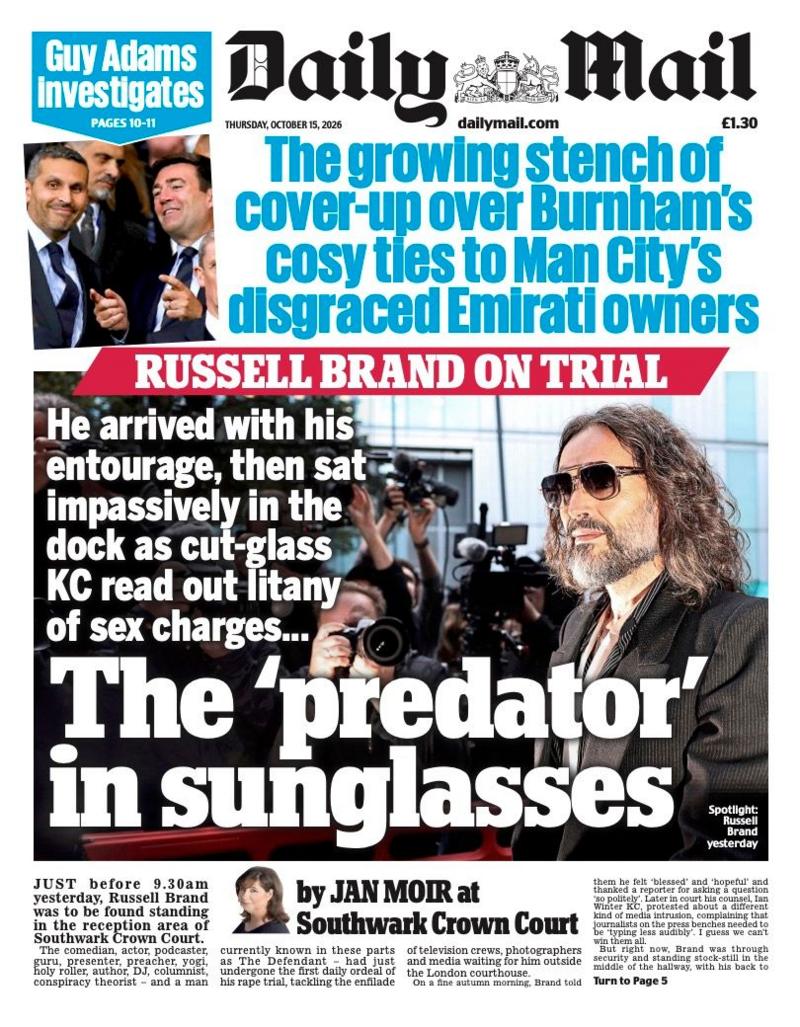
    ‘Predator in sunglasses’

    Russell Brand was “the ‘predator’ in sunglasses” as he arrived for his trial for rape and sexual assault, says the Daily Mail. The Sun reports that he was described as “ruthless” and “calculated”. He denies the charges. Volodymyr Zelenskyy met Andy Burnham “amid tensions over access to Musk’s Starlink”, says The Guardian. Burnham says “We need The Independent more than ever”, as the paper celebrates its 40th anniversary. There are more seven-year-olds on disability benefits than 50-year-olds, according to The Telegraph.

    See the newspaper front pages


    tall tale

    Gourd speed

    Residents of an Iowan town were granted a Halloween treat when a giant inflatable pumpkin broke free of its tethers and hurtled down the street in high wind. Trying to make light of the situation, Dubuque’s city council captioned a post on X with “They see me rollin’… inflated …They tryin’ to catch me flyin’ in a hurry”. Local police officer Luke Bock said his first thought when seeing the object on a traffic camera was “boy, that’s a big pumpkin”.


    Morning Report was written and edited by Arion McNicoll, Will Barker, Ross Couzens and Chas Newkey-Burden, with illustrations by Julia Wytrazek.

    Image credits, from top: Andriy Dubchak / Frontliner / Getty Images; View Pictures / Universal Images Group / Getty Images; JC Olivera / Deadline / Getty Images; Illustration by Julia Wytrazek / Getty Images.
     

    Recent editions

    • Evening Review

      A ‘dangerous moment’ for Kyiv

    • Morning Report

      Pope reveals cancer diagnosis

    • Evening Review

      Calling time on the ‘leap second’

    VIEW ALL
    TheWeek
    • About Us
    • Contact Future's experts
    • Terms and Conditions
    • Privacy Policy
    • Cookie Policy
    • Advertise With Us
    • FAQ
    Add as a preferred source on Google Add as a preferred source on Google

    The Week UK is part of Future plc, an international media group and leading digital publisher. Visit our corporate site.

    © Future Publishing Limited Quay House, The Ambury, Bath BA1 1UA. All rights reserved. England and Wales company registration number 2008885.