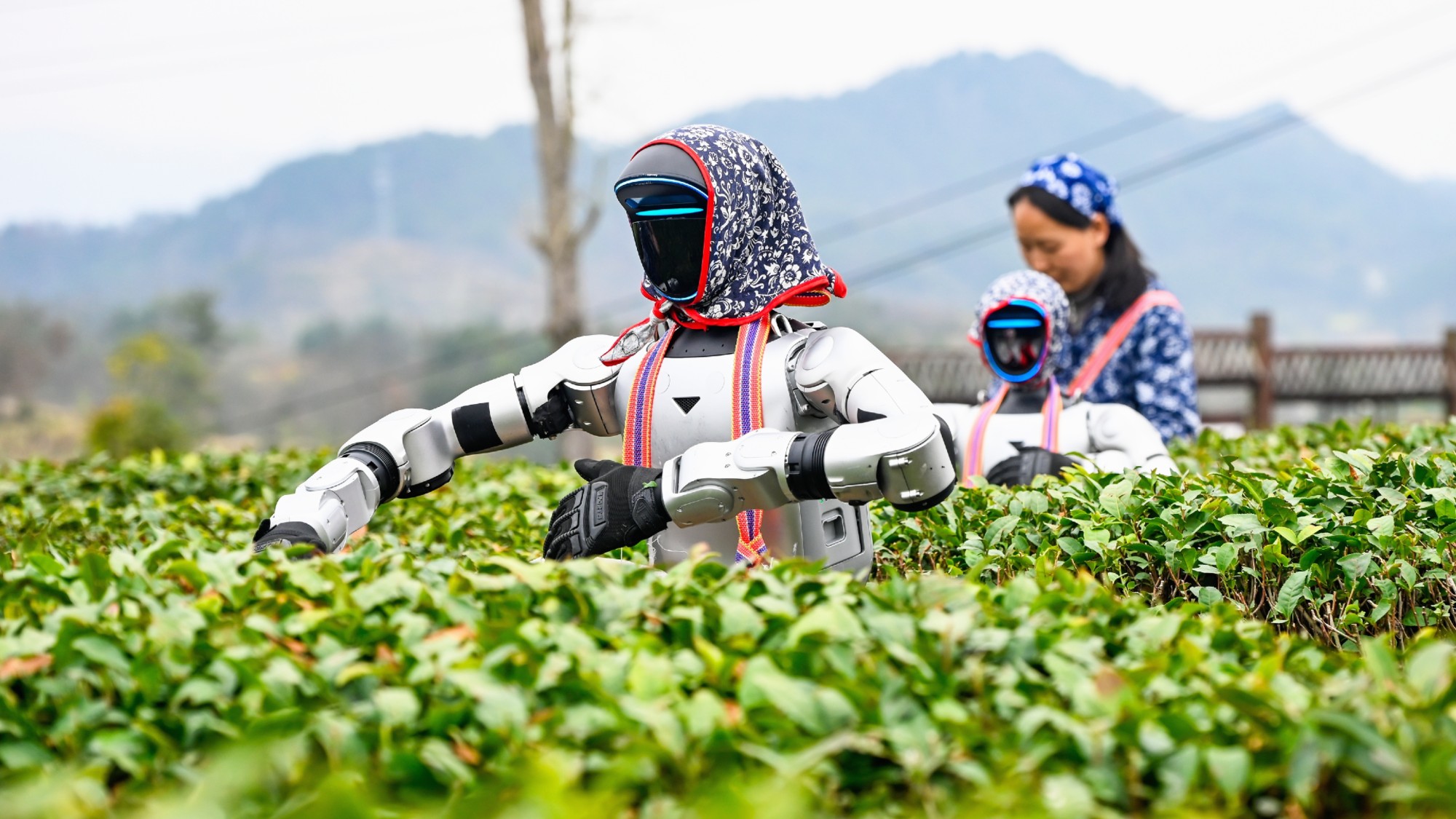
The robotics industry is advancing by leaps and bounds in China
Why the recent interest?
On 16 February, up to 677 million viewers around the world watched the Chinese New Year Spring Festival Gala, the state-run Chinese media’s annual showpiece. The stars of the show were a troupe of humanoid robots built by Hangzhou-based Unitree Robotics, which put on an amazing display of choreographed martial arts – running, jumping, high-kicking, doing backflips – alongside child performers. The broadcast underlined China’s ascendancy in the new field of robotics and in hi-tech manufacturing, fields that were previously dominated by American, Japanese and European companies. Two Chinese firms, Unitree and Agibot, have more than 50% of the global market share in humanoid robots; they shipped around 11,000 units last year. You can buy either company’s basic model for around $20,000.
What can such robots actually do?
They can perform amazing feats of mobility, autonomous navigation and manipulation: from high-energy stunts to household tasks such as pouring water and wiping counters. Retail robots made by Galbot, another big Chinese company, sell consumer items and process payments in promotional kiosks. As yet, however, few humanoid robots do any real work. Elon Musk has claimed that Tesla’s robot, Optimus, would be a catch-all assistant: butler, housekeeper, childminder and PA. In reality, in the short term they may be rolled out for use in Tesla’s factories, doing repetitive tasks such as material handling, or quality inspection – though even that is not certain. Most analysts agree that the technology to produce a general-purpose autonomous humanoid robot isn’t there yet, and won’t be for many years.
And what are their limitations?
Robots are good at performing tasks of limited complexity, in a predictable physical environment: a robot vacuum cleaner, say, or even a robo-taxi, operates according to clearly drawn rules and protocols, and uses a limited number of controls. They can also, like Unitree’s dancing robots, follow complex pre-programmed scripts. The difficulty comes when they have to interact with an unpredictable physical world. Even simple tasks – emptying a dishwasher or using a door handle – mean interpreting a large amount of data about the physical world, and manipulating objects carefully. So far, robots have proved only 30%-50% as good as humans at basic tasks such as carrying boxes. The industry hopes to be able to solve this in part by using artificial intelligence: “physical AI”, as it is known. But even that poses serious difficulties.
What are the difficulties?
The hope is that machines can learn to navigate the physical world the way ChatGPT learnt to navigate language: by absorbing vast reams of data. The difference is that there is no equivalent of the internet for robots to train on. They have to be trained by teleoperation, where humans guide a robot to do a precise task – a kung-fu kick, say – thousands of times, using motion-capture technology. There are shortcuts: robots can be trained in virtual environments. But it’s still very much a work in progress. A robot carer or plumber is still many years away
Physical AI: robotic intelligence
“The ChatGPT moment for robotics is here,” the chipmaker Nvidia’s chief executive Jensen Huang announced in January. Huang is credited with inventing the term “physical AI”, meaning artificial intelligence systems that operate in and interact with the physical world rather than existing only in software or digital form. The theory is that robots should be able to perceive the environment, reason with the power of a large language model, act accordingly, and then learn from the outcome of that action – leading industrial robotics from blind automation to intelligent interaction. The result would be robots that can use existing tools, working in spaces originally designed for humans, correctly interpreting human instructions, and handling items they have never seen before. Nvidia is a world leader in this field. It provides the “digital playgrounds” where almost every cutting-edge robot is trained, providing virtual simulations of the real world. Among the leading “physical AI” robot makers are: Boston Dynamics, whose bots are set to be used in Hyundai’s factories this year; Figure AI, backed by OpenAI and Microsoft; and Tesla. Elon Musk claims that his robots will be making more robots on production lines this year; many insiders doubt this.