A short-lived secret society founded 250 years ago this month lives on to this day in the fevered minds of conspiracy theorists
Who were the Illuminati?
They were a group of republican freethinkers founded in Bavaria on 1 May 1776 by Adam Weishaupt, a former Jesuit and professor of canon law at the University of Ingolstadt. He had initially been attracted to the Freemasons, but had found the order expensive and hostile to his ideas. The group was originally called “Bund der Perfektibilisten”, or Covenant of Perfectibility, but eventually settled on “Illuminatenorden”, or Order of Illuminati, Latin for “enlightened”. Their aims were grandiose, utopian and vague. Inspired by the “philosophes” of the French Enlightenment, they aimed to replace Christianity with a religion of reason; and to infiltrate governments, influencing policy from within to end despotism. To this end, they recruited influential people.
How did the organisation grow?
They established cells across southern Germany. Recruitment focused on rich young men sympathetic to the group’s ideology, often using Freemasons’ networks and their lodges. Goethe was a member; so, some argue, were Mozart and Schiller. (Jews, women, monks and “pagans” were barred from joining.) The Illuminati used aliases – Weishaupt’s was Spartacus – and corresponded in cipher. The society was hierarchical, with three grades: Novice, Minerval and Illuminated Minerval. As in Scientology, recruits progressed through the grades, marked with initiation rituals, and as they did so gained access to secret knowledge – including the identities of other members. Weishaupt ensured all members spied on each other and sent reports to him on their activities and character. His favourite recruits became members of the group’s ruling council, the Areopagus. At its peak, around the mid-1780s, Weishaupt’s Illuminati probably had upwards of 1,500 members, and it stretched from Paris to Warsaw, from Denmark to Italy.
What became of the Illuminati?
Despite their attempts at secrecy, loose talk meant the Illuminati’s radical plans caught the attention of Bavaria’s absolute monarchy, which was resolutely Catholic. The Elector of Bavaria, Charles Theodore, banned all secret societies in 1785. The Illuminati had unwisely kept extensive archives of their correspondence, which were discovered during a raid. The order was dismantled. Weishaupt was stripped of his chair at Ingolstadt and banished from Bavaria. Some members were imprisoned, others were driven into exile. By 1790, the real Illuminati had disappeared from the historical record.
And the conspiracy theories?
Accusations about the Illuminati’s nefarious activities spread across Europe in the late 1780s. In 1797, the father of the modern conspiracy theory, the Jesuit priest Abbé Augustin Barruel, wrote a vastly popular history of the French Revolution, which attributed it to the work of the Knights Templar, the Freemasons, and particularly the Illuminati – “enemies of the human race, sons of Satan”, who were trying to destroy monarchy, Christianity and the social order. (This thesis was also proposed by the Scottish scientist John Robison at the time, but Barruel’s book sold better.) “Illuminati fever” spread to the US, where the Federalists (led by John Adams) accused the Republicans (led by Thomas Jefferson) of trying to overthrow the government and Christianity there. Later versions roped in the Jews too. “The Protocols of the Elders of Zion”, a 1903 forgery, purported to describe a Judeo-Masonic plot for world domination. In the 1920s, the theory was modified to suggest the Jews had used the Illuminati to infiltrate European society. Such theories helped to justify Nazi atrocities.
Why are such theories still around?
“Illuminist” conspiracism remained a strain in American thinking into the 20th century. During the “Red Scare” of the 1940s and 1950s, Freemasons, Illuminati and Jews were said to be behind an “international communist conspiracy”. The idea that liberals were plotting to turn the world into a socialistic global collective became one of the enduring beliefs on the extremes of the US right. The term “New World Order” was first heard in the 1970s. (George H.W. Bush used the actual phrase in a 1990 speech about the post-Cold War world, electrifying conspiracists.)
However, it may be that a pair of countercultural pranksters did more than anyone to popularise the Illuminati myth. In the 1960s, Robert Anton Wilson and Kerry Thornley began a project they called “Operation Mindf**k” to shake up a world they felt had become too comfortable and orderly. They wrote letters to the press in which they discussed a secret society of elites called the Illuminati. Wilson and another writer published “The Illuminatus! Trilogy”, a 1975 sci-fi satire that claimed the Illuminati were behind many global events, such as the assassination of John F. Kennedy.
And are the Illuminati still going strong?
Apparently. Illuminist theories were some of the first to go viral on the early internet in the 1990s; they have since absorbed lore about, among other things, UFOs, Satanism, Davos “globalists” and Covid, which the Illuminati are said to have engineered. They have remained a fixture in fiction – they are the antagonists in Dan Brown’s 2000 thriller novel “Angels & Demons” – and in pop culture. It survives on the political fringes, too. In 2018, the former Canadian defence minister, Paul Hellyer, blamed the Illuminati for suppressing alien technology that could end our reliance on fossil fuels.
Why do people believe this?
The historian Michael Taylor, author of a forthcoming book about the Illuminati, argues that when major upheavals occur, from revolutions to the Covid pandemic, we want “an emotionally satisfying comprehensible explanation”. People prefer to blame woes on a shadowy enemy than on complex social factors and incidental triggers. “It’s really unsatisfying and unpalatable,” he says, “to accept that sometimes shit just happens.”
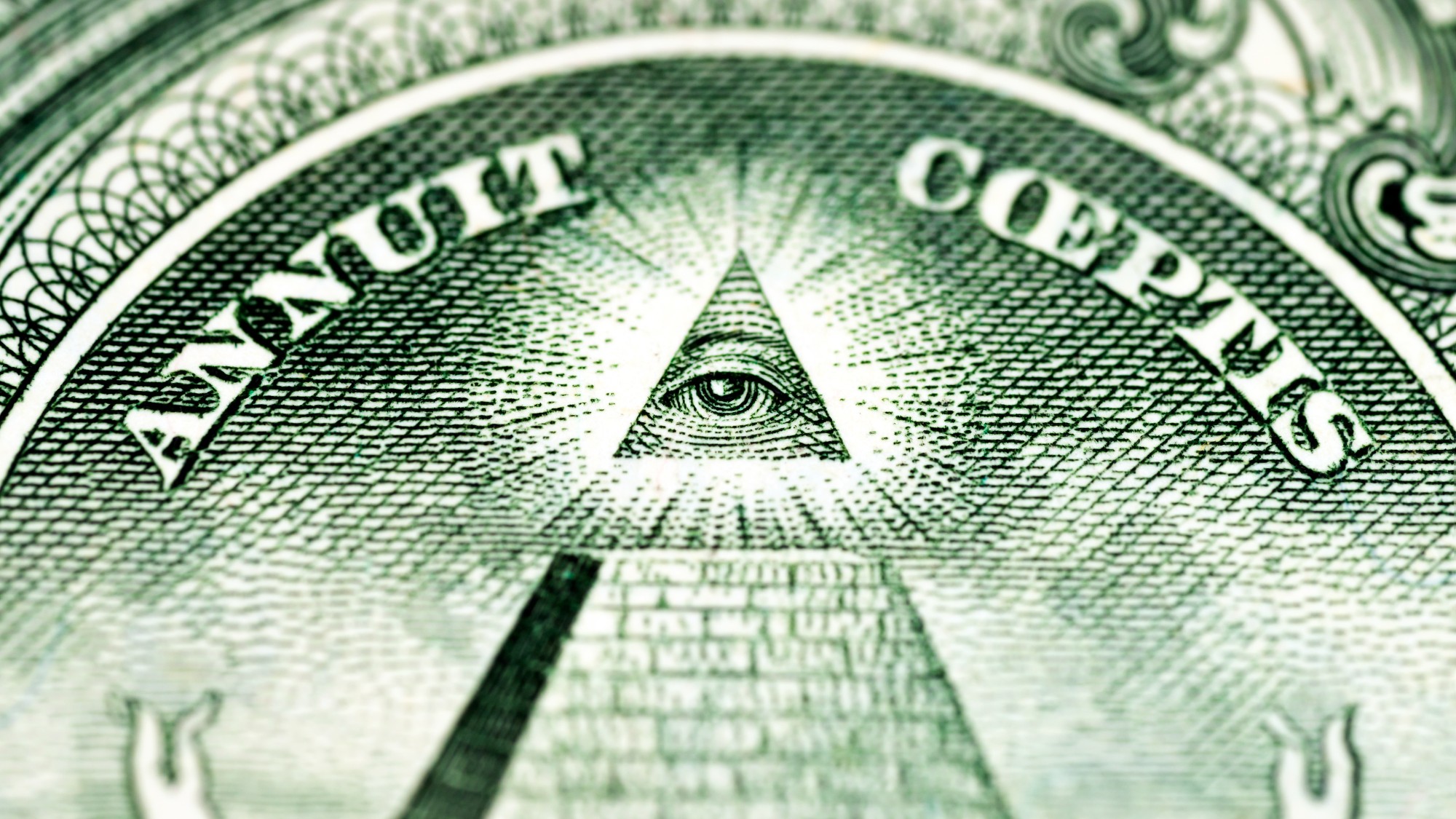
The Eye of Providence
Conspiracy theories thrive on cryptic symbols. The “Eye of Providence”, suggesting both surveillance and esoteric ritual, is a favourite. It’s a Christian symbol – maybe descended from the Egyptian Eye of Horus – representing divine providence and oversight, which appears on many buildings and in paintings. In Freemasonry, it was used as a symbol of the Supreme Architect (God). In 1782, it was adopted for the reverse of the Great Seal of the United States, with the words “Novus ordo seclorum” (“New order of the ages”); it also features on the back of the dollar bill. The seal’s designer, Charles Thomson, said the pyramid “signifies strength and duration”, and the eye, providence. In 1789, it was printed on France’s “Declaration of the Rights of Man and of the Citizen”, symbolising paternalistic watchfulness over the new nation.
The “Illuminatus! Trilogy” popularised the idea that it is a symbol of Illuminati control. In 2013, Beyoncé made a triangular hand gesture when singing at the Super Bowl; she was accused of being one of the Illuminati. Madonna, Jay-Z and other celebrities have used the symbol ironically, feeding the conspiracists. The far-right radio host Alex Jones claimed in 2014 that the singer Katy Perry was an “Illuminati priestess”.