The Week The Week
flag of US
US
flag of UK
UK
https://cdn.mos.cms.futurecdn.net/skoGBi9qKFoUtnNWkovjJQ.jpg

SUBSCRIBE

Try 6 Free Issues

Sign in
  • View Profile
  • Sign out
  • The Explainer
  • Talking Points
  • The Week Recommends
  • Podcasts
  • Newsletters
  • From the Magazine
  • The Week Junior
  • More
    • Politics
    • World News
    • Business
    • Health
    • Science
    • Food & Drink
    • Travel
    • Culture
    • History
    • Personal Finance
    • Puzzles
    • Photos
    • The Blend
    • All Categories
  • Newsletter sign up Newsletter
  • The Week Evening Review
    Gabbard resurfaces 2020 claims, ‘ghost students,’ and NASA’s safety concerns

     
    TODAY’S BIG QUESTION

    Why is Tulsi Gabbard trying to relitigate the 2020 election? 

    When FBI agents raided election offices in Georgia on Wednesday looking for evidence of fraud in the 2020 presidential election, there was a surprising figure in their ranks: Director of National Intelligence Tulsi Gabbard. And her role in relitigating the campaign that President Donald Trump lost,  but never conceded, is drawing scrutiny.

    It’s “unprecedented” for an intelligence chief to join an FBI raid, said NBC News. Her job is to “track threats from foreign adversaries,” and federal law prohibits Gabbard from “taking part in domestic law enforcement.” 

    The White House disagrees. Gabbard is “trying to keep the elections safe,” Trump said to reporters this week. It’s notable, however, that Gabbard last year “dismantled” intelligence operations tracking “foreign actors seeking to interfere in American elections or institutions,” said NBC News.

    Democrats and election experts “expressed alarm and bewilderment” about Gabbard’s role in the raid, said Politico. The raid may not simply be about reexamining 2020, according to critics, but could instead be building a foundation for Trump to interfere in future elections. 

    What did the commentators say?
    Federal agencies are “jumping in line” to help Trump “prove the unprovable” about the 2020 election, said Zachary B. Wolf at CNN. Gabbard, in particular, has been a “voracious spreader of election conspiracy theories.” And it’s now clear that she has spent “months of her time” since her elevation to DNI investigating those alleged conspiracies. Her involvement in the Georgia raid is a sign of how far Trump will go to “rewrite his 2020 election loss” and perhaps “stymie Democrats hoping to win control of Congress this fall.”

    Gabbard has been “less visible” than colleagues on big foreign policy issues like Venezuela and Iran, said Jeet Heer at The Nation. But she has “made herself useful” to Trump as the administration’s “driving force” to vindicate his 2020 conspiracy theories. Democrats need to let Gabbard and other officials know that if they “abuse their power, there will be criminal consequences.”

    What next?
    Trump’s 2020 election claims have been “debunked again and again,” said The New York Times. “Scores” of lawsuits attempting to overturn President Joe Biden’s election win that year were dismissed by judges, and Trump’s then-Attorney General Bill Barr even publicly refuted his boss’ claims. Democrats say they will investigate Gabbard’s role in this latest effort.


    QUOTE OF THE DAY

    ‘Canada is not doing well. They are doing very poorly. And you can’t look at China as the answer.’ 

    Trump, to reporters at a screening of his wife Melania’s documentary,  on why it’s “very dangerous” for Canada to boost trade with China. Several Western leaders have visited China recently to “hedge against their increasingly volatile relationships” with the U.S., said The New York Times. 


    IN THE SPOTLIGHT

    ‘Ghost students’ are stealing millions in student aid

    Colleges and universities are facing a new fraud tactic that has made them more susceptible to digital theft. Known as ghost students, hackers are exploiting pandemic-related vulnerabilities to steal millions of dollars in student financial aid.

    Over the past five years, the federal government has uncovered more than $350 million in fraud perpetrated by ghost student schemes, said Jason Williams of the Department of Education's Office of Inspector General to ABC News. And that's "only in the universe of what we know and what we have adjudicated."

    ‘Scourge’ on US colleges
    For thousands of colleges inundated with ghost students, these “sophisticated thieves have become a scourge,” said ABC News. The scammers use stolen or fake identities to enroll in online classes and apply for grants and loans, then disappear once they receive the funds. The fraudsters are “robbing the federal government of hundreds of millions of dollars and leaving an untold number of victims.”

    It’s a "huge issue," Williams said to ABC. As they steal identities, these loans are “not being repaid.” They are being assigned to people who “don’t even know they have a debt” until the IRS alerts them. Thieves have tried to steal financial aid for decades, but when the pandemic hit, “everybody went to online learning,” which “really did open the door” for more widespread fraud.

    In California alone, “nearly a third of all community college applicants in 2024 were identified as fraudulent,” according to the California Community Colleges system. In some cases, professors “discover almost no one in their class is real,” said The Associated Press. 

    Fighting back with AI
    The federal government is “on the hook for tuition aid lost to scammers,” said ABC News. But it is the community colleges, which “accept almost all applicants through open enrollment,” that often “carry the burden of sniffing out fake applications.” Doing so requires “resources, technology and expertise that many institutions do not possess.” The Department of Education implemented “enhanced fraud controls and identity verification requirements” last year, which “helped schools combat fake applicants.”

    Minnesota is using AI to identify new techniques used by ghost students, said Craig Munson, Minnesota’s chief information security officer, to Fortune. “Just as we leverage AI to protect ourselves, the attackers also continue to leverage it in new and interesting ways.” It’s like an “arms race.”


    Statistic of the day

    71,667: The number of Gazans killed since Israel’s bombardment began after the Oct. 7, 2023, attacks, according to Gaza’s health ministry. Israel has just accepted the U.N.-backed figures for the first time, sources said to Haaretz. The former chief of the Israeli military provided a figure of 65,000 last year that was close to the health ministry’s number.


    the explainer

    NASA’s lunar rocket is surrounded by safety concerns

    NASA is nearing the final preparations for its first crewed moon mission since the Apollo era, but the mode of transportation has some experts worried. The agency’s Artemis II mission, which will take astronauts on a flyby of the moon, is set to launch in the coming months aboard the Orion spacecraft. But concerns over a key element of the vehicle have led to calls to hold off on the mission.

    What are the primary concerns?
    The main issue is related to Orion’s heat shield. This coating along the bottom of the spacecraft protects the vehicle from extreme temperatures upon reentering Earth’s atmosphere. Orion’s shield for Artemis II is “nearly identical” to the one used for the uncrewed Artemis I mission, and that prior mission’s Orion vehicle returned from space with a shield “pockmarked by unexpected damage,” said CNN.

    NASA hired an independent agency to investigate why the shield was damaged. The report was largely redacted but concluded that it became charred in large pieces — a phenomenon it was “not designed nor was it expected” to protect the spacecraft from. Using this investigation, NASA “identified the technical cause of unexpected char loss across the Artemis I Orion spacecraft,” the agency said in a press release. Despite these findings, NASA plans to forge ahead with Artemis II using the same coating.

    What next?
    The Artemis II flight will mark a major moment for NASA, as it will be the “first time humans have traveled beyond low Earth orbit in more than 50 years,” said ABC News. Ahead of the planned mission, NASA has “full confidence” in Orion’s shield, NASA Administrator Jared Isaacman said to reporters. 

    Not everyone has the same confidence. NASA made a “huge mistake with the approach to manufacturing the heat shield, as I pointed out since the return of the first Artemis I Orion capsule nearly a year and a half ago,” Dr. Ed Pope, an expert on heat shield technology, said on LinkedIn after the investigation.


    Good day 📱

    … for Apple. Huge demand for its iPhones, AirPods and Apple Watch drove sales far beyond Wall Street estimates. Revenue grew 23% year over year from September to December, said CEO Tom Cook, making it the company’s “biggest quarter in history.”


    Bad day 📉

    … for Microsoft. The company lost $400 billion in stock market value yesterday. It had reported a 17% rise in quarterly revenue, but its rapid surge in spending on AI infrastructure spooked investors and sparked a sharp sell-off. By the end of the day, Microsoft’s stock price dropped 10% — the company's largest single-day loss since 2020.


    Picture of the day

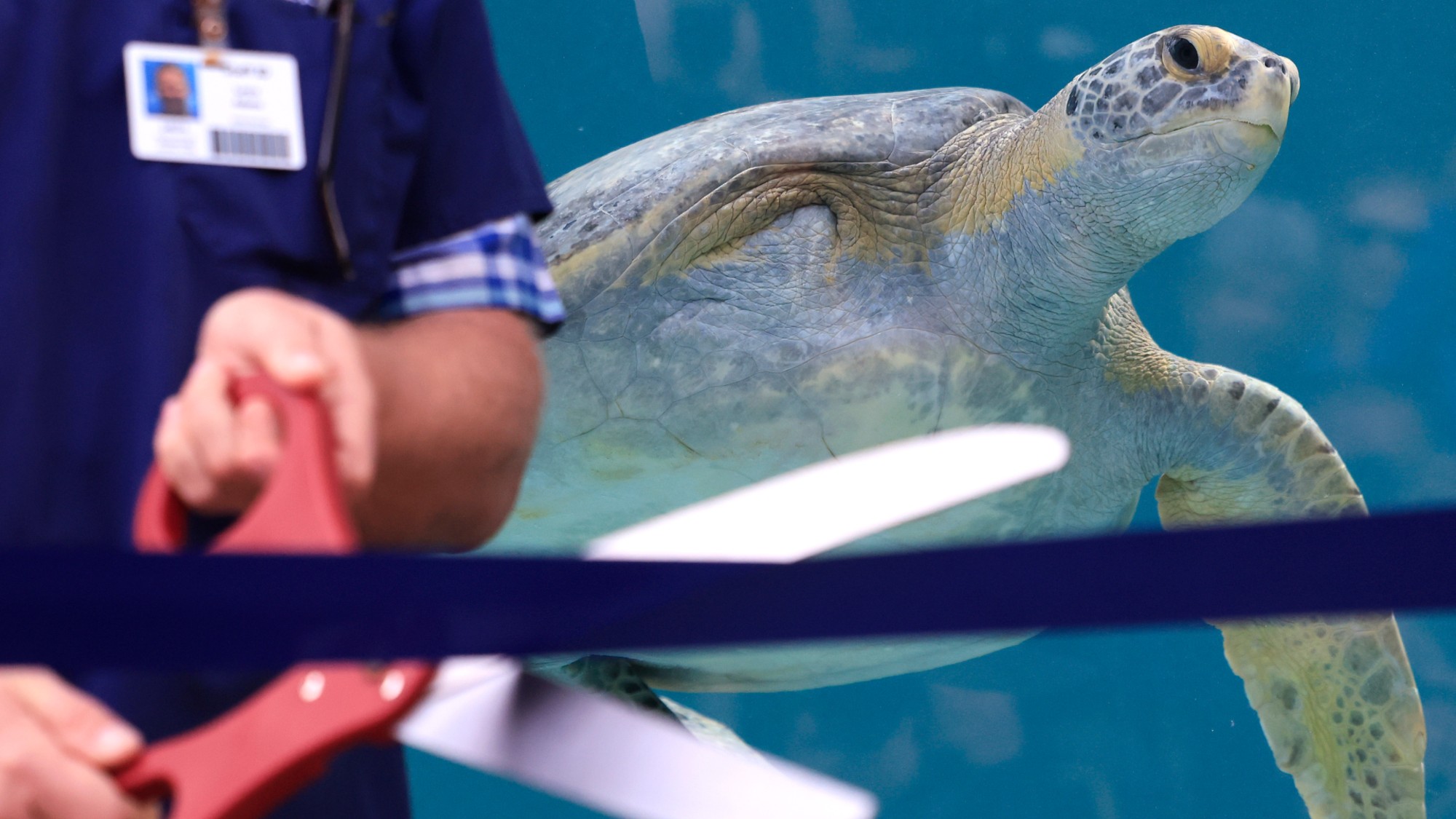
    On the mend

    A rescued green sea turtle named Porkchop, who had her flipper amputated, swims past a ribbon-cutting ceremony for a sea turtle rehabilitation area at the Aquarium of the Pacific in Long Beach, California. Porkchop will soon be released back to the wild. 
    Mario Tama / Getty Images


    Puzzles

    Daily sudoku

    Challenge yourself with The Week’s daily sudoku, part of our puzzles section, which also includes guess the number

    Play here


    The Week recommends

    The best fan fiction that went mainstream

    The blockbuster series “Fifty Shades of Grey” notoriously started as racy fanfic based on the young adult vampire series “Twilight.” Despite its humble beginnings, this famous example proved that fan fiction websites could be catnip for an already established fan base. And since then, several fanfic authors have crossed over into major mainstream success.

    ‘After’
    Anna Todd’s 2014 novel, “After,” began as fanfic on the social storytelling platform Wattpad, with an edgy love interest modeled after former One Direction member Harry Styles. “After” follows “bright-eyed” Tessa during her freshman year of college, where she meets a “broody, tattooed British deviant” named Hardin Scott, said Business Insider. The romantic series has been adapted into four films. (out now, $22, Simon & Schuster)

    ‘Alchemised’
    Featuring Harry Potter characters Draco Malfoy and Hermione Granger as an enemies-to-lovers pair, the Dramione pairing has spurred several fan fictions. SenLinYu’s 2025 debut is a dark romance and a “gargantuan doorstopper clocking in at over a thousand pages” that’s “not for the faint of heart,” said Paste Magazine. (out now, $35, Penguin Random House)

    ‘Throne of Glass’
    Sarah J. Maas’ 2012 debut novel began as a story loosely based on Cinderella that she began writing as a 16-year-old in 2002, called “Queen of Glass.” Since then, the book was turned into a traditional novel and has become part of one of the author's popular fantasy series. (out now, $19, Bloomsbury)

    Read more


    Poll watch

    Over three-fifths of Americans (61%) believe limiting access to personal data is very important, according to a YouGov survey. But of this majority, 33% admit to taking only moderate care to protect this data. Adults 65 and over are the most likely to prioritize data safety at 74%. 


    INSTANT OPINION

    Today’s best commentary

    ‘If Cuba falls, the Global South is to blame too’
    Belén Fernández at Al Jazeera
    The U.S. has “effectively been trying to destroy” Cuba for “no fewer than 67 years,” says Belén Fernández. “This time around, however, the threat carries a bit more weight in light of the Trump administration’s abduction” earlier this month of Nicolás Maduro. One would “hope, then, that other countries, particularly the self-declared allies of Cuba, might step up to defend the island against U.S. predations or at least credibly register their opposition to imperial impunity.”

    ‘California is failing its homeless students’
    Margaret Olmos at the San Francisco Chronicle
    Nearly “300,000 California students are trying to learn without a stable place to sleep,” and Gov. Gavin Newsom’s budget “failed to include dedicated funding for students experiencing homelessness,” says Margaret Olmos. The “consequences of inaction are profound.” This moment “presents a clear budget choice.” California lawmakers can “continue relying on inadequate and unstable federal funding, or they can deepen investment in what works.” Education is “one of the most effective tools for preventing homelessness.”

    ‘Bruce Springsteen’s new anti-ICE anthem is no “Blowin’ in the Wind.” And that’s OK.’
    Jeff Slate at MS NOW
    Bruce Springsteen’s new “anti-ICE anthem isn’t quite as bad as Paul McCartney’s ghastly post-9/11 anthem, ‘Freedom,’” but “he’s arguably done more than any other major artist to speak out against the Trump administration’s draconian policies, and maybe that’s enough,” says Jeff Slate. The song’s lyrics are “clunky, and the production is unsophisticated, presumably due to the fact that it was written and produced less than a week after Pretti’s death.” But “maybe, in fact, it’s exactly what we need right now.”


    WORD OF THE DAY

    pharmacokinetics

    The study of how a body affects a drug, from absorption to elimination. Drug developer Nanexa AB has announced that preclinical data show its PharmaShell drug-delivery formulation drastically improves the pharmacokinetics of monthly GLP-1 weight-loss drug injections. This could “mitigate many common side effects” like nausea and gastrointestinal issues, according to the company. 


    Evening Review was written and edited by Theara Coleman, Nadia Croes, Scott Hocker, Justin Klawans, Joel Mathis and Summer Meza, with illustrations by Stephen Kelly and Julia Wytrazek.

    Image credits, from top: Illustration by Stephen Kelly / Getty Images; Grafissimo / Getty Images; Mauricio Paiz / NurPhoto / Getty Images; Bloomsbury / Penguin Random House / Simon & Schuster
     

    Recent editions

    • Morning Report

      Starmer opens door to UK visit for Xi

    • Evening Review

      How world leaders are reacting to the Trump test

    • Morning Report

      Iran has ‘fingers on trigger’ as US standoff intensifies

    VIEW ALL
    TheWeek
    • About Us
    • Contact Future's experts
    • Terms and Conditions
    • Privacy Policy
    • Cookie Policy
    • Advertise With Us
    • FAQ
    Add as a preferred source on Google

    The Week UK is part of Future plc, an international media group and leading digital publisher. Visit our corporate site.

    © Future Publishing Limited Quay House, The Ambury, Bath BA1 1UA. All rights reserved. England and Wales company registration number 2008885.