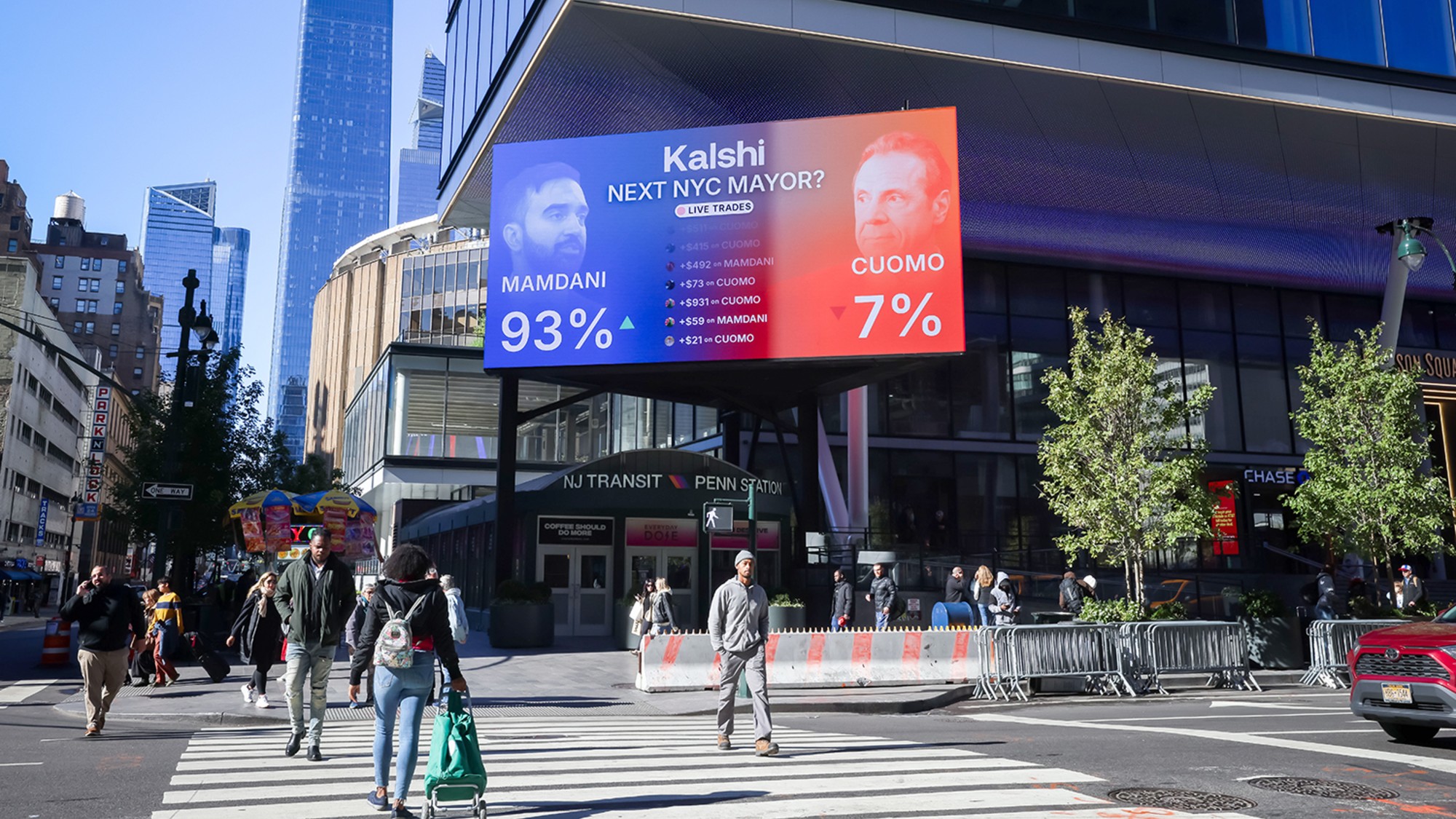
Americans are betting billions on prediction markets like Kalshi and Polymarket. What could go wrong?
What are prediction markets?
They’re online platforms where users can bet on the outcomes of future events. Almost any event can be added to the market: who will win the Super Bowl or an election, the direction a California wildfire will spread, whether the U.S. will confirm the existence of aliens before 2027, when the Cuban president will be ousted. Proponents say these markets are different from traditional gambling, because they double as valuable sources of information that can help governments, businesses, and ordinary citizens make smart decisions. Prediction markets are “the most effective way to aggregate information and the crowd wisdom,” said Tarek Mansour, who co- founded Kalshi in 2018. Critics counter that platforms like Kalshi and Polymarket are just another way to bilk gambling- addicted Americans—and that they are rife with insider trading. The day before the U.S. went to war with Iran, more than 150 accounts placed a total of $855,000 in bets correctly predicting an American strike over the next 24 hours. At least 16 accounts made over $100,000. It “makes you think it was someone who knew something about the timing,” said economist Eric Zitzewitz. Such incidents are unlikely to slow the markets’ rapid growth: About $12 billion was traded on Kalshi and Polymarket in December, up more than 400% from a year earlier.
How do the markets work?
Users place bets by buying a “contract”: a yes or no option on a question such as “Will the Democrats win the House in the midterms?” The value of the contract moves up and down like a stock, fluctuating between $0 and $1. That price reflects the market’s view on the likelihood of a future event: $0.30 means there’s a 30% likelihood, for example. A payout occurs if the event happens and the value of the contract hits $1. Unlike a traditional sports book, there is no “house” that makes money when bettors lose. Instead, the platforms make money by charging transaction fees on contracts. Prediction markets say the lack of a house means they shouldn’t be regulated like casinos, and that their platforms are legitimate financial instruments because they let users hedge against risk. Many experts are skeptical of those claims. “It definitely looks, smells, and feels like gambling,” said Steve Ruddock, a gambling industry analyst.
How are they regulated?
Lightly. Prediction markets are overseen by the federal Commodity Futures Trading Commission, and the Trump administration has taken a soft touch with the industry. ( President Trump’s son Donald Trump Jr. has invested in Polymarket through his venture capital firm and is an adviser to Kalshi.) Several states have sued or sent cease and desist letters to prediction markets over sports gambling, which is banned in 20 states and, where it is allowed, is typically legal only for over-21s. States say the markets are skirting those rules, as well as the tax obligations of sports books, a major source of revenue for a state like Nevada. CFTC head Mike Selig has vowed to defend prediction markets against what he calls “an onslaught” of state litigation. Utah Gov. Spencer Cox, a Republican, promised in turn that he would take prediction markets and the CFTC to court, saying the markets are “destroying the lives of families and countless Americans, especially young men.”
Is that true?
Some users have made huge profits on the markets. Logan Sudeith, 25, quit his job as a financial risk analyst to become a full-time gambler on Kalshi and Polymarket. He told NPR he made $100,000 in one month, $25,000 more than he used to make in a year. A bet on Time magazine’s person of the year alone earned him $40,236. Alan Cole, a 37-year-old tax economist, put $342,195.63—his life’s savings—into Kalshi bets that Elon Musk’s DOGE wouldn’t successfully cut government spending. He netted over $128,000. But for every big winner, there are many more losers. K.A., a 24-year-old engineer from Virginia, told Business Insider that he pumped $10,000 into Kalshi over eight days in December and took out loans so he could place more bets. “There’ll be a big winning streak at the beginning,” he said. “Then bam, everything’s gone.” Critics say the prevalence of insider trading on the platforms means the odds are rigged against ordinary Americans.
How common is insider trading?
Anecdotal evidence suggests it’s prevalent. In February, an anonymous day-old Polymarket account won $17,000 by correctly guessing 17 of 20 bets about the Super Bowl halftime show, including whether Lady Gaga and Ricky Martin would appear—a success rate that strongly suggests the bettor had inside information. Other examples are more concerning: Less than five hours before the January raid that captured Venezuelan president Nicolás Maduro, a Polymarket account doubled down on bets that the U.S. would invade Venezuela. The trader netted more than $400,000, but Polymarket didn’t pay out, saying the raid didn’t count as an invasion. In Israel, a civilian and a military reservist were arrested last month for allegedly using secret intelligence to place Polymarket wagers on military operations. Such bets are dangerous, said Joseph Grundfest, a former Securities and Exchange commissioner, “because you are signaling to your enemies what may happen.”
Are there any guardrails?
Some. Kalshi said it has enacted new rules based on those of the New York Stock Exchange and Nasdaq. “If you have material nonpublic information on a market, you cannot trade it,” said Mansour. But regulation remains largely voluntary: The CFTC has no guidelines on insider trading on the platforms, and Polymarket has no explicit ban on the practice. Some prediction market evangelists want to keep the rules lax. Insider trading, said Tre Upshaw, who runs a startup that provides analytics for Polymarket traders, “just accelerates the truth faster.”