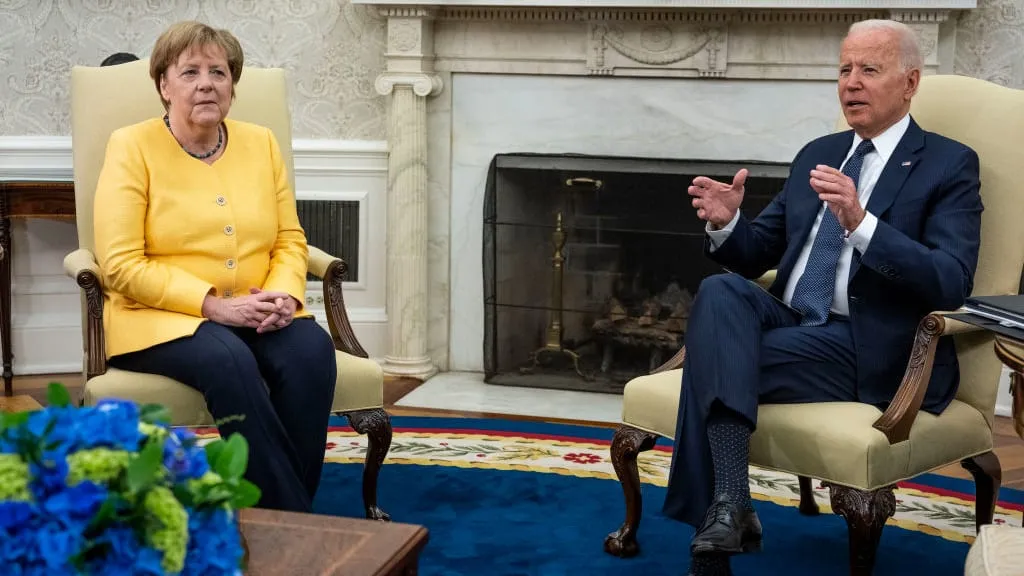
Biden, Merkel discuss controversial pipeline during White House meeting
German Chancellor Angela Merkel on Thursday became the first European leader to meet President Biden at the White House, where they discussed the controversial Nord Stream 2 gas pipeline that will go from Russia to Germany under the Baltic Sea.
Biden has shared his concerns over the pipeline, which is nearly complete, saying it will make Europe more reliant on Russian gas and puts Russia in a position where it can place pressure on Ukraine. During their joint press conference on Thursday, Merkel said the "idea is and remains that Ukraine remains a transit country for natural gas, that Ukraine just as any other country in the world has a right to territorial sovereignty." Germany, she added, will take action "should Russia not respect this right of Ukraine that it has as a transit country."
They both agreed that Russia can't be allowed to weaponize energy. "We stand together and will continue to stand together to defend our eastern flank allies at NATO against Russian aggression," Biden said. The leaders also spoke about the coronavirus pandemic, with Biden saying he has asked the head of his coronavirus task force for an idea of when Europeans might be able to freely travel again to the U.S.
The Week
Escape your echo chamber. Get the facts behind the news, plus analysis from multiple perspectives.
Sign up for The Week's Free Newsletters
From our morning news briefing to a weekly Good News Newsletter, get the best of The Week delivered directly to your inbox.
Merkel is the second-longest-serving chancellor in German history, and will not be seeking re-election in September. Biden told Merkel that "on a personal note, I will miss seeing you at our summits. I truly will." He praised the "cooperation" between Germany and the United States, saying it is "strong and we hope to continue that, and I'm confident that we will." Merkel agreed, adding, "I value the friendship."
A free daily email with the biggest news stories of the day – and the best features from TheWeek.com
Catherine Garcia has worked as a senior writer at The Week since 2014. Her writing and reporting have appeared in Entertainment Weekly, The New York Times, Wirecutter, NBC News and "The Book of Jezebel," among others. She's a graduate of the University of Redlands and the Columbia University Graduate School of Journalism.
-
‘Let 2026 be a year of reckoning’Instant Opinion Opinion, comment and editorials of the day
-
Why is Iran facing its biggest protests in years?TODAY’S BIG QUESTION Iranians are taking to the streets as a growing movement of civic unrest threatens a fragile stability
-
How prediction markets have spread to politicsThe explainer Everything’s a gamble
-
Israel approves new West Bank settlementsSpeed Read The ‘Israeli onslaught has all but vanquished a free Palestinian existence in the West Bank’
-
US offers Ukraine NATO-like security pact, with caveatsSpeed Read The Trump administration has offered Ukraine security guarantees similar to those it would receive from NATO
-
Hong Kong court convicts democracy advocate LaiSpeed Read Former Hong Kong media mogul Jimmy Lai was convicted in a landmark national security trial
-
Australia weighs new gun laws after antisemitic attackSpeed Read A father and son opened fire on Jewish families at Sydney’s Bondi Beach, killing at least 15
-
How Bulgaria’s government fell amid mass protestsThe Explainer The country’s prime minister resigned as part of the fallout
-
Benin thwarts coup attemptSpeed Read President Patrice Talon condemned an attempted coup that was foiled by the West African country’s army
-
Femicide: Italy’s newest crimeThe Explainer Landmark law to criminalise murder of a woman as an ‘act of hatred’ or ‘subjugation’ but critics say Italy is still deeply patriarchal
-
Brazil’s Bolsonaro behind bars after appeals run outSpeed Read He will serve 27 years in prison