Sign up to get Today’s Best Articles in your inbox
Join 350,000+ subscribers and keep yourself informed with a selection of
The Week’s most interesting, enlightening and entertaining stories - plus daily puzzles.
You are now subscribed
Your newsletter sign-up was successful
Want to add more newsletters?
An account already exists for this email address, please log in.
Are the comforts of modern life making humans dumber?
Gerald Crabtree, a scientist at Stanford University, counterintuitively argues that our ancient ancestors were much smarter than we are
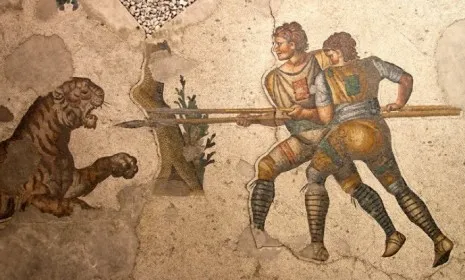
The claim: Once upon a time the human brain was evolving at a rapid pace. Some 50,000 to 500,000 years ago, our prehistoric ancestors, armed with little more than their wits, had to hunt down prey and build shelter to protect themselves from the elements, or perish. Natural selection, in other words, dictated that only the smartest survived. But with all the comforts of modern living, is that still the case? Gerald Crabtree, a developmental scientist at Stanford University, says it isn't. He argues that humanity's collective intelligence has gone downhill ever since we started living on farms.
Key quote: "I would wager that if an average citizen from Athens of 1000 B.C. were to appear suddenly among us, he or she would be among the brightest and most intellectually alive of our colleagues," claims Crabtree, who estimates that human beings reached their intellectual peak 2,000 to 6,000 years ago. In theory, that Athenian would have "a good memory, a broad range of ideas, and a clear-sighted view of important issues."
The evidence: In the journal Trends in Genetics, Crabtree argues that just one mutation in any one of our 2,000 to 5,000 genes lowers our intellectual and emotional abilities. Using knowledge of the rate of mutations, he and his team of researchers conclude that the average person harbors two "intelligence-stunting genetic changes that evolved over the last 3,000 years," says Tia Ghose at LiveScience. In other words, advances in technology and medicine have masked an "underlying decline in brain power" that, in the future, will continue to contribute to the "dumbing down" of our species, says The Independent.
The Week
Escape your echo chamber. Get the facts behind the news, plus analysis from multiple perspectives.
Join more than 350,000 subscribers and keep yourself informed with a selection of The Week’s most interesting, enlightening and entertaining stories - plus daily puzzles.
Join more than 350,000 subscribers and keep yourself informed with a selection of The Week’s most interesting, enlightening and entertaining stories - plus daily puzzles.
The conclusion: In the past, a hunter-gatherer who wasn't capable of devising a plan to fight off saber-toothed tigers probably died, whereas in modern times, a Wall Street executive who makes a similar mistake is instead rewarded with a substantial bonus and becomes more attractive to a potential mate. Clearly, argue researchers, "extreme selection is a thing of the past."
The debate: We're not losing our smarts at all, one critic of Crabtree's theory tellsLiveScience. Rather, we "humans have just diversified [our brain power] with various types of intelligence." That's why we can now do things like play chess, compose poetry, or smash together atoms.
[Crabtree] takes the line that our intelligence is designed to allow us to build houses and throw spears straighter at pigs in the bush, but that is not the real driver of brain size... In reality, what has driven human and primate brain evolution is the complexity of our social world, [and] that complex world is not going to go away. Doing things like deciding who to have as a mate or how best to rear your children will be with us forever.
Sign up to get Today’s Best Articles in your inbox
A free daily email with the day’s biggest news and analysis – and the best features from TheWeek.com
"You don't get Stephen Hawking 200,000 years ago. He just doesn't exist," says psychologist Thomas Hills of the University of Warwick, who wasn't involved in the study. "But now we have people of his intellectual capacity doing things and making insights that we would have never achieved in our environment of evolutionary adaption."