Sign up to get Today’s Best Articles in your inbox
Join 350,000+ subscribers and keep yourself informed with a selection of
The Week’s most interesting, enlightening and entertaining stories - plus daily puzzles.
You are now subscribed
Your newsletter sign-up was successful
Want to add more newsletters?
An account already exists for this email address, please log in.
The biometrics boom
New technology can identify you by unique traits in your eyes, your voice, and your gait. Is there cause for alarm?
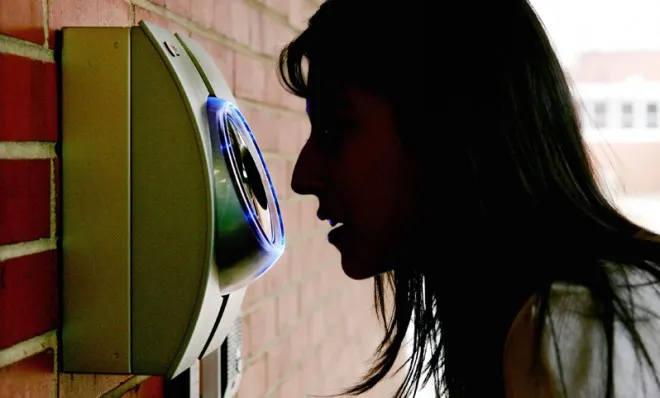
It is the science of identifying individuals by their unique biological characteristics. The best known and earliest example is fingerprints, used by ancient Babylonians as a signature and by police since the turn of the 20th century to identify criminals. But in the last decade there has been a boom in more advanced biometric technology, allowing people to be identified, and sometimes remotely tracked, by their voices, the irises of their eyes, the geometry of their faces, and the way they walk. The FBI is currently consolidating existing fingerprint records, mug shots, and other biometric data on more than 100 million Americans into a single $1.2 billion database. When it is completed, in 2014, police across the country will theoretically be able to instantly check a suspect against that vast and growing array of data. Law-enforcement officials are enthusiastic about this growing power, while civil libertarians are aghast. "A society in which everyone's actions are tracked is not, in principle, free," said William Abernathy and Lee Tien of the Electronic Frontier Foundation. "It may be a livable society, but would not be our society."
How did the boom come about?
The Week
Escape your echo chamber. Get the facts behind the news, plus analysis from multiple perspectives.
Join more than 350,000 subscribers and keep yourself informed with a selection of The Week’s most interesting, enlightening and entertaining stories - plus daily puzzles.
Join more than 350,000 subscribers and keep yourself informed with a selection of The Week’s most interesting, enlightening and entertaining stories - plus daily puzzles.
The age of terrorism has created enormous interest in — and lowered resistance to — identifying and tracking individuals in a very precise way. "[Biometrics] represent what terrorists fear most: an increased likelihood of getting caught," said Homeland Security spokesman Russ Knocke. Since 2002, the government has fingerprinted all foreign visitors to the U.S. at airports and borders, collecting approximately 300,000 prints per day. In Afghanistan and Iraq, U.S. forces have gathered iris data from 5.5 million people, to identify suspected insurgents and prevent infiltration of military bases. Fueled by the growth of iris scans in particular, the global biometrics industry now has revenues of $10 billion — and is expected to double that in five years.
How do iris scans work?
Every person has unique patterns within the colored part of his or her eye. A device scans your iris and compares it with photos of irises on record, identifying people with accuracy rates of 90 to 99 percent, depending on the conditions and system used. Iris scanners are now widely used on military bases, in federal agencies, and at border crossings and airports. An improved version can remotely assess up to 50 people per minute, making it possible to scan crowds for known criminals or terrorists whose iris patterns are on file. Facial recognition technology, which identifies people through such geometric relationships as the distance between their eyes, has also come a long way. The technology is still only about 92 percent accurate, but "the error rate halves every two years," said facial recognition expert Jonathon Phillips.
What other biometrics are there?
Sign up to get Today’s Best Articles in your inbox
A free daily email with the day’s biggest news and analysis – and the best features from TheWeek.com
The U.S. military is already using radar that can detect the unique rhythm of a person's heartbeat from a distance, and even through walls. That technology is being developed for use in urban battlefields, but may one day become a law-enforcement tool. A person's gait, too, is completely individual, and the technology to recognize it has advanced to the point where a person can be identified by hacking into the sensor that tracks the movement of the cellphone in his or her pocket. "Because it does not require any special devices, the gait biometrics of a subject can even be captured without him or her knowing," said Carnegie Mellon University biometrician Marios Savvides.
What are the privacy implications?
Civil liberties groups warn that if these technologies are not restrained by law, they could be used in truly Orwellian ways. No laws currently limit data collection from biometric technology or the sharing of that data among federal agencies. Law-enforcement officials can use driver's license photos to identify or hunt for suspects, for example; the government or private companies could collect a person's biometric data without his consent and use it to track his movements. "That has enormous implications, not just for security but also for American society," said Chris Calabrese of the American Civil Liberties Union.
Is there any turning back?
Probably not, especially now that private companies are embracing biometrics. Already, TD Bank and Barclays Bank are using voice recognition technology to verify account holders. In the not-too-distant future, we'll be able to start our cars with our fingerprints, use facial recognition or iris scans instead of passwords on smartphones and other electronic devices, and have doctors check our medical records by scanning our faces. These uses of biometrics will provide convenience and efficiency, but at a steep price in privacy. Iris technology that reads our eye movements, for example, will be able to determine what we look at in stores — then use that data to create highly personalized advertising aimed at what we've displayed interest in. "For companies and governments," said the ACLU's Jay Stanley, "the incentives associated with biometrics all point the other way from privacy."
Biometrics in the Third World
Here in the U.S., proposals to put biometric data on Social Security cards have faltered because of concern among civil libertarians and conservatives over government overreach. But in much of the developing world, the concept of personal privacy carries less legal and cultural weight, and there a biometric revolution is taking place, with some 160 massive data-gathering projects underway. Until recently, more than a third of people in developing countries were not registered in any way at birth, making it hard for them to open bank accounts, get government benefits, or vote. Biometric IDs could change that. India is taking the fingerprints and iris scans of all 1.2 billion of its citizens. Nandan Nilekani, the founder of outsourcing firm Infosys and the project's leader, says being identified will allow India's largely anonymous masses to claim services to which they're entitled under the law, rather than being forced to bribe bureaucrats. "Unique identification is a means to empowerment," he said.