The Week The Week
flag of US
US
flag of UK
UK
https://cdn.mos.cms.futurecdn.net/flexiimages/jacafc5zvs1692883516.jpg

SUBSCRIBE & SAVE

Less than $3 per week

Sign in
  • View Profile
  • Sign out
  • The Explainer
  • The Week Recommends
  • Newsletters
  • Cartoons
  • From the Magazine
  • The Week Junior
  • Student Offers
  • More
    • Politics
    • World News
    • Business
    • Health
    • Science
    • Food & Drink
    • Travel
    • Culture
    • History
    • Personal Finance
    • Puzzles
    • Photos
    • The Blend
    • All Categories
  • Newsletter sign up Newsletter
  • WeekDay AM: 10 Things you need to know this morning
    West Bank settlements, trail hunting ban, and Saudi Arabia’s execution surge

     
    today’s international story

    Israel expands West Bank settlements

    What happened
    Israel’s security cabinet has signed off on the formal recognition of 19 additional Jewish settlements in the occupied West Bank, deepening a long-running policy of expansion in territory Palestinians claim for a future state. The decision lifts the number of settlements approved during the past three years to 69, according to Israeli officials, and follows UN findings that construction activity has reached levels not seen since 2017.

    Who said what
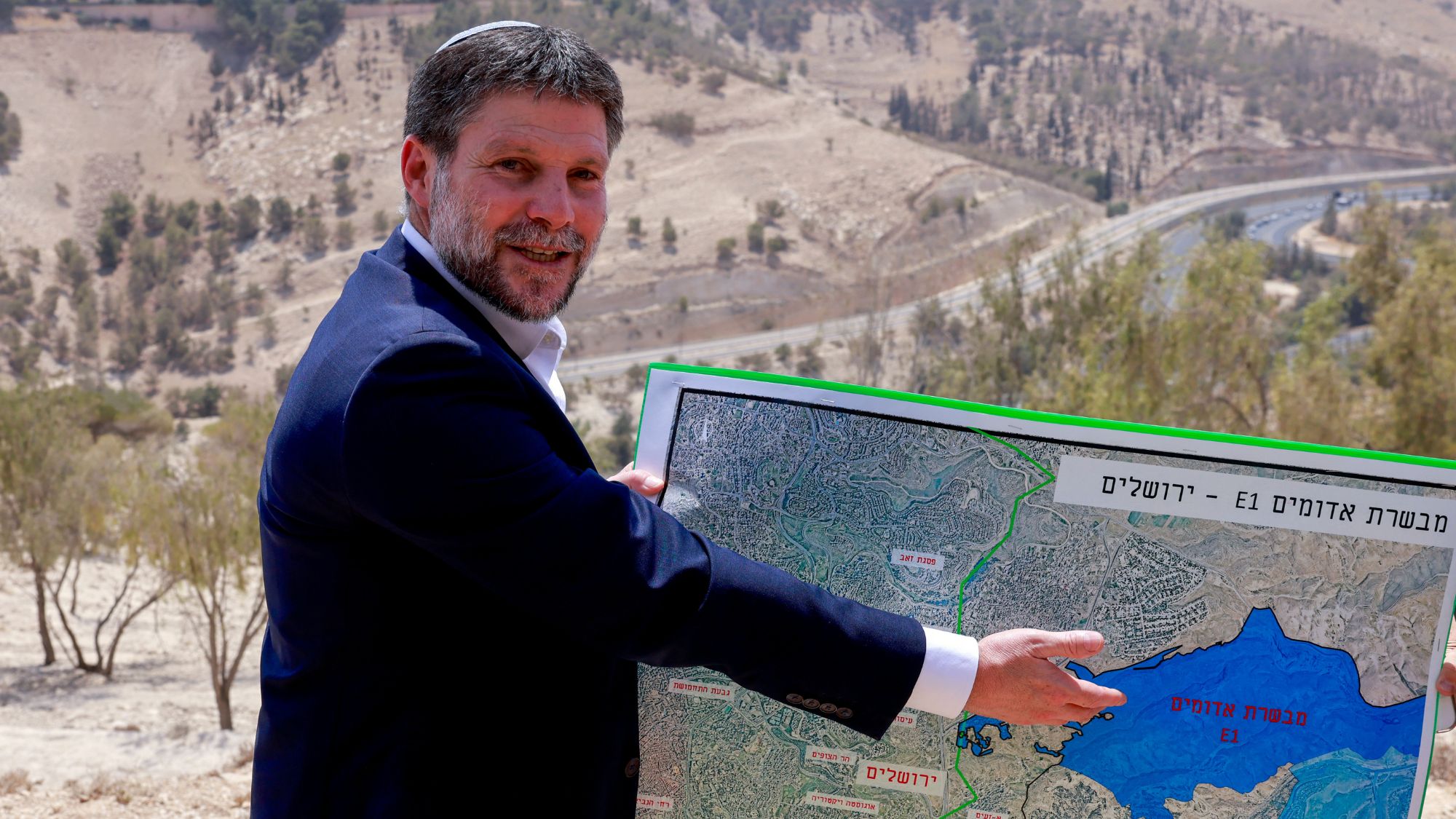
    When he first announced the plans in August, Israeli Finance Minister Bezalel Smotrich (pictured above) said the new settlements would “bury the idea of a Palestinian state”. The Israeli establishment of settlements is “often condemned internationally”, said Felix Tamsut on Deutsche Welle, and yesterday’s announcement was no different with UN Secretary-General Antonio Guterres warning that Israel’s “relentless” settlement drive would heighten tensions.

    Settlement expansion has certainly “angered Arab nations who have consistently said it undermines prospects for a two-state solution”, said Shaimaa Khalil and Mallory Moench on the BBC. It has also “raised concerns about the possible annexing of the occupied West Bank”.

    What next? 
    Israel’s settlements are “widely considered illegal under international law”, said Sky News and have been “criticised for fragmenting the territory of a future Palestinian state by confiscating land and displacing residents”. International pressure is expected to intensify, particularly after several Western nations, including the UK, formally recognised a Palestinian state earlier this year.


    today’s politics story

    Government set to ban trail hunting

    What happened
    Trail hunting will be outlawed in England and Wales under a new animal welfare plan to be published by the government today. The activity involves laying an animal-scent trail for dogs to follow, with riders tracking them on horseback. It has remained lawful since restrictions were introduced in 2004, because it does not directly involve killing wildlife.

    Who said what
    “In our manifesto we said we would ban trail hunting, and that's exactly what we'll do,” said animal welfare minister Baroness Hayman. Hunting organisations opposed the move. Countryside Alliance chief executive Tim Bonner said revisiting the issue was “completely unnecessary”.

    What next?
    Ministers will consult on the details of the ban in the new year. Trail hunting is banned in Scotland, while hunting with dogs remains legal in Northern Ireland. Any ban will “raise questions over the future of the approximately 170 hunt packs in England and Wales”, said Jane Dalton in The Independent. They will now “face a dilemma over whether to continue in a different form or whether to fold”.


    Today’s human rights story

    Rights groups condemn surge in Saudi executions

    What happened
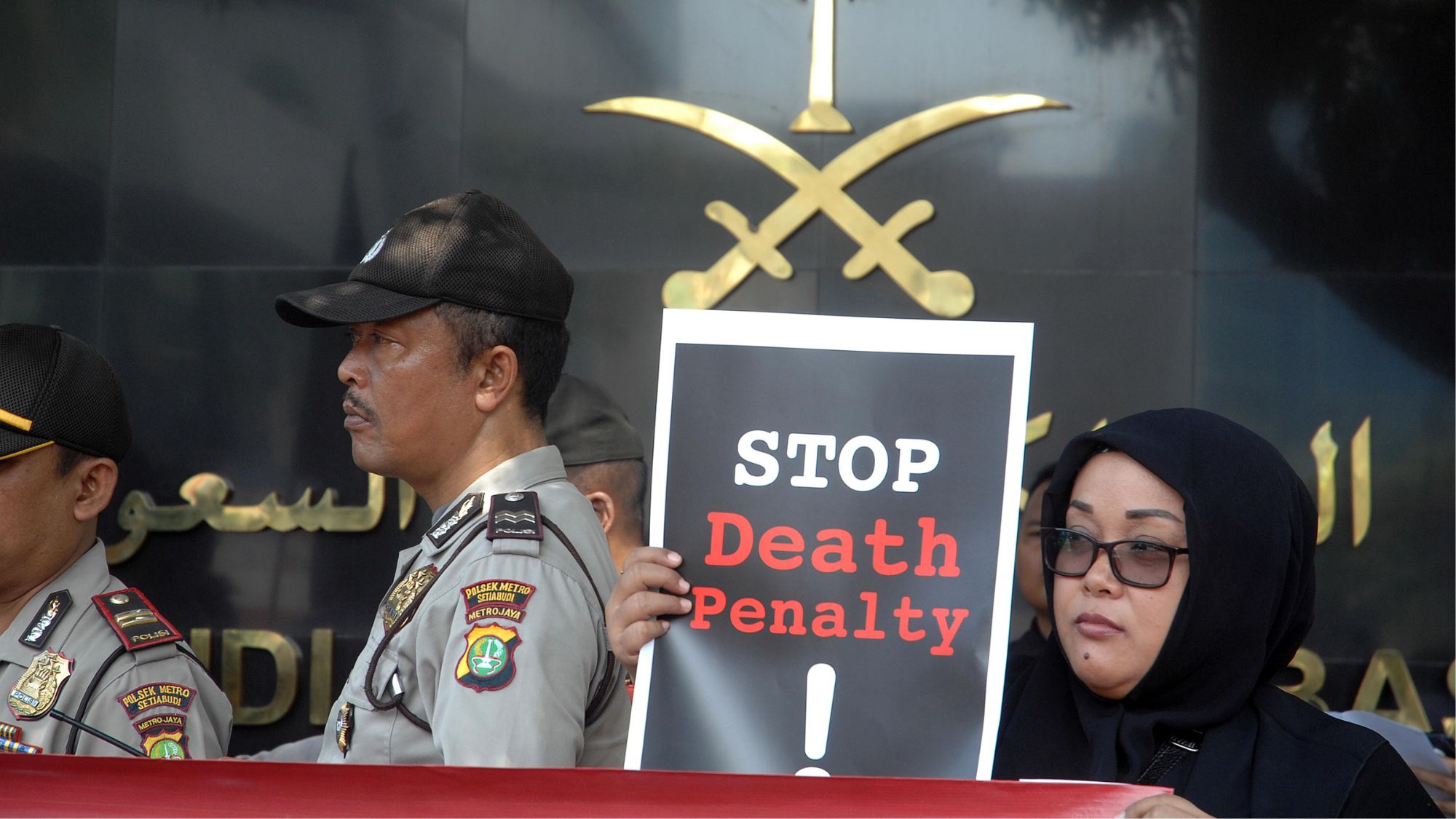
    Saudi Arabia has recorded its highest ever annual execution total for a second consecutive year, with at least 347 people put to death so far, according to campaign group Reprieve. Most of those executed were sentenced for non-lethal crimes, primarily involving drugs, campaigners said, including 96 solely linked to hashish.

    Who said what
    “Saudi Arabia is operating with complete impunity now,” said Jeed Basyouni, Reprieve’s head of death penalty for the Middle East and North Africa. She said torture and forced confessions are now “endemic” within the Saudi justice system.

    In a bid to diversify his country’s economy away from oil, de facto Saudi ruler Mohammed bin Salman has “opened Saudi Arabia up to the outside world, taken the religious police off the streets, and allowed women to drive”, said Caroline Hawley on the BBC. But the kingdom’s human rights record remains “abysmal”, according to the US-based campaign group Human Rights Watch.

    What next?
    The UN is urging an immediate suspension of executions and greater transparency, as scrutiny of Saudi Arabia’s human rights record continues from international monitors and allies.


    It’s not all bad

    Thousands gathered at Stonehenge before dawn yesterday to welcome the winter solstice. Revellers from around the world, including pagans, druids and first-time visitors, watched light stream through the stones on the year’s shortest day. English Heritage staff praised the inclusive atmosphere, while travellers described a bucket-list moment and a rare chance to connect with history, mystery and one another. Others around the country may simply be relieved that the long slide into shorter days is now over.


    under the radar

    The small Caribbean island courting crypto billions

    A Belgian billionaire has a quiet, ambitious plan to create the “Dubai of the Caribbean” on the island of Nevis, said The Brussels Times. Olivier Janssens, who holds Nevisian citizenship through an investment scheme, has unveiled plans for “Destiny”, a “libertarian community with its own legal system” on the Caribbean island.

    The “multibillion-dollar project” is likely to involve a “massive reshaping of the south coast of the island” where the development “is already displacing long-term residents by buying their land”, said the Financial Times. It forms part of a wider trend known as the “network state” movement, in which tech billionaires are attempting to establish “their own, more libertarian, territories”. 

    Destiny is closer to fruition than most because St Kitts and Nevis recently passed new legislation to allow the creation of so-called Special Sustainability Zones, where “innovative approaches to the governance of tech and digital assets” can be trialled, said Cryptopolitan.

    The optics of a “foreign-led takeover” of Nevisian land have sparked a “fiery” debate, said Jam Radio. Former prime minister Timothy Harris described the project as an instrument of “neo-colonialism” and a “return to plantation-era subjugation”.

    Janssens has promised that Destiny will be “open to Nevisians and remain under government jurisdiction”, said the Daily Mail, and has pledged a “$50 million [£37.3 million] investment in Nevis’ infrastructure”. The project will serve as a “defining test of how far the island is willing to go in reimagining development, law, and partnership with global capital”, said St Maarten’s The Daily Herald.


    on this day

    22 December 1994

    Silvio Berlusconi resigned as Italian Prime Minister after seven months in office, following the fracturing of his coalition. This week, MediaForEurope, Italy’s largest media group, founded by Berlusconi and run by his son, publicly endorsed Paramount’s bid for Warner Bros Discovery, claiming it would preserve competition in the streaming market.


    Today’s newspapers

    ‘European return?’

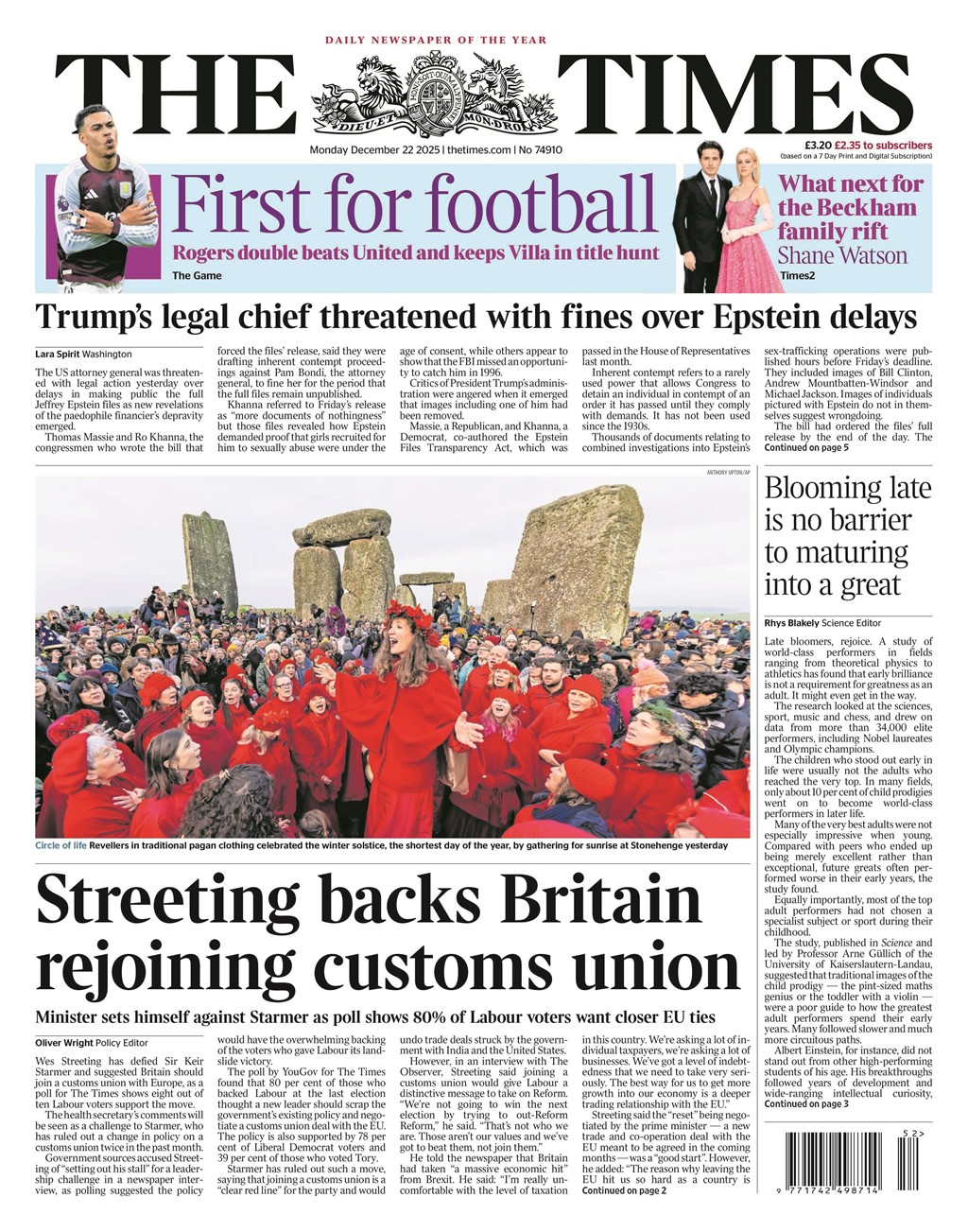
    “Streeting backs Britain rejoining customs union”, says The Times. “Don’t call migration a threat, says EHRC chief”, reports The Telegraph. “Hopes of deal rise as doctors’ strike ends”, The Guardian says. “Thousands face care home ‘eviction’ amid funding crisis”, says The i Paper. “Albanian kingpins smuggling criminals out of UK”, the Daily Mail says. “Foreign buyers snap up ‘undervalued’ UK companies as takeovers surge 74%”, says the Financial Times.

    See the newspaper front pages


    tall tale

    Supermarket swipe

    Thieves dressed as Santa and his elves stole $3,000 (£1,625) worth of goods from a grocery store in Montreal, in a yuletide heist inspired by Robin Hood. The festive gang were filmed filling up carts with food before leaving without paying. An activist group called Robins des ruelles or Robins of the Alleys claimed responsibility for the heist. Writing on social media, it said the goods were redistributed to needy people and community groups. A spokesperson for the store was less filled with seasonal spirit, stressing that theft is still a criminal act.


    Morning Report was written and edited by Arion McNicoll, Rebekah Evans, Will Barker, Ross Couzens, and Chas Newkey-Burden, with illustrations by Marian Femenias-Moratinos.

    Image credits, from top: Menahem Kahana / AFP via Getty Images; Jory Mundy / Getty Images; NurPhoto via Getty Images; Illustation by Marian Femenias-Moratinos / Getty Images.

    Morning Report and Evening Review were named Newsletter of the Year at the Publisher Newsletter Awards 2025
     

    Recent editions

    • Saturday Wrap

      Trump’s AI order

    • Evening Review

      What reclassifying marijuana means

    • Morning Report

      Brown, MIT murder cases end with dead suspect

    VIEW ALL
    TheWeek
    • About Us
    • Contact Future's experts
    • Terms and Conditions
    • Privacy Policy
    • Cookie Policy
    • Advertise With Us
    • FAQ
    Add as a preferred source on Google

    The Week is part of Future US Inc, an international media group and leading digital publisher. Visit our corporate site.

    © Future US, Inc. Full 7th Floor, 130 West 42nd Street, New York, NY 10036.