The Week The Week
flag of US
US
flag of UK
UK
https://cdn.mos.cms.futurecdn.net/flexiimages/jacafc5zvs1692883516.jpg

SUBSCRIBE & SAVE

Less than $3 per week

Sign in
  • View Profile
  • Sign out
  • The Explainer
  • The Week Recommends
  • Newsletters
  • Cartoons
  • From the Magazine
  • The Week Junior
  • Student Offers
  • More
    • Politics
    • World News
    • Business
    • Health
    • Science
    • Food & Drink
    • Travel
    • Culture
    • History
    • Personal Finance
    • Puzzles
    • Photos
    • The Blend
    • All Categories
  • Newsletter sign up Newsletter
  • Saturday Wrap, from The Week
    Ukraine anniversary, student loan rows, and ‘near civil war’ in Lyon

     
    controversy of the week

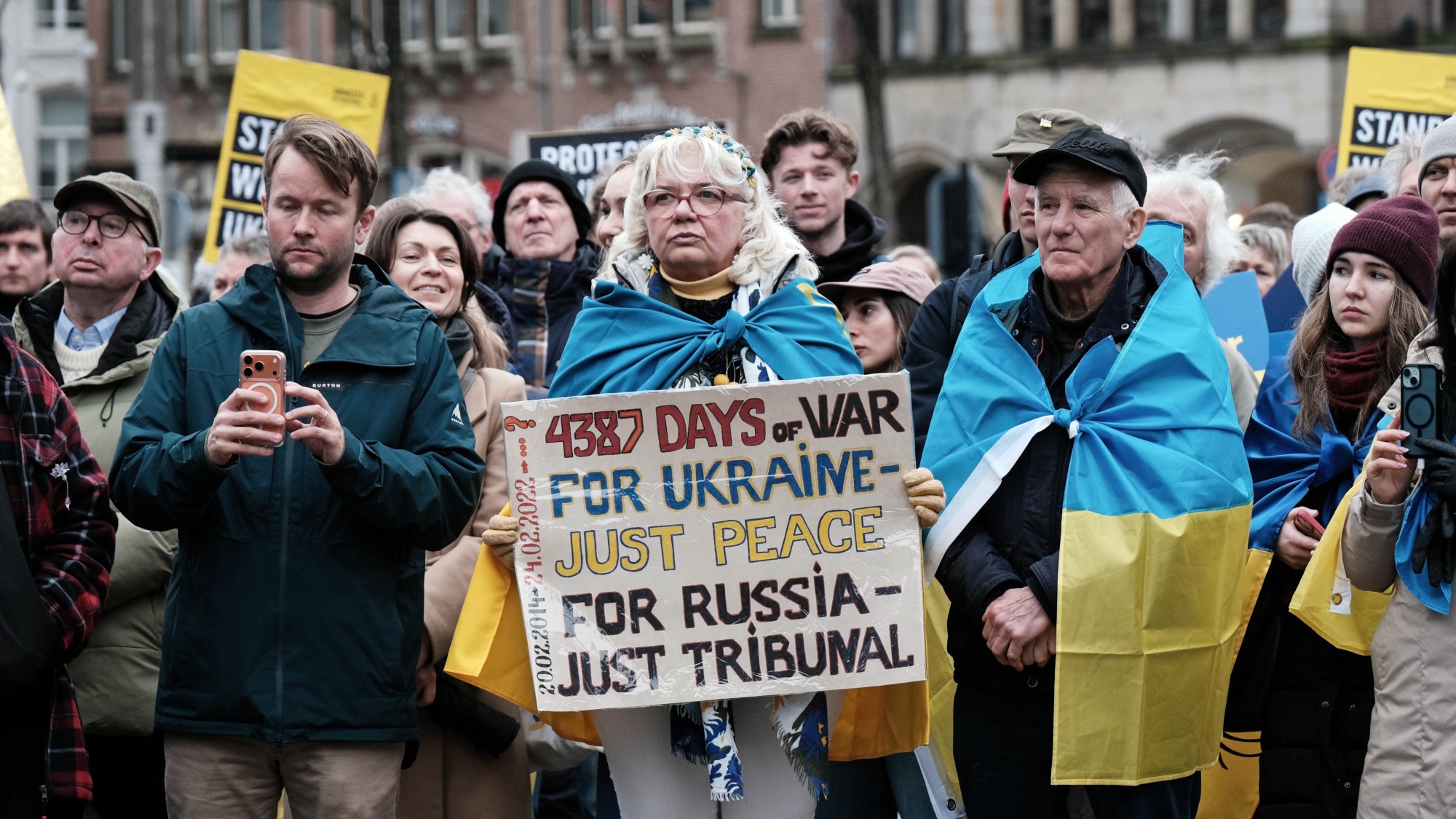
    A grim anniversary: conflict in Ukraine enters fifth year

    When Russian troops invaded on 24 February 2022, “most experts expected Ukraine’s defeat within days”, said Rajan Menon in The Guardian. “Russia’s population is more than three times Ukraine’s, its GDP around 10 times bigger, its army far larger.” But Ukraine defied the “doomsday predictions” and, four years on, it still holds 80% of its territory. Its army has sustained an estimated 500,000 to 600,000 casualties, including 100,000 to 140,000 fatalities, but Russia has reportedly suffered far more: an estimated 1.2 million casualties, including up to 325,000 deaths. Ukrainian drones have “prevented Russia’s generals from fighting the kind of war they prefer”, and have trapped them in a “war of attrition” in which every inch of territory gained is a struggle. Ukraine has kept Russia’s Black Sea fleet at bay, and is increasingly reaching into enemy territory: more than half of Russia’s oil refineries have been struck at least once, heavily reducing their capacity. 

    In all wars, “defenders can expect the casualty ratio to lean in their favour”, said Memphis Barker in The Telegraph. But in the “bloodiest sections” of the front line, near the eastern city of Pokrovsk, Kyiv’s army is eliminating fully 25 Russians for every Ukrainian killed. Over the past two months, the Russian army has reportedly started “to lose more men than it can recruit”: on average, a mind-boggling 40,000 per month. Combine Ukraine’s drone “kill zones” with Vladimir Putin’s disregard for the lives of his soldiers, “and the result is a charnel house of historically freakish proportions”. Ukraine was also given a boost this month when SpaceX stopped Russian forces using its Starlink satellites, said Ibrahim Naber on Politico. This “constrained Russian military capabilities”, and in the days that followed, “Ukraine recaptured roughly 77 square miles in the country’s southeast”. Yet “bloody conflict has become an end in itself” for Putin, and any peace plan acceptable to Ukraine will never satisfy him, said Peter Caddick-Adams in the Daily Express. “A Russia not at war would reveal angry relatives, muttering veterans, the tanking economy and questions about his leadership. For the man who could stop the conflict in an instant, peace would be more dreadful than war.” 

    When the full-scale invasion began in 2022, it was “hard to imagine” it lasting more than a year, said The Kyiv Independent. Today, the idea that it could continue until 2030 is “unbearable – but not unrealistic”. A pattern has been set: “Russia escalates. Ukraine adapts. The West deliberates. Talks resume. Talks stop. The war grinds on – and Ukraine buries its dead.” For Putin’s Russia, this is a war of “imperial restoration”, and that project requires Ukrainian obeisance. For Ukraine, its very existence is “on the line. When both sides view the war in existential terms and both retain external backing, a multi-decade-long conflict is not far-fetched. History offers plenty of such precedents.”


    Briefing of the week

    The row over student loans

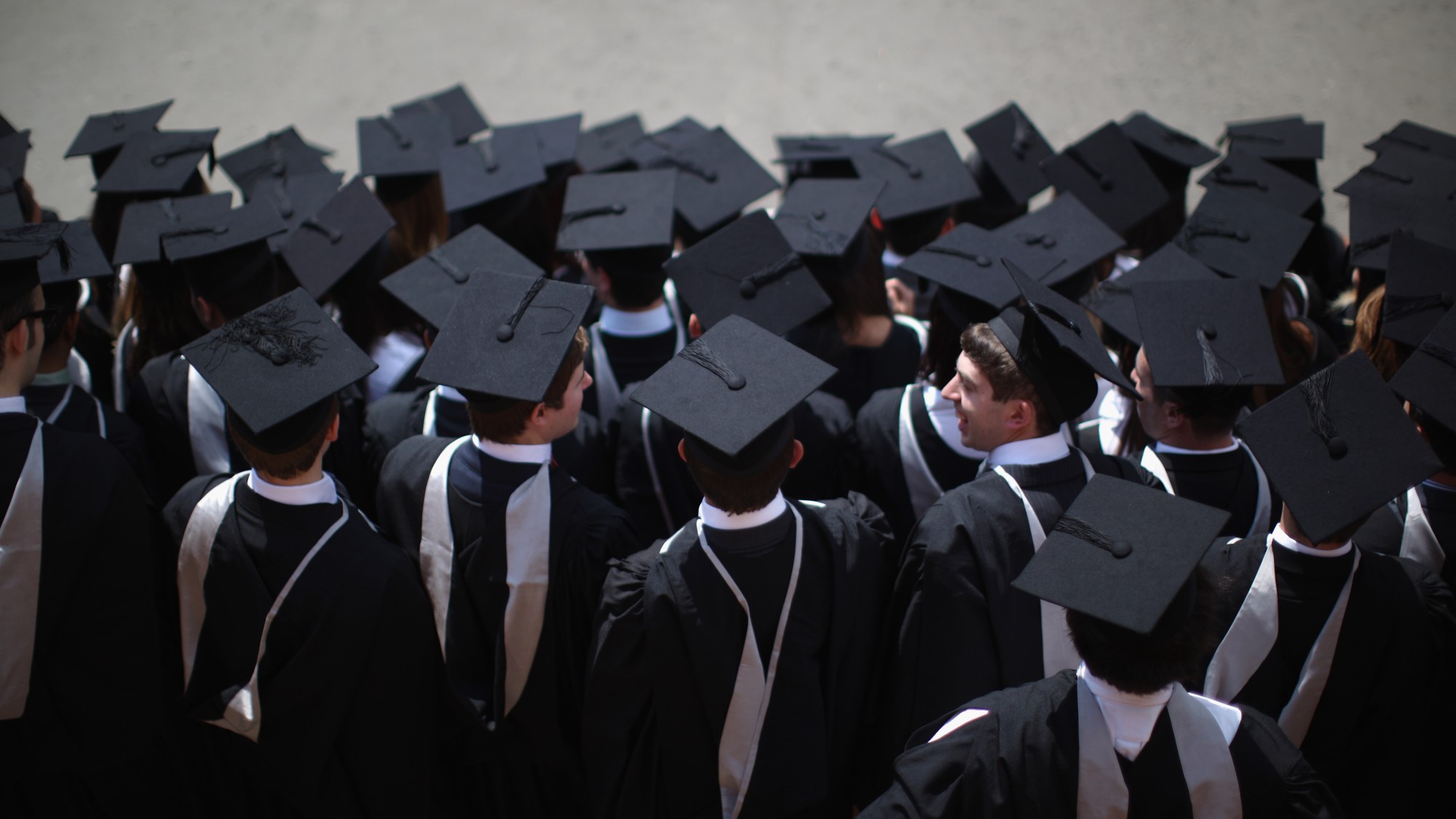
    Millions of graduates have been left with hefty student loans, at high interest rates, and they’re not happy. Is the system unfair?

    Why are people angry?
    Many graduates who took out student loans feel they got “an incomprehensibly unfair deal that they did not understand and now cannot escape”, says John Blake, formerly of the Office for Students. The problems are worst for the estimated 5.8 million people who took out “Plan 2” loans, the main scheme from late 2012 to mid 2023. While the interest rate on other loans is set at the Retail Prices Index (RPI) measure of inflation, Plan 2 loans are charged at RPI plus up to 3%. Then at the last Budget, Rachel Reeves froze the threshold at which repayment in England starts between April 2026 and 2030; it was meant to rise with inflation. This means that more people will have to pay, while interest has snowballed, even for those with hefty monthly repayments. The result is a large cohort of angry indebted graduates.

    How do Plan 2 loans work?
    They were introduced for students in England and Wales in 2012, after the coalition government tripled tuition fees from £3,290 to £9,000 per year (there are no fees for students from Scotland, and they’re capped at about half the rate in Northern Ireland). While studying, each borrower was charged interest at the RPI rate plus 3%. Afterwards, it moved to tiered rates starting at RPI, rising up to RPI+3%, depending on earnings (those making £51,245 or more currently pay the full rate). However, borrowers don’t have to pay anything until they reach the repayment threshold, now set at £28,470. Then they pay back 9% of their earnings above the threshold. After 30 years, any outstanding balance is written off.

    How does this affect people in practice?
    To take one example, Patrick Ba Tin, 30, borrowed some £50,000 in student loans – around average as a total – and was told he would hardly notice the repayments. Now a regulatory analyst earning a decent wage, Ba Tin has paid £5,000 towards his loans since graduating, with the current rate at £300 per month. Even so, the loan is actually growing: he now owes £75,000 in total; he will probably have to keep paying for the full 30 years. Of course this affects his finances, and his ability to buy a home. A typical graduate from the Plan 2 cohort has to earn at least £66,000 a year just to make his or her debt go down. Nadia Whittome, a Labour backbencher, has only managed to pay off £1,000 of her £49,600 debt despite six years on an MP’s salary. And repayments come on top of already high tax rates. So a Plan 2 loan holder earning £51,245 will take home only 49% of their earnings above that.

    How have loans changed since?
    Plan 5 student loans replaced Plan 2 for courses starting in August 2023. These don’t charge interest above the rate of inflation: the rate simply follows the RPI. But borrowers have to start paying them back sooner – the repayment threshold is only £25,000, not far off the minimum wage – and the repayment term is 10 years longer: 40 years. Under this system, in contrast to Plan 2, no one will have to pay back more than they borrowed in real terms, and the Institute for Fiscal Studies estimates that 79% of initial borrowers will repay their loans in full. However, lower earners will pay more and higher earners less than they would have under the previous system. Plan 5 will also be costlier for the taxpayer in the long run.

    Is the system unfair?
    It is harsh for holders of Plan 2 loans. A loan holder who started a course in 2022 will pay around £8,700 more on average than someone who took one out a year later. Tinkering with the repayment threshold, by Conservative and Labour governments, has made repayments unpredictable. The finance guru Martin Lewis has called on Reeves to reconsider her repayment threshold freeze, saying it isn’t “moral” to change the terms of a loan; polls suggest half of Plan 2 loan holders think the product was “missold” to them. The National Union of Students and The Times have also called for an end to the freeze, along with cuts to the Plan 2 interest rate and a cap on the total amount of interest payable. Arguably, the RPI measure shouldn’t be used at all: the government is phasing it out – because it is deemed about 1% too high – in favour of the Consumer Prices Index (CPI). Beyond that, there is the wider issue of inter-generational unfairness. The Plan 2 cohort were the first to be hit with substantial tuition fees, which were not charged at all until 1998. In addition, young people face high property prices, and governments that arguably protect the finances of pensioners at the expense of younger generations. 

    Can Plan 2 loans be defended?
    They are in some respects generous, and more like a graduate tax than a bank loan. They do protect low earners; and during the ultra-high inflation period after Covid, the government intervened to cap interest rates. More broadly, the student loan system reflects important trade-offs. Britain has a mass university system – some 50% of young people in the UK go into higher education – and it has to be paid for somehow. All the main parties in England have decided that those who benefit most directly – well-paid graduates – should bear much of the burden. The costs are considerable: the total outstanding Plan 2 debt is about £200 billion.

    What is likely to happen?
    Reeves has insisted that the student loans system is “fair and reasonable”, and that the freeze was necessary for getting “the balance right between tax and spending”. But sources suggest discussions are taking place about possible measures to make the loans fairer, perhaps by tweaking interest rates. Kemi Badenoch has announced that the Tories would abolish the “unfair” additional interest, at the cost of some £2 billion per year, paid for by cutting funding for “low-quality degrees”. But this – unlike raising the earnings threshold – would only benefit those earning enough to clear the debt within 30 years.

    The solution: a graduate tax?
    The idea of funding universities with a graduate tax has been mooted since the 1960s, when economists pointed out that a relatively small group of people were getting an expensive benefit paid for out of general taxation. The idea came up again during the expansion of higher education in the 1990s, and at one time or another it has been backed by the likes of Gordon Brown and Vince Cable. In practice, the loans function much like a tax – repayments are collected through the tax system – and proponents argue that presenting them with a future tax obligation is less stressful than being saddled with a large debt.

    Implementing a tax would raise major administrative issues, though. There is no register of graduates. And might it incentivise students not to graduate? Or encourage high-earning graduates to move elsewhere? There are already problems in this area: at least 70,000 loan holders living abroad were reported not to be making repayments in 2024. No country in the world imposes a pure graduate tax, though many use income-contingent loans. The UK loans are high, though, since people here contribute more to their education: only 23% of higher education is paid for by public funding in the UK, well below the OECD average of 67%.



    Spirit of the age

    A majority of British parents (64%) support a ban on social media for under-16s, but half say they would ignore it and still allow their children access to social media platforms such as Instagram. The Public First survey also found that 68% thought their children would find ways around a ban.


    VIEWPOINT

    Down with facts

    “There is endless talk about the effects of phone use on the young, but it poses perhaps less obvious threats to my generation. Conversation, in boomer circles, has been profoundly damaged by the relatively recent introduction of facts. In my experience, the best conversations are the ones where no one really knows what they’re talking about. I’ve participated in many debates about, say, football or politics, so gloriously unhindered by evidence, so recklessly inventive, that they constitute a sort of folk art. In the past, knowledgeable people were very thin on the ground, but now the smartphone has given everyone the chance to be a killjoy.”

    Frank Skinner in The Observer


    talking point

    Death in Lyon: the growing violence in French politics

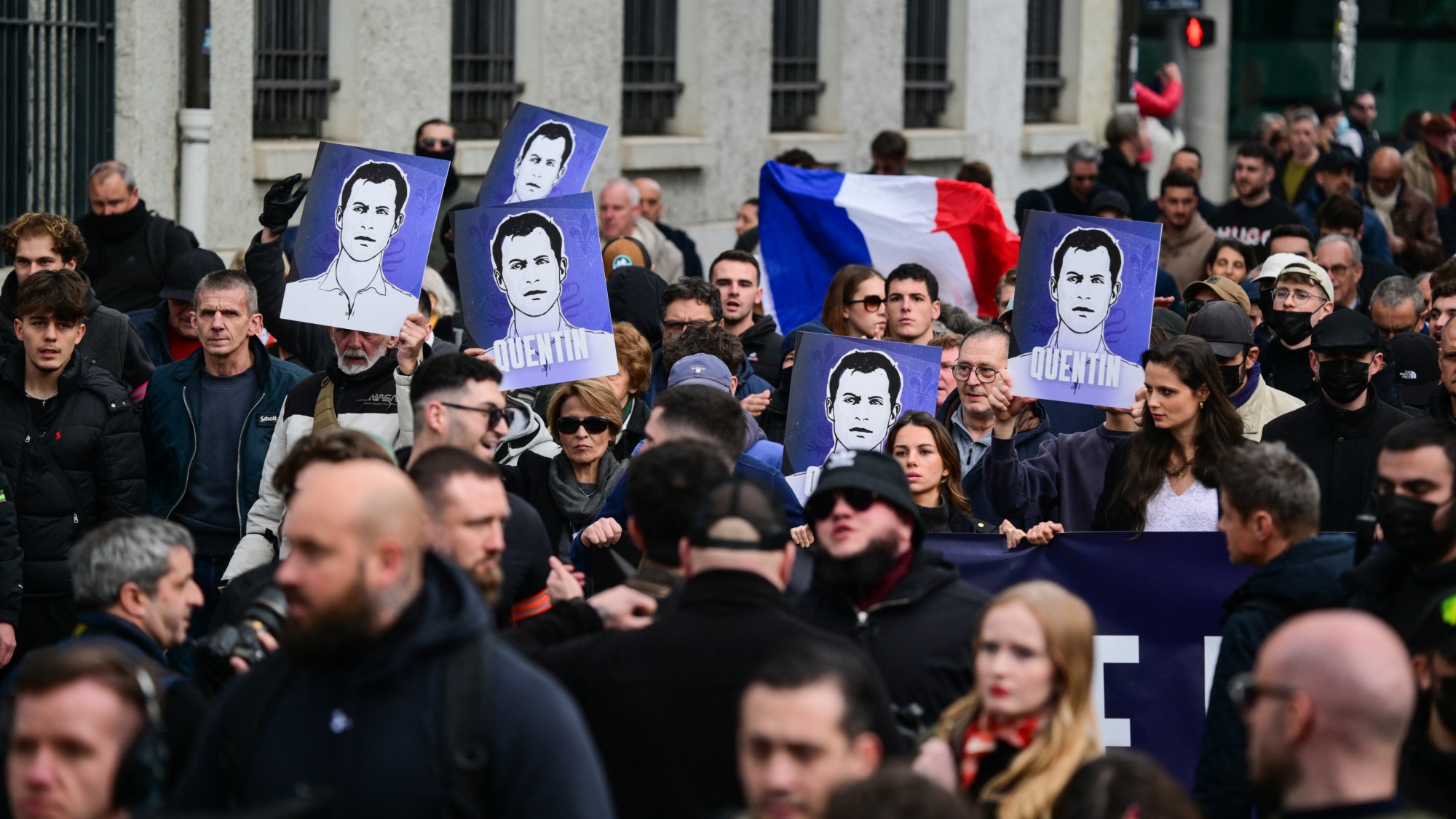
    French politics is starting to give off a “whiff of near civil war”, said Renaud Dély on France Info. On 12 February in Lyon, a far-right activist and devout Catholic called Quentin Deranque was “lynched in the street for his political beliefs by thugs from the far-left”. He died in hospital from head injuries two days later. The 23-year-old data scientist was a member of Audace Lyon, a neo-fascist group that organises “white self-defence” training sessions, and which had offered to provide security to a group of self-proclaimed “feminist nationalists” protesting against the appearance of radical-left MEP Rima Hassan at a university conference. Hassan, well known for her fiercely pro-Palestinian views, is a leading light of France Unbowed (LFI), the party led by Jean-Luc Mélenchon, the candidate who finished third in the 2022 presidential election.

    Most of the 11 people arrested over Deranque’s death had been members of the banned group Young Guard, which has been aligned with LFI, and at least three of whom had reportedly worked for one of its MPs, Raphaël Arnault. Mélenchon insists his party abhors violence, but it now looks as if it will not fare well in next month’s municipal elections. Lyon itself is known as a bastion of the far-right, and a far-right demonstration swept through the city on Saturday. 

    Deranque’s killing did not come as a surprise, said Paul Sugy in Le Figaro. Despite its claims to the contrary, the Left’s “anti-fascist” movement has long endorsed physical violence. For evidence of that you just have to look at the Young Guard, which Arnault co-founded in Lyon in 2018, said Gavin Mortimer in The Spectator. It was ordered to disband last summer by the Council of State for inciting violence, and for offering recruits street-fighting lessons. Given its close ties to this proscribed organisation, Mélenchon’s LFI, already languishing at 10% in the polls before the scandal, is unlikely to recover its reputation.

    What happened in Lyon last week buries for ever the left’s constant claim of moral superiority. The killers of Deranque “did not simply commit murder”, said Le Monde. In mimicking the methods of the “fascists” whom they say they are fighting, “they have sullied progressive and humanist struggles and offered a martyr to their adversaries”. Nevertheless, justified horror at their scandalous violence should not blind us to the unsavoury nature of many of those in the far-right National Rally (RN), now leading in the polls ahead of next year’s presidential election. Some of its supporters wantonly promote violence, and are “implacable enemies of democracy and the Republic”. 

    The right and far-right are “shamefully exploiting” this tragedy, said Anthony Cortes in L’Humanité. By demonising the entire left, figures such as RN president Jordan Bardella hope the electorate will overlook far-right brutality, such as last month’s savage beating near Lyon of a 17-year-old student of Syrian origin. Just as French parties, Mélenchon’s included, have tried to ostracise the RN, so Bardella is now asking other parties to form a united front against LFI. Such “irresponsible political opportunism” in the wake of Deranque’s death may well have fuelled last week’s bomb threat against LFI’s Paris HQ, and attacks against the party’s offices across the country. 

    Politicians and citizens must together do all they can to ensure the situation doesn’t escalate further, said Fabienne Lemahieu in La Croix. Things may be bad, but they’re still a far cry “from the meticulously planned clashes of the 1970s and 1980s between skinheads and antifascists”. Let’s keep things that way by maintaining calm. To that end, LFI must urgently carry out a “genuine internal reassessment”, said Loup Besmond de Senneville in the same paper. It must stop lowering the public discourse by turning everything into a face-off. “The far-right must be fought at the ballot box and through ideas, not by shouting or becoming complicit with those who kill.”


    It wasn’t all bad

    A century on from the death of its architect, and 144 years after its first stone was laid, Barcelona’s soaring Sagrada Família finally reached its maximum height last week, when a crane lifted the upper part of a four-armed cross on to the top of its central tower, The Tower of Jesus Christ. The church, already the world’s tallest, now rises 566ft above the Catalan city. Antoni Gaudí, who died in 1926 after being hit by a tram aged 73, had not expected to see the monument built in his lifetime, and though the exterior now looks quite complete, there is still an estimated decade’s worth of decorative work to do.


    People

    Gisèle Pelicot

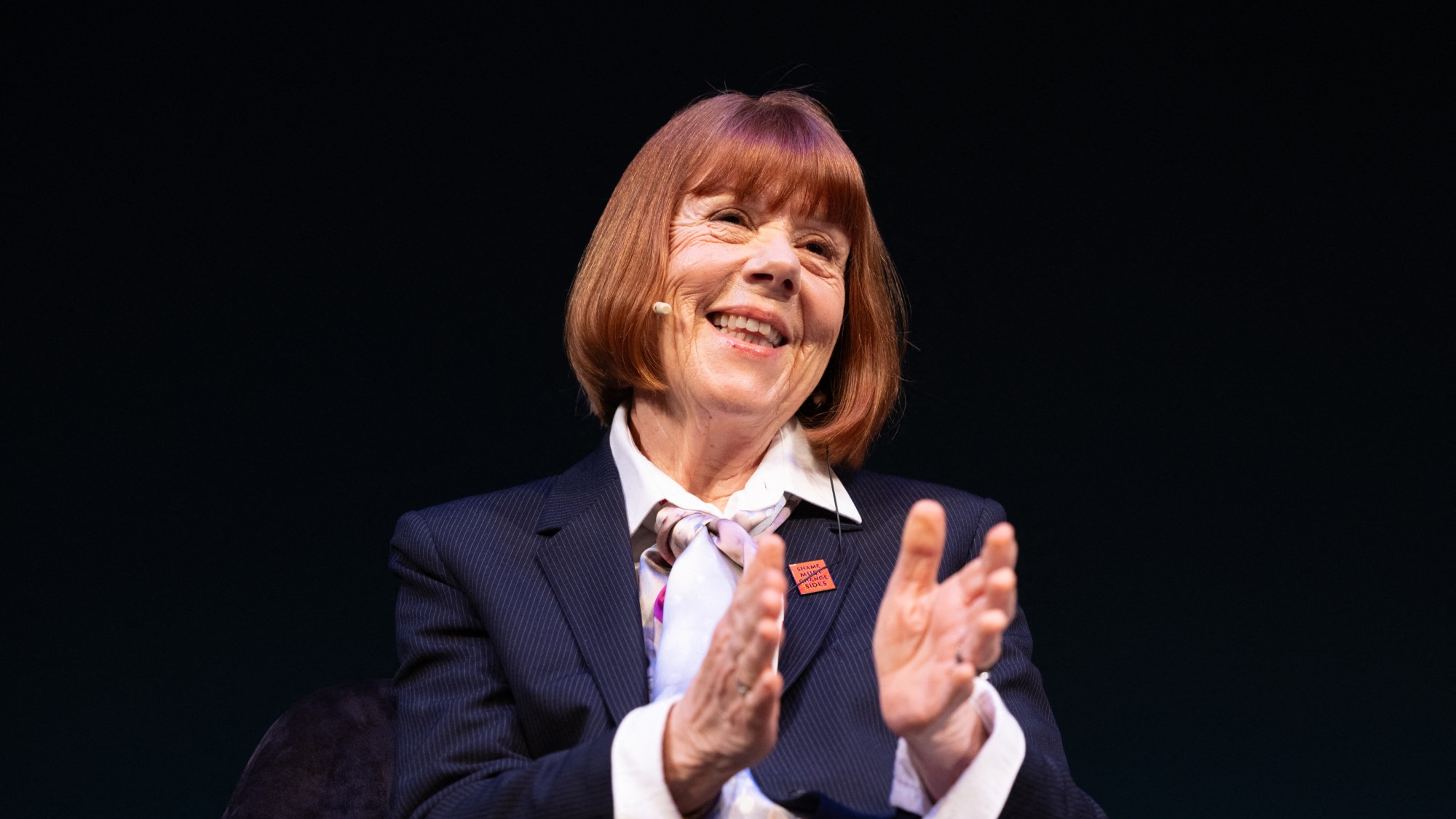
    It is 17 months since Gisèle Pelicot became a household name in the most awful of circumstances. She had waived her right to anonymity during the trial of her husband, Dominique, who, over the course of almost a decade, had repeatedly drugged Gisèle and invited dozens of strangers to rape her in her own home. The case took a terrible toll on her. 

    Yet today, Pelicot, 73, is still able to look back on the first four-fifths of her 50-year marriage with some fondness. “We had a nice life, after all,” she told Gaby Wood in Vogue. “For 40 years, I was married to a good man. Friends would ask me: ‘Doesn’t he have a brother?’ He cooked, he did DIY, he was athletic, he was tidy – he had many good qualities.” Looking back, she believes that her ex-husband, who she now refers to as “Monsieur Pelicot”, had a split personality. “There was an A side and a B side,” she explains. “I never saw the B side. I only discovered it during the trial.” And although she can’t bring herself to forgive him (“Forgiveness is very difficult for me. Impossible even”), she does not see him as a “monster”. “He’s a human being, despite what he has done.” 

    As for her, she says, she has given herself “permission to be happy”. She has a new partner, Jean-Loup, and is keen to “move on”. “I have no regrets,” she says. “When I look at myself in the mirror, I say: ‘We’re OK, you and me. It’s not that bad, after all.’”


    Image credits, from top: Georgios Kostomitsopoulos / NurPhoto / Getty Images; Christopher Furlong / Getty Images; Olivier Chassignole / AFP / Getty Images; Alexandra Beier / AFP / Getty Images
     

    Recent editions

    • Morning Report

      ICE and Columbia tangle over student arrest

    • Evening Review

      Trump’s Epstein allegations

    • Morning Report

      US and Cuba clash over speedboat shootout

    VIEW ALL
    TheWeek
    • About Us
    • Contact Future's experts
    • Terms and Conditions
    • Privacy Policy
    • Cookie Policy
    • Advertise With Us
    • FAQ
    Add as a preferred source on Google

    The Week is part of Future US Inc, an international media group and leading digital publisher. Visit our corporate site.

    © Future US, Inc. Full 7th Floor, 130 West 42nd Street, New York, NY 10036.