US ethics watchdogs argue that no other president has exploited his position for gain as extensively as Donald Trump
What sort of figures are involved?
Being a “dealmaker” has always been part of Donald Trump’s brand, and he was never shy about, as Forbes puts it, “leveraging the presidency for profit”: the non-profit group Citizens for Ethics identified 3,737 conflicts of interest during his first presidential term. His second term, though, has been on quite a different scale. According to an analysis by The New Yorker’s David Kirkpatrick, Trump and his family had made $4 billion out of the presidency by January this year – boosting his net worth by 40% since his re-election. Forbes suggests that he personally has made $2.6 billion since his inauguration, taking his net worth to $6.5 billion.
The lines between Trump family businesses and government power have now been comprehensively blurred. “The law’s totally on my side; the president can’t have a conflict of interest,” Trump said in 2016; and he has acted accordingly.
How has he been able to do this?
Trump, unlike his predecessors, has always refused to disentangle himself from his financial interests or to release all his tax returns. But his financial norm-breaking during his first term was relatively cautious: charging the Secret Service full rates at his Florida resort or encouraging supplicants to stay at his Washington hotel.
In January, he told The New York Times he had restrained his family’s business activities during his first term. “I got absolutely no credit for it,” he said. “I found out that nobody cared, and I’m allowed to [do business in office].”
In practice, he is. After being sworn in, Trump fired the director of the Office of Government Ethics, a post-Watergate institution that’s meant to prevent financial conflicts of interest. He hasn’t appointed a new one.
How has he made money?
While Trump was out of office, his family businesses diversified beyond property and brand licensing to include a publicly traded social media company, Truth Social, and a crypto venture, World Liberty Financial (WLF). Launched three days before his second inauguration, his personal crypto token, “$Trump”, soared in value to $73, before going into decline (it’s now worth $1.68). Investors lost around $2 billion, but Trump’s businesses and partners have made more than $320 million in trading fees. All his crypto ventures soared after his election, clearly in part because of his political influence. Two Abu Dhabi companies invested $500 million in WLF and bought $2 billion of its stablecoin; weeks later, the Trump administration authorised the sale of previously restricted AI chips to the UAE. The Financial Times found that by October 2025, Trump-affiliated crypto ventures had made more than $1 billion in profits.
What about the old businesses?
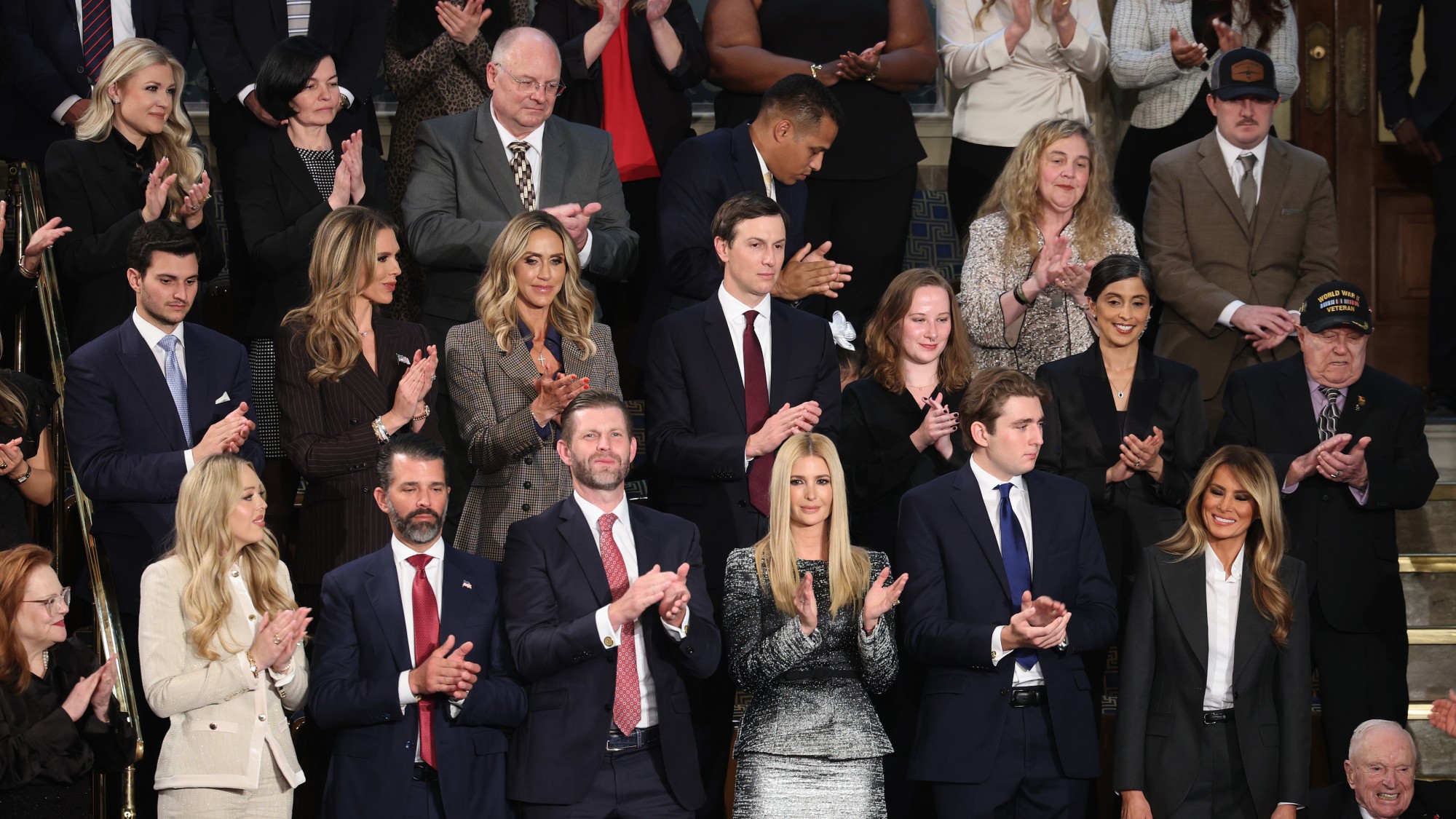
Under the nominal leadership of the president’s eldest sons, Donald Jr and Eric, the Trump Organization has negotiated real-estate deals in Qatar, Saudi Arabia, Oman, the UAE, Vietnam and Serbia, which are set to double the size of its foreign business. At the same time, the Trump administration has been negotiating trade tariffs and sensitive defence arrangements with these nations.
Trump announced that the G20 summit in December will be held at his own resort, Trump National Doral Miami, in Florida. And – very unusually – the Trump Organization has continued to trade vigorously in stocks and shares. In February, for example, Trump’s money managers bought at least $1 million in Dell stock. Trump started praising the company publicly nine days later; in May, a $9.7 bllion Pentagon contract sent Dell’s share price through the roof.
Any other money-spinners?
Many. A series of Trump-linked felons have been pardoned. Changpeng Zhao, a crypto billionaire convicted of violating money laundering laws, was pardoned after reportedly brokering a $2 billion investment involving WLF’s stablecoin. Paul Walczak, a care-home executive convicted for a $7 million tax fraud, received a presidential pardon after his mother attended a $1 million-a-head dinner with Trump. Trump’s fundraising vehicle, Maga Inc, a loosely regulated “political action committee”, is still open, though he can’t constitutionally stand for election again; it has raised over $340 million since the last election.
There’s also an opaque donor fund for Trump’s new White House ballroom; Public Citizen, a non-profit, reports that donors to it have won more than $50 billion in federal contracts in six months. There’s another fund, for his presidential library foundation in Miami – which Trump says will be “a hotel”. It will also receive the $400 million Boeing 747 he accepted from Qatar last year; and $63 million pledged from legal settlements.
What legal settlements?
Trump has launched a range of lawsuits against big companies. They have often chosen to settle, arguably for political reasons. Meta, for instance, pledged $22 million to his library in a case over the suspension of his account following the Capitol riots. Paramount, while seeking White House approval for its merger with Warner Bros., paid $16 million to settle an apparently frivolous case over coverage of Trump by its news subsidiary CBS. Trump has even sued government bodies that he himself controls, and then negotiated settlements at the taxpayers’ expense.
In May, the Internal Revenue Service and the Justice Department announced a “settlement” that gave Trump immunity from all tax claims against him, and also established a $1.8 billion fund to compensate citizens “victimised” by the Biden administration. The fund, however, proved too much for Republicans; and a court ordered it to be halted.
What can be done?
Trump is right, in a sense, that he is allowed to do this: federal laws banning officials from having financial interests affected by government policy do not apply to the president, because he is not an employee. In theory, the constitution forbids the president from receiving “emoluments” (benefits beyond his salary). But Congress dictates how this clause operates, so it is essentially a political question. Democrats are treating it as such, and intend to make presidential corruption a major theme of the midterm elections.
Moving markets
Since 1963, US presidents have tried to insulate themselves from financial impropriety by putting their assets in blind trusts, meaning that they don’t know where their money is invested. Trump has taken a different approach.
A recent ethics filing shows that the Trump Organization executed 3,700 trades in the first quarter of 2026. Trump himself signed the filing – suggesting there’s no blind trust. The filing (which gives ranges rather than precise numbers) shows a $0.5 million-$1 million purchase of Nvidia stock a week before the Commerce Department gave the company permission to sell chips to China; a $65,000-$150,000 investment in Palantir days before the announcement of a billion-dollar contract with the Department of Homeland Security.
It also shows a $1 million-$5 million investment in Boeing, for which he helped to negotiate a massive export deal to China. Also of concern are a series of oil futures trades this year that closely anticipated major, market-moving Iran policy announcements by Trump. The White House denies any wrongdoing.