In what promises to be a closely fought general election on 27 October, Benjamin Netanyahu could finally lose his grip on power
Why is this election so important?
The consensus is that Israel’s forthcoming election is one of the most consequential in the country’s 78-year history, and a defining moment for its political identity. It is the first since the 7 October attacks three years ago; and the first time voters have had a chance to pass judgement on the government’s failure to prevent that catastrophe, and on Israel’s prosecution of its subsequent wars on Gaza, Lebanon and Iran.
It could herald a reset in relations between Israel and its international allies, many of whom have been critical of Benjamin Netanyahu’s hardline government, particularly over Gaza. Above all, the election could herald the political demise of Netanyahu, Israel’s longest-serving PM, who has led the nation for all but 18 months since 2009.
What is the current make-up of Israel’s parliament?
The ruling party needs a majority of at least 61 seats out of 120 in the Knesset. Because of its proportional representation system – voters cast one vote for a national party-list – even the largest parties rarely win more than 35 seats, and Israel has always had coalition governments. At present, Netanyahu’s right-wing Likud has 32 seats. To govern, it relies on two ultra-orthodox Haredi parties, Shas and United Torah Judaism (with 18 seats together), the ultra-nationalist Religious Zionist and Otzma Yehudit (Jewish Power) parties (with 13 seats between them), and the centre-right New Hope party (with four seats).
The government is widely regarded as the most extreme Israel has ever had. The main opposition bloc – ranging from the remnants of the once-mighty Labor Party to secular, liberal Yesh Atid to the centre-right Yisrael Beiteinu – has more than 40 seats, but has refused to govern with Netanyahu since 2019, partly because he was the defendant in three corruption cases. Hadash-Ta’al and Ra’am, representing the 20% of Israel’s population that is Arab, have 10 seats.
And how likely is Netanyahu to lose?
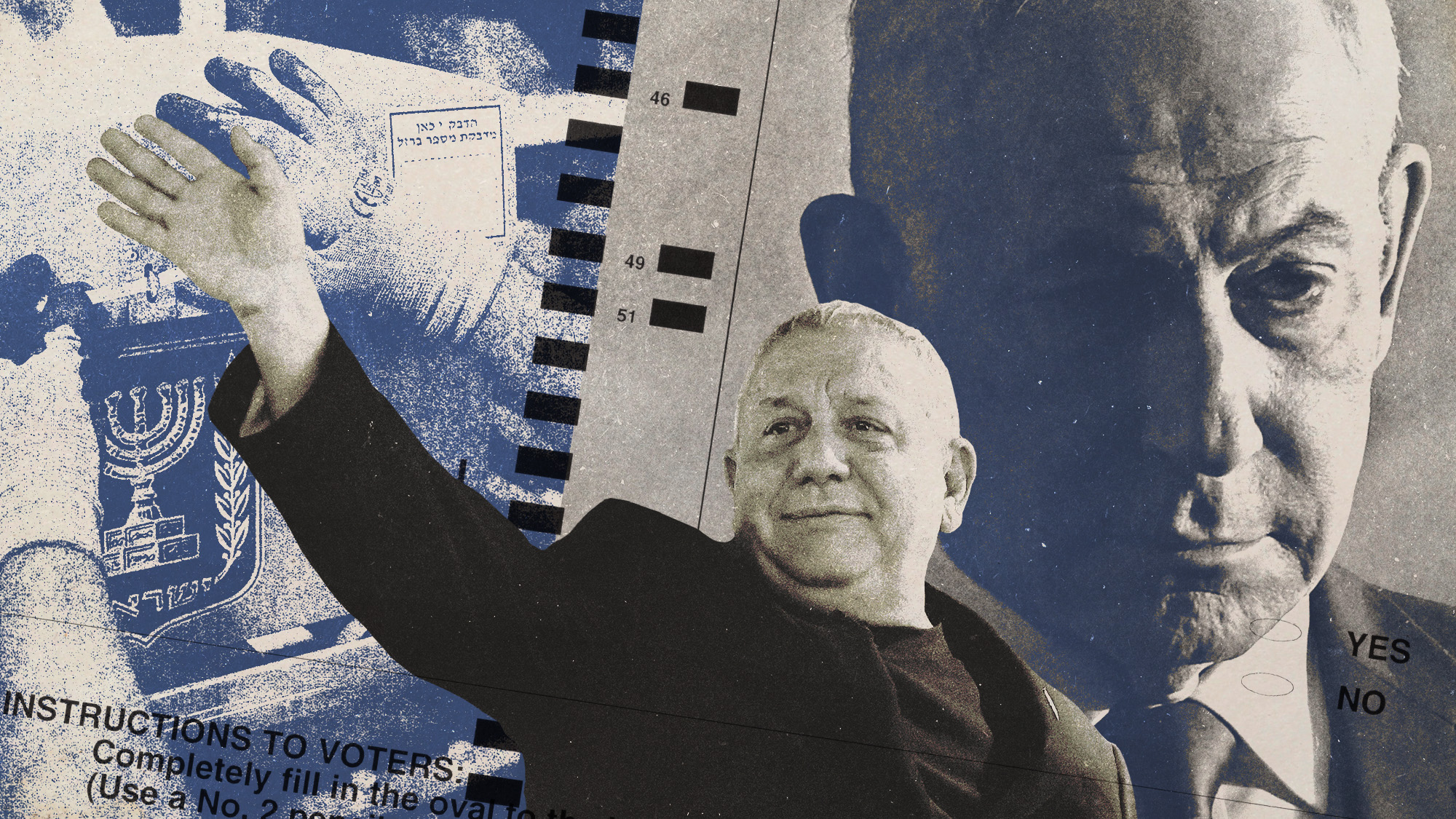
The emergence of Gadi Eisenkot, a former general, and his newly formed centre-right Yashar party, has consolidated the anti-Netanyahu opposition. He is seen as the PM’s principal rival, and could replace him. However, according to most opinion polls, the election is too close to call. The Economist’s poll tracker suggests that Likud and Yashar are neck-and-neck, on 22 seats each; that Netanyahu’s coalition will fall short of the 61 seats needed for a majority; but that Eisenkot’s coalition is likely to fall short too.
What are Eisenkot’s credentials?
A former IDF chief of staff, Eisenkot served in Netanyahu’s war cabinet until June 2024, when he resigned with a scathing criticism of the PM’s revanchist strategy in Gaza. He launched his party, Yashar (meaning “straight” or “honest”) just over a year later; since then, it has steadily risen in the polls. Although without Netanyahu’s charisma, Eisenkot, the son of Jewish immigrants from Morocco, is widely regarded by voters as a man of integrity. His son, Gal Meir, was killed in Gaza in December 2023, during an operation to recover the bodies of two Israeli hostages.
Netanyahu’s allies have sought, somewhat unconvincingly, to cast him as too left-wing and squeamish to protect Israel’s security. In fact, as a general, he pioneered Israel’s “Dahiya doctrine”, named after Hezbollah’s stronghold in south Beirut, which calls for the overwhelming use of force against civilian infrastructure in areas from which attacks are launched; he also categorically opposes the creation of a Palestinian state.
Are there other contenders?
Conceivably, there is Naftali Bennett, who served as PM in 2021/22 but could not keep his diverse coalition together. Another right-winger, and a former Netanyahu aide, he has merged his party with that of the centrist Yair Lapid, another former PM, under the banner “Yachad” (“Together”); but their party lags well behind leaders Yashar and Likud in the polls. Bennett also rejects a two-state solution. Lapid accepts it in theory, but thinks that it is not realistic for the foreseeable future.
How about the Arab parties?
They are on course to win at least 10 seats in the Knesset. However, Eisenkot has ruled out a coalition with the Arab parties, only one of which (the conservative-Islamist Ra’am) has ever agreed to join an Israeli government (briefly in 2021). Their very participation has been the subject of controversy: on 2 October, Israel’s supreme court overturned a ban on them running in the contest at all. The ban had been imposed by the central elections committee, a political body dominated by Netanyahu allies, on the basis that the parties supported armed struggle against Israel.
So what would the opposition do differently?
In many respects, not much: the Israeli journalist Nadav Eyal has described Israeli politics as “50 shades of right-wing”. However, an Eisenkot coalition would establish a commission of inquiry into the 7 October attacks. It would seek to end the exemption of Haredi men from military service, an agreement dating back to 1948 that has become very controversial. It would roll back many of the judicial reforms introduced by Netanyahu, designed to give more control over the judiciary. It would also crack down on violent Israeli settlers in the West Bank – though it would retain settlements authorised in Israeli law. And it would try to reset troubled relations with Israel’s allies.
And if Netanyahu wins again?
It would mean more of the same. Many liberal Israelis fear that a new Netanyahu coalition, again likely backed by the far-right, would take the state in an increasingly autocratic direction: comparisons to Hungary and Turkey are often made. For the first time in Israeli history, emigration has begun to outpace immigration: in the period 2023-26, more than 200,000 Israelis left the country.