The Week The Week
flag of US
US
flag of UK
UK
https://cdn.mos.cms.futurecdn.net/flexiimages/jacafc5zvs1692883516.jpg

SUBSCRIBE & SAVE

Less than $3 per week

Sign in
  • View Profile
  • Sign out
  • The Explainer
  • The Week Recommends
  • Newsletters
  • Cartoons
  • From the Magazine
  • The Week Junior
  • Student Offers
  • More
    • Politics
    • World News
    • Business
    • Health
    • Science
    • Food & Drink
    • Travel
    • Culture
    • History
    • Personal Finance
    • Puzzles
    • Photos
    • The Blend
    • All Categories
  • Newsletter sign up Newsletter
  • Sunday Shortlist, from The Week
    ‘Tremendous’ adaptations, and a ‘crushingly sad’ book

     
    THEATRE REVIEW

    A Christmas Carol (or two)

    Delightful retellings of the Dickens classic from around the country

    As often happens at this time of year, “A Christmas Carol” has lately been “outdoing London buses”, said Ron Simpson on WhatsOnStage – with several great productions coming along at the same time. There are two in Yorkshire alone. At Leeds Playhouse (until 17 January), director Amy Leach has revived Deborah McAndrew’s vivid and assured adaptation, first staged in Hull eight years ago. Back then, the setting was the Humber docks, where Ebenezer Scrooge worked as a trader and manufacturer.

    For Leeds, Dickens’ old miser has been turned into a West Riding factory boss – once again rooting the story in 19th-century industry – and “it works perfectly”. There’s a brass band, carols (of course), and leading the large cast of actors and musicians is Reece Dinsdale, who delivers a “tour de force” central performance. It’s a “wonderfully designed” and handsome show, said Matt Barton in The Stage, with a superb set that fills the stage with fiery factory chimneys.

    The trick for any new version of this festive favourite is to “present it with the vitality that Dickens intended”, rather than with “deadening reverence”, said Mark Brown in The Telegraph. At Sheffield Crucible (until 10 January) adapter Aisha Khan and director Elin Schofield have done just that, to produce a “moving and ultimately joyous adaptation”. The show bristles with creative innovations, most notably the singing of traditional carols that are unique to Sheffield and South Yorkshire. “One can’t help but think that Dickens – whose readings took him to locations across Britain – would have approved of such a charming way of giving his story a local resonance.” The energetic and multitasking cast is impressive across the board. Ian Midlane delivers a self-doubting Scrooge, and brilliantly conveys the “ferocity of his breakdown and the giddy joy of his redemption”, said Ron Simpson on WhatsOnStage.

    In London, Mark Gatiss’ highly praised, spooky and spine-tingling adaptation has returned to the Alexandra Palace Theatre for the third year running (until 4 January). This year it stars Neil Morrissey as Marley’s ghost and Matthew Cottle as Scrooge. On the other side of the Thames, the Old Vic’s “carol-singing, deluxe mince pie” of “A Christmas Carol” (until 10 January) makes its north London rival look like a newcomer, as it is now in its ninth year, said Dominic Maxwell in The Times. Paul Hilton is not as famous as some of the actors who’ve played Scrooge at this theatre – but he delivers one of the best performances to date, bringing an edgy, “off-kilter charisma” to the role. The Old Vic’s has always been a traditional, comfort-and-joy-filled production, and it still makes for a “tremendous” evening.


    EXHIBITION REVIEW

    Turner Prize 2025

    Work by the four artists nominated for this year’s award is on display at Bradford’s Cartwright Hall 

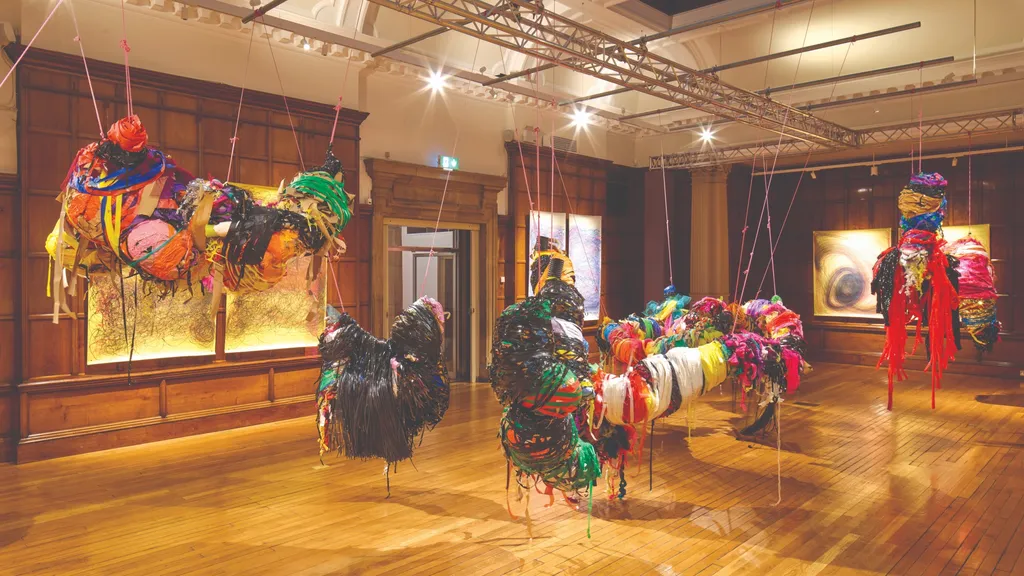
    The Turner Prize is “the cockroach of art”, said Waldemar Januszczak in The Sunday Times. Established some 40 years ago, it has proved remarkably resilient: “however bad it gets, it survives the hammering and comes back for more”. This year’s iteration takes place at Bradford’s Cartwright Hall, and sees the award “up to its usual cultural nonsenses”. As ever, four artists from (or based in) the UK have been shortlisted: there’s the photographer Rene Matic, aged just 28; the Korean-Canadian multimedia artist Zadie Xa; the Iraqi-born painter Mohammed Sami; and Nnena Kalu, this year’s winner – a learning-disabled Scottish artist with severe autism.

    Each gets a room in the gallery to present an emblematic selection of their work, the first of which comes courtesy of Matic. Mixed race, queer and non-binary, Matic “complains continuously of feeling culturally divided”. Their room contains a lot of empty sloganeering and a display of “wonky” photos of pro-Palestinian demonstrations, gay marches and right-on graffiti. Whatever you feel about those causes, Matic doesn’t transform them “into good art”.

    The artists in this year’s show certainly “know how to make a physical impact”, said Mark Hudson in The Independent. A case in point is Xa, whose room feels “more like some psychedelic nightclub than an art display”, with a mirrored golden floor and soundscapes emanating from shells and tinkling bells. Amid all this are her paintings, “hallucinatory compositions” that channel the shamanic traditions of her Korean heritage. In this vivid context, sadly, they look like “pieces of decorative scene-setting”.

    Sami’s much more traditional paintings, meanwhile, evoke the “traumas” of Iraqi history without resorting to the clichés of reportage. They’re eerie things: one “vast” canvas gives us “a blasted palm forest” through “a fog of orange dust”, a human presence hinted at by the green lines of military lasers. The mood is “‘Apocalypse Now’ via computer games, with a touch of Monet”. It is so thrilling that it makes the other artists feel “a shade superficial”.

    Sami should have won the prize, said Alastair Sooke in The Telegraph. His “haunting” contemporary history paintings are like “half-remembered nightmares” of Iraq’s recent conflicts. They stand head and shoulders above Kalu’s efforts: namely, a number of “cocoon-like” abstract cultures hewn from materials such as fabric and VHS tape. They have “a festive, exuberant quality”, but there’s not much more to them. Her win is a milestone for disabled people, but a “maddening” decision nonetheless. Is the Turner, in the end, “about recognising artistic excellence or not”?

    Comparisons between Kalu and the others “are not much help”, said Adrian Searle in The Guardian. She has limited verbal communication; her works suggest “a constant flux between objects and space, herself and others”. Each sculpture is born of “drive and urgency and intent”; they are “so full of life and energy, you think they might burst”. She is a worthy winner.

    Cartwright Hall Art Gallery, Bradford. Until 22 February


    BOOK OF THE WEEK

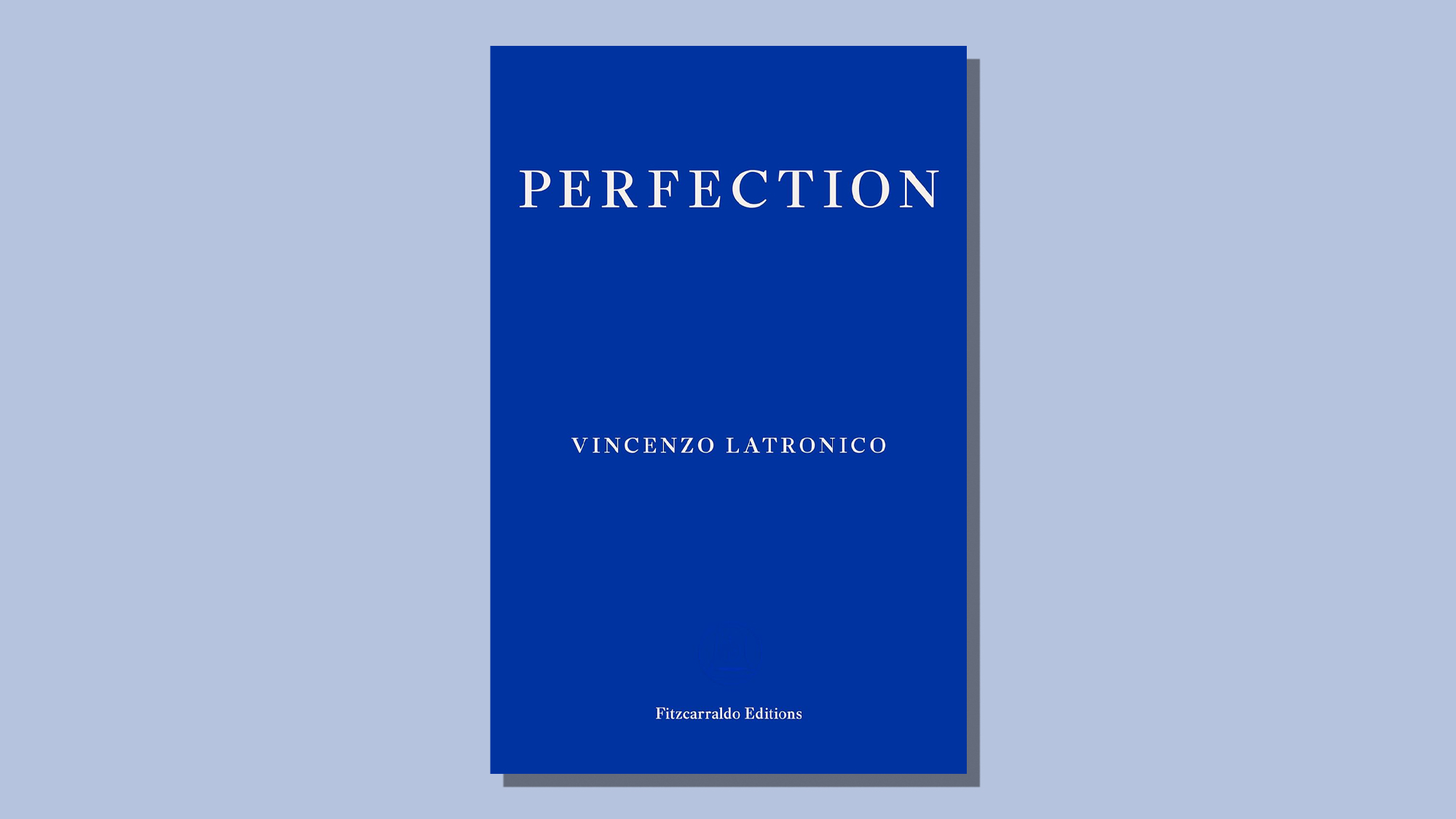
    Perfection 

    by Vincenzo Latronico 

    This short novel by Italian writer Vincenzo Latronico is inspired by Georges Perec’s 1965 debut, “Things” – which chronicled the lives of two market researchers through the objects they own. In Latronico’s updated version, Anna and Tom are a pair of freelance digital creatives living in Berlin in the 2010s. Striving for a “rarefied” existence, they define themselves through their taste: owning the right objects, going to the right restaurants, obsessively curating their lives online. “A crushingly sad indictment of a rootless generation – digital nomads wandering through a generic Europe ... it is funnier and far more moving than a book about the woes of late capitalism ought to be”, said Daniel Swift in The Spectator. 


    OBITUARY

    Frank Gehry   

    The “starchitect” responsible for the Guggenheim Bilbao

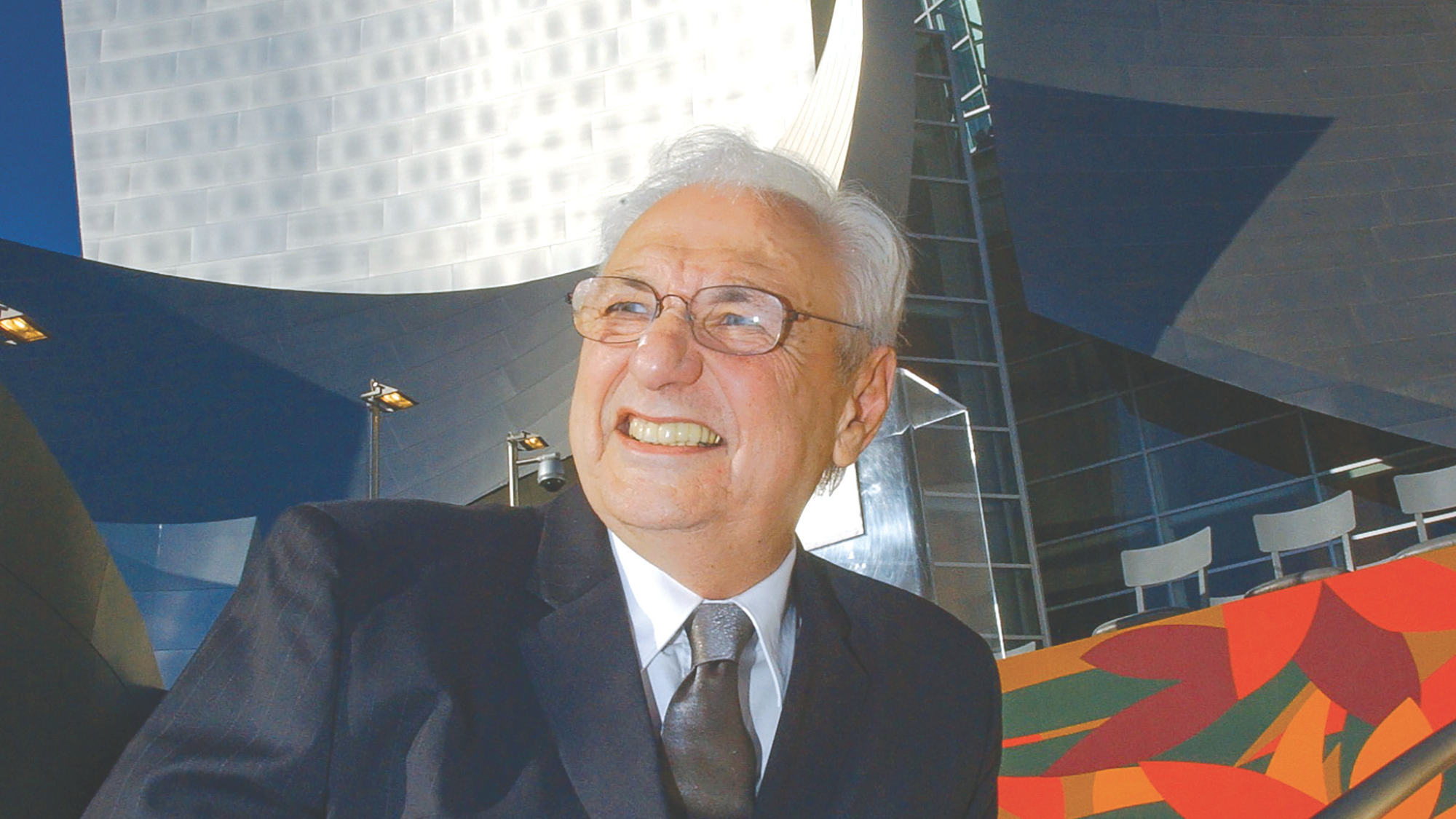
    Frank Gehry, who has died aged 96, was one of the 20th century’s most influential architects. In a globe-trotting career spent defying the constraints of modernism, with its clean, straight lines, he produced a series of bold, exuberant designs that were expressive, fluid and sculptural. With unmissable “wow factor”, these became instant landmarks, said The Times. The most famous, the Guggenheim in Bilbao, helped to revitalise a whole city, and cemented his reputation as one of the modern era’s first “starchitects”. Gehry disliked the term, and was dismayed by the idea that he was creating a spectacle, said the Financial Times. He took pride in being a practical architect, not a “fey dreamer”. Yet he did regard himself as an artist, and did not deny seeking to make an impact. “I want buildings that have passion in them,” he said in 1997, “that make people feel something – even if they get mad at them.”

    Frank Owen Goldberg was born into a working-class Jewish family in Toronto in 1929, said The New York Times. As a child, he enjoyed building miniature cities out of the scraps in his grandfather’s hardware store; the recurring fish motif in his work has been ascribed to his memories of the carp his grandmother kept in the bath, to make gefilte fish. In 1947, the family moved to Los Angeles, for his father’s health. After taking a series of manual jobs, Frank enrolled first in art classes, and later in an architecture course at the University of Southern California. He changed his surname in the 1950s, at the behest of his first wife, Anita Snyder, to protect their children from antisemitic bullying.

    While working for a firm known for designing early shopping malls, Gehry began mixing with notable West Coast artists. Before long, he’d launched his own practice, and taken “a position outside normal architecture”, said The Guardian. He made his first truly avant-garde statement in 1978, when he transformed his bungalow in Santa Monica by adding to it layers of corrugated metal, plywood, and chain-link fencing. His neighbours hated it, but the leading architect Philip Johnson hailed it as “the freshest creation in architecture”, and it led to him being regarded as a pioneer of deconstructivism.

    As Gehry’s reputation grew, his style evolved to “folding, twisting and slanting forms”, said The Washington Post – which were facilitated by his use of CATIA, software designed for the aerospace industry that he’d adapted to make complex calculations about structural loads and stresses in buildings. This enabled him to indulge in “whimsical experiments” such as the Dancing House in Prague – his 1996 collaboration with Vlado Milunic nicknamed “Fred and Ginger”. It also informed the Guggenheim Bilbao – a riot of sinuous, twisting forms clad in 33,000 titanium panels which turned the rundown port city into a major tourist destination. Its success enabled him to complete his “audaciously curvilinear” Walt Disney Concert Hall in LA, which had been delayed by financial problems. By 2005 he was so famous, he was invited to appear as himself in “The Simpsons”. He receives a letter from Marge asking him to design a concert hall for Springfield. In disgust, he scrunches the paper up, throws it on the ground – and is so inspired by the shape it forms, he accepts the commission.

    Gehry was sometimes accused of spreading himself too thin. His planned Guggenheim Abu Dhabi was commissioned nearly 20 years ago, and has still not opened. Yet he never stopped working, said The Wall Street Journal – and insisted that he’d never stop pushing at the boundaries. “I cannot face my children if I tell them I have no more ideas,” he said in 2015. “It is like giving up and telling them there is no future for them.”

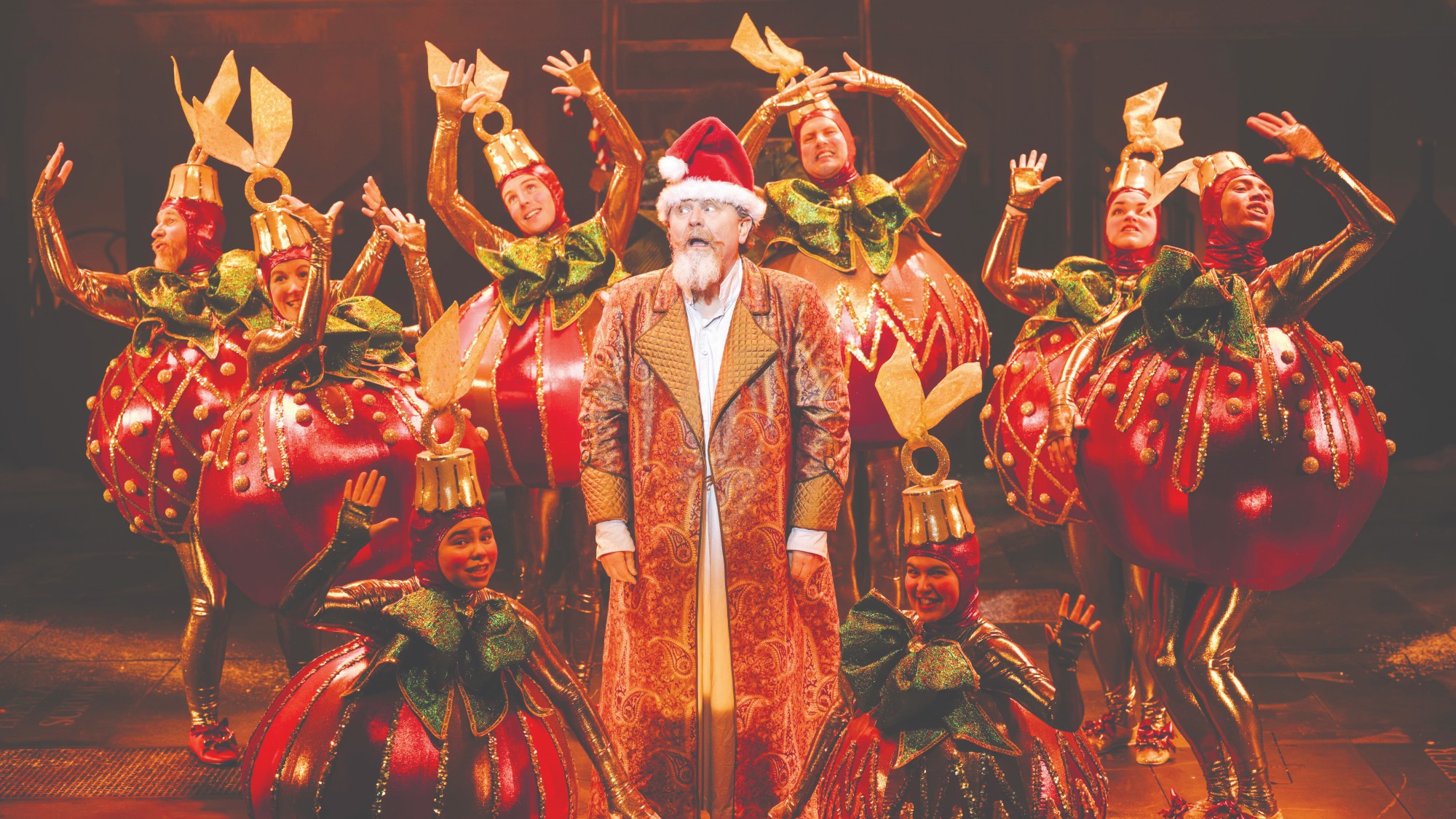


    Image credits, from top: Charlie Swinbourne; David Levene; Fitzcarraldo Editions; Bob Riha Jr / Getty
     

    Recent editions

    • Evening Review

      What reclassifying marijuana means

    • Morning Report

      Brown, MIT murder cases end with dead suspect

    • Evening Review

      Trump takes a ‘sledgehammer’ to climate research

    VIEW ALL
    TheWeek
    • About Us
    • Contact Future's experts
    • Terms and Conditions
    • Privacy Policy
    • Cookie Policy
    • Advertise With Us
    • FAQ
    Add as a preferred source on Google

    The Week is part of Future US Inc, an international media group and leading digital publisher. Visit our corporate site.

    © Future US, Inc. Full 7th Floor, 130 West 42nd Street, New York, NY 10036.