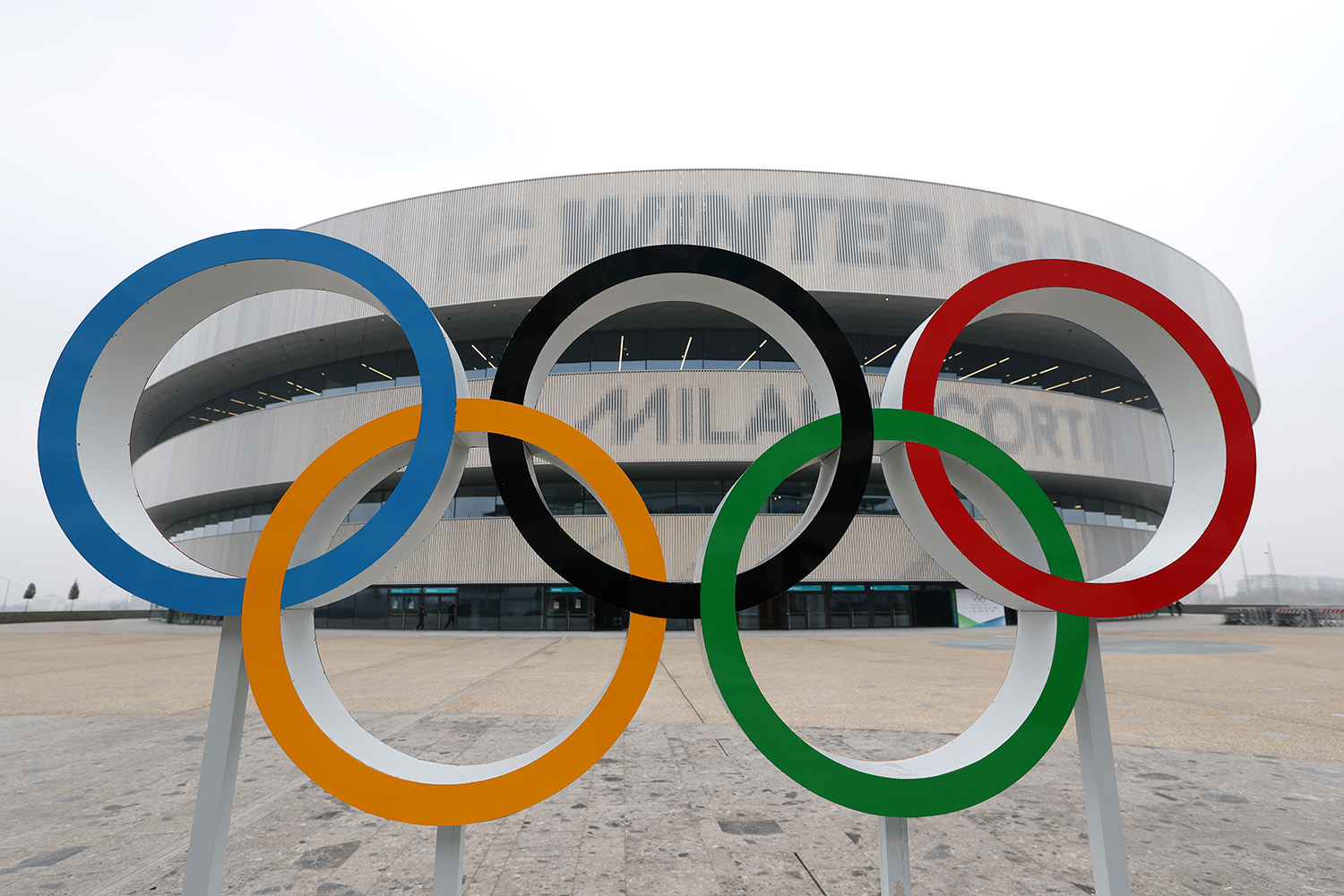
The Milan-Cortina Winter Olympics kicked off this week. Will Italy regret playing host?
Was Italy ready for the Games?
Not entirely. But the Winter Olympics are now underway, and over the next two weeks, more than 3,500 athletes from 93 countries will compete across 16 sports, ranging from alpine skiing to luge to figure skating. These Olympics are the most geographically spread out of any Games in history, with 25 sporting venues and six Olympic Villages spanning some 8,495 square miles in Northern Italy. The two main hubs, the city of Milan and the alpine resort of Cortina d’Ampezzo, sit 250 miles apart. Construction delays and cost overruns have plagued the Games. Days before the opening ceremony, work was still ongoing at the Santagiulia arena, a new $292 million ice hockey venue in Milan; it was originally budgeted at $210 million. Some locals have been angered by the event’s environmental cost. Cortina Mayor Gianluca Lorenzi received death threats after centuries-old trees were felled to make way for a $131 million bobsledding track. Lorenzi insists that “the project is an added value for Cortina.” But history shows that the Olympics often leave behind a legacy of debt, white elephants, and bitterness.
How much did these Games cost?
The Milan-Cortina Olympics have an operating budget of about $1.9 billion—which is largely covered by broadcasting and sponsorship deals, and sales of tickets and merchandise. But that budget does not include capital costs, including the construction of new Olympic venues or improvements to rail and road systems. The Italian government allocated about $4.2 billion in public money for infrastructure spending. The International Olympic Committee argues that the Games pay for themselves by raising a city’s profile and attracting tourists, and some reports suggest Milan-Cortina could deliver a $6 billion economic boost. But most host cities do not see a positive return on investment: Beijing spent $40 billion on the 2008 Summer Games and generated only $3.6 billion in revenue, while London 2012 spent $18 billion and generated $5.2 billion. “For many cities and many countries,” said sports economist Robert Baade, the Olympics are “a money-hemorrhaging endeavor.”
Why are the Games so expensive?
It’s partly because they’ve expanded to allow more events, more athletes, more venues, and more spectators. But it’s also due to each host city wanting their Games to be more impressive than the predecessor’s. One-upmanship, extravagant architectural plans, and a comparatively short construction schedule result in big bills, which are often not reflected in the original bids. An Oxford University study found that from 1960 to 2016, host cities went over budget by an average of 156%. For some Games, the cost overrun was far higher: The 2014 Winter Games in Sochi cost Russia at least $30 billion, 289% more than was expected at the time of bidding. And the 1976 Games in Montreal went 720% over projections, leaving the city with a $1.5 billion debt that took almost three decades to pay off.
“There’s this kind of relentless underestimation of costs,” said sports historian David Goldblatt, “because if anyone knew the real bill at the beginning they would never sign up.” Only one host city has turned a profit in recent decades: Los Angeles. It was the sole bidder for the 1984 Games after the Montreal debacle, and insisted that most events be held in existing facilities. L.A. ended up with a surplus of over $200 million on revenues of $619 million.
What happens to new infrastructure?
Ideally, arenas and other facilities get repurposed when the athletes go home. A 2022 IOC report claims that 85% of venues built for past Olympics remain in use: Rome’s Olympic Stadium, built for the 1960 Games, is now home to soccer clubs Roma and Lazio, and the colossal National Aquatics Center used in Beijing 2008 is today a popular water park. But many facilities fall into disrepair, because they are too expensive to repurpose or are simply not needed. A $38 million aquatics stadium in Rio de Janeiro was left to crumble after the 2016 Games, while Athens is littered with decaying stadiums and pools from the 2004 Games. “We’ve got the ruins of ancient Olympia in Greece,” said historian Miles Osgood, “but now we’ve got the ruins of modern Olympia.”
Is there a more sustainable way?
Paris 2024 was promoted as the most sustainable tournament yet. Temporary structures were used to turn historic landmarks into venues—beach volleyball was played by the Eiffel Tower, judo bouts happened at the Champ de Mars—and existing facilities were refurbished and reused. With a total cost of $10 billion, Paris was the cheapest Summer Games in a quarter-century. But this stripped-back approach is possible only in cities with ample pre-existing infrastructure. “It will be very, very unlikely that we will see another city from an emerging economy or [one] that hasn’t hosted the Games already stage a new edition of the Games,” said Oxford University economist Alexander Budzier. The next Summer Games, in 2028, will take place in Los Angeles—which was selected after Budapest; Hamburg, Germany; and Rome pulled out of bidding over budget concerns.
How is L.A. faring?
Local leaders have pledged not to leave the city saddled with debt. As in 1984, Los Angeles aims to use existing facilities, and officials estimate the total cost of the event will come in at about $7 billion. That figure has swelled 30% since L.A. secured hosting rights in 2017, but sports economist Andrew Zimbalist said there’s still “a decent chance that L.A. is going to break even.” But many residents and experts wonder if spending on the Games is the best use of resources, with swathes of the city still struggling to rebuild from the devastating 2025 wildfires, an ongoing homelessness crisis, and the city’s nearly $1 billion budget deficit. “Given what the city and the region now face,” said Joel Kotkin, a fellow in urban studies at Chapman University, “why would you want to put more stress on it?”