The Week The Week
flag of US
US
flag of UK
UK
https://cdn.mos.cms.futurecdn.net/flexiimages/jacafc5zvs1692883516.jpg

SUBSCRIBE & SAVE

Less than $3 per week

Sign in
  • View Profile
  • Sign out
  • The Explainer
  • The Week Recommends
  • Newsletters
  • Cartoons
  • From the Magazine
  • The Week Junior
  • Student Offers
  • More
    • Politics
    • World News
    • Business
    • Health
    • Science
    • Food & Drink
    • Travel
    • Culture
    • History
    • Personal Finance
    • Puzzles
    • Photos
    • The Blend
    • All Categories
  • Newsletter sign up Newsletter
  • Brand Logo
    Colbert-CBS row, Hegseth firings and Witkoff-Kushner diplomacy

     
    TODAY’S MEDIA story

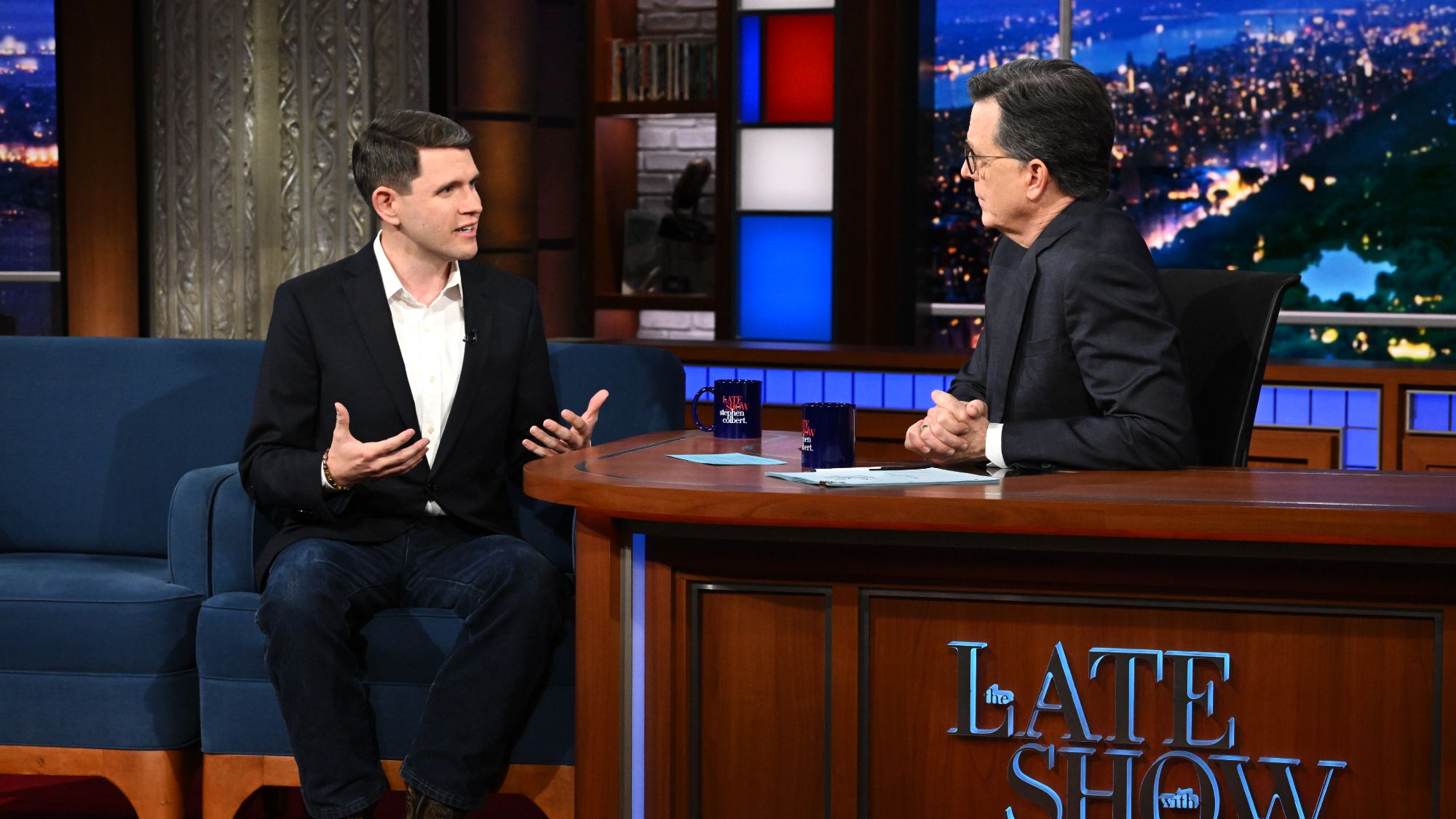
    Colbert, CBS spar over FCC and Talarico interview

    What happened
    CBS yesterday disputed “Late Night” host Stephen Colbert’s on-air assertion Monday night that network lawyers had “in no uncertain terms” told him not to air an interview with James Talarico, a Democratic Texas state representative running for U.S. Senate, because of threats from Federal Communications Commission Chair Brendan Carr. CBS said “The Late Show” was “not prohibited” from airing the interview but “was provided legal guidance that the broadcast could trigger the FCC equal-time rule.” Colbert last night pushed back on that “crap” statement. “They know damn well that every word of my script last night was approved by CBS’s lawyers,” he said.

    Who said what
    The FCC’s equal-time rule, which mandates that radio and broadcast television stations give all candidates for a political office air time if one of them appears, has several exemptions, including for “bona fide” news programming. “Media companies have long taken it as a given that late-night shows qualified for the same exemption,” The New York Times said. 

    But Carr has “remade” the FCC into a “speech enforcer tackling perceived liberal bias in the media industry,” threatening to “take action against broadcasters that do not follow rarely enforced FCC rules,” The Washington Post said. After Carr issued new “guidance” last month that late-night and daytime talk shows should not count on the “bona fide” exemption, the FCC opened an equal-time investigation of ABC’s “The View” over another Talarico interview. 

    Carr’s guidance “applies only to television and not radio, which is home to many right-leaning talk shows,” The Wall Street Journal said. The equal-time rule also doesn’t apply to cable TV or streaming, so “The Late Show” posted Colbert’s Talarico interview online. “I think that Donald Trump is worried that we’re about to flip Texas,” Talarico said in the video. Republicans “ran against cancel culture, and now they are trying to control what we watch, what we say, what we read, and this is the most dangerous kind of cancel culture. The kind that comes from the top.”

    What next?
    Talarico has “used the controversy to garner attention for his Senate candidacy,” CNN said. His Colbert interview was viewed more than 3 million times on YouTube yesterday, the first day of early voting in his March 3 primary fight against Rep. Jasmine Crockett (D-Texas). 


    TODAY’S MILITARY story

    Pentagon spokesperson forced out as DHS’s resigns

    What happened
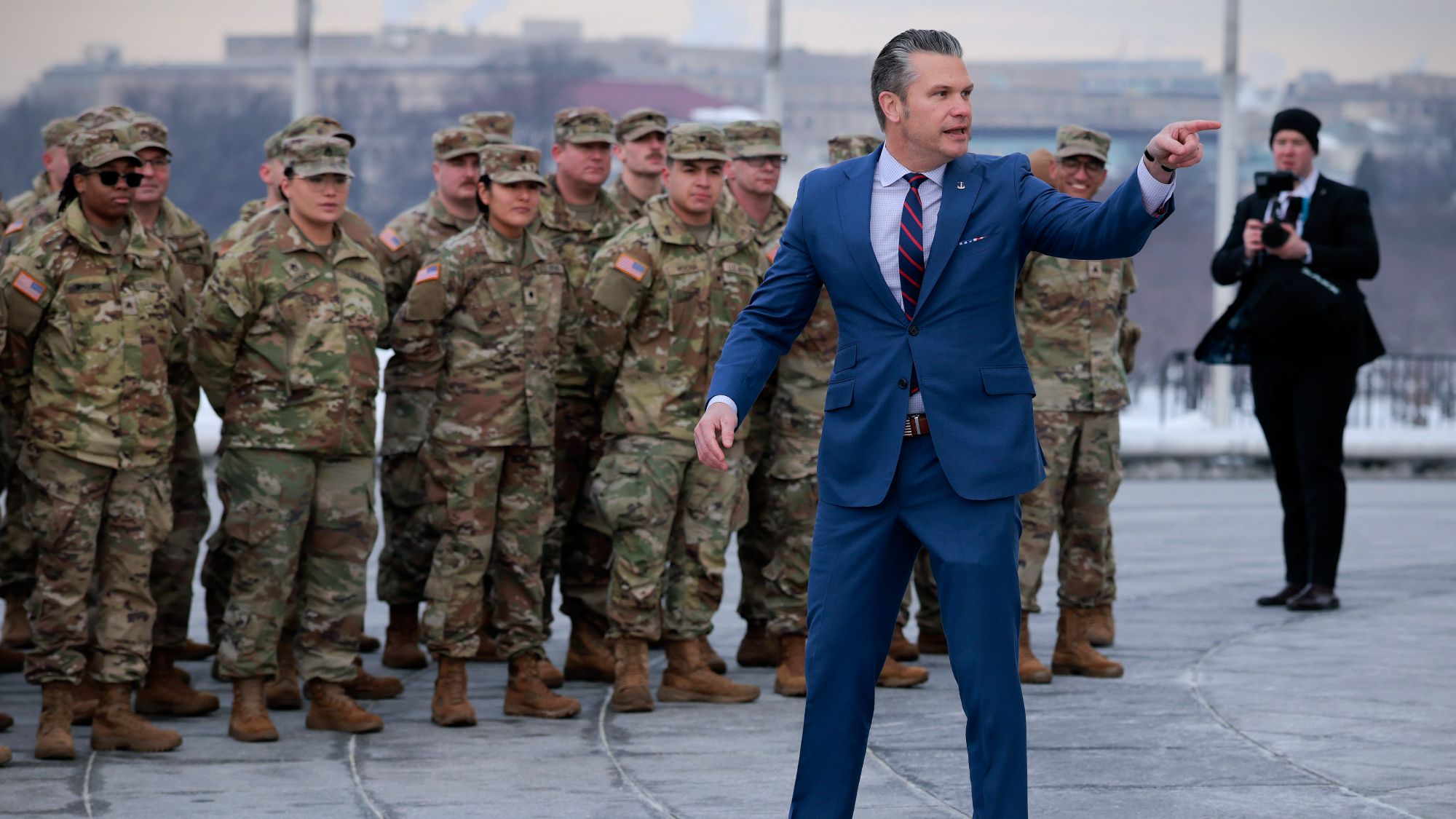
    Defense Secretary Pete Hegseth ordered Army Secretary Dan Driscoll to fire senior military adviser and chief public affairs official Col. David Butler, news organizations reported yesterday. Driscoll yesterday thanked Butler for his “lifetime of service in America’s Army and to our nation” but did not address the reason for his “upcoming retirement.” Separately, Homeland Security spokesperson Tricia McLaughlin yesterday said she was resigning after a year tenaciously defending President Donald Trump’s increasingly unpopular immigration crackdown. 

    Who said what
    Butler was “one of the Army’s best communicators,” Fox News said, and Driscoll “had resisted Hegseth’s pressure to fire” him for months. It is “unusual for a defense secretary to weigh in on the firing of an Army spokesman,” The New York Times said. Hegseth blamed Butler for “news articles late last year that compared him unfavorably” to Driscoll, a close friend of Vice President JD Vance, but the defense secretary has also “made no secret of his hatred” for Butler’s former boss, Gen. Mark Milley. 

    Butler’s “previous work as the senior spokesman” for Milley “appears to be a factor in his removal,” The Washington Post said, citing inside sources. But Hegseth also “takes issue with Driscoll’s rising profile and increasing responsibilities within the Trump administration,” and the firing is part of their “latest clash.” Hegseth had blocked dozens of Army promotions for months, and Butler, nominated for brigadier general, “elected to submit his retirement paperwork rather than hold up his colleagues’ promotions,” the Post said. “Current and former defense officials expressed astonishment at Butler’s ouster.”

    What next?
    McLaughlin is “leaving DHS next week,” Politico said, and will be replaced by her deputy, Lauren Bis, and new hire Katie Zacharia, a frequent Fox News guest.


    TODAY’S INTERNATIONAL Story

    Witkoff and Kushner tackle Ukraine, Iran in Geneva

    What happened
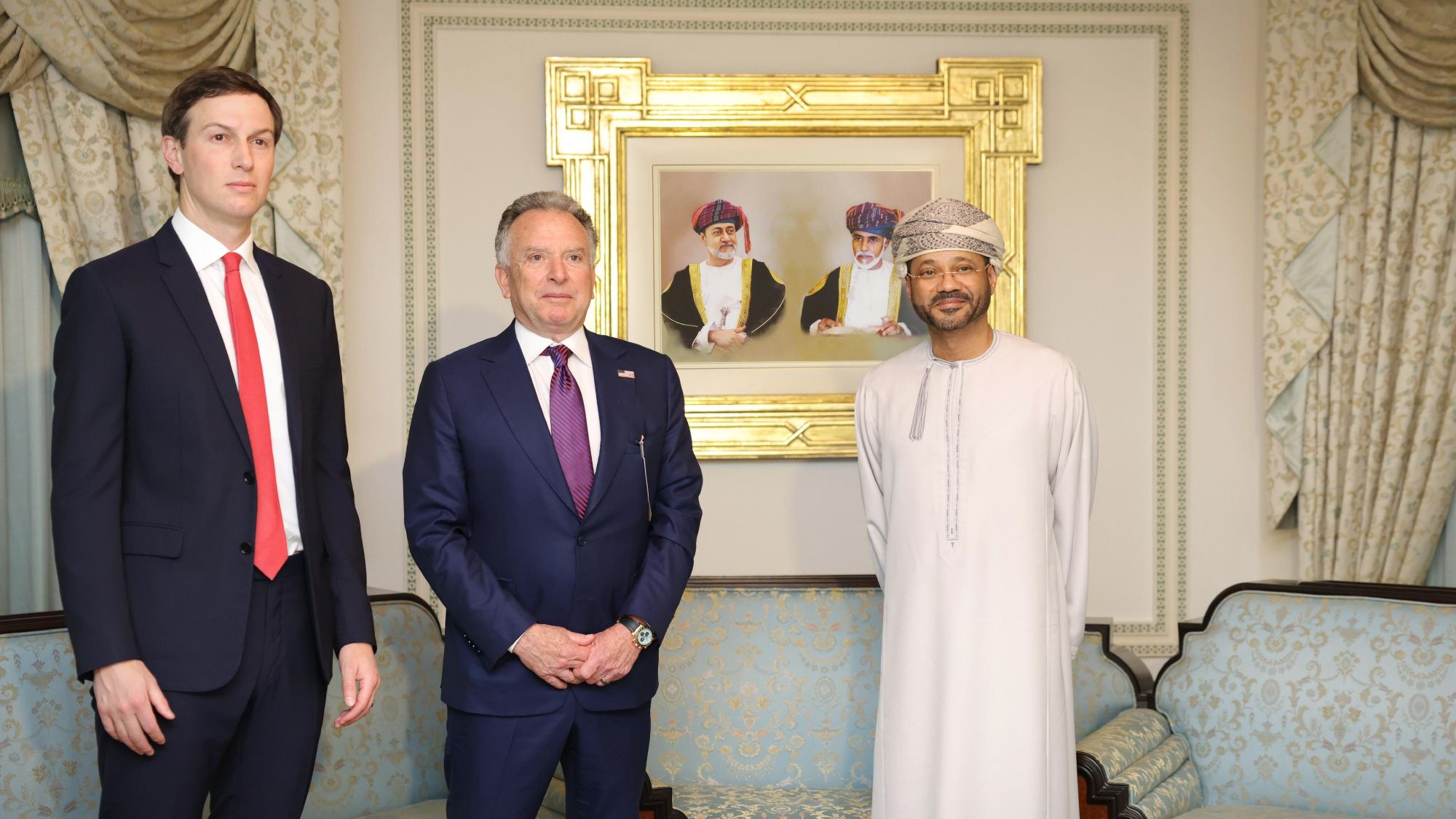
    President Donald Trump’s two main envoys, his friend Steve Witkoff and son-in-law Jared Kushner, yesterday held back-to-back negotiations in Geneva aimed at securing a nuclear deal with Iran and an end to Russia’s war in Ukraine. The indirect talks with Iranian Foreign Minister Abbas Araghchi, mediated by Oman, were “more constructive” than previous talks and made “good progress” toward a “clear path ahead,” Araghchi told Iranian TV.

    Who said what
    Sending Witkoff and Kushner to solve two entrenched conflicts “in a single day in Geneva” has “raised questions not only about whether they are overstretched and outmatched, but about their serious prospects for resolving either of the twin crises,” Reuters said. Trump’s “diplomacy without diplomats” gambit, The New York Times said, was a “stark example” of his “conviction that the State Department and the National Security Council, the two institutions that have coordinated negotiations over global crises for nearly 80 years, are best left on the sidelines.” Secretary of State Marco Rubio, who heads both organizations, was not involved in yesterday’s shuttle diplomacy. 

    “Some countries really welcome this informal structure” of transactional deal-making, said Asli Aydintasbas of the Brookings Institution. But “I have not seen anyone hugely impressed with the diplomatic skills of the current team.” Having “Witkoff and Kushner tasked with resolving all the world’s problems is, frankly, a shocking reality,” Mohanad Hajj-Ali of the Carnegie Middle East Center in Beirut told Reuters. 

    What next?
    The U.S.-Russian-Ukrainian talks are continuing for a second day, but “expectations were low for a breakthrough,” Reuters said. Today’s talks, the Times said, “were expected to focus on the fate of Ukrainian-held territory” that “Moscow wants under its control as the price for ending the war.” 


    It’s not all bad

    Aquatic life in China’s Yangtze River is showing substantial signs of recovery, thanks to a fishing ban and government investment to help 200,000 fishers find new careers. Since the ban was put in place in 2021, fish biomass has doubled and biodiversity has improved by 13%, according to a new study published in the journal Science. The endangered Yangtze finless porpoise is also slowly coming back, with its population increasing to 600 from 400.


    Under the radar

    Microdramas are booming

    Entertainment is moving from the big screen to the small screen in the form of microdramas, or shows designed to be consumed in multiple parts and viewed on a cellphone. The success of these mini movies in China prompted their leap to the U.S., where they earned $1.4 billion in revenue in 2025. Microdramas mirror the way we “consume TikTok and Instagram content,” making them “perfectly suited for the shorter attention spans of today's online users,” said Hello! magazine. 

    Microdramas are similar to soap operas, focusing on common tropes and over-the-top theatrics. Their total duration can be the length of a feature film, but split into 80 parts. The episodes “often end on cliffhangers, making viewers want to binge the whole thing,” said Hello!. 

    While these shorts appear on TikTok and Instagram, ReelShort and DramaBox are growing in popularity as dedicated microdrama apps. The “first few episodes are typically free to watch,” but “once you want to see more, you’ll have to pay up,” said NPR. This could “cost viewers $10 to $20 a week.” Microdramas are cheap to create, too, banking on “little-known actors, tight budgets and accelerated production timelines.”

    Most microdramas are non-union productions, but that may soon change, as one studio in Los Angeles is producing “one of the first ever SAG microdramas, which features an Oscar-nominated actor,” said Deadline. That could impact the industry, “proving that new formats can deliver top-tier creative work while upholding strong labor standards,” said Duncan Crabtree-Ireland, the national executive director of SAG-AFTRA.


    On this day

    February 18, 2010

    WikiLeaks published the first leaked document from U.S. Army intelligence analyst Chelsea Manning. The controversial website eventually published nearly 750,000 leaked government documents from Manning. She was sentenced to 35 years in prison, though her sentence was commuted in 2017.


    TODAY’S newspaperS

    ‘He was Somebody’

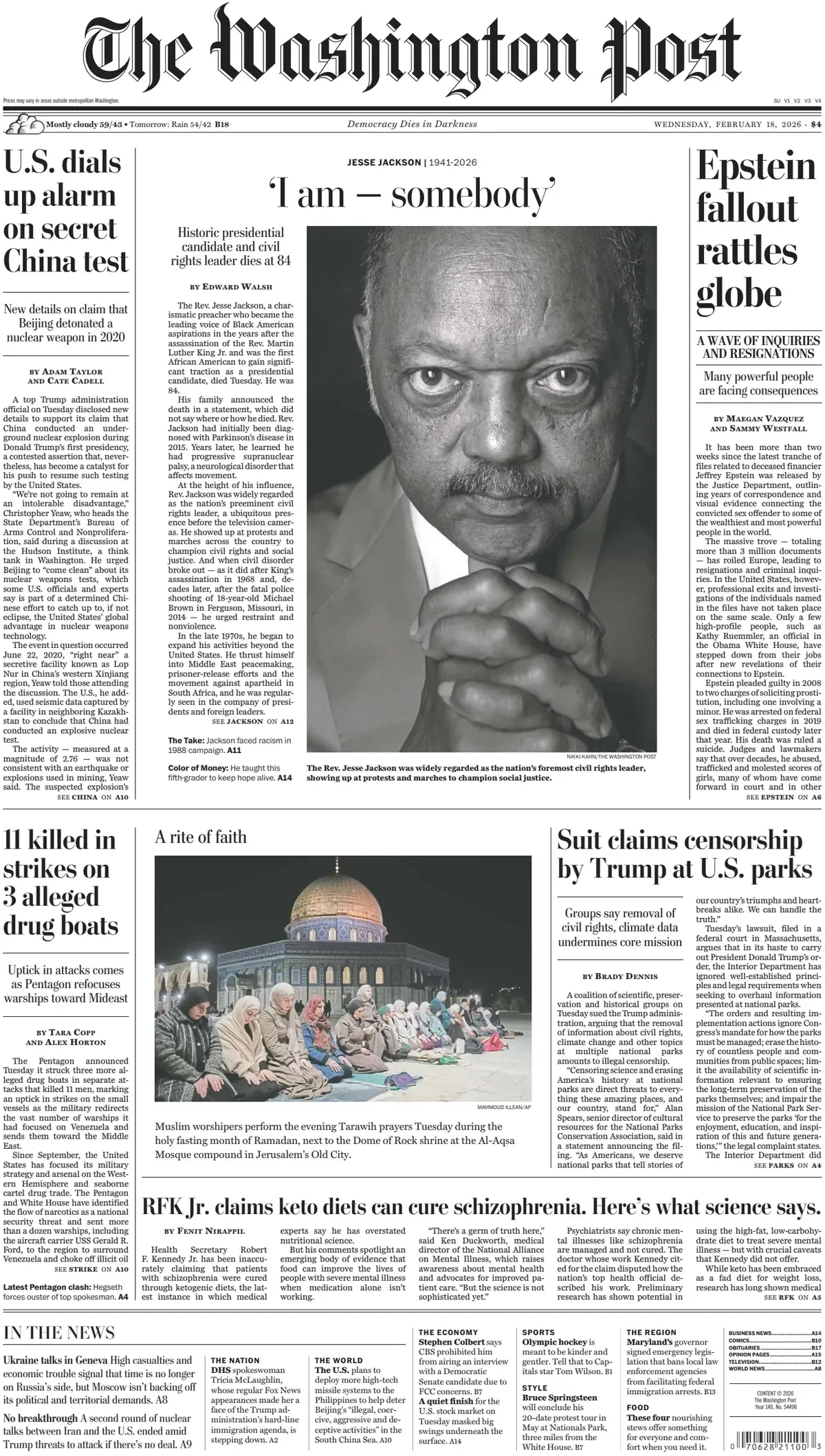
    The Rev. Jesse Jackson, who died yesterday, “kept dream alive,” The Dallas Morning News says on Wednesday’s front page. “He kept hope alive, fighting for more inclusive America,” The Minnesota Star Tribune says. “He was Somebody,” says the Chicago Sun-Times. “Warner, in shift, reopens talks with Paramount,” setting “deadline for ‘best and final’ offer,” The Wall Street Journal says. “Vaccine makers curb research and shed jobs” as “Kennedy puts up obstacles,” The New York Times says. “Questions arise over payouts by FEMA,” as “officials get theirs” and others wait, USA Today says. “11 killed in strikes on 3 alleged drug boats,” The Washington Post says. “Rare overlap of Lent, Ramadan offers opportunity for learning,” says the Houston Chronicle.

    ► See the newspaper front pages


    Tall tale

    Smell it to the judge

    A Raising Cane’s restaurant in Boston is accusing its landlord of using complaints about “chicken finger smells” to try to evict the fast-food joint from the building. Raising Cane’s, which primarily sells fried chicken tenders, said in a lawsuit against the landlord that the eviction threat is an “extortionate scheme.” The restaurant claims it has spent $230,000 to “minimize the odor,” but will stop making efforts to clear the air due to “unreasonable demands” regarding the smell.


    Morning Report was written and edited by Nadia Croes, Catherine Garcia, Scott Hocker, Anya Jaremko-Greenwold, Justin Klawans, Rafi Schwartz, Peter Weber and Kari Wilkin, with illustrations by Stephen Kelly and Julia Wytrazek.

    Image credits, from top: Scott Kowalchyk / CBS via Getty Images; Chip Somodevilla / Getty Images; Oman Foreign Ministry / Anadolu via Getty Images; Illustration by Julia Wytrazek / Getty Images
     

    Recent editions

    • Evening Review

      The odds of war with Iran

    • Morning Report

      The Epstein ouster list grows longer

    • Sunday Shortlist

      Desert survival

    VIEW ALL
    TheWeek
    • About Us
    • Contact Future's experts
    • Terms and Conditions
    • Privacy Policy
    • Cookie Policy
    • Advertise With Us
    • FAQ
    Add as a preferred source on Google

    The Week is part of Future US Inc, an international media group and leading digital publisher. Visit our corporate site.

    © Future US, Inc. Full 7th Floor, 130 West 42nd Street, New York, NY 10036.