The Week The Week
flag of US
US
flag of UK
UK
https://cdn.mos.cms.futurecdn.net/flexiimages/jacafc5zvs1692883516.jpg

SUBSCRIBE & SAVE

Less than $3 per week

Sign in
  • View Profile
  • Sign out
  • The Explainer
  • The Week Recommends
  • Newsletters
  • Cartoons
  • From the Magazine
  • The Week Junior
  • Student Offers
  • More
    • Politics
    • World News
    • Business
    • Health
    • Science
    • Food & Drink
    • Travel
    • Culture
    • History
    • Personal Finance
    • Puzzles
    • Photos
    • The Blend
    • All Categories
  • Newsletter sign up Newsletter
  • The Week’s Saturday Wrap
    Trump's visit with Xi, a looksmaxxing administration, and third country deportations

     
    controversy of the week

    Trump in China: American ‘decline’ on display?

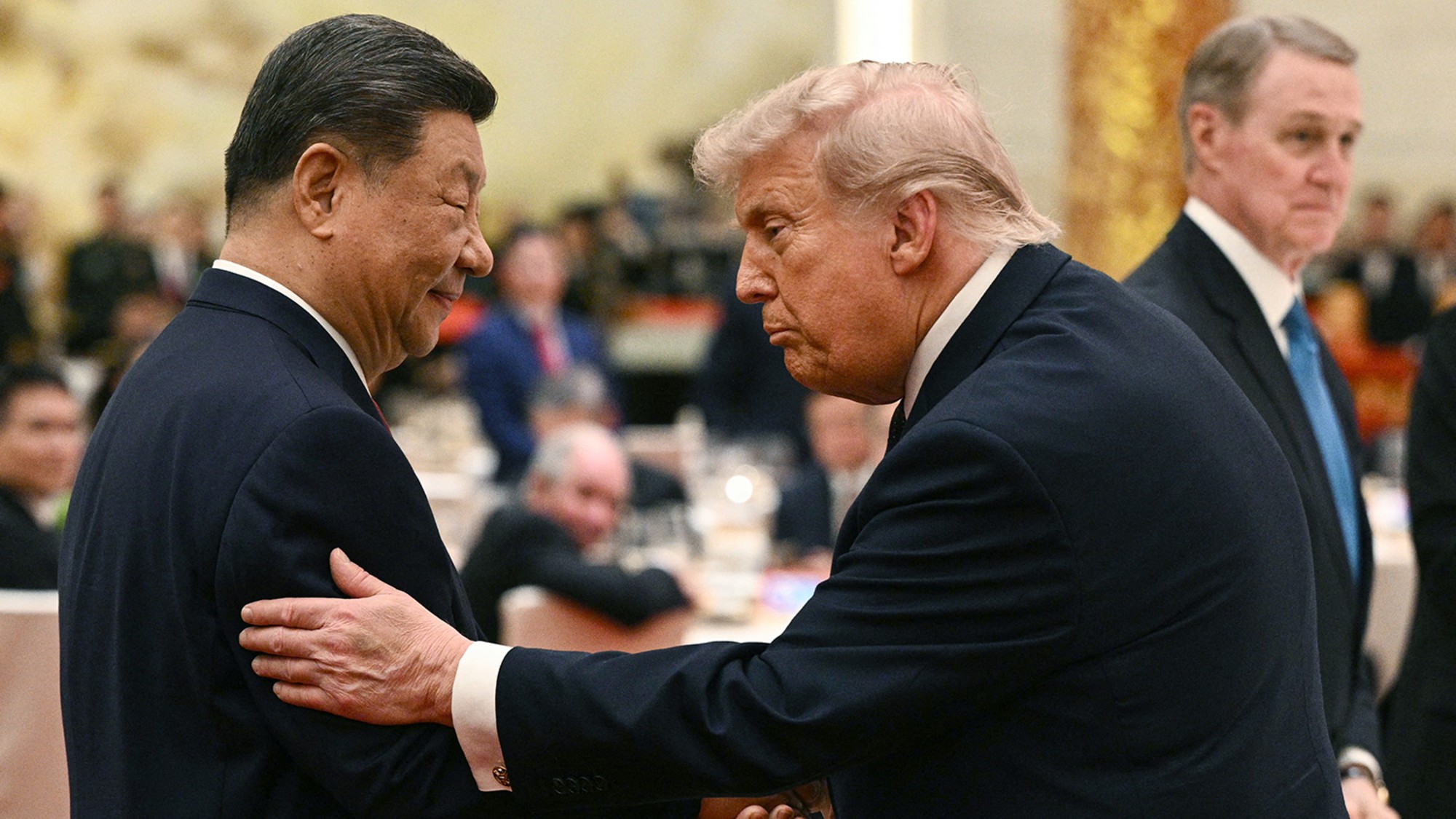
    “He came, he saw, he left without much to show for it,” said David Smith in The Guardian. Throughout last week’s state visit to Beijing, President Trump slathered compliments on Xi Jinping, praising China’s president-for-life as a “great leader” who is “very tall.” But Trump’s flattery got him nowhere. After 43 hours, he flew home having secured only the “vague outlines” of a few commercial deals, no agreement to slow the AI arms race, and no help on Iran, which China could pressure to reopen the Strait of Hormuz. In fairness, Trump did extract a promise from Xi to send him seeds from some rosebushes he admired. Trump reciprocated with a far more valuable gift, said The Economist: doubt over U.S. support for Taiwan. Despite a Reagan-era commitment to never negotiate with China over arms sales to the island nation — which Beijing considers a rogue province — Trump said he was delaying approval of a $14 billion weapons sale to Taiwan, calling it a “good negotiating chip” in talks with Beijing. As for America’s long-standing posture of strategic ambiguity on whether U.S. forces would defend Taiwan from a Chinese attack, Trump told reporters on the flight home: “The last thing we need right now is a war that’s 9,500 miles away.”

    “Not so fast,” said Gerard Baker in The Wall Street Journal. Trump says a lot of things, particularly in the “afterglow” of a state visit. But Secretary of State Marco Rubio quickly clarified that our Taiwan policy is “unchanged,” and U.S. law requires Washington to give Taiwan the means to defend itself. But the change in China’s posture was unmistakable. An emboldened Xi warned of looming “clashes and even conflicts” over Taiwan and cautioned Trump to avoid the “Thucydides trap,” whereby a declining power’s fear of a rising one draws both into war. Once the classical reference was explained to our president, Trump insisted Xi had been slighting America’s decline under “Sleepy Joe Biden.” But Xi’s meaning was plain, as is China’s new “confidence.” 

    It’s easy to overlearn the lessons of history, said Lydia Polgreen in The New York Times. In his chronicle of the Peloponnesian War (431–404 B.C.), the ancient Greek historian Thucydides charts the violence that erupted when Athens — an ambitious power much like Xi’s China — “challenged the pre-eminence of Sparta.” That scenario has repeated throughout history, “with the ambition and aggression of the challenger almost always ending in bloodshed.” But the current threat to the U.S.-led global order is not China so much as the chaos Trump has unleashed with his bullying of allies, his self-sabotaging tariffs, and his epic miscalculation in Iran. “America is overthrowing America.”

    Xi should check his hubris, said Ross Douthat, also in the Times. For the record, Sparta defeated upstart Athens in the Peloponnesian War, and the post-Covid U.S. economy has actually outpaced China’s in recent years. Longer term, China’s “crashing” birth rate — now one child per woman and falling — will make it “incredibly difficult” to sustain economic growth. As for the Thucydides trap, “China shouldn’t worry,” said Paul Krugman in his Substack newsletter. America is declining, but we’re not about to “lash out at a rising China” while we’re led by a self-absorbed, “pathetic” president whose main message to Americans, upon returning home, was that Xi has nice ballrooms and therefore he deserves one, too. If you want classical analogies, “think of America right now as the Roman Empire under Caligula, although Caligula didn’t do anything like as much damage.”


    VIEWPOINT

    A weird obsession with appearances reveals much

    “Trump and his attendants are fixated on looks — to a degree that’s not remotely normal, with no appreciation for how much of themselves and their vacuous governing philosophy they’re revealing. Never have I witnessed a White House so devoted to surfaces. Surfaces caked with makeup. Surfaces puffed up with hair spray. Surfaces glossed with gold. Surfaces that glitter blue — or someday might, if the over-budget overhaul of the Lincoln Memorial Reflecting Pool ever works out as promised. Appearances simultaneously obscure reality and substitute for it. Your sheen is your success, and you are what you impersonate.”

    Frank Bruni in The New York Times


    briefing

    Destination unknown

    Some migrants can’t legally be sent home. So President Trump is deporting them to third countries.

    What is a third-country deportation?
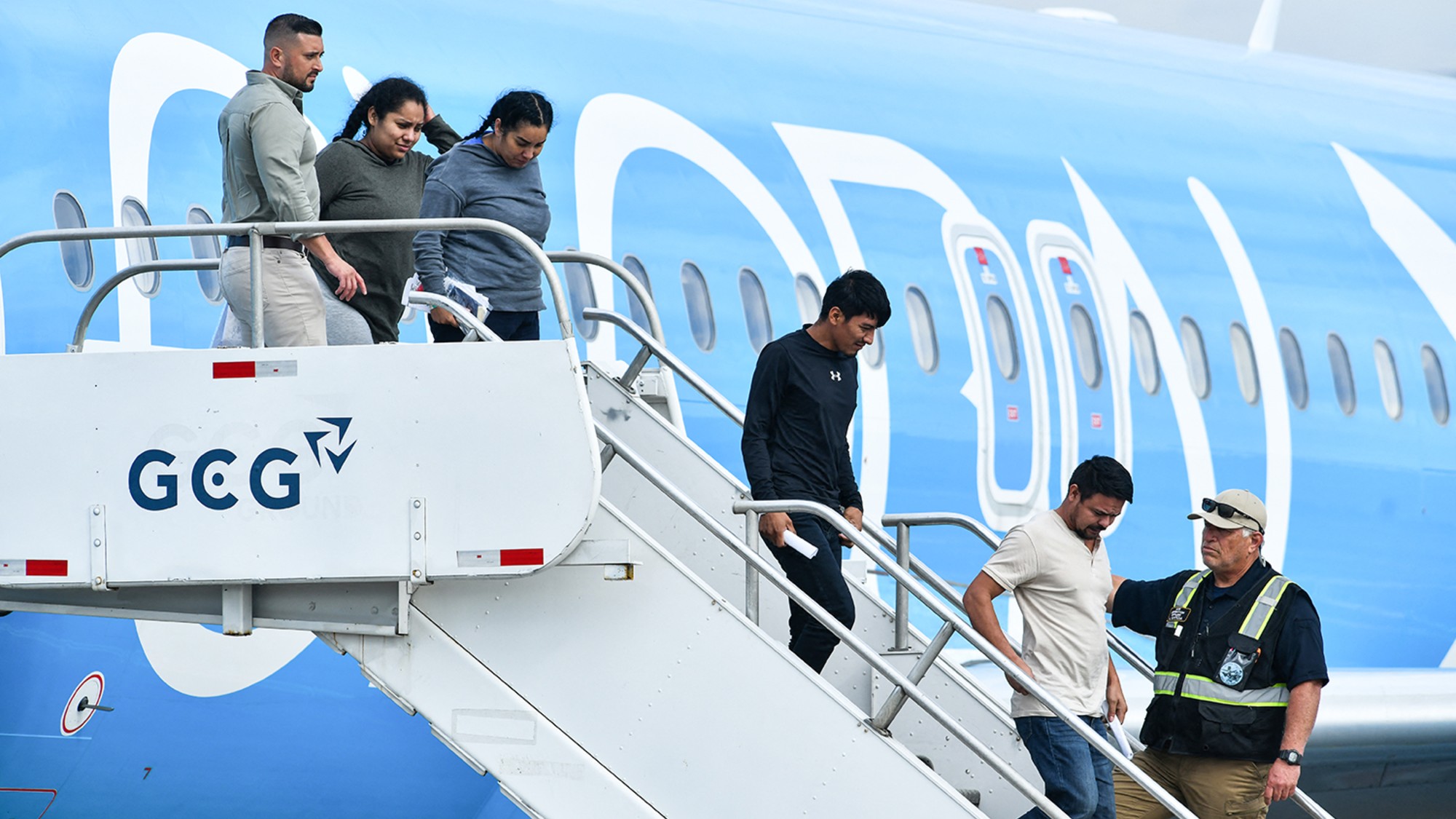
    It’s the removal of a migrant or asylum seeker to a country with which he or she has no legal or personal ties. While only about 17,500 of the more than 800,000 people deported so far during President Trump’s second term have been sent to third countries, those removals are a key part of his immigration agenda. His administration has brokered transfer deals with at least 33 nations—most of them poor and corruptly run—and has paid at least $44 million to those countries in connection with the deportation agreements. The Department of Homeland Security argues the policy is needed to remove migrants who are “so uniquely barbaric that their own countries won’t take them back.” But most third-country deportees have no criminal record, and most have been granted some form of legal relief that bars the government from shipping them home, where they may face torture, persecution, or death. Some migrants have been removed suddenly from detention centers and flown to countries in Africa, Latin America, or Central Asia with abysmal human rights records. “They took us, they put us on a plane, and they chained us by our hands and feet,” said one Colombian deportee, who didn’t know until mid-flight that his destination was the Democratic Republic of Congo, an active war zone. The U.S., said Nicole Waddersheim of the nonprofit Human Rights Watch, “is doing enforced disappearances.”

    Where are deportees being sent?
    About 90% have been transferred to Mexico under a Biden-era agreement that let federal agents at the southern border turn back migrants during the 2021–23 immigration surge. But Trump has tried to speed up the pace of deportations by shipping migrants to any country that will take them. In February 2025, 200 people— including 81 children—from countries including Iran, Afghanistan, Angola, and China were flown on two planes to Costa Rica; many of those deported had tried to claim asylum in the U.S. Weeks later, Homeland Security shipped 261 mostly Venezuelan men to the brutal CECOT prison in El Salvador; many reported being tortured and sexually assaulted at the facility. The administration paid El Salvador more than $4 million to hold the men, whom it accused on scant evidence of being gang members. After four months at CECOT, the Venezuelans were sent to their home country. The administration then began looking farther afield for third-country destinations, striking deals with countries including Eswatini, Equatorial Guinea, Rwanda, and South Sudan.

    Is this policy legal?
    That’s being contested in federal court. The Immigration and Nationality Act outlines a procedure for third-country deportations, and in June 2025 the Supreme Court ruled the administration could deport migrants to countries other than their own without giving them a “meaningful opportunity” to raise fear-based claims of torture. The following  month, Immigration and Customs Enforcement said officers could “immediately” begin sending migrants to “alternative” countries, with as little as six hours’ notice. Other courts, though, have rejected the agency’s legal justifications for specific removals: A U.S. district judge last week ordered the Trump administration to return to the U.S. a 55-year-old Colombian asylum seeker with diabetes, hyperlipidemia, and hypothyroidism who was deported to Congo—even after the country refused to accept her because it couldn’t provide sufficient medical care. The plaintiff “meets the standard for irreparable harm,” said Judge Richard Leon, “up to and including death.”

    What conditions do deportees face in third countries?
    Some have described landing in tropical locations without receiving the appropriate vaccinations and then being locked up by local authorities. Those sent to Eswatini, Africa’s only absolute monarchy, were immediately ferried to a moldy, bug-infested maximum-security facility where, one Laotian migrant told his lawyer, he felt “like a caged animal.” At least two of 26 migrants sent to Cameroon contracted malaria, and journalists who have tried to contact them have had their phones and laptops confiscated. In Equatorial Guinea, deportees are held under armed guard at a remote hotel; some have contracted typhoid fever. Weeks after 11 deportees arrived in Ghana, 10 were driven to its border with Togo and told to cross over on foot. That was especially terrifying for two of the female deportees. 

    Why was that?
    Because they were Togolese and had fled to the U.S. to escape the threat of genital mutilation and forced marriage. “In this country, nobody can help me,” said one of the women, who is now in hiding in Togo. U.S. law prohibits asylum seekers from being sent to their home country if their “life or freedom would be threatened.” But there’s no legal mechanism to stop a migrant from being deported to a third country, which then transfers them home. In November, 50 humanitarian parole recipients from Ukraine were flown to Poland and then escorted across the border to their wartorn homeland. One man on the plane “was a 36-year-old who came to America as a child 20 years ago,” said a deportee. “He hardly speaks any Ukrainian.”

    Are more deportations in the works?
    The Trump administration is drawing up plans to send 1,100 Afghan nationals currently housed at a U.S. military base in Qatar to Congo. The group includes former interpreters and special forces that fought alongside U.S. troops. Here in the U.S., more than 24,000 migrants have received third-country removal orders and are awaiting deportation. “It is a country I don’t know, I have no family there, I don’t speak their language,” said Bolivian asylum seeker José Yugar-Cruz, 37, who is set to be deported to Congo. “I keep thinking it’s a nightmare that I will wake up from.”



    Only in America

    Nebraska is suing a barbershop-themed cocktail bar for not actually being a barbershop. Omaha’s Barber Shop Blackstone features striped poles, barbershop chairs, and such cocktails as the Straight Razor and the Hot Towel Margarita. But because the bar does not offer shaves or haircuts, the state attorney general says its owners were “knowingly deceptive” in co-opting symbols and equipment from “the ancient and proud profession” of barbering.


    It wasn’t all bad

    Following a long rehab, a great horned owl is flying freely again after construction workers discovered it inside a concrete mixer in Utah. Although animal rescue workers cleared away dried cement from the owl’s right wing, the concrete had frayed its existing feathers and left it unable to grow new ones. In early May, it underwent a risky procedure to transplant 11 new feathers onto existing shafts. In the aviary, the owl flew silently again with ease, and the staff released it back into the wild. 


    talking points

    Religion: Christian nationalism on the Mall

    The nation just got “a preview of what American theocracy would look like,” said Guthrie Graves-Fitzsimmons in MS.now. Thousands of people gathered on the National Mall this week for Rededicate 250, a White House–backed and taxpayer-funded prayer event that featured “a who’s who of religious-right figures,” including Defense Secretary Pete Hegseth, House Speaker Mike Johnson, and evangelical preacher Franklin Graham, who blasted America as “sick with sin, transgenderism, same-sex marriage.” The kickoff for a series of events celebrating America’s 250th anniversary, the rally framed the U.S.’s founding as an explicitly Christian project. It’s the most aggressive attack on the Constitution’s guarantee of religious freedom “that the Christian nationalist movement has yet attempted on American soil.” And it’s one based on a lie: The U.S. was founded 250 years ago as a secular democracy, not a theocracy. “We cannot rededicate something to God when the nation was never dedicated to one narrow religious movement.”

    President Trump, who was busy playing golf, appeared in a prerecorded video reading from the biblical book of Chronicles, said Sarah Posner in Talking Points Memo. Still, his supporters spent the day “trying to turn the anniversary of our independence from a king into a spectacle of worship of their wannabe king.” Evangelical podcaster Eric Metaxas even claimed in his speech that God had “raised up” Trump to build a White House ballroom. But Rededicate 250 made it clear that not all Christians are welcome under Trump’s tent, said Amanda Marcotte in Salon. Sure, there was “a smattering of token Catholics” among the speakers—and even one rabbi. But the event was dominated by white, far-right evangelicals. “Promoting voices like these sends a message loud and clear: The rest of you don’t matter.” 

    Such brazen displays of Christian nationalism could push us into “a vicious cycle,” said Andrew Egger in The Bulwark. The “charlatans” who spoke at Rededicate 250 are increasingly the only “Christians” encountered by irreligious types on the Left. And the more those on the religious right tie Christianity to MAGA, the less they can be surprised “if their political opponents turn out to be hostile not only to MAGA but to Christianity itself.” For those believers who years ago made peace with Trump on the “spurious argument” that only he stood between them and “a political movement hostile to their faith, I worry that they may meet their destiny on the road they took to avoid it.”


    people

    Why Frampton plays on

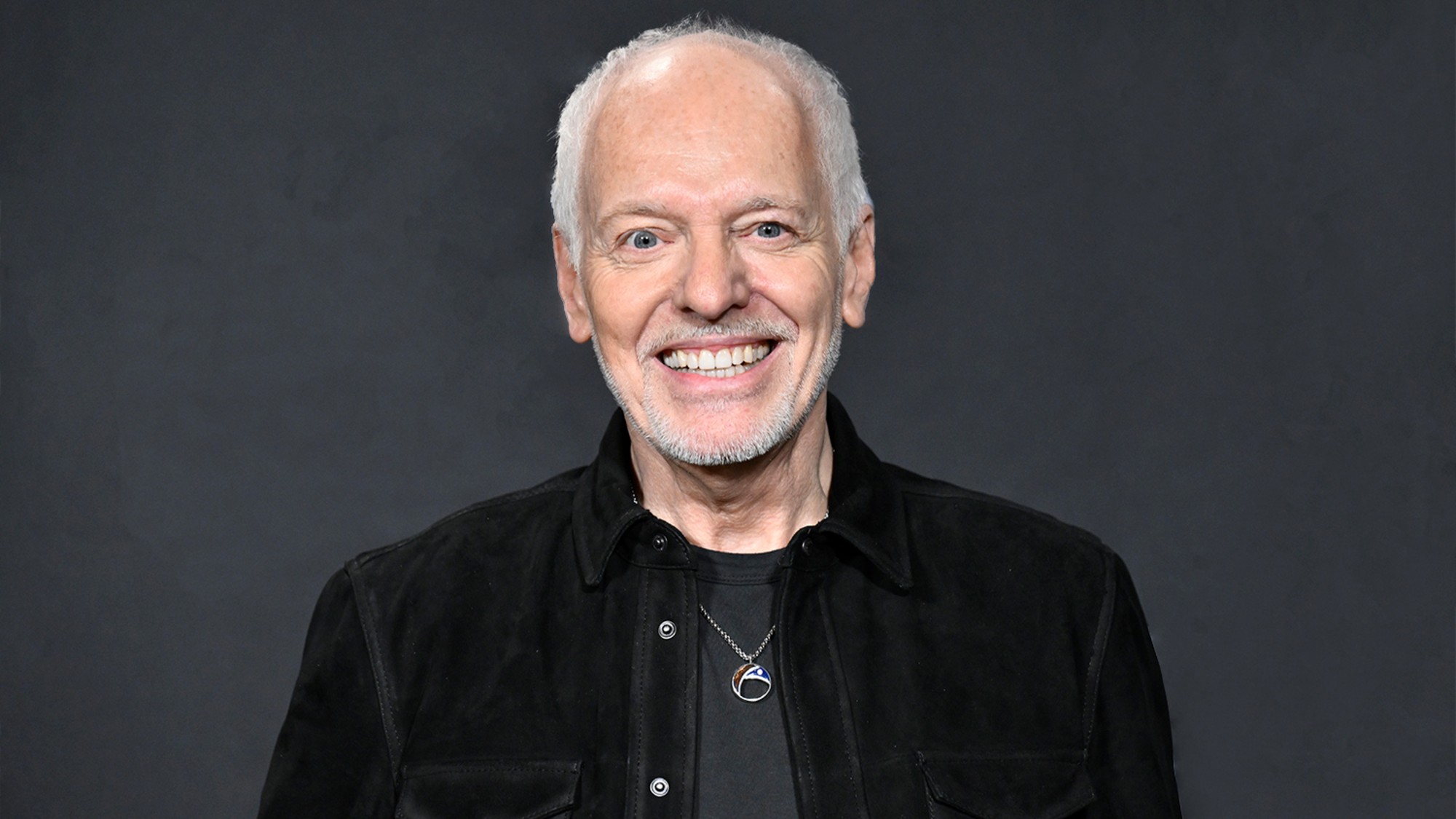
    Peter Frampton had just turned 59 when he realized something was wrong with his health, said Grayson Haver Currin in The New York Times. It was 2009, and the British guitar hero was on a songwriting retreat with his musician son, Julian, in Big Sur, Calif. While out hiking, “Julian said, ‘Let’s run up this hill,’” recalls Frampton, now 76. “Normally I would beat him, and I didn’t. It felt like there were insects in my legs, like they were vibrating.” Five years and a series of falls later, Frampton was diagnosed with inclusion body myositis, a progressive muscular disease in which fat commandeers muscles in the limbs and steadily weakens them. It seemed like a cruel fate for a live-music powerhouse like Frampton, “but big things never worried me, because the big things you can’t do anything about. If I don’t accept what I have, I’m going to be mad for the rest of my life.” Realizing he was running out of time to play the guitar, Frampton released three albums in five years. He figured writing fresh songs would take too long, so they were filled with covers and updates of old hits. Frampton has since written new material with Julian and has found new ways to navigate the guitar with his thinning arms. “In my mind, I’m more successful than I’ve ever been,” he says. “Because I like myself, I like what I do. I’ve reached the point where I don’t care what anybody else thinks.”


    Saturday Wrap was written and edited by Theunis Bates, Chris Erikson, Bill Falk, Bruno Maddox, Scott Meslow, and Tim O’Donnell.

    Image credits, from top: Getty (2) Reuters, AP
     

    Recent editions

    • Evening Review

      Could Texas go blue?

    • Morning Report

      Senate GOP revolts over Trump ‘slush fund’

    • Evening Review

      Pentagon pulls troops from Europe

    VIEW ALL
    TheWeek
    • About Us
    • Contact Future's experts
    • Terms and Conditions
    • Privacy Policy
    • Cookie Policy
    • Advertise With Us
    • FAQ
    Add as a preferred source on Google Add as a preferred source on Google

    The Week is part of Future US Inc, an international media group and leading digital publisher. Visit our corporate site.

    © Future US, Inc. Full 7th Floor, 130 West 42nd Street, New York, NY 10036.