The architect who made buildings flow like water
Frank Gehry literally changed the shape of architecture. In a globe-spanning career spent in rebellion against the square strictures of modernism, he designed buildings with radically tilted angles and swooping curves like a cubist painting rendered in 3D. Gehry creations became instant landmarks everywhere, and in Bilbao, Spain, his Guggenheim art museum almost single-handedly revitalized a whole city. Not everyone loved Gehry’s style, whether it was his rough, industrial-style early work—which critic Mike Davis called “Dirty Harry architecture”— or the colossal, highly polished complexes that boldly imposed their “starchitect” creator’s will onto the landscape. But Gehry insisted that a building had to be more than just functional. “I want buildings that have passion in them,” he said in 2003, “that make people feel something, even if they get mad at them.”
Gehry was born in Toronto as Frank Owen Goldberg, the son of a heavy drinker who “held a series of jobs,” said The New York Times. As a kid, Frank tinkered in his grandfather’s hardware store and watched his grandmother buy a live carp to make gefilte fish, a memory that inspired a recurring fish motif in his work. Frank’s world “abruptly fell apart in the mid-1940s,” when his father had a heart attack while the two were arguing; Frank blamed himself. His father never fully recovered, and the family moved to a poor area of Los Angeles seeking a milder climate. On the advice of an art teacher, Frank studied architecture at the University of Southern California; on the advice of his first wife, he changed his surname “to avoid antisemitism.” He spent his early career “toiling as a mid-level designer” at “a firm known for its shopping malls.”
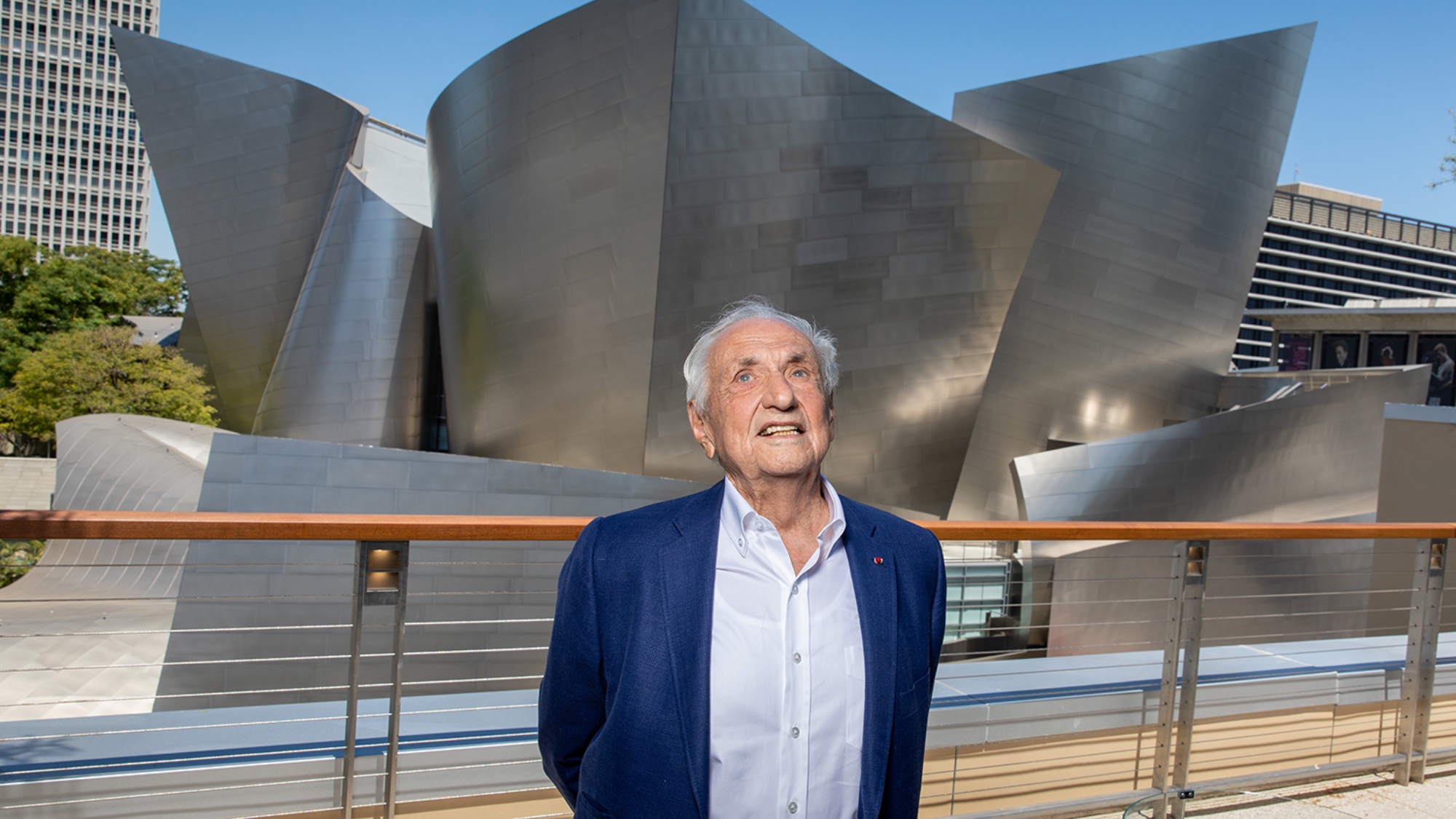
By the 1970s, though, he had “staked a position outside normal architecture,” said The Guardian. He made his first truly avant-garde statement in 1978 with his own Santa Monica, Calif., house, transforming the Dutch colonial with layers of corrugated metal, plywood, and chain-link fencing. It was “hated by the neighbors” but hailed by critics as “the freshest creation in architecture.” As Gehry’s reputation grew, his style “evolved into a sophisticated and playful collage of folding, twisting, and slanting forms,” said The Washington Post. These shapes became possible by his use of CATIA, a computer drafting system for aerospace manufacturing. It enabled “whimsical experiments” such as his 1996 collaboration with Czech architect Vlado Milunic on Dancing House, a Prague hotel and office complex that looked like a couple dancing and was nicknamed “the Fred and Ginger building.” It also informed the 1997 masterpiece that “vaulted Gehry into architecture’s pantheon,” the Guggenheim Bilbao. A riot of sinuous, twisting forms clad with 33,000 titanium panels, the riverfront museum transformed the economically and politically troubled Basque city into a major tourist destination. His success in Spain helped him save another ambitious design, the “audaciously curvilinear” Walt Disney Concert Hall in Los Angeles. He’d begun the $274 million project in 1988, but it got bogged down in economic troubles; thanks to private donations it finally opened in 2003.
“There were disappointments,” said the Los Angeles Times, such as the coolly received 2000 Experience Music Project in Seattle. At times Gehry was suspected of “spreading his talents too thin,” and his planned Guggenheim Abu Dhabi, commissioned in 2006, still has yet to open. Yet “Gehry’s work didn’t slow down” even in his 90s, said The Wall Street Journal. While he was known for recurring motifs, he objected to any suggestion that he had begun to repeat himself. “I cannot face my children if I tell them I have no more ideas,” he said in 2015. “It is like giving up and telling them there is no future for them.