Sign up to get Today’s Best Articles in your inbox
Join 350,000+ subscribers and keep yourself informed with a selection of
The Week’s most interesting, enlightening and entertaining stories - plus daily puzzles.
You are now subscribed
Your newsletter sign-up was successful
Want to add more newsletters?
An account already exists for this email address, please log in.
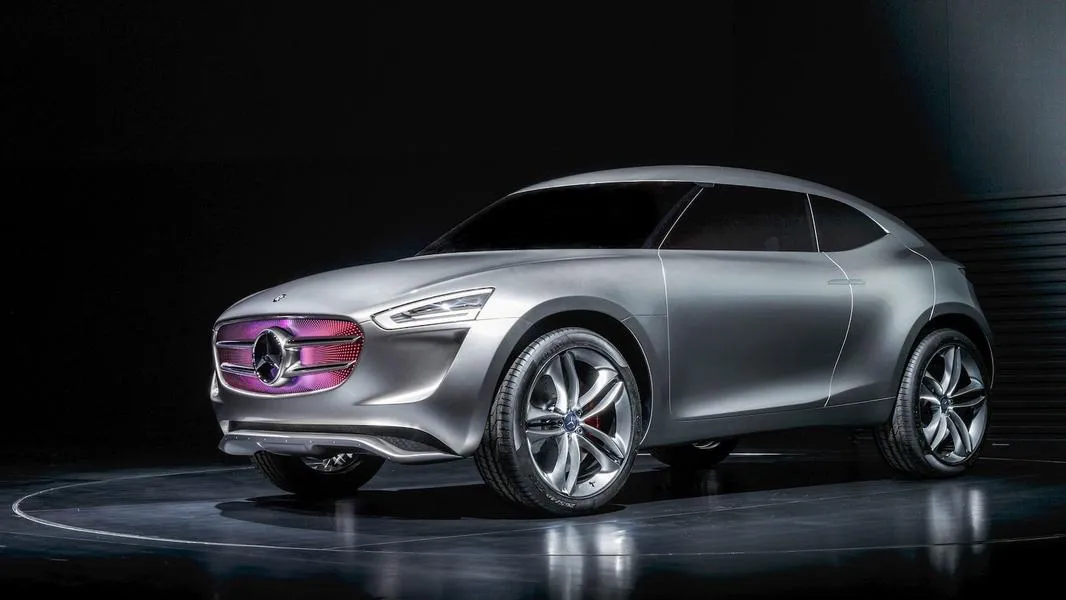
Mercedes' beautiful new Vision G-Code concept car has a solar-panel paint job
Mercedes calls the stylish, compact hatchback an SUC, or Sports Utility Coupé, but that's hardly the car's biggest innovation. It has a holographic grille that signals what "mode" the car is in, camera-equipped rearview mirrors that retract into the car, hybrid electric and hydrogen combustion engines, and a wrap-around windshield. But the most striking feature is probably the paint job. Mercedes explains:
The Week
Escape your echo chamber. Get the facts behind the news, plus analysis from multiple perspectives.
Join more than 350,000 subscribers and keep yourself informed with a selection of The Week’s most interesting, enlightening and entertaining stories - plus daily puzzles.
Join more than 350,000 subscribers and keep yourself informed with a selection of The Week’s most interesting, enlightening and entertaining stories - plus daily puzzles.
High-tech "multi-voltaic silver" paint finish also ensures the power supply in the SUC of the future. On the one hand, it acts like a giant solar cell with excellent efficiency. On the other, "multi-voltaic silver" is also charged electrostatically by the relative wind or by the natural wind when the vehicle is stationary. [Mercedes]
The G-Code will never hit market as presented in present form, and its actually aimed at China's booming auto-consumer market. But if this is the future of of the automobile, nice. If you want to gawk at the prospective car of the near-future, Mercedes has you covered in their glossy video below. Seriously, that steering wheel. --Peter Weber
Peter has worked as a news and culture writer and editor at The Week since the site's launch in 2008. He covers politics, world affairs, religion and cultural currents. His journalism career began as a copy editor at a financial newswire and has included editorial positions at The New York Times Magazine, Facts on File, and Oregon State University.