Sign up to get Today’s Best Articles in your inbox
Join 350,000+ subscribers and keep yourself informed with a selection of
The Week’s most interesting, enlightening and entertaining stories - plus daily puzzles.
You are now subscribed
Your newsletter sign-up was successful
Want to add more newsletters?
An account already exists for this email address, please log in.
Medicare doctors have a top 1 percent and bottom 99 percent of earners, too
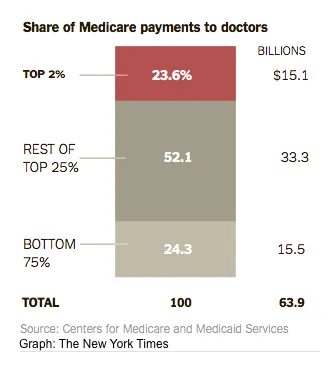
Doctors who take Medicare patients are just like the rest of society: The top 2 percent rake in the lion's share of the money, earning almost exactly the same amount as the bottom 75 percent. The top 1 percent alone takes about 14 percent of the pie. We know this because of detailed records released by the Centers for Medicare and Medicaid Services on 880,000 doctors who received a total of $77 billion in 2012. Via The New York Times, here's how that money is distributed among physicians:
A single Florida ophthalmologist, Salomon Melgen, earned $20.8 million in Medicare payments in 2012, and nine other doctors brought in more than $10 million. Melgen, whose office the FBI raided in January 2013, is best known for political donations to Sen. Robert Menendez (D-N.J.) and lots of prominent Florida politicians. (Melgen maintains he did nothing wrong.) The New York Times has a searchable database if you're interested in how much your doctor is reimbursed by Medicare.
Why are we only getting this data now? The American Medical Association won a court injunction in 1979 to prevent the release of doctor-specific Medicare billing information. After a federal judge vacated that order in 2013, the AMA declined to challenge the ruling. The Wall Street Journal, which offers a more detailed history of that fight, also has this chart showing how much each type of specialist typically earns each year:
The Week
Escape your echo chamber. Get the facts behind the news, plus analysis from multiple perspectives.
Join more than 350,000 subscribers and keep yourself informed with a selection of The Week’s most interesting, enlightening and entertaining stories - plus daily puzzles.
Join more than 350,000 subscribers and keep yourself informed with a selection of The Week’s most interesting, enlightening and entertaining stories - plus daily puzzles.
Every fiscal cycle Congress passes a "doc fix," which eases cuts in Medicare payments automatically scheduled under 1997 legislation designed to tame the budget deficit. (The latest "doc fix" was passed about a week ago.) Maybe this information will give lawmakers the tools to better target those cuts.
Sign up to get Today’s Best Articles in your inbox
A free daily email with the day’s biggest news and analysis – and the best features from TheWeek.com
Peter has worked as a news and culture writer and editor at The Week since the site's launch in 2008. He covers politics, world affairs, religion and cultural currents. His journalism career began as a copy editor at a financial newswire and has included editorial positions at The New York Times Magazine, Facts on File, and Oregon State University.