Sign up to get Today’s Best Articles in your inbox
Join 350,000+ subscribers and keep yourself informed with a selection of
The Week’s most interesting, enlightening and entertaining stories - plus daily puzzles.
You are now subscribed
Your newsletter sign-up was successful
Want to add more newsletters?
An account already exists for this email address, please log in.
Solar Impulse II: Swiss pilots to circle globe in solar plane
Aircraft unveiled this week has a wingspan greater than that of a 747 but weighs just 1.6 tonnes
TWO Swiss pilots hope to become the first people to circumnavigate the globe in an aeroplane powered only by the sun.
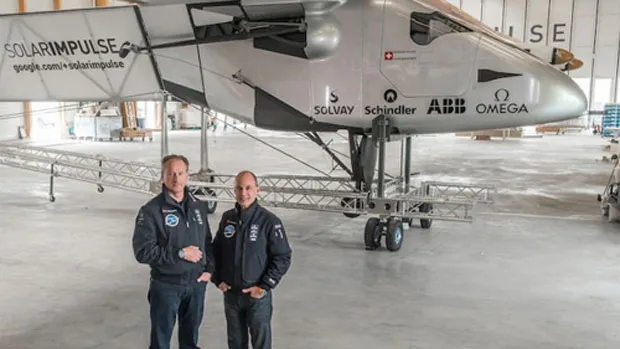
The experimental plane, named the Solar Impulse II, was presented in Switzerland's Payerne airforce base in the east of the country on Wednesday. Its inventors Bertrand Piccard and Andre Borschberg say the new model is bigger and better than the first prototype they flew across America five years ago (pictured below).
The Solar Impulse II has a wider wingspan, a more efficient engine, an improved cabin, and is made from lighter materials than its predecessor. The aircraft's vast wings are 72 metres wide and have been fitted with 17,000 solar cells that convert sunlight into electricity to power its motors. To put the scale into perspective, a Boeing 747's wings stretch to 64 metres.
The Week
Escape your echo chamber. Get the facts behind the news, plus analysis from multiple perspectives.
Join more than 350,000 subscribers and keep yourself informed with a selection of The Week’s most interesting, enlightening and entertaining stories - plus daily puzzles.
Join more than 350,000 subscribers and keep yourself informed with a selection of The Week’s most interesting, enlightening and entertaining stories - plus daily puzzles.
The material used to make the wings weighs approximately one-third as much as printer paper. Consequently, the whole aeroplane weighs just 1,600kg, about the same as a family car.
Piccard says that the plane will fly slowly at 60 or 70 miles per hour to save energy. The around-the-world flight is anticipated to take around 25 days, which the pilots will spread across three or four months.
Along the way, the pilots will invite school students, universities and government representatives to view the plane in a bid to promote solar technology.
"We believe if we can demonstrate this in the air, where it is the most difficult to do, people will understand that they can also use the same technologies for their daily lives," Piccard told CBS News in an interview last year.
Sign up to get Today’s Best Articles in your inbox
A free daily email with the day’s biggest news and analysis – and the best features from TheWeek.com
Initial testing of the Solar Impulse II will take place in May this year before the circumnavigation attempt between April and July 2015.