The Week The Week
flag of US
US
flag of UK
UK
https://cdn.mos.cms.futurecdn.net/skoGBi9qKFoUtnNWkovjJQ.jpg

SUBSCRIBE

Try 6 Free Issues

Sign in
  • View Profile
  • Sign out
  • The Explainer
  • Talking Points
  • The Week Recommends
  • Podcasts
  • Newsletters
  • From the Magazine
  • The Week Junior
  • More
    • Politics
    • World News
    • Business
    • Health
    • Science
    • Food & Drink
    • Travel
    • Culture
    • History
    • Personal Finance
    • Puzzles
    • Photos
    • The Blend
    • All Categories
  • Newsletter sign up Newsletter
  • Saturday Wrap, from The Week
    Reform donation, Israeli draft evasion, and Labour leadership contest

     
    talking point

    The issue dividing Israel: ultra-Orthodox draft dodgers

    What will it take for the ultra-Orthodox community to play its part in Israel’s survival? Despite 7 October 2023; despite the “near-existential” threat Israel faces across a variety of fronts; despite the “attendant acute military manpower crisis” and the enormous sacrifices experienced by so many Israeli families in the Gaza war – despite all this, the Haredi community remains adamant that young ultra-Orthodox men should be exempt from Israel’s compulsory military service. It’s pure moral cowardice, said David M. Weinberg in The Jerusalem Post. Nothing in the Torah forbids serving in war. Yet now, in a cynical bid to win back the support of his erstwhile Haredi government partners, Benjamin Netanyahu’s Likud party has introduced a bill that essentially entrenches the community’s “draft evasion”.

    “The roots of this issue go back to the founding of the state,” said Eric R. Mandel in the same paper, “when David Ben-Gurion exempted approximately 400 Torah scholars from military service.” Back then, Haredim were far fewer in number, and Israel’s first prime minister believed their small and insular world would soon enough fade from existence. “Instead, the opposite occurred.” Driven by one of the highest birth rates in the developed world, Haredim today make up about 13% of Israelis; by 2065 it’s estimated they’ll reach 25%. And over the decades, their exemption from Israeli life has become “institutionalised”, producing a class of citizens who neither serve in the army nor participate in the workforce, yet still enjoy hefty state subsidies. That imbalance had already created serious tensions within Israeli society; but post-7 October and the ensuing war in Gaza, what was once a cultural issue has now become Israel’s “greatest internal security threat”.

    A turning point in all this came in June 2024, said Sam Sokol in The Times of Israel (Jerusalem), when the supreme court called a halt to the all-too-blatant pro-Haredi discrimination and ruled that the government must start conscription immediately. After the ruling, religious “yeshiva” schools harbouring draft dodgers saw their budgets slashed, and draft refusers lost access to state benefits. But Netanyahu’s coalition has long been dependent on two ultra-Orthodox parties, Shas and United Torah Judaism (UTJ), said Haaretz (Tel Aviv). So even though the Israel Defense Forces (IDF) is short of 10,000 soldiers, or between 12 and 15 battalions, in the wake of the Gaza war, Netanyahu’s government, in direct violation of the Supreme Court’s ruling, has repeatedly called up reservists in their 30s and 40s – men with families – instead of recruiting from the 80,000 or so eligible 18- to 24-year-olds from the ultra-Orthodox community.

    Likud’s new bill is an attempt to put this inflammatory issue to bed, said Shalom Yerushalmi in The Times of Israel: Netanyahu is parading it as a “historic achievement”, claiming it will force thousands of Haredi men into uniform. In reality, “not a single battalion, never mind a division, will come of it”. And that’s because it’s “chock-full of loopholes”, said Sokol. Criminal sanctions on draft dodgers are only due to come into effect in 2027; not only full-time yeshiva students, but anyone who’s studied in a yeshiva for two years between ages 14 to 18 will be considered ultra-Orthodox, and granted yearly deferments from enlistment. The only recruitment likely to rise in number given those incentives is that of applicants to yeshivas.

    The bill has caused turmoil in Israel, said Ravit Hecht in Haaretz, and even within Netanyahu’s coalition. But the PM won’t mind. Having given the appearance of coming up with a solution, he can now sit on the bill while the nation argues it out. In short, he has resorted to “his time-tested tactic of playing for time” ahead of the 2026 elections. It’s classic Netanyahu, said Sima Kadmon on Ynet (Rishon LeZion): throw “a chunk of meat into the arena”, make us fight among ourselves and, in so doing, crucially, make us forget all about “his own failures”.




    Spirit of the age

    More than half of teenagers have gone online for mental-health support in the past year, including 25% who’ve used AI chatbots, a survey has found. Those who had been affected by serious violence, either as victim or perpetrator, are the most likely to have sought help online, according to Youth Endowment Fund research. Among them, 90% had gone online for support, almost twice the rate of the others surveyed (48%).


    talking point

    Starmer: are his days as PM numbered?

    “The race to replace Keir Starmer has begun,” said Peter Franklin on UnHerd. With Labour languishing in the polls, and its recent Budget widely panned, Parliament is buzzing with rumours and speculation. Allies of Health Secretary Wes Streeting are reportedly pushing for him to be installed as the new Labour leader, with Angela Rayner returning to her old role as deputy, as part of a “Wangela” dream ticket. Both parties have denied any such pact. Others being mentioned as possible leadership contenders include Andy Burnham, the mayor of Greater Manchester; Lucy Powell, the party’s newly elected deputy leader; and even Energy Secretary Ed Miliband, who is popular with members but who led Labour to a crushing general election defeat in 2015. “Astonishingly, it’s taken Labour roughly half as long as the Tories under Boris Johnson to get from a crushing election victory to dumping the party leader – or, at least, seriously thinking about it.”

    All the signs are now pointing to a Labour leadership contest after May’s local elections, if not before, said Ailbhe Rea in The New Statesman. Streeting’s supporters believe he’s the favourite, but Rayner is more popular with Labour members. She, however, “needs time to rebuild after her resignation”. Unsurprisingly, her allies are cautioning against rushing the process of choosing a new leader, while many of Streeting’s backers are insisting there’s no time to lose. I don’t think a change of leadership is a good idea at this stage, said John Rentoul in The Independent. But with each round of speculation draining further authority from Starmer, it now looks inevitable.

    Starmer’s days as Labour leader appear to be numbered, agreed William Hague in The Times. If he is indeed replaced next year, it will mean that Britain will have had “seven PMs in 10 years – more than in the previous 40 – suggestive of democracy becoming dysfunctional”. Starmer has limited options at this stage. He can’t “move further left without enraging taxpayers”, and his party won’t let him move right. All he can really do, then, is to “go forward, with speed”, by injecting more urgency into the reform process. Why, for instance, is the grooming gangs inquiry not up and running yet? Why is the initiative to lower energy prices for some manufacturers not coming into force until 2027? “There is a big prize waiting for a prime minister who can make officials run down corridors and show the country that intentions turn into results.” Even if such actions could not save Starmer’s premiership, they’d surely help restore some faith in government.


    controversy of the week

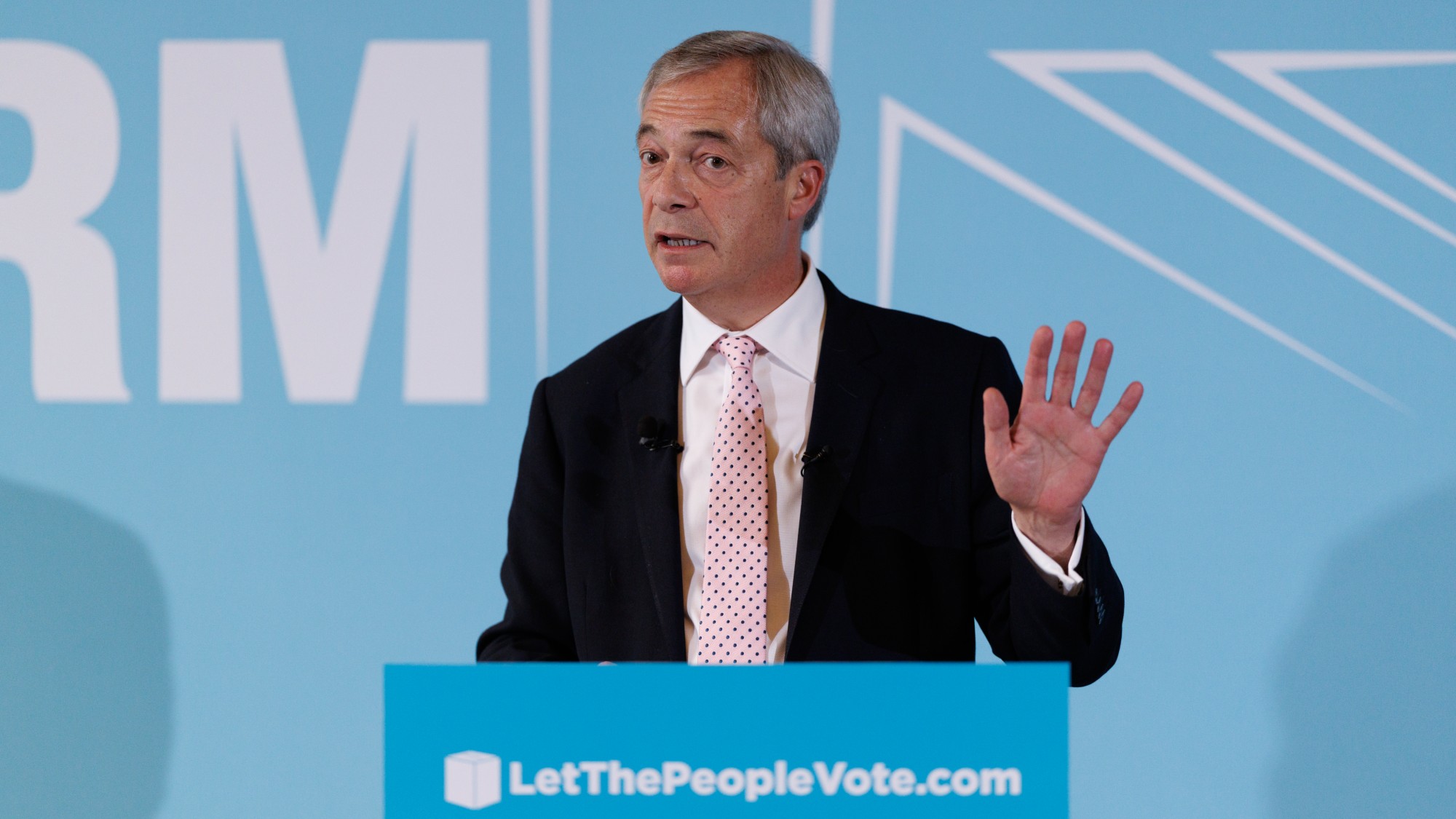
    Farage in the spotlight

    Reform UK has received a record £9 million donation from Christopher Harborne, a British-Thai cryptocurrency mogul, according to the latest quarterly declarations to the Electoral Commission. It’s the largest-ever single donation by a living person to a British political party. News of the gift comes at a time when Reform is leading in the national polls, but has been forced onto the defensive over a series of other, less welcome, stories.

    Last week, Nigel Farage denounced what he called “a false story” in the Financial Times, which reported that he had told donors that he expected “a deal or merger” between his party and the Tories ahead of the next general election. “The idea I’d work with them is ludicrous,” he said. Reform also faced more questions about Farage’s alleged behaviour at school. Twenty-eight former pupils and teachers now claim to have witnessed racist or antisemitic behaviour by him at Dulwich College in south London. Richard Tice, Reform’s deputy leader, said Farage’s accusers were peddling “made up twaddle”. Farage has admitted that he was “offensive” at school, but insists he never made comments “with malice”. He angrily accused the BBC of “double standards and hypocrisy”, saying it should apologise for all the politically incorrect programmes it broadcast during the same era, such as “The Black and White Minstrel Show” and “It Ain’t Half Hot Mum”. Farage faced separate accusations of racism last week over a campaign video in which he lamented the “cultural smashing of Glasgow”, citing the recent finding that nearly one in three school pupils in the city speak English as a second language. The comment prompted Keir Starmer to call Farage a “toxic, divisive disgrace”.

    This week, it emerged that Farage had been reported to the police over claims of falsified election expenses. A former member of his campaign team, Richard Everett, says the Reform leader exceeded the £20,660 local election spending limit during his successful bid for the Clacton constituency last year by about £9,000, because some costs – including the refurbishment of a Reform-themed bar in the campaign office, and the loan of an armoured Land Rover used in a rally – weren’t declared. A Reform UK spokesman denied any wrongdoing.


    Viewpoint

    Christmas creep

    “I am sure the Christmas creep is getting creepier, as in sooner, every year. The big day is weeks away and yet already it is some sort of miracle to bag a parking place near any town centre. It’s a collective madness. ‘Last minute gifts!’ shouts an email that arrived 25 days before Christmas. ‘Black Friday extended!’ cries another. Winter markets, with their ticky-tacky chalets, are ubiquitous. Ordering a turkey (£85) involves the planning usually reserved for booking a holiday. Everything seems to be at least a week earlier this year. How much earlier can it get? I am afraid to report that, this week, I saw a bunch of Mini Egg packets in a shop. Easter panic soon!”

    Ann Treneman in The Times


    It wasn’t all bad

    Linguistics experts at Aberystwyth University are compiling the first-ever complete dictionary of ancient Celtic languages, reports The Guardian. It won’t be a vast tome, because so much of the written record has been lost, but Dr Simon Rodway and his team hope that, by scouring sources ranging from Julius Caesar’s account of his conquests to ancient memorial stones, they will be able to gather more than 1,000 words, from as far back as 325BC.


    People

    Jessie J

    Just over a decade ago, the singer Jessie J went from being “one of the hottest properties in pop to has-been overnight”, said Simon Hattenstone in The Guardian. She’d had a string of hits between 2011 and 2014, including three No. 1s; but after that, single after single suddenly flopped.

    In a way, she says, failure came as a relief: she was still in her 20s, and welcomed her new-found anonymity. “I don’t love being famous… When I dropped off, I had a shaved head, nobody recognised me, I could go back to doing normal shit.” But she also admits that she lost belief in what she was doing: any music she did make was resolutely uncommercial; and her label had started to lose interest.

    Then, in 2018, she did something completely unexpected: she entered the Chinese talent contest “Singer”. “My managers at the time said, ‘This TV show keeps coming in, and you’d be a special guest,’ and I said, ‘Just say yes to it… I need a shake-up.’” Only when she landed in China did she realise she hadn’t been booked as a special guest at all – but as a contestant. Yet she carried on anyway and, after 11 episodes, got to the final. Watched by 500 million people, she sang “I Will Always Love You”, and won the competition outright. “It was a plot twist,” she has said of her unexpected popularity on Chinese television, “but it turned out to be one of the best experiences of my career.”


    Image credits, from top: Dan Kitwood / Getty Images; Fadel Senna / AFP / Getty Images; Jonathan Brady / WPA Pool / Getty Images; JMEnternational / Getty Images
     

    Recent editions

    • Sunday Shortlist

      A ‘gloriously cheering’ festive treat

    • Saturday Wrap

      Record donation to Reform UK

    • Evening Review

      A rail nightmare before Christmas?

    VIEW ALL
    TheWeek
    • About Us
    • Contact Future's experts
    • Terms and Conditions
    • Privacy Policy
    • Cookie Policy
    • Advertise With Us
    • FAQ
    Add as a preferred source on Google

    The Week UK is part of Future plc, an international media group and leading digital publisher. Visit our corporate site.

    © Future Publishing Limited Quay House, The Ambury, Bath BA1 1UA. All rights reserved. England and Wales company registration number 2008885.