Adult social care is regarded as the most significant unresolved policy issue in Britain. The PM has promised to ‘rip off the plaster’
What’s the problem with social care?
The social care system is fragmented, severely underfunded, and creates stark disparities – particularly in England. Adult social care covers a large range of services given to the frail and disabled, with the two main categories being long-term support for working-age adults with disabilities, and care for older people, which cost roughly similar amounts.
In England in 2024/25, total spending in the area rose to £34.5 billion, a 4% real-terms increase on the year before. Growing costs are driven in part by a fast-ageing society. In 1972 there were around 7.5 million people aged 65 or over in the UK, about 13% of the population. In 2022, there were around 12.7 million (or 19%). Publicly funded social care is provided by local authorities, and mainly outsourced to private providers.
Growing expenditure puts local authorities under severe strain; adult social care now accounts for around 20% of English local authorities’ total spending. In addition, the system is seen as unfair and dysfunctional, placing a heavy burden on the NHS and on carers, paid and unpaid.
Why is the system thought to be unfair?
While “healthcare needs” – cancer, say – are theoretically met in full by the NHS, those with “social care needs” – trouble with eating, washing, mobility etc. – who have even fairly modest means have to pay for care themselves (although the dividing line between the two categories is often unclear). With health, the costs are shared across society; with care, the unlucky ones can face catastrophically large bills. The Department of Health and Social Care estimates that around a third of all over-65s in England need social care of some kind, and that about one in seven individuals over the age of 65 will face lifetime care costs exceeding £100,000.
How exactly does the system work?
First, the local council will conduct a needs assessment. Then there is a means test. In England and Northern Ireland, in most cases only people with assets worth less than £23,250 get any state support (income such as pensions is included in the calculation). Below that, there is a sliding scale: those with £14,250 or less receive full funding.
The value of a home is ignored for at-home care but usually included if the person has to move into residential care, unless a spouse continues living there. Care at home costs perhaps £20-£35 per hour, though the fees can be much higher. Residential care, for self-funders, costs on average £1,460 per week for the basics, according to healthcare data provider LaingBuisson.
In many parts of the country it is higher than that. In Wales, weekly care payments are capped, and the residential care thresholds are higher. In Scotland the system is more generous still: personal care at home is free for those who need it. Residential care is means-tested, though both the upper threshold (£36,750) and lower one (£22,750) are higher, and care costs, as opposed to accommodation and food costs, are met by the local authority.
What is Andy Burnham’s plan?
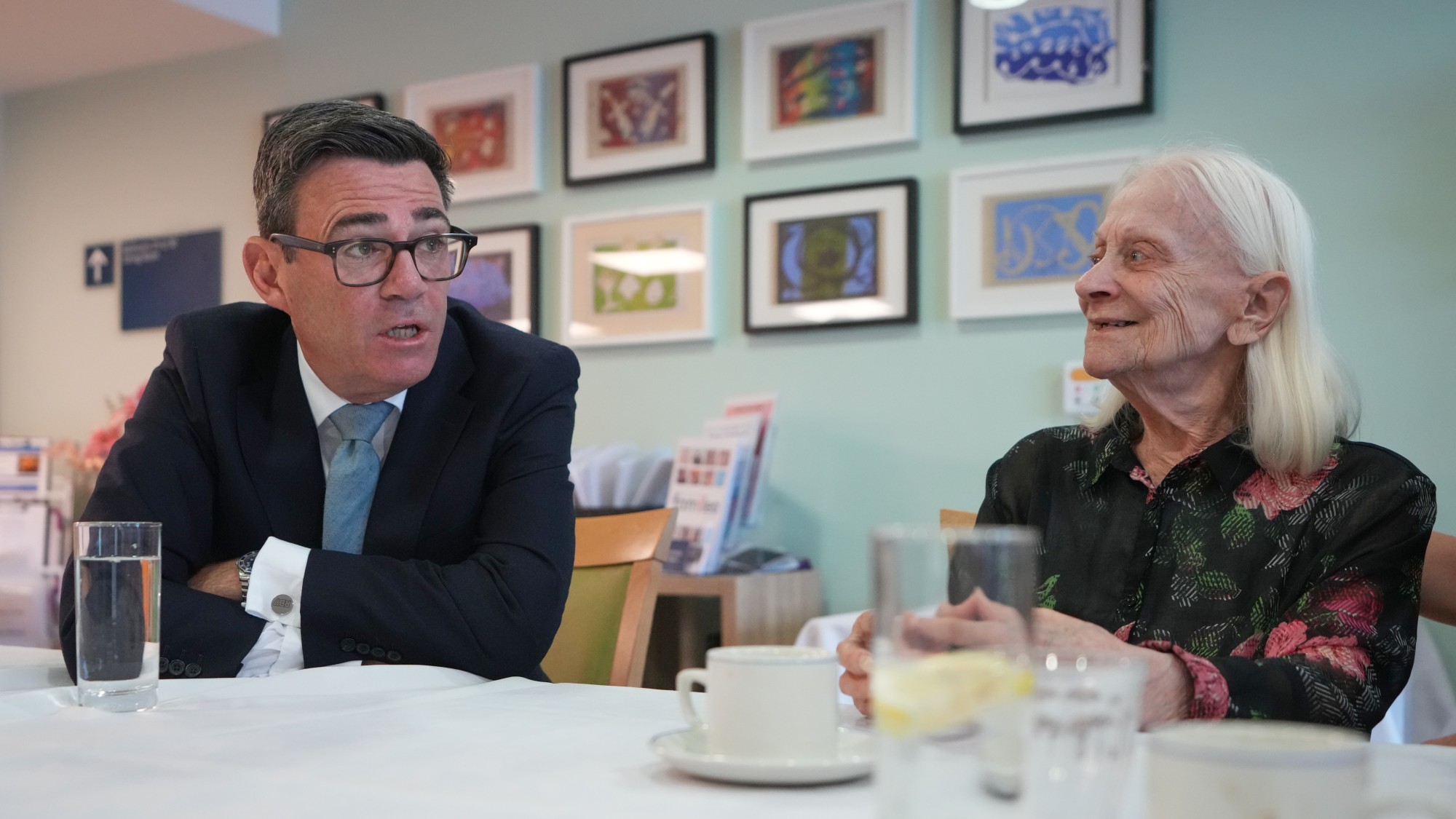
The PM said in his conference speech last week that Labour would create a “National Care Service” for England, along NHS lines: free at the point of use, funded from general taxation, “where everyone contributes and everyone is covered”. The service will not be created until the next parliament, and the full plan won’t even be unveiled until Louise Casey has published her report next year, but we know it will follow the Scottish approach: offering free personal care at home, with those in residential care paying for “bed and board” costs only. Though much more generous – and more expensive – than the English system, this could still leave people very exposed to high costs. Average costs for bed and board alone often reach £1,300 a week.
How could such people be protected?
That would require either a full, wall-to-wall National Care Service, with residential care free at the point of use and funded by tax (which Burnham has not proposed); or a payment cap. This is a financial limit on how much an individual has to pay for their own personal care over their lifetime. The Dilnot Commission in 2011 suggested that no one should have to contribute more than £35,000 (over £50,000 in today’s money) towards care over their lifetime, nor more than £10,000 per year for bed and board.
How much would all this cost?
It’s hard to say. In 2023, the Health Foundation estimated that a comprehensive NHS-style system for England would cost an extra £18.5 billion per year; while a Scotland-style system would cost £7.5 billion; and a cap on care costs, £4 billion. Burnham announced that the pension triple lock would be replaced after the next election.
But the authoritative Institute for Fiscal Studies has warned that this would not meet the costs of social care. Labour argues that there would be some savings from a decent care system: it would take pressure off the NHS, freeing up perhaps £2 billion a year in the long term, according to the King’s Fund think-tank. But it added that such figures should be treated with caution.
Why hasn’t it been fixed before?
Many governments have tried: there have been three major commissions and dozens of official inquiries since 1997. But politically, it is very difficult, partly because the costs of the current system only fall on a small number of people, so it is not widely regarded as an important issue, while the solutions are unpopular. In 2010, Burnham, then the health secretary, outlined plans for a National Care Service funded from a £20,000 levy on estates at death. This was branded a “death tax”, and Labour lost the election.
At the 2017 election, Theresa May’s Conservative manifesto proposed raising the means-testing threshold from £23,250 to £100,000, but recovering more costs from estates. This “dementia tax”, as it was dubbed, contributed to May’s disastrous campaign. Burnham aims to get “cross-party consensus”.
How other nations pay for care
At present, England’s system is “one of the most threadbare in the developed world”, according to Thea Stein of the Nuffield Trust, which has analysed the arrangements of 11 comparable nations and regions. England is an “outlier” in that eligibility for any public funding at all is strictly means-tested.
The most generous system is in Denmark, where the state pays 100% of care costs, with no means test. Those in residential care do get billed for bed and board, but means-tested housing benefit is available. Australia has a similar system, also funded by general taxation. In most cases, bed and board have to be paid for, but there are a series of daily spending caps on different elements, such as food and hotel costs.
Japan, with the oldest population in the world, introduced a tax on all over-40s in 2000, ring-fenced for care. Everyone who needs it is given a monthly care allowance. They contribute 10%-30% of costs, depending on income; total contributions are capped. A similar insurance system operates in Germany, but with no cap. Individuals usually pay half of costs. Unusually, adult children can (in rare cases) be liable to pay for parents’ care if the parents run out of money.