German artist renowned for his upside-down technique
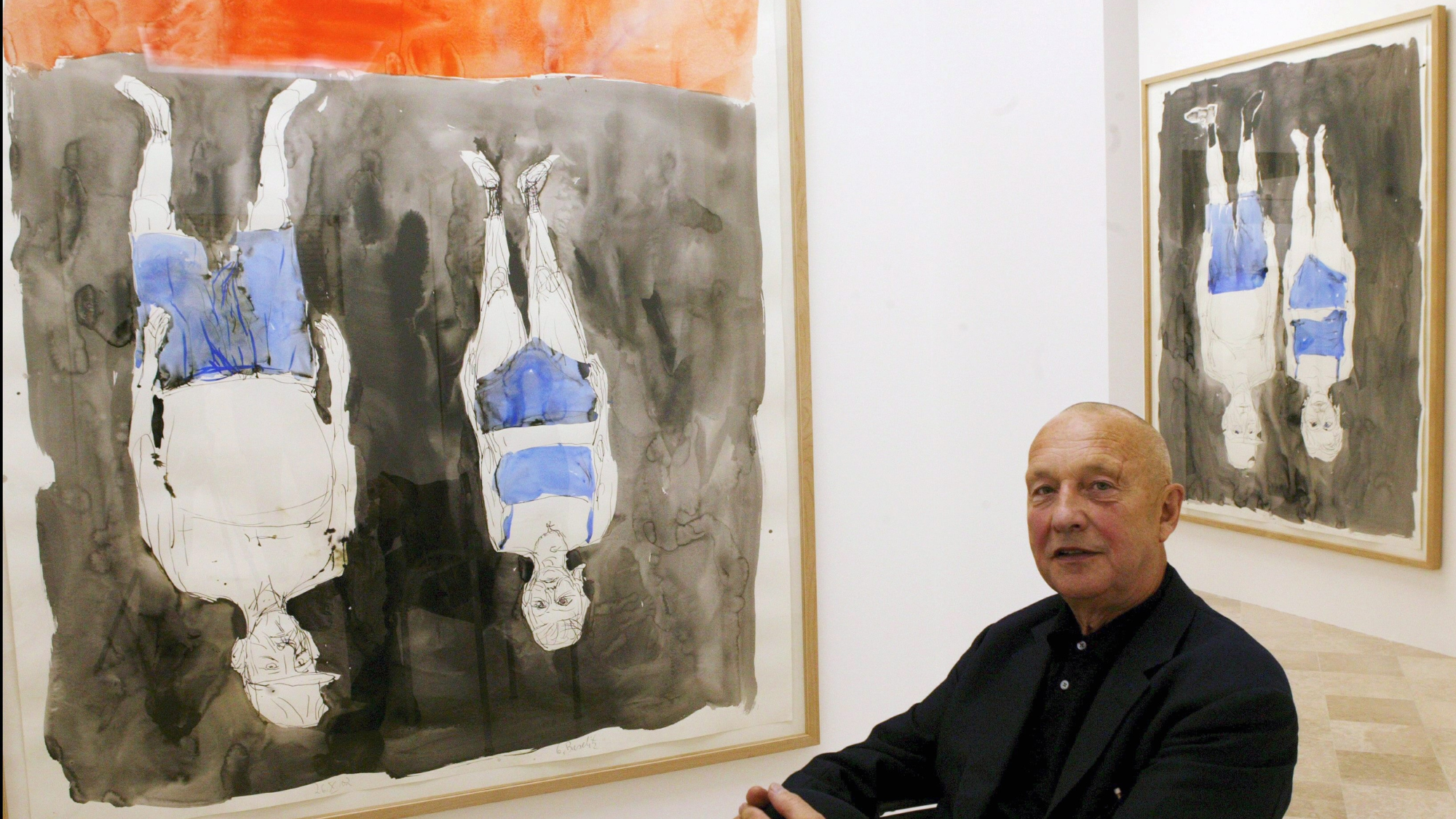
One of the most significant German artists of the postwar era, Georg Baselitz was known in particular for his upside-down paintings. Having grown up under Nazi and communist rule, he’d rejected both the figurative work sanctioned in the GDR and the confident abstractionism dominant in the West, and by turning the world on its head he found a path between them, said The New York Times. Confronted with his inverted images, the viewer was forced to consider the mechanics of the piece – the patterns, the colours, the texture. Dark and often horrifying, his neo-expressionist work “revelled” in raw emotion, and engaged fiercely with the complexities of his country’s recent history. As he put it: “I was born into a destroyed order, a destroyed landscape, a destroyed people, a destroyed society.”
He was born in 1938 as Hans-Georg Bruno Kern in Deutschbaselitz, some 20 miles from Dresden, where his father worked as a teacher, and had joined the Nazi Party. In February 1945, he saw the sky glow red during the firebombing of Dresden; and a few days later, he walked through the city’s smouldering streets with his mother, as she pushed their belongings in a handcart. “The dead, the half-dead, [were] everywhere,” he recalled. “No one … ever said: ‘The British did that,’ because everyone knew we were guilty.” They had hoped to flee the advancing Russians, but ended up trapped in the east, where they lived hand to mouth for a while. Aged 18, he enrolled in an art school in East Berlin, where the only permitted style was socialist realism. Angry and rebellious, he detested this repression, and after a year he was expelled for “sociopolitical immaturity” and was sent to work in a factory. The wall had not yet gone up, however, so he was able then to make his way to West Berlin, to continue his studies there. At this point, he changed his name in honour of his home in Saxony.
In the West, he was inspired by abstract expressionism, but found it ultimately indulgent, said The Times. He took an interest in the raw distorted forms of prewar German artists including Emil Nolde and Ernst Ludwig Kirchner, and also “African tribal art and the art of the mentally disturbed”. He wanted to shock Germany out of its complacency, he said. His first solo show, in 1963, included “The Big Night Down the Drain” – which depicted a shirtless figure, holding a huge penis, as if masturbating. It was seized by the authorities on grounds of public decency, and only returned to him two years later after a court battle. “I am an avant-gardist,” he told Der Spiegel. “What I do is quite aggressive and quite evil.”
After that, he produced his “The Hero” series, images of bedraggled figures in tattered military uniforms. The art critic Norman Rosenthal called them “a tragic mannerist elegy for the lost and burned landscape of Germany”. Then, in 1969, he started exhibiting his upside-down paintings. “The hierarchy where the sky is at the top and the ground down below is only an agreement, one that we have all got used to, but one that we absolutely do not have to believe in,” he said. Many of them featured eagles (symbols of both the Third Reich and the postwar German state) that seemed to be in freefall. He also repeatedly painted his wife, Elke Kretzschmar, upside-down. As well as oils, he produced prints and sculptures hewn out of wood. In 1980, he exhibited at the Venice Biennale a figure based on a West African Lobi carving, which seemed to be delivering a Nazi salute. It caused outrage, and brought him global renown. In 2013 he caused further controversy, by telling an interviewer that women “don’t paint very well”. Yet Baselitz did not seem sexist in person, said Jackie Wullschläger in the Financial Times. Happily married for 64 years, he came across as “gracious, friendly, articulate and independent in mind and spirit”. Elke survives him, with their two sons, who are both gallerists.