Titan of British art who never stopped seeing
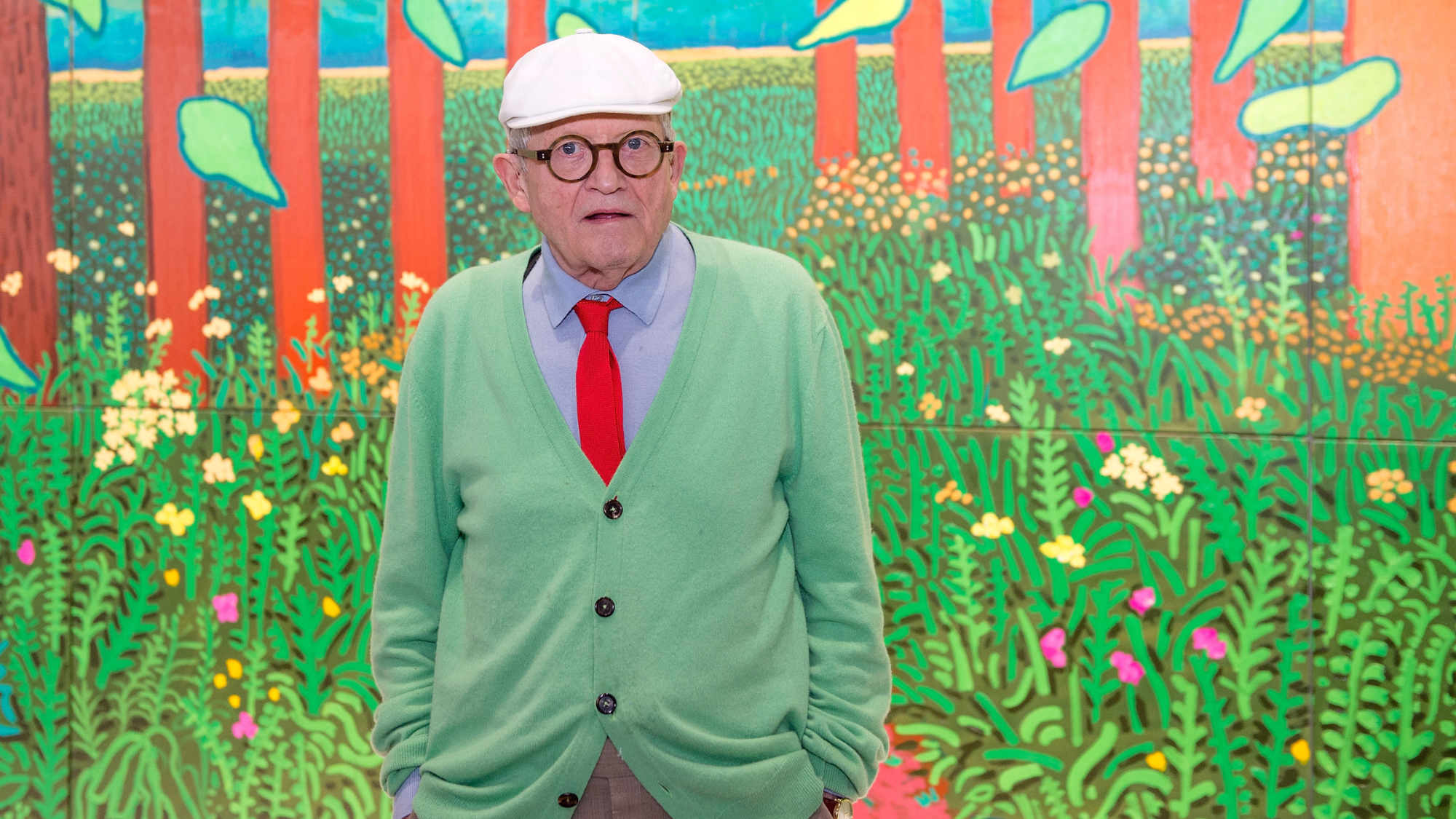
David Hockney, who has died aged 88, was widely considered to have been Britain’s greatest living artist, said The Telegraph: instantly recognisable, with his bleached-blond hair, round glasses, impish smile and “ever-smouldering cigarette”.
What drove him was an intense need to understand “the way the world works, how the eye sees it and how the brush sets it down”, said Laura Freeman in The Times. He worked in oils, acrylics, watercolours, charcoal, pen and ink, pencil, felt-tips, crayons; he produced etchings and drypoints; and made use of Polaroid cameras, Xerox photocopiers, inkjet printers and the iPad. Hockney’s work was not always universally admired by the critics; but his aim, he said, had never been to please a room full of art-world insiders, but to make pictures that were appreciated by a lot of people. And he did. People flocked to his exhibitions; their posters became collectors’ items. In 2018, one of the sun-drenched paintings he produced in California – 1972’s “Portrait of an Artist (Pool with Two Figures)” – became the most expensive artwork by a living artist ever sold at auction, at $90 million (£67 million).
Yet neither his enormous success, nor the glamorous circles in which he moved – in Los Angeles, Paris and London – seemed fundamentally to change him. He retained a deep-seated seriousness about his work and a ferocious dedication to it.
David Hockney was born in Bradford in 1937, the fourth of five children. His mother, Laura, was a devout Methodist and a vegetarian, while his father, Kenneth, an accounts clerk, had been a conscientious objector, and was a militant anti-smoker. From the age of three, Hockney drew where he could – even on the kitchen floor. Years later, he said that being gay in that era had not been as hard for him as it might have been, because he had always felt set apart by his talent. To his parents’ delight, he won a scholarship to Bradford Grammar School and at 16, he was awarded a grant to attend Bradford School of Art. On his first day, he turned up in a suit, bowler hat and red scarf, but while his dress sense was outlandish, his work ethic was even then decidedly Protestant, said Sam Woodhouse on BBC News: he was at his easel for 12 hours a day.
He was taken on by the dealer John Kasmin, who oversaw his production of “A Rake’s Progress”, a series of etchings inspired by a visit to New York in 1961. He’d relished the energy of the city and its more permissive attitudes, and these semi-abstract etchings depicted the rake cruising in Central Park, dyeing his hair and drinking in gay bars. Kasmin marketed them at £250 a set. With the proceeds, Hockney flew back to New York in 1963, and then on to Los Angeles.
His first California picture was 1964’s “Plastic Tree Plus City Hall”, said The Guardian, which celebrated the flat artificiality of LA, what the critic Robert Hughes called its role as a “glaring, over-lit, antiseptic madhouse”. He followed it up with the pool paintings that remain among his most famous, including “Peter Getting Out of Nick’s Pool”, featuring the tan-lined bottom of Peter Schlesinger, his muse and lover, and 1967’s “A Bigger Splash”. In 1973 that work lent its name to a semi-fictionalised documentary about the artist. Shot over three years, it was focused on Hockney’s painful break-up from Schlesinger, his partner from 1966.
The 1980s were a difficult period. As HIV-Aids ravaged LA’s gay community, Hockney saw countless friends and acquaintances fall sick and die. That his hearing was starting to deteriorate left him further isolated. Professionally, he moved away from painting and started to work on his “joiners” – hundreds of photographs that he stitched together to create images that encompassed multiple viewpoints. He called this new cubism. Having produced evocative set and costume designs for “The Rake’s Progress” at Glyndebourne in the mid-1970s, he embarked on major projects for the Metropolitan Opera in New York. More intimately, he painted and drew his beloved dachshunds, Stanley and Boodgie, over and over again.
Meanwhile, he had continued to paint his mother, on his many visits home. She died in 1999, aged 98. A few years later, he left LA and settled in the Edwardian villa overlooking the sea that he had bought for her, in Bridlington. From his studio nearby, he produced a series of monumental paintings of the Wolds landscape. These formed the basis of “A Bigger Picture” – a record-breaking exhibition at the Royal Academy in 2012. The following year tragedy struck when his 23-year-old studio assistant, Dominic Elliott, was found dead in his house after a drink and drugs bender. Hockney – who had been asleep at the time – was devastated. Soon after, he moved to Normandy with his partner of two decades, Jean-Pierre Gonçalves de Lima, where he captured the shifting landscape on an iPad.
Over the years, Hockney was offered countless honours and turned most down – including a knighthood. He did, however, accept the Order of Merit. It was a personal gift from the then-Queen, and he reasoned that it would be ungracious to reject it. Arguably, the honour he most appreciated came in 2007, said Sam Woodhouse. At a dinner at Tate Britain to mark his 70th birthday, it was announced that the smoke alarms would be turned off for 10 minutes at the end, so that Hockney could have a cigarette with his coffee.