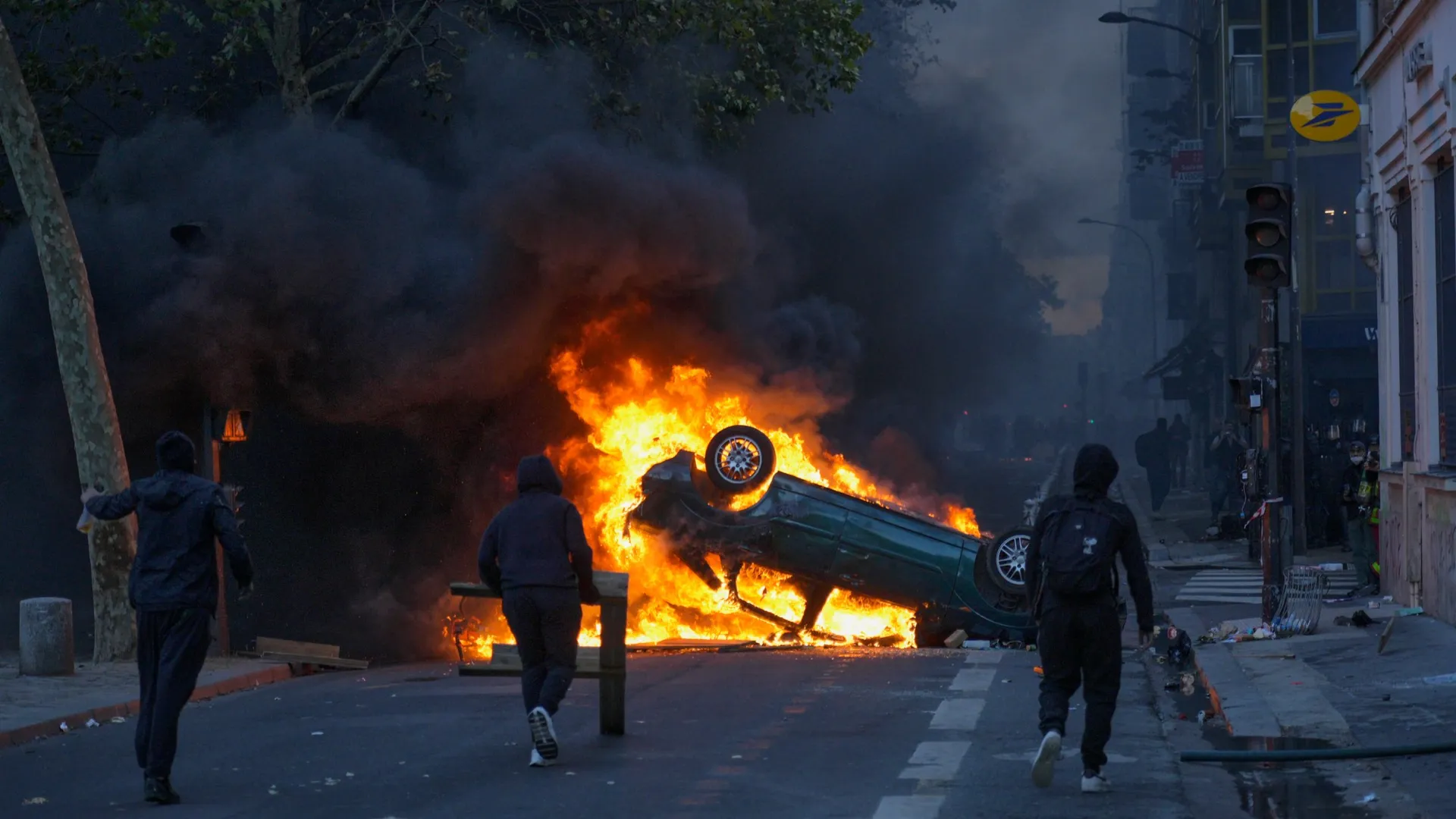
Masked protesters clad in black have been a feature of protests around the world for decades. And the so-called Black Bloc has been back in the news, accused by the French government of turning peaceful protests into violent riots.
‘Do not need a conductor’
Originating among anarchist and radical left activists in West Germany in the 1980s, a Black Bloc is an “anti-establishment protest tactic” used by “temporary groups formed for a specific cause” and operating “without hierarchy,” said Francis Dupuis-Déri, a political science professor at the Université du Québec à Montréal, at The Conversation in 2017.
The strategy spread through activist networks in North America in the 1990s, culminating in the infamous Battle of Seattle during the 1999 World Trade Organization summit. It has since figured in the anti-austerity movements of the 2010s and recent youth-led protests across Asia and South America.
Ideologically identified with “anarchist, anti-capitalist and anti-fascist movements,” participants “eschew political parties,” said the Financial Times. They “pose a big problem” for the police and trade unions, who “do not want chaos to mar” traditional anti-government demonstrations.
These people are “very well coordinated but in a horizontal way,” said Guillaume Farde, a security and defense specialist at the Paris Institute of Political Studies, to the Times. Tactics are disseminated via social media or encrypted messaging apps, and gatherings are often impromptu. They are like members of an “orchestra who know the music so well that they do not need a conductor.”
‘Deploys propaganda’
The “founding fathers” of the Black Bloc were “autonomist and anarchist activists,” said Le Monde, but the “spectrum has broadened” to include more people who “define themselves as free spirits.” For this reason, the movement is difficult to pin down, and police sources cited by the French paper fear that, behind the scenes, “real ideologists are developing a doctrine and structure that unifies and deploys propaganda.”
Others see this as an attempt by the authorities to make the Black Bloc something it’s not. The Black Bloc “doesn’t mean anything,” said Henri, a 40-year-old who doesn’t define himself as an anarchist or extreme leftist, to Le Monde. It’s “just because it’s not distinctive. It’s the best way not to be identified. We are all in the same boat.” |