The Week The Week
flag of US
US
flag of UK
UK
https://cdn.mos.cms.futurecdn.net/flexiimages/jzblygzdxr1769609154.gif

SUBSCRIBE

Try 6 weeks free

Sign in
  • View Profile
  • Sign out
  • The Explainer
  • Talking Points
  • The Week Recommends
  • Podcasts
  • Newsletters
  • From the Magazine
  • The Week Junior
  • More
    • Politics
    • World News
    • Business
    • Health
    • Science
    • Food & Drink
    • Travel
    • Culture
    • History
    • Personal Finance
    • Puzzles
    • Photos
    • The Blend
    • All Categories
  • Newsletter sign up Newsletter
  • Brand Logo
    AI lawfare, NYC bomb charges and sex-trafficking conviction

     
    TODAY’S AI story

    Anthropic sues Pentagon to lift blacklisting

    What happened
    Anthropic yesterday sued Defense Secretary Pete Hegseth, the Defense Department and several other federal agencies in federal court, arguing that the administration’s move to blacklist the AI firm as a national security risk was “unprecedented and unlawful.” The Constitution “‌does not allow the government to wield its enormous power to punish a company for its protected speech,” Anthropic said. 

    Hegseth last week formally designated the company a “supply chain risk” over Anthropic’s insistence that its AI tool Claude not be used for autonomous lethal weapons or mass surveillance of Americans. President Donald Trump said on social media that all federal agencies must stop using Claude within six months. 

    Who said what
    The supply-chain risk designation “effectively cuts off Anthropic’s work with the Defense Department” and its contractors, The New York Times says, and it “has never been used on an American company.” The label is “usually reserved for Chinese and Russian firms suspected of helping foreign spies,” The Washington Post said. The Pentagon’s “unprecedented step” came “even as Anthropic’s tools were playing a central role” in “Trump’s bombing campaign in Iran.” 

    “It is absurd for the government to argue that Anthropic is the kind of company meant to be addressed by this statute,” especially when the Pentagon “has repeatedly sought to obtain Anthropic’s services for national defense,” Georgetown University law professor Mark Jia told the Post. It would be “perfectly reasonable” for the Pentagon to cancel its contracts with Anthropic because they don’t believe a private company should set policy or determine when “autonomous lethal weapons are ready for prime time,” Dean Ball, a former Trump White House AI policy adviser, said on “The Ezra Klein Show.” But they don’t have the “statutory power” to “completely destroy the company” in “a kind of political assassination.” 

    What next?
    The White House is “preparing an executive order formally instructing the federal government to rip out Anthropic’s AI from its operations,” Axios said, and it “could be issued as soon as this week.” Anthropic’s “standoff with the Defense Department has cost it Uncle Sam as a customer,” The Wall Street Journal said, but it has also brought a “surge of public goodwill” and a “momentary advantage in the ferocious talent war between rival artificial intelligence labs.”


    TODAY’S Law ENFORCeMENT story

    Failed NYC bombing inspired by ISIS, police say

    What happened
    Two Pennsylvania teenagers who threw homemade explosive devices at a far-right anti-Islam rally outside the New York City mayor’s official residence on Saturday told police they were inspired by the Islamic State (ISIS), New York officials and federal prosecutors said yesterday. The incident is being investigated as an “act of ISIS-inspired terrorism,” New York Police Commissioner Jessica Tisch said at a press conference alongside Mayor Zohran Mamdani (pictured above). Mamdani, the city’s first Muslim mayor, was not at Gracie Mansion during the protest or failed attack. 

    Who said what
    Emir Balat, 18, and Ibrahim Kayumi, 19, were charged in federal court yesterday with using a weapon of mass destruction, transporting explosives across state lines and other crimes. Balat is accused of throwing two jars filled with screws, bolts and a “dangerous and highly volatile homemade explosive that has been used in IED attacks around the world,” Tisch said. Neither bomb ignited. 

    Under questioning, Kayumi said he had watched ISIS propaganda “and was partly inspired to carry out his actions that day by ISIS,” according to the criminal complaint, while Balat volunteered that he wanted to “carry out an attack bigger than the Boston Marathon bombing.” The two teens are accused of “committing a heinous act of terrorism and proclaiming their allegiance to ISIS,” Mandami said in a statement, and “they should be held fully accountable for their actions.” 

    What next?
    City officials said there is “no evidence” that the attempted bombing was “linked to the war in Iran,” said NPR. A federal magistrate ordered Balat and Kayumi detained until their next court appearance on April 8. 


    TODAY’S CRIME Story

    Star real estate brothers convicted of sex trafficking

    What happened
    A federal jury in Manhattan yesterday found former star real estate brokers Oren and Tal Alexander and their brother Alon guilty on all 10 counts of sex trafficking and related crimes. During a five-week trial, prosecutors said the Alexander brothers worked together to drug and rape scores of women, including minors, from at least 2008 to 2021. Eleven women testified that one or more of the brothers had sexually assaulted them, and jurors were shown a video Oren Alexander (pictured above with Alon) recorded of himself raping an incapacitated 17-year-old girl in 2009.

    Who said what
    The verdict “caps the downfall” of Tal, 39, and Oren, 38, “the highflying real-estate agents who once brokered some of the country’s priciest transactions in New York, Aspen and Miami,” The Wall Street Journal said. Alon, Oren’s twin, worked at the family’s security business. The victims “testified that they met the brothers at nightclubs, parties and on dating apps,” The Associated Press said, then “were attacked after accepting their invitations to all-expense paid getaways.” 

    Defense lawyers “argued that the brothers were playboys and womanizers but not criminals,” The New York Times said. They unsuccessfully “cast the victims as a bloc of scorned women, all motivated by shame, regret and greed.” The jurors saw the Alexanders’ conduct “for what it was — calculated, brutal sexual abuse that, unimaginably, the defendants celebrated,” U.S. Attorney Jay Clayton said in a statement.

    What next?
    “We believe in our clients’ innocence,” Marc Agnifilo, a lawyer for Oren Alexander, said after the verdict. “We’re going to keep fighting.” U.S. District Judge Valerie Caproni set sentencing for Aug. 6. The brothers, incarcerated since their 2024 arrests, face up to life in prison.


    It’s not all bad

    Artist S.C. Mero built the Electrical Box Theater on a downtown Los Angeles street so all creatively minded people can have a place to perform. It is 6 feet tall and 3 feet deep, with a red velvet door. From the outside, it looks like a typical electrical box, which appeals to people who are “intimidated to get up on a stage,” Mero told the Los Angeles Times. Experimental musicians, poets and clowns have already put on impromptu performances at the box.


    Under the radar

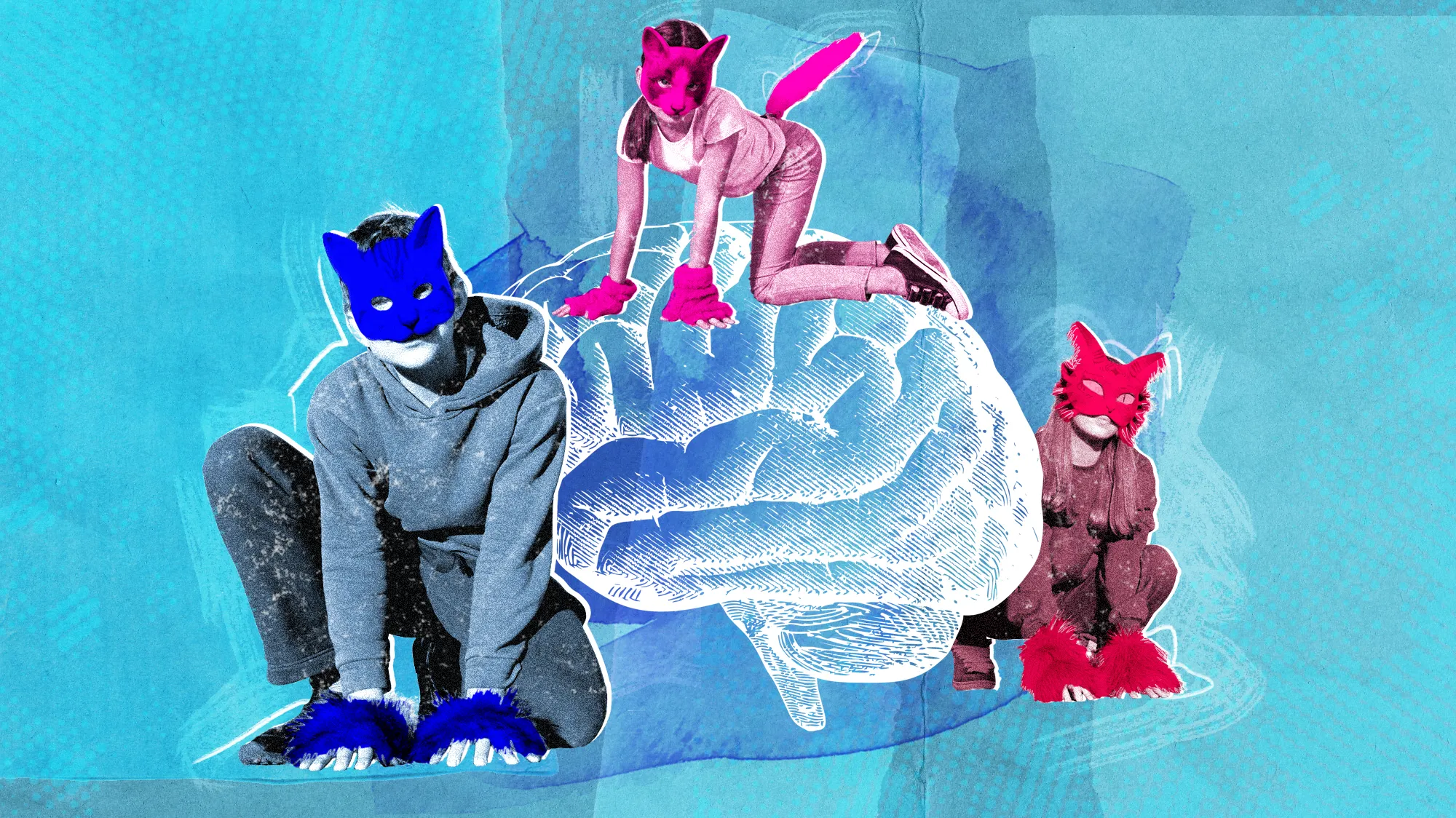
    Therians: the humans who identify as animals

    Some humans are living out their animal instincts through the therian movement. A small online subculture, therians claim to have a nonhuman identity, and they embrace it in their everyday lives. 

    A therian is a person who “identifies as a nonhuman animal on an integral, personal level,” said the Therian Guide website. Many also adopt animal-like behaviors or characteristics, or “identify as something animalistic which may not have existed on Earth.” The trend has been most popular in Uruguay and Argentina but has been expanding to other parts of Latin America.

    The term “therian” is a shortening of the Greek term “therianthrope,” meaning half-human, half-animal. The label began to “circulate in the 1990s on internet forums,” said Euronews. It “grew discreetly, almost clandestinely, through mailing lists and websites of the pre-Facebook era.” 

    With the rise of social media, the community has become more public on TikTok, Instagram and YouTube. “The therian phenomenon is a perfect example of how algorithms and social media, with a mixture of political interest and morbid curiosity, can fabricate a news story out of thin air,” Adrián Juste, an analyst at Spain’s Al Descubierto think tank, told El País.

    Critics suggest the movement “may be a response to experiences of alienation, low self-esteem or a search for community,” said Al Día. Still, the attraction to therianthropy is not inherently harmful. “If the experience does not affect a young person’s ability to form relationships, attend school or maintain healthy routines, there is no reason to automatically pathologize it.”


    On this day

    March 10, 1876

    The first successful telephone call was made between Alexander Graham Bell and his assistant Thomas Watson. It lasted just a few seconds, with Bell saying, “Mr. Watson, come here. I want to see you.” In the 150 years since, telephones have evolved from wall-mounted, hand-cranked devices to today’s pocket-sized smartphones.


    TODAY’S newspaperS

    ‘No indication of yielding’

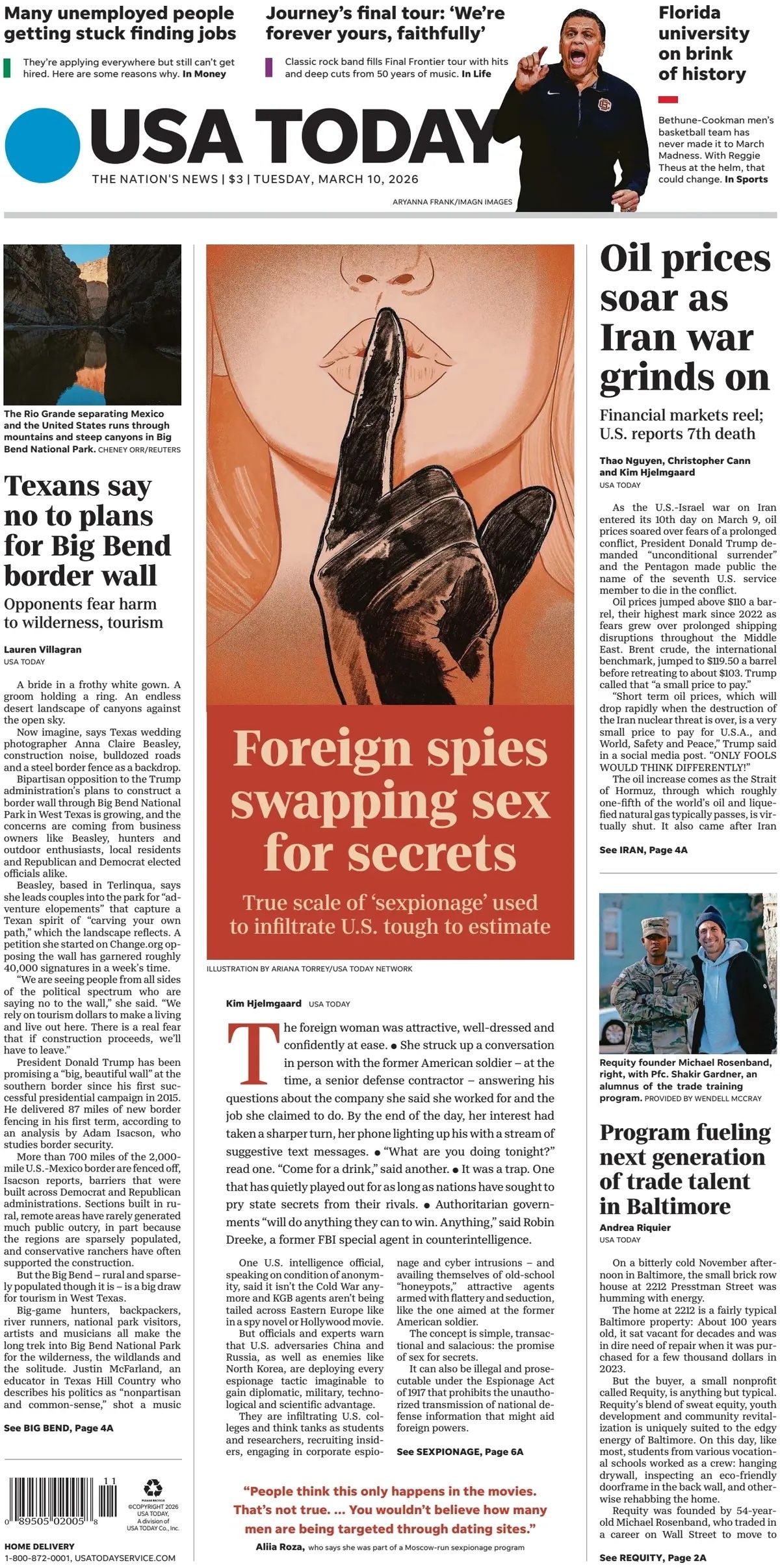
    “World economies begin to see blowback of U.S. war in Iran,” The New York Times says on Tuesday’s front page. “Oil prices spike as Iran war deepens,” says The Minnesota Star Tribune. “U.S.-Iran war spikes gas prices,” The Atlanta Journal-Constitution says. “Tehran regime gives no indication of yielding amid war’s heavy toll,” The Wall Street Journal says. “Live Nation agrees to antitrust deal, changes,” the Los Angeles Times says. “Push to fill federal jobs is on after cuts,” reversing “Musk-led purge,” The Washington Post says. “Foreign spies swapping sex for secrets,” says USA Today. “Charlie Kirk bills fail to advance,” The Oklahoman says. “Psychedelics saved the Victorians,” says the San Francisco Chronicle. 

    ► See the newspaper front pages


    Tall tale

    Think inside the box

    In Japan, people are climbing into coffins for 30-minute meditation sessions. The coffins “look surprisingly friendly,” said Vice, decorated with cute fabrics and adornments. At the Tokyo relaxation salon Meiso Kukan Kanoke-in, patrons are invited to settle in and spend their time in the box reflecting on life “through being conscious of death.” They also get to decide if they want an open or closed casket and have the choice of listening to music or resting in silence.


    Morning Report was written and edited by Nadia Croes, Catherine Garcia, Scott Hocker, Anya Jaremko-Greenwold, Justin Klawans, Rafi Schwartz, Peter Weber and Kari Wilkin, with illustrations by Stephen Kelly and Julia Wytrazek.

    Image credits, from top: Joel Saget / AFP via Getty Images; Lloyd Mitchell / Bloomberg / Getty Images; Matias J. Ocner / Miami Herald / Bloomberg via Getty Images; Illustration by Marian Femenias-Moratinos / Getty Images
     

    Recent editions

    • Evening Review

      How will the Iran war end?

    • Morning Report

      Ali Khamenei’s son Mojtaba becomes Iran’s new leader

    • Sunday Shortlist

      Ian McKellen’s ‘fascinating’ portrait of LS Lowry

    VIEW ALL
    TheWeek
    • About Us
    • Contact Future's experts
    • Terms and Conditions
    • Privacy Policy
    • Cookie Policy
    • Advertise With Us
    • FAQ
    Add as a preferred source on Google Add as a preferred source on Google

    The Week UK is part of Future plc, an international media group and leading digital publisher. Visit our corporate site.

    © Future Publishing Limited Quay House, The Ambury, Bath BA1 1UA. All rights reserved. England and Wales company registration number 2008885.