The Week The Week
flag of US
US
flag of UK
UK
https://cdn.mos.cms.futurecdn.net/flexiimages/jzblygzdxr1769609154.gif

SUBSCRIBE

Try 6 weeks free

Sign in
  • View Profile
  • Sign out
  • The Explainer
  • Talking Points
  • The Week Recommends
  • Podcasts
  • Newsletters
  • From the Magazine
  • The Week Junior
  • More
    • Politics
    • World News
    • Business
    • Health
    • Science
    • Food & Drink
    • Travel
    • Culture
    • History
    • Personal Finance
    • Puzzles
    • Photos
    • The Blend
    • All Categories
  • Newsletter sign up Newsletter
  • Brand Logo
    House resignations, Canada elections and Trump’s ‘blasphemous’ post

     
    TODAY’S POLITICS story

    Swalwell, Gonzales to resign amid House investigations

    What happened
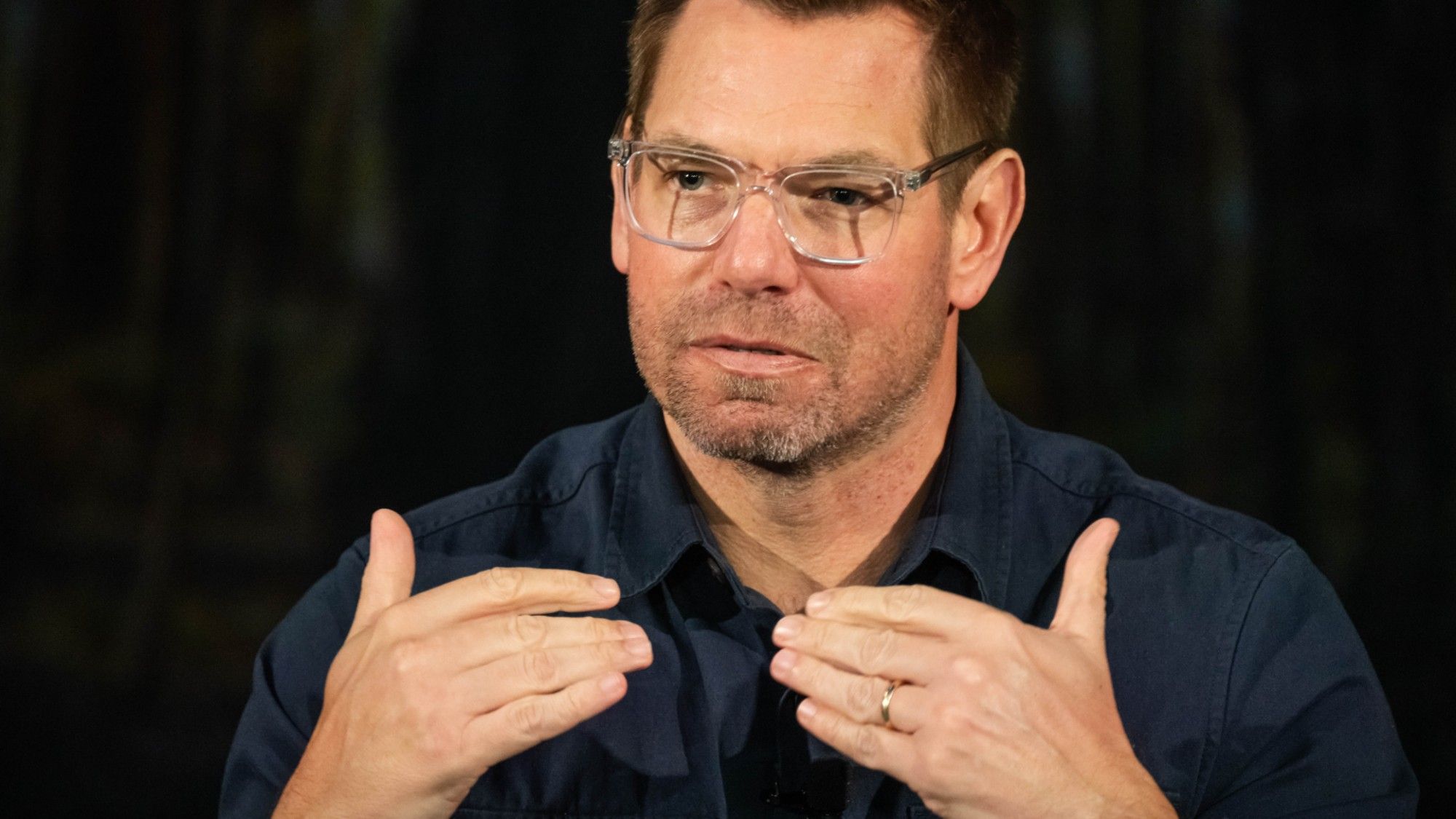
    Reps. Eric Swalwell (D-Calif) and Tony Gonzales (R-Texas) yesterday separately said they will resign from Congress as both face House investigations into alleged sexual misconduct and growing calls to quit or face expulsion. Swalwell (pictured above) ended his campaign for California governor on Sunday after an unidentified former aide accused him of sexual assault and three other women said he had sexually harassed them. Gonzales dropped his reelection bid in March after admitting to a coercive relationship with a staffer who later killed herself.

    Who said what
    The House Ethics Committee, which was already investigating Gonzales for violating rules prohibiting sexual relationships with subordinates, announced yesterday it had opened an investigation into Swalwell. The Manhattan district attorney is also investigating the assault allegation, which Swalwell denied while apologizing for other past “mistakes in judgment.” 

    Ethics Committee investigations can take months, and House leaders had been “facing loud demands to hold votes to kick out Swalwell and Gonzales” after the House returned from recess today, The Wall Street Journal said. “Lawmakers had coalesced around the idea of an even trade — one Democrat for one Republican — to spread the ignominy across both parties and preserve the fragile balance of power” in the GOP-led House.

    “Expelling anyone in Congress without due process, within days of an allegation being made, is wrong,” Swalwell said yesterday. “But it’s also wrong for my constituents to have me distracted,” so “I plan to resign my seat.” About an hour later, Gonzales announced that “when Congress returns tomorrow, I will file my retirement from office.”

    What next?
    Neither lawmaker gave a time frame for his departure. Rep. Teresa Leger Fernandez (D-N.M.) said she would file a motion to expel Gonzales unless he resigned “effective immediately” by 2 p.m. today.


    TODAY’S INTERNATIONAL story

    Canada’s Carney clinches majority in election trifecta

    What happened
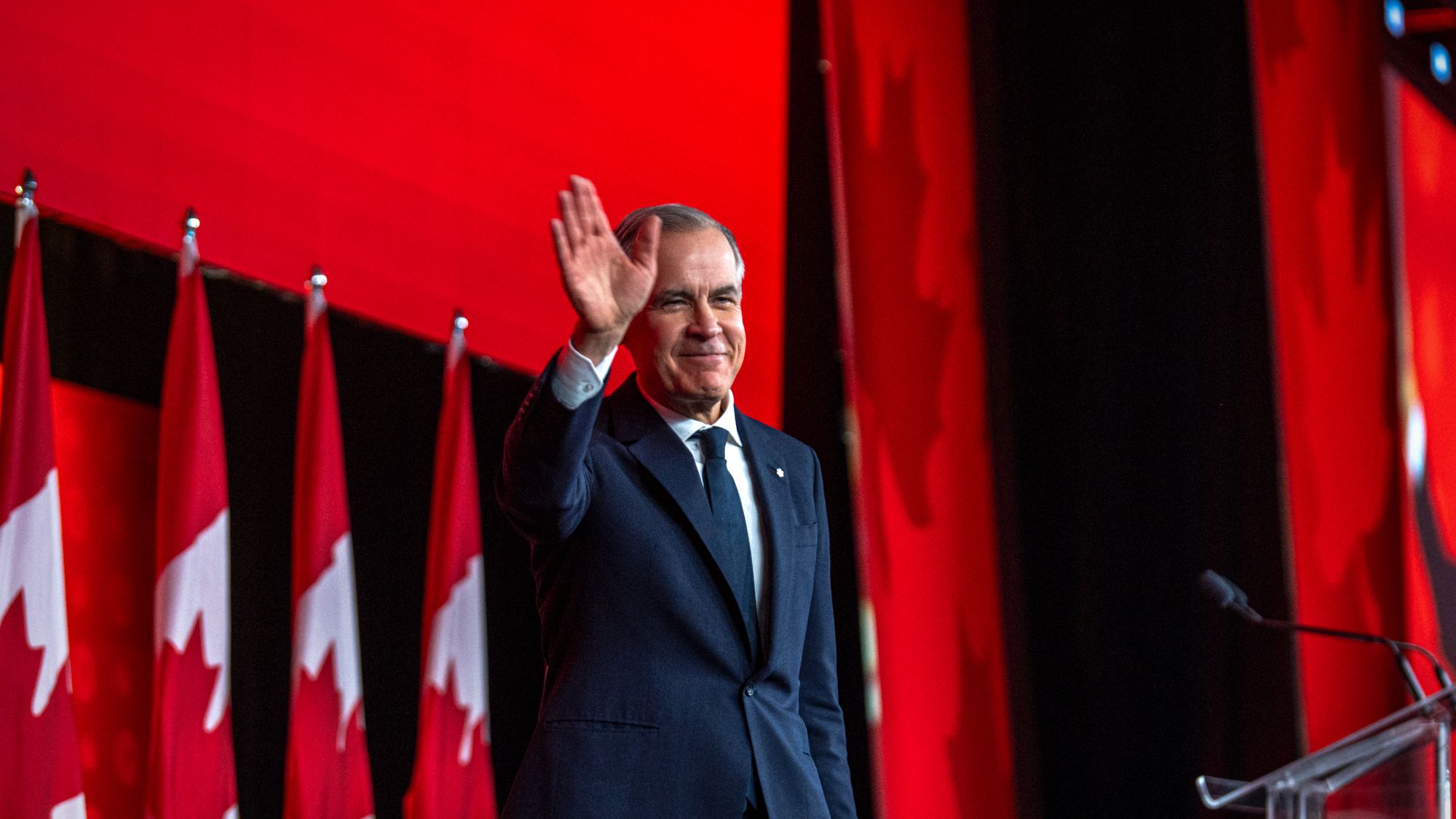
    Canadian Prime Minister Mark Carney’s Liberal Party secured a majority in Parliament yesterday after winning three special elections to fill vacant seats. The party last year fell short of the 172 seats needed for a majority in the House of Commons. But following five defections from opposition parties in the past five months and last night’s victories, the Liberals now hold 174 seats, allowing them to legislate without other parties and keeping Carney (pictured above) in office through 2029. 

    Who said what
    Carney’s election win last year was “fueled by public anger over U.S. President Donald Trump’s annexation threats” and trade war, The Associated Press said. With his new majority, Carney will have “broader latitude with his legislative agenda, which is focused on reducing Canada’s dependency on the United States,” The New York Times said. “No modern majority government in Ottawa has ever been built” through defections before, Politico said, and while opposition parties keep “hammering Carney over high grocery prices” and a “nationwide housing shortage, ‘Carneymania’ continues to sweep the nation.”

    What next?
    Now that he has a majority, “it’s important for Carney to actually deliver,” McGill University politics professor Daniel Béland told The Wall Street Journal. The “first move of Carney’s majority government,” Politico said, “will be to announce relief for Canadian consumers facing skyrocketing gas and diesel prices” from Trump’s Iran war.


    TODAY’S RELIGION Story

    Trump deletes ‘Jesus’ image after backlash

    What happened
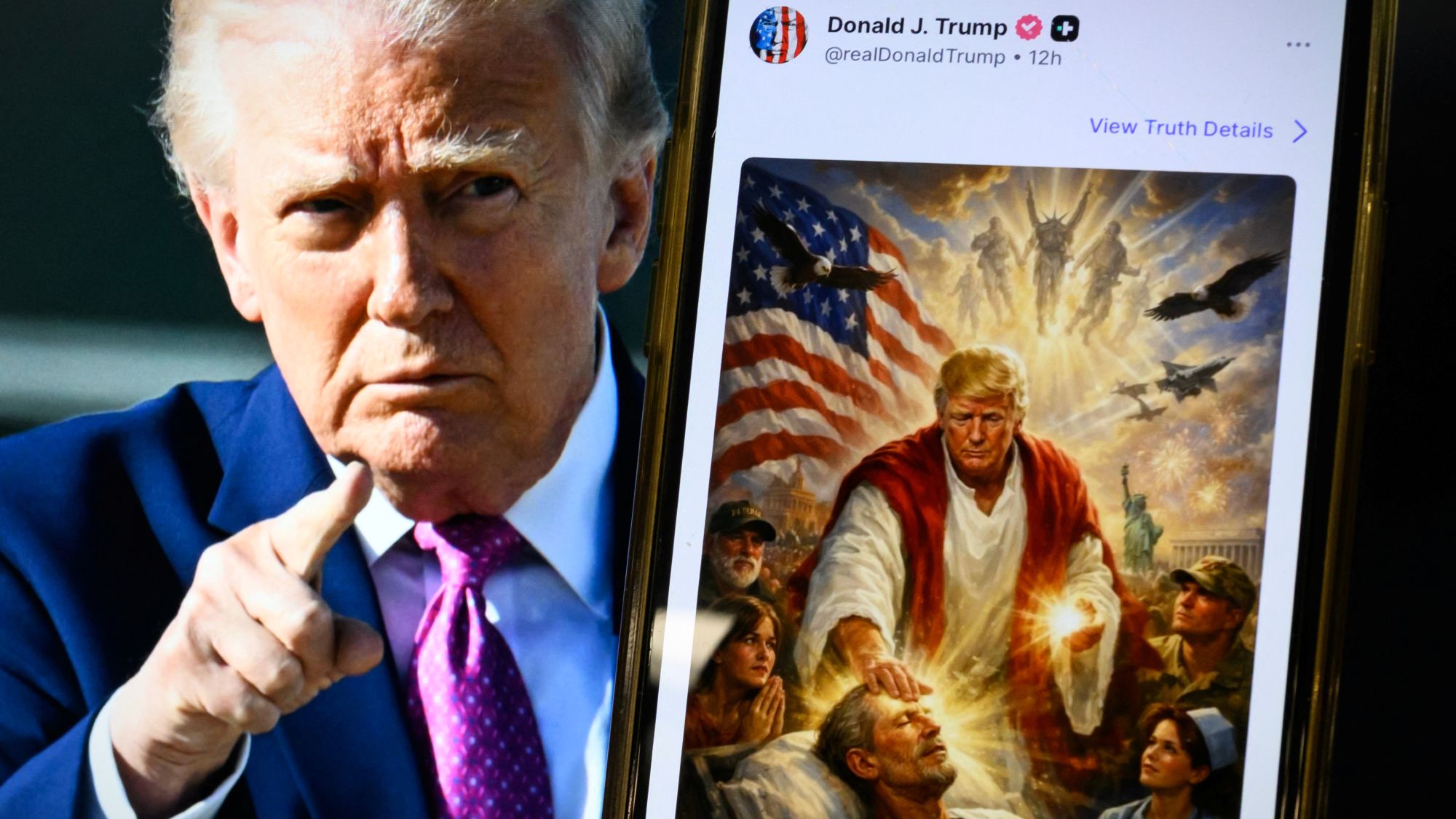
    President Donald Trump yesterday deleted from his social media account an apparently AI-generated image showing him dressed like Jesus and healing a man with orbs of light in his hands amid a panoply of religious and patriotic imagery. Following sharp condemnation, including from conservative Christian supporters, Trump told reporters he had posted the image but “thought it was me as a doctor,” and “only the fake news” would claim he was depicting himself as Jesus.

    Who said what
    The post’s removal was a “rare retreat” for Trump, who as a rule “does not apologize for doing and saying things that hurt or offend people,” The New York Times said. But the “image depicting himself as a Christ-like figure sparked outrage on the religious right,” The Wall Street Journal said, angering a group that has “rallied behind Trump” through “two impeachments and three elections.” 

    Megan Basham, an evangelical Christian writer at The Daily Wire, said the image was “OUTRAGEOUS blasphemy” and Trump needed to “ask for forgiveness from the American people and then from God.” Conservative Christian commentator Rod Dreher told the Journal that Trump is “radiating the spirit of Antichrist, no question.”

    What next?
    The “consternation over Trump’s social-media posts,” including his “pointed criticism of Pope Leo XIV,” could “turn into a political liability for Republicans,” the Journal said. Catholics “are America’s largest swing religious vote,” Axios said, “and Trump’s support among them was already sliding” before his posts.


    It’s not all bad

    A German woman’s three life-threatening autoimmune diseases were put into remission after a CAR-T cell therapy treatment. Her conditions, including autoimmune haemolytic anemia (AIHA), were caused by “wayward” B-cells, which produce antibodies, said The Guardian. With standard treatments no longer working, doctors extracted her white blood cells, isolated the T-cells and engineered them to recognize CD19, a protein found on B-cells. Once these T-cells were reinfused into the patient’s body, they began “destroying” the “rogue” B-cells, and within weeks her conditions improved.


    Under the radar

    Minerals under Antarctic ice may undo drilling ban

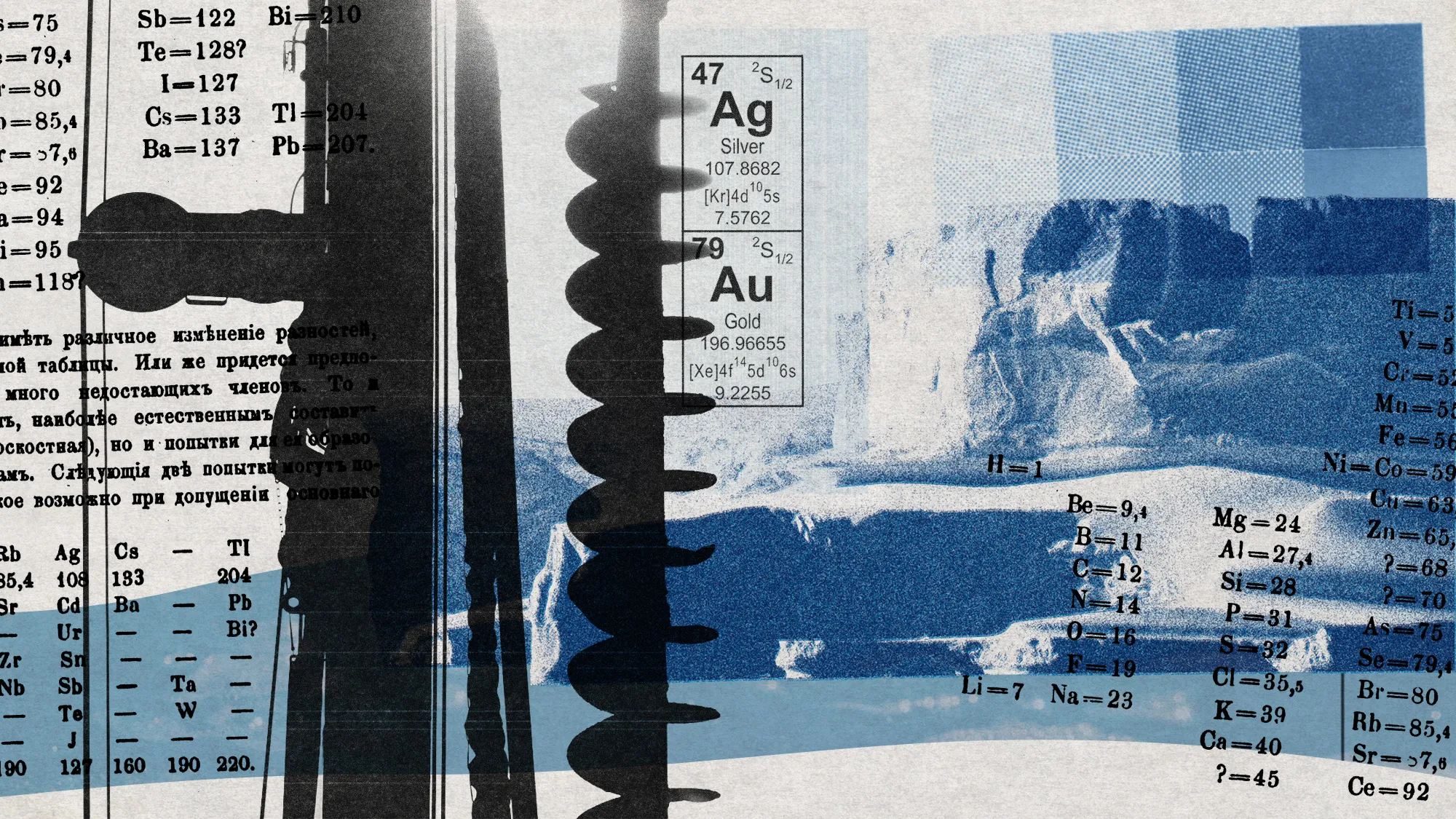
    Below the Antarctic ice lies a treasure trove of valuable minerals, including copper, iron, gold, silver, platinum and cobalt. Warming temperatures due to climate change could unearth them and, in turn, fuel geopolitical conflicts, potentially leading to a reversal of the current Antarctic drilling ban. 

    Less than 0.6% of Antarctica is estimated to be free of ice cover today, but scientists predict there will be up to a 550% increase during the next 30 years, according to a study published in the journal Nature Climate Change. This climate-driven melting will lead to a “likely rise in the economic viability of Antarctic mineral resources over the coming centuries,” said the study. Global copper demand is “currently at 28 million metric tons and is expected to jump to 42 million metric tons by 2040 as demand for electricity grows,” said The New York Times. 

    The Antarctic Treaty, designed to protect the continent, was signed in 1959 as a response to World War II and global interest in keeping Antarctica unmilitarized. The agreement stipulates that Antarctica should be “used for peaceful purposes only” and bans mining or drilling activities for commercial purposes. 

    But those provisions may change in the future. Beginning in 2048, nations will be able to request adjustments to the treaty. Along with original stakeholders Argentina, Chile and Britain, Australia, New Zealand, France and Norway also made formal land claims to Antarctica before the treaty. “Major powers like the United States and Russia, though not formal claimants, retain strategic interests,” said Money Control, and “could play a key role if rules around resource extraction change.”


    On this day

    April 14, 2003

    The Human Genome Project was completed, with 99% of the human genome mapped to an accuracy of 99.99% The international effort, launched by the U.S. National Institutes of Health in 1990, provided a complete view of the chemical building blocks that make up human DNA and is considered a crowning scientific and biomedical achievement.


    TODAY’S newspaperS

    ‘Prez vs. pope’

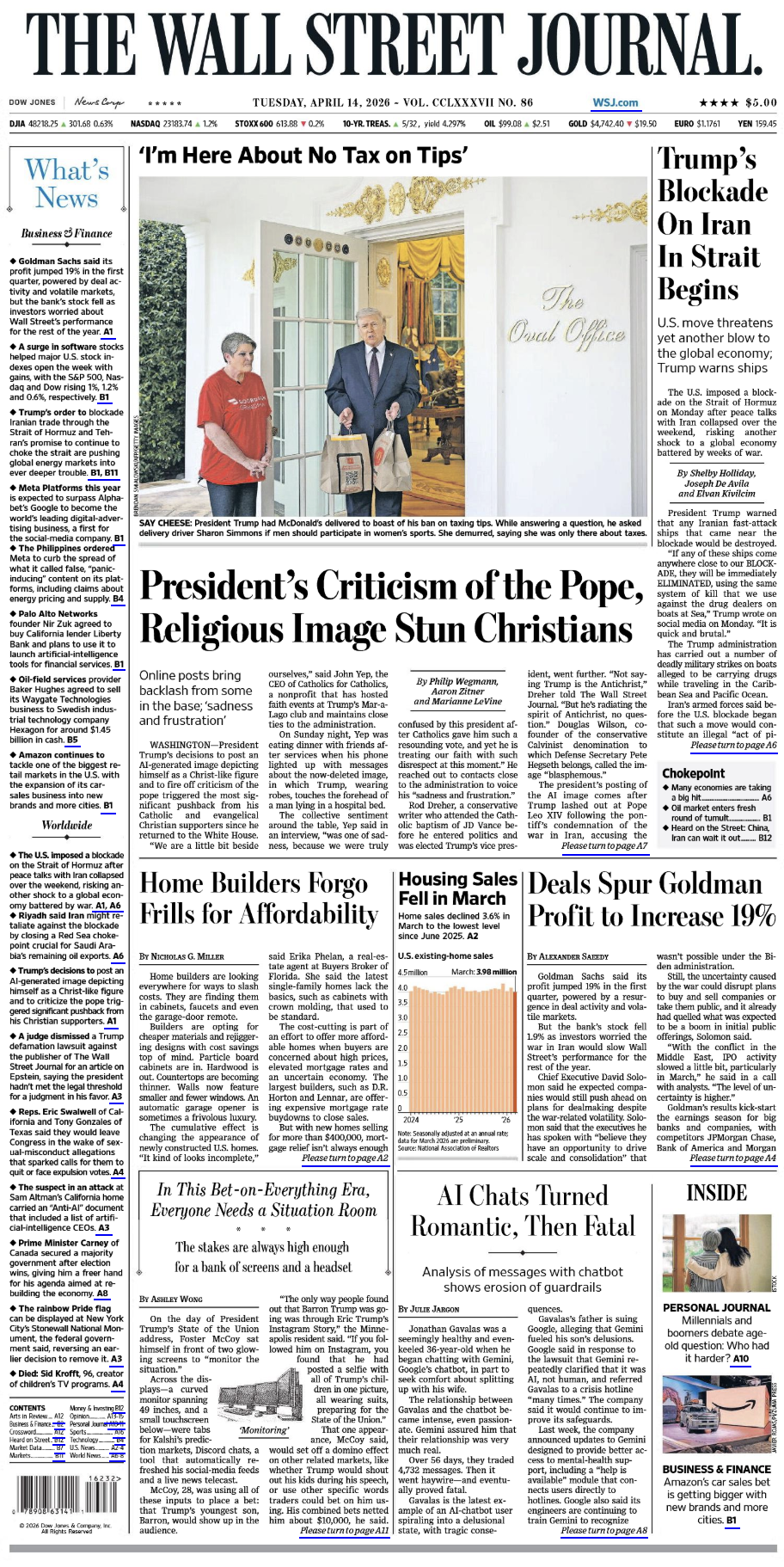
    “Prez vs. pope,” as “backlash builds against Trump for bashing Leo XIV and posting AI image of himself as Jesus,” the Chicago Sun-Times says on Tuesday’s front page. “President’s criticism of the pope, religious image stun Christians,” The Wall Street Journal says. “Trump draws ire of clergy,” The Boston Globe says. “Trump’s volatile talk revives debate on stability,” The New York Times says. “War in Middle East dims GOP’s midterm prospects,” The Washington Post says. “U.S. seals off Iran’s crucial Gulf ports,” USA Today says. “Tehran threatens ports in Persian Gulf,” The Dallas Morning News says. “ICE could face kidnap charges,” The Minnesota Star Tribune says. “Swalwell resigning from House,” says the San Francisco Chronicle. “Exit scrambles governor’s race as Democrats fret,” says the Los Angeles Times. 

    ► See the newspaper front pages


    Tall tale

    Beetle mania

    University of British Columbia engineering students are suspected of hanging a hollowed-out Volkswagen Beetle on a rock face over the Sea-to-Sky Highway in Squamish. Placing Beetle shells in “difficult locations” is a tradition for UBC engineering students, and it sometimes backfires: In 2009, a Beetle shell came crashing down from the Iron Workers Memorial Bridge in Vancouver, said The Associated Press. Squamish Mayor Armand Hurford was unimpressed, as the highway is in a “sacred place” for the Squamish Nation.


    Morning Report was written and edited by Nadia Croes, Catherine Garcia, Scott Hocker, Anya Jaremko-Greenwold, Justin Klawans, Rafi Schwartz, Peter Weber and Kari Wilkin, with illustrations by Stephen Kelly and Julia Wytrazek.

    Image credits, from top: Sarah Reingewirtz / MediaNews Group / Los Angeles Daily News / Getty Images; Andrej Ivanov / AFP via Getty Images; Mandel Ngan / AFP via Getty Images; Illustration by Julia Wytrazek / Getty Images
     

    Recent editions

    • Evening Review

      Hungary for change?

    • Morning Report

      Hungarian opposition secures landslide win

    • Sunday Shortlist

      Zendaya’s ‘compulsively watchable’ romcom with a twist

    VIEW ALL
    TheWeek
    • About Us
    • Contact Future's experts
    • Terms and Conditions
    • Privacy Policy
    • Cookie Policy
    • Advertise With Us
    • FAQ
    Add as a preferred source on Google Add as a preferred source on Google

    The Week UK is part of Future plc, an international media group and leading digital publisher. Visit our corporate site.

    © Future Publishing Limited Quay House, The Ambury, Bath BA1 1UA. All rights reserved. England and Wales company registration number 2008885.