The Week The Week
flag of US
US
flag of UK
UK
https://cdn.mos.cms.futurecdn.net/flexiimages/jzblygzdxr1769609154.gif

SUBSCRIBE

Try 6 weeks free

Sign in
  • View Profile
  • Sign out
  • The Explainer
  • Talking Points
  • The Week Recommends
  • Podcasts
  • Newsletters
  • From the Magazine
  • The Week Junior
  • More
    • Politics
    • World News
    • Business
    • Health
    • Science
    • Food & Drink
    • Travel
    • Culture
    • History
    • Personal Finance
    • Puzzles
    • Photos
    • The Blend
    • All Categories
  • Newsletter sign up Newsletter
  • Brand Logo
    Ogles ouster, Fauci contempt and AI-built viruses

     
    TODAY’S ELECTIONS story

    Trump-backed Ogles unseated in GOP primary

    What happened
    Rep. Andy Ogles (R-Tenn.) lost his bid for reelection yesterday, ousted in a Republican primary by former state Agriculture Commissioner Charlie Hatcher. The primaries were held under a new map Tennessee Republicans passed to eliminate the state’s last Democratic-held congressional district following the Supreme Court’s weakening of Voting Rights Act protections for minorities. 

    State Rep. Justin Pearson (D) won his primary for that previously Democratic Memphis-based seat, which was cracked into three GOP-leaning districts, and will face state Sen. Brent Taylor (R). Rep. Steve Cohen (D) “chose not to seek reelection to the seat, which independent political analysts now rate as safe Republican,” Reuters said.

    Who said what
    Ogles (pictured above) has “faced backlash over anti-Muslim and anti-immigrant rhetoric” and campaign finance controversies, The New York Times said, but his loss was “seen as an upset.” It was a “rare rejection of a candidate endorsed by President Donald Trump,” The Associated Press said. Trump and House Speaker Mike Johnson (R-La.) “tried to boost his campaign in the final days,” Politico said, but a “flood of outside money” for Hatcher from a renewable energy super PAC, “coupled with a newly redrawn district that forced Ogles to reach new voters,” helped seal his loss.

    What next?
    Sen. Marsha Blackburn won the GOP primary for governor, making her the heavy favorite over Democratic nominee Jerri Green, a Memphis city council member. It’s the first time in Tennessee that “either major political party has nominated a woman” for governor, the Times said.


    TODAY’S POLITICS story

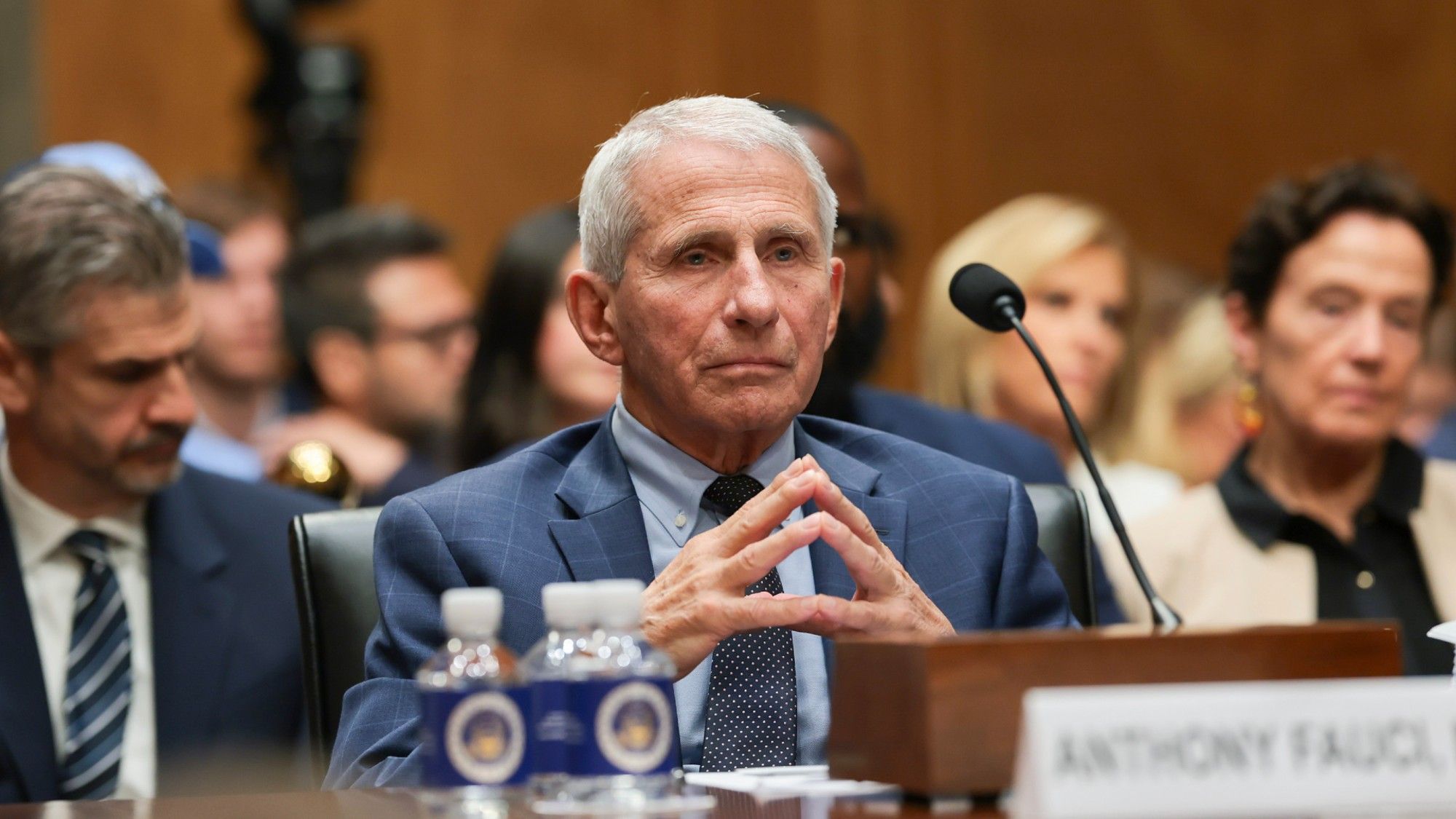
    GOP Senate panel votes to refer Fauci for contempt

    What happened
    The Senate Homeland Security Committee yesterday voted along party lines to hold former U.S. infectious disease chief Dr. Anthony Fauci in contempt of Congress for repeatedly refusing to answer questions last week in testimony on the federal response to Covid-19. Committee Chair Sen. Rand Paul (R-Ky.) and other Republicans contended that Fauci could not invoke his Fifth Amendment rights “because he’d already received a preemptive pardon from former President Joe Biden,” CNN said. But “GOP lawmakers also openly acknowledged” last week that they “hoped to get Fauci to perjure himself in his testimony, allowing them to bring new charges.”

    Who said what
    “Fauci faced no risk of federal prosecution,” Paul said. “All he had to do was tell the truth.” Fauci’s lawyer called the vote a “crude political stunt” to “punish” a public servant for “exercising his constitutional rights.” Paul appears so “hellbent on putting Fauci in jail” that his office immediately hand-delivered the contempt resolution to federal prosecutors, Politico said. Contempt referrals “rarely bypass the full Senate,” The Wall Street Journal said, and “it isn’t clear whether a referral made in such a manner is legally valid.”

    What next?
    The Justice Department yesterday evening said it had received Paul’s referral, is “reviewing it and will work with the Senate accordingly.” If prosecutors decide to file charges and win a conviction, Fauci faces up to a year in prison. 


    TODAY’S SCIENCE Story

    Scientists unveil first AI-designed virus

    What happened
    Scientists at Stanford University yesterday reported in the journal Science that they had successfully directed artificial intelligence to create 16 new viruses. This first-ever use of AI to design and build viruses not found in nature raised “hopes for medical advances” like eliminating drug-resistant bacteria, The New York Times said, “while also raising the disturbing possibility that the technology could someday be used to invent dangerous pathogens.”

    Who said what
    “Synthesizing viruses from scratch is hardly new,” the Times said, but the Stanford and Arc Institute researchers went “well beyond” previous efforts by teaching AI to “recognize patterns of DNA structure in nature, and then to use that data to write recipes for entirely new viruses.” Their AI tool, Evo, was fed genetic sequences “much like ChatGPT and other language models are trained on large sets of existing text material,” CNN said.

    What next?
    The new study “arrives at a moment of heightened anxiety regarding danger posed by increasingly powerful AI models,” The Wall Street Journal said. Evo was constrained to create “simple viruses” that can “only infect bacteria and pose no threat to humans.” But the breakthrough “raises urgent biosafety and biosecurity questions,” Johns Hopkins health security experts said in a corresponding Science article. “The ability to compose viral genomes using generative AI now exists; the governance to safely steer it does not.” 


    It’s not all bad

    Recovering stroke patients can get a major boost in activity levels and mobility when animals visit them, according to a new Mayo Clinic study. Participants who walked, brushed and petted therapy dogs said they felt safer and showed more motivation, engagement and interest in their treatment. These interactions can “change the entire dynamic of a rehabilitation session,” making a “meaningful difference” in a patient’s “recovery experience,” said Whitney Romine, Mayo Clinic’s manager of animal-assisted services.


    Under the radar

    ‘Bra doping’ at the women’s Tour de France

    This year’s Tour de France Femmes has been rocked by allegations that some riders are artificially exaggerating their bust size to gain an aerodynamic advantage. Several women’s WorldTour teams have raised concerns that cyclists riding for rival outfits are padding their sports bras to give them a boost in time trials, according to Dutch cycling news site WielerFlits.

    The practice of “chest fairing,” also known as “bra boosting” or “bra doping,” involves increasing the surface area of the chest to change the airflow around the torso. An optimized chest fairing can reduce drag by as much as 3.6%, which could gain a time trial cyclist at least 0.78 seconds every kilometer, according to research published in the Journal of Wind Engineering and Industrial Aerodynamics in 2024. 

    “You won’t gain tens of seconds,” said study lead Bert Blocken, an aerodynamics expert at Scotland’s Heriot-Watt University. But over a 20- to 30-km time trial “it could save enough seconds to make the difference.”

    The UCI, cycling’s governing body, took the unusual step this week of issuing a warning that the Tour de France Femmes race jury overseeing the final checks for Monday’s stage 4 time trial would pay “particular attention” to clothing and accessories that “could modify riders’ morphology.”

    But “confusion remains as to what exactly” the jury was tasked with looking for, said Cycling Weekly. Also, “how are you going to police it?” Koen de Kort, head of technical and innovation at professional cycling team Lidl-Trek, told The Athletic. Determining the permissible amount of bra padding veers into a “gray area of what you’re allowed to check.”


    On this day

    August 7, 2007

    San Francisco Giants slugger Barry Bonds hit his 756th home run, breaking the all-time record set by Hank Aaron in 1974. Bonds is still widely acknowledged as one of baseball’s greatest players, but his MLB records and other accolades come with an asterisk due to widespread allegations of steroid use.


    TODAY’S newspaperS

    ‘DOJ misfire’

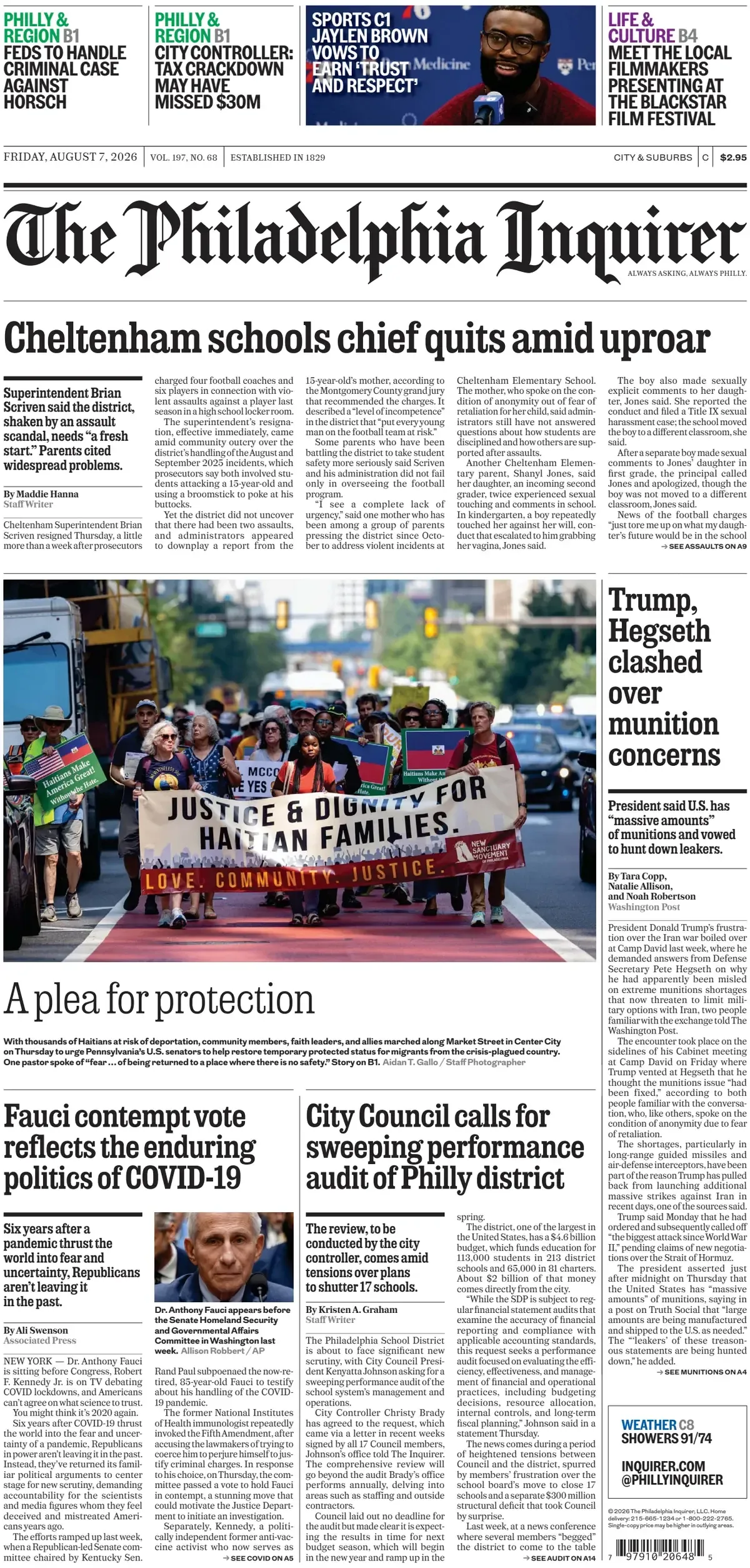
    Divided “FCC OKs lifting cap on station owners,” the Los Angeles Times says on Friday’s front page. New FCC ruling “could shake up local stations,” expanding broadcasters’ reach, The Atlanta Journal-Constitution says. “SNAP changes are adding to struggles” for the “food insecure,” The Oklahoman says. “Federal overhaul” of Head Start “draws concern,” The Dallas Morning News says. Trump “vowed to hunt down leakers” after he and “Hegseth clashed over munition concerns,” The Philadelphia Inquirer says. “Ukraine pleas for defenses go unheeded,” The New York Times says. “U.S. says Putin willing to test NATO with limited assaults,” The Wall Street Journal says. “Reflecting Pool case latest DOJ misfire,” says USA Today.

    ► See the newspaper front pages


    Tall tale

    The show must NOT go on

    The musical director of a Vermont production of “The Rocky Horror Show” allegedly sent himself threatening text messages so the show would be canceled. After Kenneth Grenier reported the threats, the play was called off over safety concerns. And when an Essex Police Department investigation found that the messages came from an IP address registered to Grenier’s home, he admitted to sending the texts, saying he wanted to leave the show to avoid dealing with “difficulties with the cast and crew,” Essex police said.


    Morning Report was written and edited by Helen Brown, Nadia Croes, Catherine Garcia, Scott Hocker, Anya Jaremko-Greenwold, Justin Klawans, Rafi Schwartz and Peter Weber, with illustrations by Stephen Kelly and Julia Wytrazek.

    Image credits, from top: Heather Diehl / Getty Images; Anna Moneymaker / Getty Images; Motortion / iStock / Getty Images Plus; Illustration by Julia Wytrazek / Getty Images
     

    Recent editions

    • Evening Review

      How worried should we be about rogue AI?

    • Morning Report

      Cambridge professor resigns amid plagiarism row

    • Evening Review

      Europe’s disappearing rivers

    VIEW ALL
    TheWeek
    • About Us
    • Contact Future's experts
    • Terms and Conditions
    • Privacy Policy
    • Cookie Policy
    • Advertise With Us
    • FAQ
    Add as a preferred source on Google Add as a preferred source on Google

    The Week UK is part of Future plc, an international media group and leading digital publisher. Visit our corporate site.

    © Future Publishing Limited Quay House, The Ambury, Bath BA1 1UA. All rights reserved. England and Wales company registration number 2008885.