The Week The Week
flag of US
US
flag of UK
UK
https://cdn.mos.cms.futurecdn.net/flexiimages/jzblygzdxr1769609154.gif

SUBSCRIBE

Try 6 weeks free

Sign in
  • View Profile
  • Sign out
  • The Explainer
  • Talking Points
  • The Week Recommends
  • Podcasts
  • Newsletters
  • From the Magazine
  • The Week Junior
  • More
    • Politics
    • World News
    • Business
    • Health
    • Science
    • Food & Drink
    • Travel
    • Culture
    • History
    • Personal Finance
    • Puzzles
    • Photos
    • The Blend
    • All Categories
  • Newsletter sign up Newsletter
  • Brand Logo
    Mail voting ruling, ocean heat record and 49ers owner arrest

     
    TODAY’S VOTING story

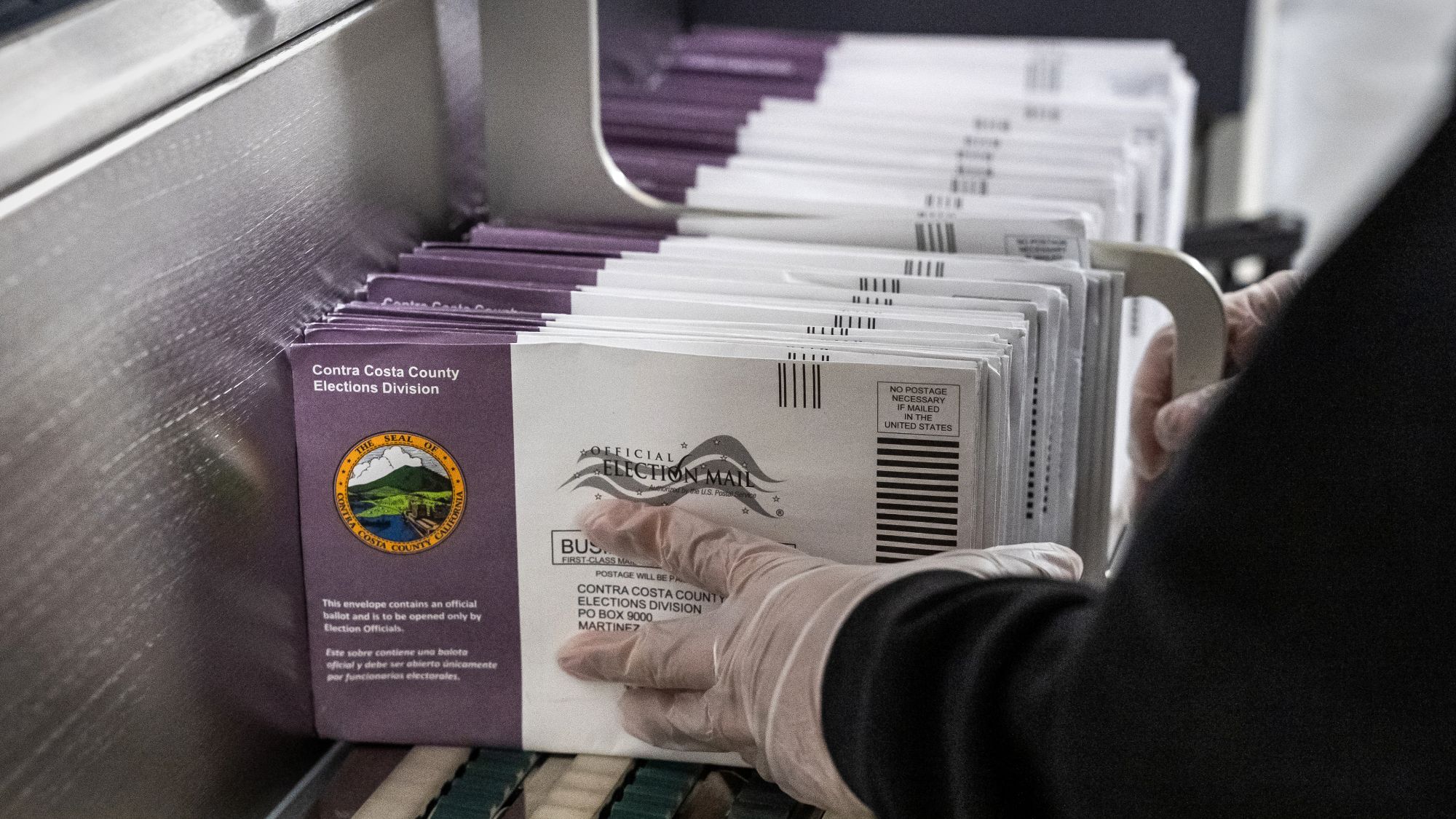
    Supreme Court eases block of Trump’s mail ballot order

    What happened
    The Supreme Court’s conservative majority yesterday overturned a federal judge’s block of President Donald Trump’s executive order to restrict mail-in voting and make other election changes. The 6-3 emergency ruling was on procedural grounds and did not address the constitutionality of Trump’s order, much of which is still blocked through a different injunction from the same federal judge in Boston, Indira Talwani. The U.S. Postal Service issued a final rule late Friday confirming that, if the courts allow, it would refuse to deliver mail ballots in states that did not comply with Trump’s order.

    Who said what
    The Supreme Court ruling “means the administration can move ahead with planning for restricting the use of mail ballots,” The New York Times said. But it “does not mean that any measure taken by the government to implement the order will necessarily be lawful,” the court’s unsigned majority opinion said. “On that score, time will tell.” 

    Justice Ketanji Brown Jackson wrote in a dissent that the ruling “needlessly injects chaos and uncertainty” into the upcoming midterms and furthers the court’s “Kafkaesque nightmare” regarding “election-related challenges.” Yesterday’s ruling “may not lead to a single election procedure changing” before November, The Associated Press said, “but it has already thrown into uncertainty the method that nearly one-third of the country uses to vote,” including Trump.

    What next?
    “Time is running out” for Trump’s voting changes, the AP said. After the first mail ballots are sent from North Carolina on Sept. 4, “it would be virtually impossible for all states” to fully comply.


    TODAY’S CLIMATE story

    World’s ocean temperatures hit record high

    What happened
    The world’s ocean temperatures reached 70 degrees Fahrenheit over the weekend, the hottest on record, Europe’s Copernicus Climate Change Service announced yesterday. The previous daily average record was set in March 2024, but oceans may not have been this warm in “millennia,” The Washington Post said. 

    Who said what
    Global ocean temperatures typically peak in March or April, so this off-season record is “another clear signal of an ocean under growing stress,” said Copernicus deputy director Samantha Burgess. The brewing “super” El Niño is “adding heat to the system, but it is doing so on top of decades of human-driven warming.” The seas are likely the warmest they have been “for the entire Holocene period, and possibly even as far back” as “125,000 years ago,” University of Ottawa environmental studies professor Ryan Katz-Rosene said on social media. “Should be major news!”

    “An ocean this warm destabilizes weather patterns and threatens food security, economic prosperity and marine life,” former NOAA chief Jane Lubchenco told The Associated Press. “A warmer ocean is not our friend.” 

    What next?
    “Warmer seas help to fuel more extreme weather,” supercharging storms and intensifying heatwaves, the BBC said. This year’s El Niño “is expected to keep strengthening until Christmas” and is “on course to be the strongest in centuries.”


    TODAY’S SPORTS Story

    49ers owner arrested in Ohio prostitution sting

    What happened
    San Francisco 49ers principal owner Jed York yesterday pleaded no contest in Ohio to misdemeanor charges of disorderly conduct and possessing criminal tools, after being arrested Sunday at an East Palestine trailer park on suspicion of “engaging in prostitution.” As part of a plea deal to reduce the prostitution charge, York (pictured above) was fined $1,150, completed an online course and was credited with time served for one day in the Columbiana County Jail.

    Who said what
    The “criminal tool in ​York’s possession was believed to be a cellphone used to reply to a prostitution advertisement,” Reuters said. The cellphone was returned to him but “$160 that was seized was to be given to the Mahoning Valley Human Trafficking Task Force,” The Associated Press said. Columbiana County Prosecutor Vito Abruzzino told the AP that prostitution cases typically ended in plea deals. The 49ers said it was a “legal matter” that “has been resolved” and there would be no “further comment at this time.” 

    What next?
    The NFL said the case “will be reviewed under the personal conduct policy.” But it’s yet to be determined “whether York will emerge with the same punishment that a player would receive for the same offense,” said NBC Sports. “Owners are supposedly held to a higher standard than players,” but “there’s a perception” they are often “held to a lower standard in practice.”


    It’s not all bad

    An otter was spotted in New York’s Bronx River for the first time since the early 1900s, when the waterway was polluted with slaughterhouse and factory runoff. An image of the animal was captured by a motion-activated camera owned by scientist R.J. Hawkins. “I could hardly believe what I was seeing,” Hawkins told The Guardian. The river has undergone conservation work, and the otter sighting shows why “long-term wildlife monitoring and environmental restoration efforts matter.”


    Under the radar

    Antarctica’s melting ice is leaking mercury

    The frozen landscape of Antarctica is releasing higher levels of mercury into the ocean and marine ecosystem because of climate change, and the toxic metal is accumulating in the region’s wildlife, causing health problems in the food chain. Mercury has also reached the commercial fish industry, bringing the problem home directly to humans.

    Mercury “reaches Antarctica through the atmosphere, traveling from sources such as coal plants and mining operations to settle on Antarctic ice and the Southern Ocean,” said Eos. As it “accumulates in sediment, it can transform into methylmercury, a more toxic form that more readily accumulates in living organisms.”

    Mercury accumulation in Antarctica, specifically on the Antarctic Peninsula, has “doubled relative to the global shelf average and risen sharply since industrialization,” said a study published in the journal PNAS. The increase is “driven not only by atmospheric deposition but also by climate warming–induced ice melt and erosion that remobilize legacy mercury stored on land.” 

    Methylmercury “enters and travels through the Antarctic food web, taken up by plankton, then krill, fish, seabirds and marine mammals,” said Eos. The toxin can “harm animals’ neurology, behavior, growth and reproduction.” Already, mercury levels in “Antarctic species such as Antarctic toothfish, marlin and sharks frequently exceed previous records and food safety limits,” said Science Alert. The metal can also get to commercial fisheries, where mercury pollution can affect human health.


    On this day

    August 25, 1916

    President Woodrow Wilson signed the National Park Service Organic Act, creating the National Park Service to conserve America’s natural and historic wonders and “leave them unimpaired for the enjoyment of future generations.” Under Interior Secretary Doug Burgum, President Donald Trump’s NPS projects in the capital are being expedited while hundreds of needed repairs “throughout the nationwide system of parks are languishing,” The Atlantic said. 


    TODAY’S newspaperS

    ‘Misery index’

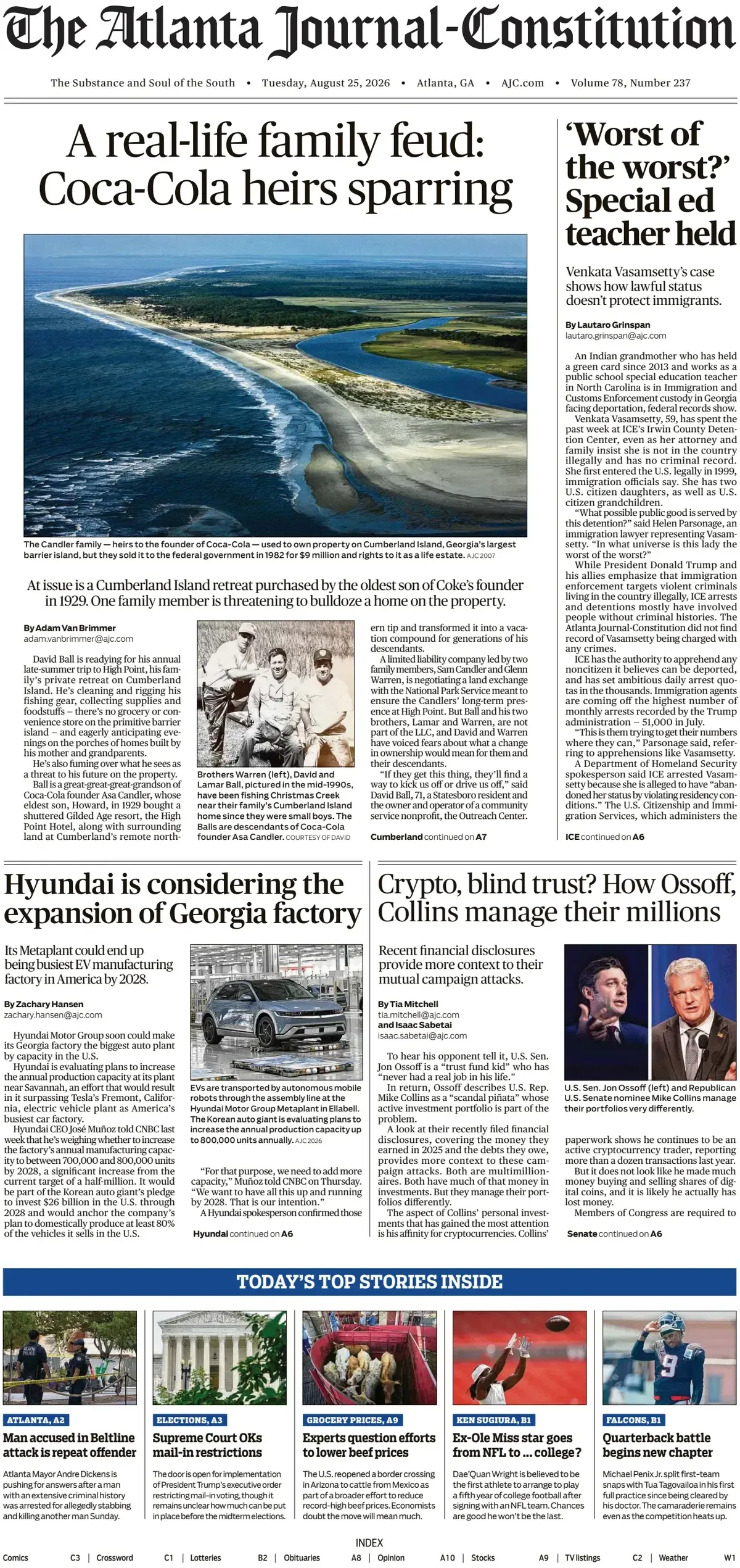
    “U.S. launches new wave of sanctions against Iran” as White House’s “oil math doesn’t add up in Hormuz,” The Wall Street Journal says on Tuesday’s front page. “Trump threatens 50% tariffs on cars, trucks amid Canada spat,” The Sacramento Bee says. “Deaths by Russian AI-guided drones are a first,” The New York Times says. “Armed gangs went on another killing spree in Haiti, leaving a trail of dead,” the Miami Herald says. Florida “faces caregiver shortage as Haitians lose TPS,” The Palm Beach Post says. “‘Worst of the worst?’ Special ed teacher held” by ICE, The Atlanta Journal-Constitution says. “Farmers struggle to receive services” after “thousands of USDA departures,” The Minnesota Star Tribune says. “The heat is rising, and so is the misery index,” says the Los Angeles Times. “Fall forecast calls for summer extension,” with “El Niño dominant driver,” says USA Today.

    ► See the newspaper front pages


    Tall tale

    Getting pickled

    Pringles created a chip for dill pickle fans, and now Pringles Dill Pickle enthusiasts can enjoy their favorite flavor in a glass. Pringles Dill Pickle Potato Vodka, made in collaboration with Sugarlands Distillery, has a “sharp vinegar and dill” taste with a “salty twist,” said The Independent. Sugarlands recommends using the vodka for martinis, picklebacks and “any cocktail that needs a little snap.” Pringles also recently worked with Miller Lite on a beer-flavored chip.


    Morning Report was written and edited by Nadia Croes, Catherine Garcia, Scott Hocker, Anya Jaremko-Greenwold, Justin Klawans, Rafi Schwartz, Peter Weber and Kari Wilkin, with illustrations by Stephen Kelly and Julia Wytrazek.

    Image credits, from top: David Paul Morris / Bloomberg via Getty Images; Kevin Carter / Getty Images; Matthew Huang / Icon Sportswire / Getty Images; Illustration by Stephen P. Kelly / Getty Images
     

    Recent editions

    • Evening Review

      What is the threat to the UK from Russia?

    • Morning Report

      US-Canada talks degenerate into trade war

    • Sunday Shortlist

      Sian Clifford’s ‘barnstorming’ comedy

    VIEW ALL
    TheWeek
    • About Us
    • Contact Future's experts
    • Terms and Conditions
    • Privacy Policy
    • Cookie Policy
    • Advertise With Us
    • FAQ
    Add as a preferred source on Google Add as a preferred source on Google

    The Week UK is part of Future plc, an international media group and leading digital publisher. Visit our corporate site.

    © Future Publishing Limited Quay House, The Ambury, Bath BA1 1UA. All rights reserved. England and Wales company registration number 2008885.