The Week The Week
flag of US
US
flag of UK
UK
https://cdn.mos.cms.futurecdn.net/flexiimages/jzblygzdxr1769609154.gif

SUBSCRIBE

Try 6 weeks free

Sign in
  • View Profile
  • Sign out
  • The Explainer
  • Talking Points
  • The Week Recommends
  • Podcasts
  • Newsletters
  • From the Magazine
  • The Week Junior
  • More
    • Politics
    • World News
    • Business
    • Health
    • Science
    • Food & Drink
    • Travel
    • Culture
    • History
    • Personal Finance
    • Puzzles
    • Photos
    • The Blend
    • All Categories
  • Newsletter sign up Newsletter
  • Brand Logo
    Canada’s counter-tariffs, Ohio political attack and Germany’s AfD shock

     
    TODAY’S GLOBAL TRADE story

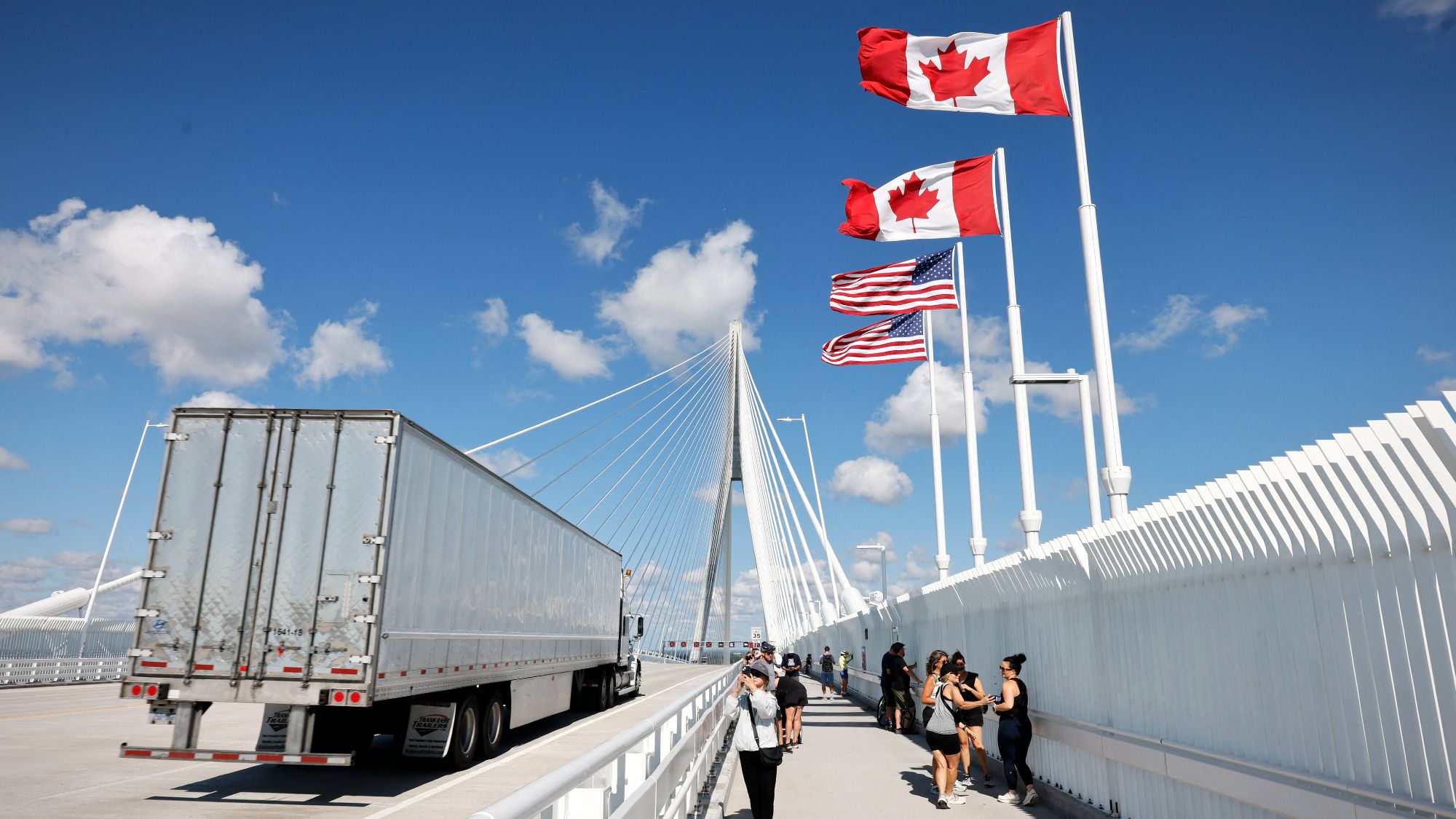
    Canada hits US with steep tariffs in mounting trade spat

    What happened
    Canada this morning imposed steep tariffs on about $20 billion of U.S. imports, aiming to match President Donald Trump’s recent 50% tariffs dollar for dollar. The hundreds of U.S. products slapped with the tariffs, ranging from 15% to 50%, include steel, aluminum, cheese, clothing, appliances and farm equipment. Trump has been “trying to humiliate Canada economically” since trade talks broke down in acrimony last month, The New York Times said, but Prime Minister Mark Carney has his “insulted and angry nation solidly behind him.” 

    Who said what
    Carney’s new retaliatory tariffs cover “roughly 6% of the $333.6 billion” in U.S. imports last year, so they’re “unlikely to dent U.S. growth overall,” The Associated Press said. But “Canada has already gone beyond tariffs in other ways,” slashing U.S. alcohol sales with provincial bans and boycotting other goods, while Canadians are “sharply” cutting travel to the U.S.

    The “spat with Canada” is the “latest evidence” that Trump “remains as committed as ever to his disruptive strategy of trade brinkmanship,” the Times said, “despite nearly two years of blistering court defeats, vicious international disputes and mounting domestic blowback” over rising prices and severed trade relationships.

    What next?
    Trump over the weekend suggested ending all trade with Canada and last night threatened to block sales of Canadian Bombardier aircraft inside the U.S. Carney has “become symbolic of resistance,” Canadian historian Robert Bothwell told the AP. So Trump will try to “make an example” of him and Canada to “theoretically terrify everybody else while in fact showing them that they need to remove themselves even further from the United States.”


    TODAY’S POLITICS story

    Ohio’s Acton attacked as campaigns start final sprint

    What happened
    A man armed with two handguns and a Taser charged toward Ohio Democratic gubernatorial nominee Dr. Amy Acton (pictured above) on Sunday as she addressed a crowd at the Canfield Fair, the Ohio State Highway Patrol said yesterday. The man, Patrick Havas, knocked down at least two elderly people but was stopped before he reached Acton and did not draw his weapons. 

    Who said what
    The apparent attack attempt came as the “unofficial start of the campaign sprint” kicked off on Labor Day weekend, Reuters said, and President Donald Trump’s “deep unpopularity is imperiling Republican chances” of keeping control of Congress and state offices. Acton’s “closer-than-expected race” against Republican Vivek Ramaswamy “has become extraordinarily toxic,” The Washington Post said. Ohio politicians from both parties condemned Sunday’s political violence, which a Ramaswamy spokesperson called “completely unacceptable.” 

    What next?
    Havas, 38, was booked in the Mahoning County ​Jail for disorderly conduct and two counts of assault. Even before the Labor Day kickoff, “this year’s campaigns already have been combative, busy and expensive,” The Associated Press said, “and they are expected to get even more so” as “voters tune in ahead of the Nov. 3 general election.” 


    TODAY’S INTERNATIONAL Story

    Germany’s post-Nazi firewall tested by far-right win

    What happened
    German Chancellor Friedrich Merz yesterday said he was “deeply shocked” by the far-right Alternative for Germany’s (AfD) victory in Sunday’s state elections in Saxony-Anhalt. AfD won a 43.8% plurality but fell three seats short of the majority needed to form a government. No far-right party has governed a state or major city in Germany since the Nazi era, and the AfD’s win in the small eastern state was the biggest challenge yet to the “firewall” that Merz’s Christian Democrats and other mainstream parties have erected against political extremism. 

    Who said what
    “This is the worst election defeat the CDU has suffered in years, even decades,” Merz told reporters. “Of course, there will have to be consequences,” but “giving up is not an option for me.” The “embattled leader,” saddled with “sagging poll numbers” and a stagnant economy, “faces an uphill battle to save his government,” The Wall Street Journal said. “Impatience with Merz is now turning to panic” in his party, with many officials “pushing him to shift the government’s political course” and a “minority” seeking to lift the party’s “ban on cooperating with the AfD at the state level.” 

    What next?
    AfD leaders said they will try to poach CDU lawmakers to gain the crucial three seats in Saxony-Anhalt or partner with the far-left BSW party, which shares the AfD’s anti-immigrant and pro-Russia views.


    It’s not all bad

    An at-home urine test detected more than 92% of bladder cancer cases in clinical trials, according to a study from Britain’s University of Birmingham and diagnostics company Nonacus. The test looks for more than 450 DNA mutations linked to bladder cancer. A thousand patients at hospitals in England and Scotland participated in the study. A larger trial is planned, and if successful, the text could mean “tens of thousands” of people are “spared” invasive diagnostic procedures, said the BBC.


    Under the radar

    Space companies are ‘starwashing’

    Space exploration has costs. But groups hoping to colonize the cosmos are not addressing the potential impacts. Starwashing, a spin on greenwashing, is when space companies “sell exploration narratives by appealing to a desire to expand humankind beyond Earth” while “downplaying or omitting the negative repercussions for Earth and the space environment,” said the University of Louisville’s Marissa E. Yingling at The Conversation. 

    Starwashing “takes attention away from actually solving the problems that are here on Earth,” Gregers Andersen, a postdoctoral researcher at the University of Southern Denmark, said to Grist. For example, Jeff Bezos “envisions building space habitats that could house billions as a solution to environmental catastrophes on Earth,” said Yingling, and Elon Musk has expressed interest in creating human settlements on Mars. But none of that will “fix pressing environmental crises such as wildfires or climate change in the near term.”

    In fact, spaceflight can take its own environmental toll. It often leads to a “globally averaged depletion of the ozone layer and contributes to global warming,” said a study published in the journal Earth’s Future. “Other environmental effects,” said Grist, include the “loss of dark sky as satellites reflect sunlight and damage to wildlife habitats around launch sites,” plus the “enormous greenhouse gas emissions involved in building and launching satellites.”

    If a “rocket, satellite network or lunar mining project is supposed to benefit everyone, companies should have to provide transparent accounting for emissions, land use, debris risks and impacts on communities,” said The Cool Down. There should also be “tougher oversight before new launch facilities, satellite fleets or data-center projects move forward.”


    On this day

    September 8, 1974

    President Gerald Ford pardoned his predecessor, former President Richard Nixon, who had resigned rather than face impeachment and removal for his role in the Watergate scandal. Ford’s decision to pardon Nixon for Watergate was one of his most controversial acts as president, and it contributed to his loss to Jimmy Carter in 1976.


    TODAY’S newspaperS

    ‘Election gamble’

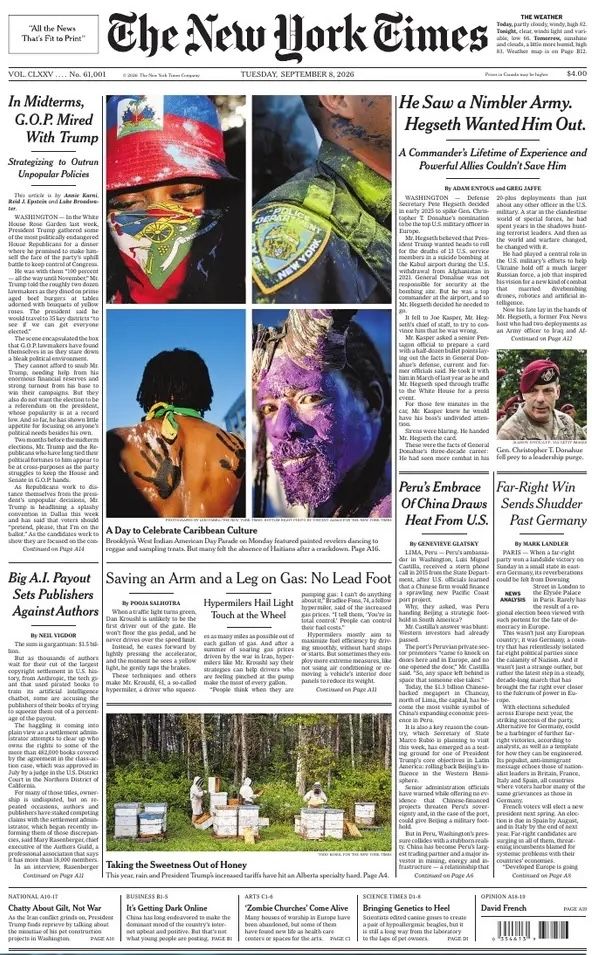
    “In midterms, GOP mired with Trump” and “strategizing to outrun unpopular policies,” The New York Times says on Tuesday’s front page. “GOP sets midterm election gamble” with “2-day convention,” USA Today says. “GOP’s no-tax stance tested” as “Social Security funds running dry,” The Washington Post says. “Answers are sought” after “cargo plane, operated by Amazon, plowed into a public road and hit vehicles, killing five,” The Minnesota Star Tribune says. “Amazon plane” hit Miami airport “cleaning contractor van filled with seven people,” the Miami Herald says. “Speed, weather to be probed in cargo plane crash,” says The Wall Street Journal. “Temporary protections ending for Salvadoran migrants,” The Philadelphia Inquirer says. “Record summer box office boosts hope for the year,” says the Los Angeles Times. 

    ► See the newspaper front pages


    Tall tale

    One for the ages

    Dale Sanders, 91, has reclaimed his title as the oldest person to complete the 2,193-mile Appalachian Trail. His trek wasn’t without stumbles — the Tennessee resident estimates he fell 71 times along the way, and had to be hospitalized once — but he kept going, “blazing new ground,” he told The Associated Press. Sanders first set the record in 2017 at age 82, and decided to take it back after his friend MJ Eberhart finished the trail in 2021 at 83.


    Morning Report was written and edited by Nadia Croes, Catherine Garcia, Scott Hocker, Anya Jaremko-Greenwold, Justin Klawans, Rafi Schwartz, Peter Weber and Kari Wilkin, with illustrations by Stephen Kelly and Julia Wytrazek.

    Image credits, from top: Jeff Kowalsky / AFP via Getty Images; Jeff Swensen / Getty Images; John MacDougall / AFP via Getty Images; Illustration by Stephen P. Kelly / Getty Images
     

    Recent editions

    • Evening Review

      Is the UK economy turning a corner?

    • Morning Report

      AfD secures historic victory

    • Sunday Shortlist

      A ‘moving’ portrait of Charles de Gaulle

    VIEW ALL
    TheWeek
    • About Us
    • Contact Future's experts
    • Terms and Conditions
    • Privacy Policy
    • Cookie Policy
    • Advertise With Us
    • FAQ
    Add as a preferred source on Google Add as a preferred source on Google

    The Week UK is part of Future plc, an international media group and leading digital publisher. Visit our corporate site.

    © Future Publishing Limited Quay House, The Ambury, Bath BA1 1UA. All rights reserved. England and Wales company registration number 2008885.