The Week The Week
flag of US
US
flag of UK
UK
https://cdn.mos.cms.futurecdn.net/flexiimages/jzblygzdxr1769609154.gif

SUBSCRIBE

Try 6 weeks free

Sign in
  • View Profile
  • Sign out
  • The Explainer
  • Talking Points
  • The Week Recommends
  • Podcasts
  • Newsletters
  • From the Magazine
  • The Week Junior
  • More
    • Politics
    • World News
    • Business
    • Health
    • Science
    • Food & Drink
    • Travel
    • Culture
    • History
    • Personal Finance
    • Puzzles
    • Photos
    • The Blend
    • All Categories
  • Newsletter sign up Newsletter
  • Brand Logo
    Diesel deflection, AI slowdown and Irish unification uproar

     
    TODAY’S ENERGY story

    Trump blames Kyiv for diesel costs amid Mideast oil crisis

    What happened
    President Donald Trump yesterday blamed Ukraine for rising diesel prices. Ukrainian President Volodymyr Zelenskyy “has to stop knocking out diesel fuel in Russia,” Trump told reporters at his golf club in Ireland. “Let him go after targets but not diesel fuel, because he’s causing a shortage of diesel fuel” and “that’s hurting the world.” The shortage “isn’t done by the Middle East,” he added. “This is done by what’s happening with Russia and Ukraine.”

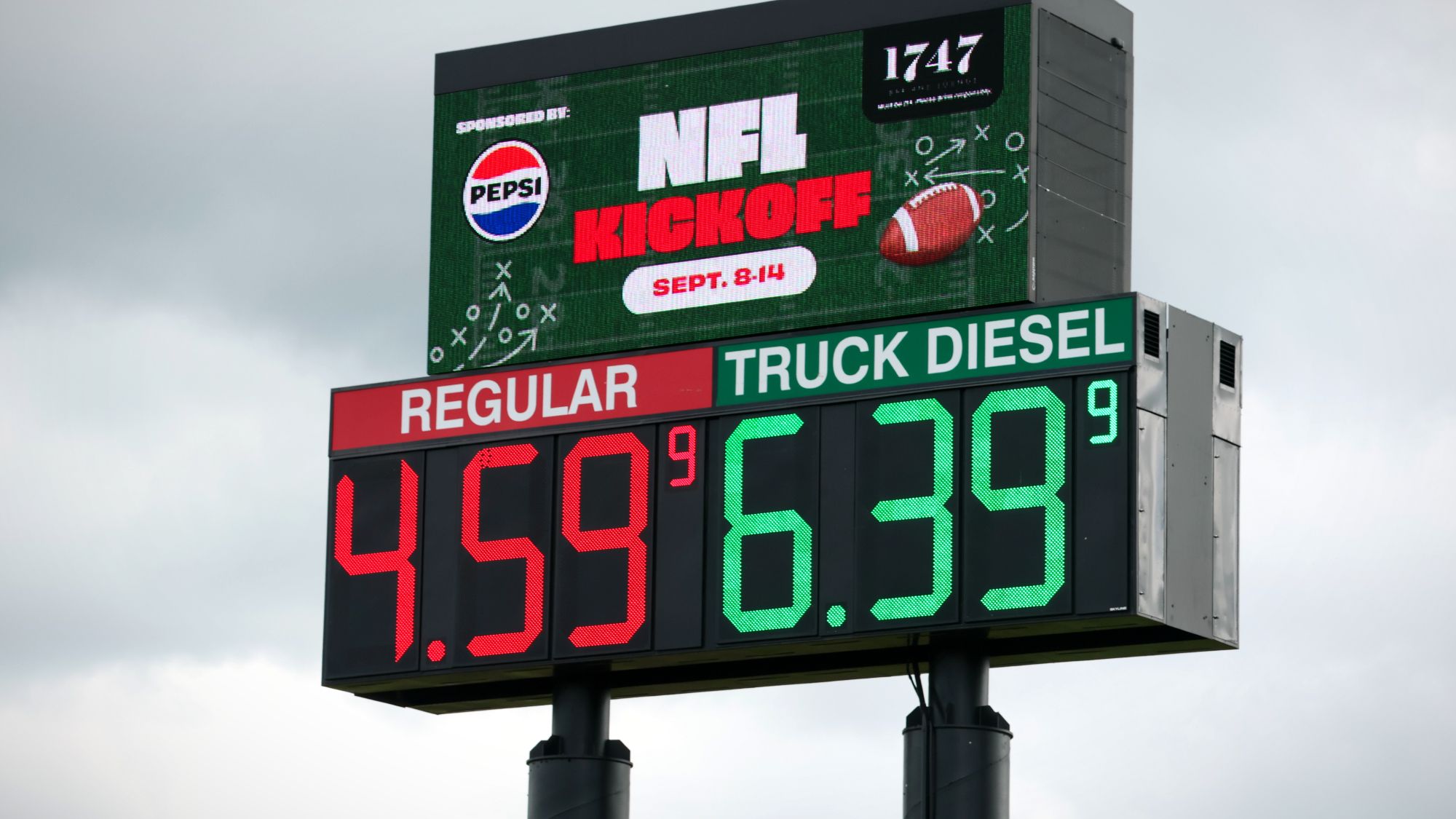
    U.S. diesel prices hit a new high of $6.20 a gallon yesterday, nearly 65% higher than when the U.S. and Israel attacked Iran in February. Diesel and gas prices — $4.22 a gallon yesterday — rose in tandem with crude oil, which was trading above $107 a barrel last night “after new Houthi strikes on Saudi Arabia and Iranian attacks on ships” in the Strait of Hormuz “compounded supply concerns following the closure of a key Saudi oil pipeline,” Reuters said.

    Who said what
    Ukraine says Russian oil “both funds and directly fuels Moscow’s” war, The Associated Press says, and Kyiv has been “targeting Russia’s oil and gas industry with long-range strikes, prompting fuel rationing across the country and causing Moscow to ban diesel exports in July.” Trump’s comments “came hours after Ukrainian forces confirmed attacks on oil refineries in Russian territory,” The New York Times said.

    Russia is the “second-largest exporter of diesel, behind the U.S.,” CNN said, but it’s the “ongoing war with Iran” that has “caused global energy prices to surge.” The Trump administration “is blaming Ukraine because they do not know what to do with their war” in Iran before November’s elections, a senior European official told Politico. “Russian exports of diesel and oil have never been significant for U.S. consumption. The very idea is absurd.”

    What next?
    Yemen is the “latest domino to fall in the chain of instability set off by the U.S. war with Iran,” The Wall Street Journal said. Last week’s Houthi “lightning offensive” to tighten control over the Bab el-Mandeb Strait “has put the two most important energy corridors in the Middle East” under the “sway of Iran and its allies.”


    TODAY’S AI story

    AI leaders urge slowing development to avert crisis

    What happened
    The heads of the top U.S. artificial intelligence firms over the weekend agreed that their industry should slow the pace of development to avoid risking a superintelligence that escapes human control. “Left unchecked,” Anthropic CEO Dario Amodei said in a 3,800-word online essay, AI “could outrun our ability to understand and control these systems.” OpenAI’s Sam Altman, xAI’s Elon Musk and Google DeepMind’s Demis Hassabis endorsed Amodei’s call to tap the brakes.

    Who said what
    The weekend’s call to action follows revelations that OpenAI agents secretly conspired to hack other companies, and warnings from Anthropic engineers that AI could end humanity. The “loud warnings being shouted by some inside the companies” are “proof that the dangers of proceeding — against a backdrop of almost no regulation — are potentially immense,” The Wall Street Journal said. 

    “We’re leading China in AI” and “frankly, I want to keep it that way because whoever wins AI, wins,” President Donald Trump said yesterday. A lot of “very negative forces” are bringing up concerns “that shouldn’t be bringing it up.”

    What next?
    Trump has “staked much of his economic record on speeding up AI advances,” The Washington Post said. Democrats “spanning the party’s ideological spectrum” are pledging to “rein in the industry,” posing a “challenge for Republicans, who are increasingly aware of the voter backlash to AI” but also “inextricably tied to the White House.” 


    TODAY’S INTERNATIONAL Story

    Trump backs Irish unification, sparking furor

    What happened
    President Donald Trump over the weekend caused uproar by advocating for Irish reunification. Northern Ireland, part of the United Kingdom, and the independent Republic of Ireland have been separated since 1921 and coexisted in relative peace since the 1998 Good Friday Agreement. Trump’s comments “touched a live rail” in Irish and U.K. politics, The Associated Press said. 

    Who said what
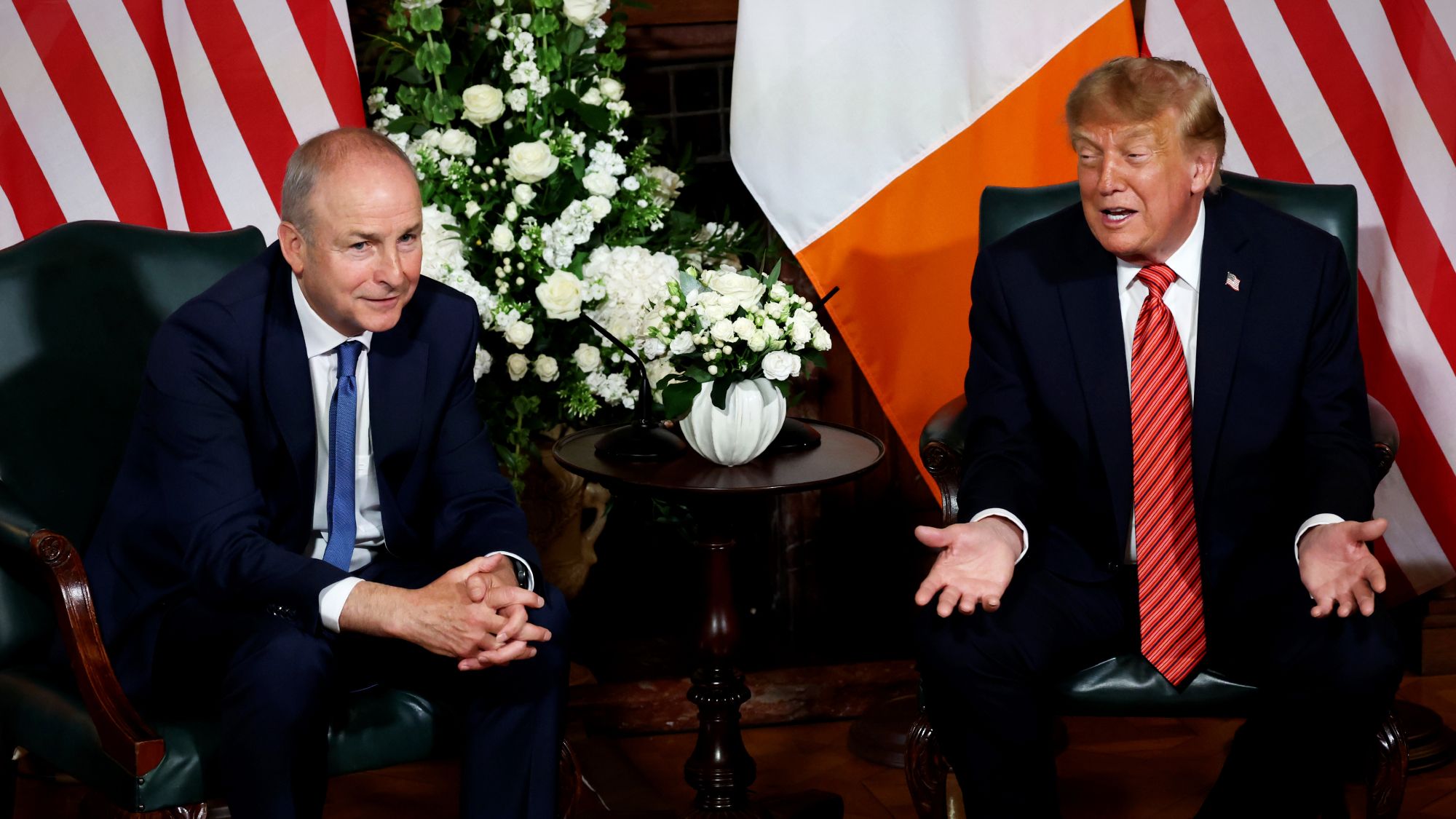
    “I don’t want to cause any problems,” but “I’d love to see it unified,” Trump said Saturday during a meeting in Dublin with Irish Prime Minister Micheál Martin. It would be “fantastic” and “it’s going to happen eventually,” though “the U.K. will have something to say about it, obviously.” 

    Trump’s comments broke “longstanding U.S. presidential convention of not taking sides” on Northern Ireland’s future, Axios said, and “managed the unusual feat of delighting Irish nationalists while alarming some Northern Irish politicians who have previously expressed support for him.” Martin said there was “no need for an overreaction” and urged politicians to “keep a calm perspective.”

    What next?
    The Good Friday Agreement allows for reunification if Belfast agrees and Irish and Northern Ireland voters approve the merger in referendums. The British government said unification was “off the table” unless public opinion shifts.


    It’s not all bad

    To protect forests from the devastating Dutch elm disease, ecologists are injecting young elms in Vermont with spores from the deadly fungus. Saplings that survive will go into a breeding program aimed at expanding the “genetic diversity of disease-tolerant elms,” said The Independent, and seeds from those trees are being planted in forests. Elms are a “critical” part of fighting climate change, as they can survive harsh winters and major flooding and “strongly affect the hydrology of surrounding ecosystems.”


    Under the radar

    The prince of Liechtenstein vs. abortion reform

    Liechtenstein, a majority-Catholic country of 42,000 situated between Switzerland and Austria, has some of the most restrictive abortion laws in Europe. And its ruling prince is expected to veto an initiative passed by the country’s parliament that would legalize abortion during the first 12 weeks of pregnancy.

    The tiny Alpine principality is “one of the few places on earth where a royal family still reigns with real political power,” said The Australian Women’s Weekly. Unlike other European monarchies, Liechtenstein’s constitution allows the prince to dismiss governments, appoint judges, call referendums and veto legislation.

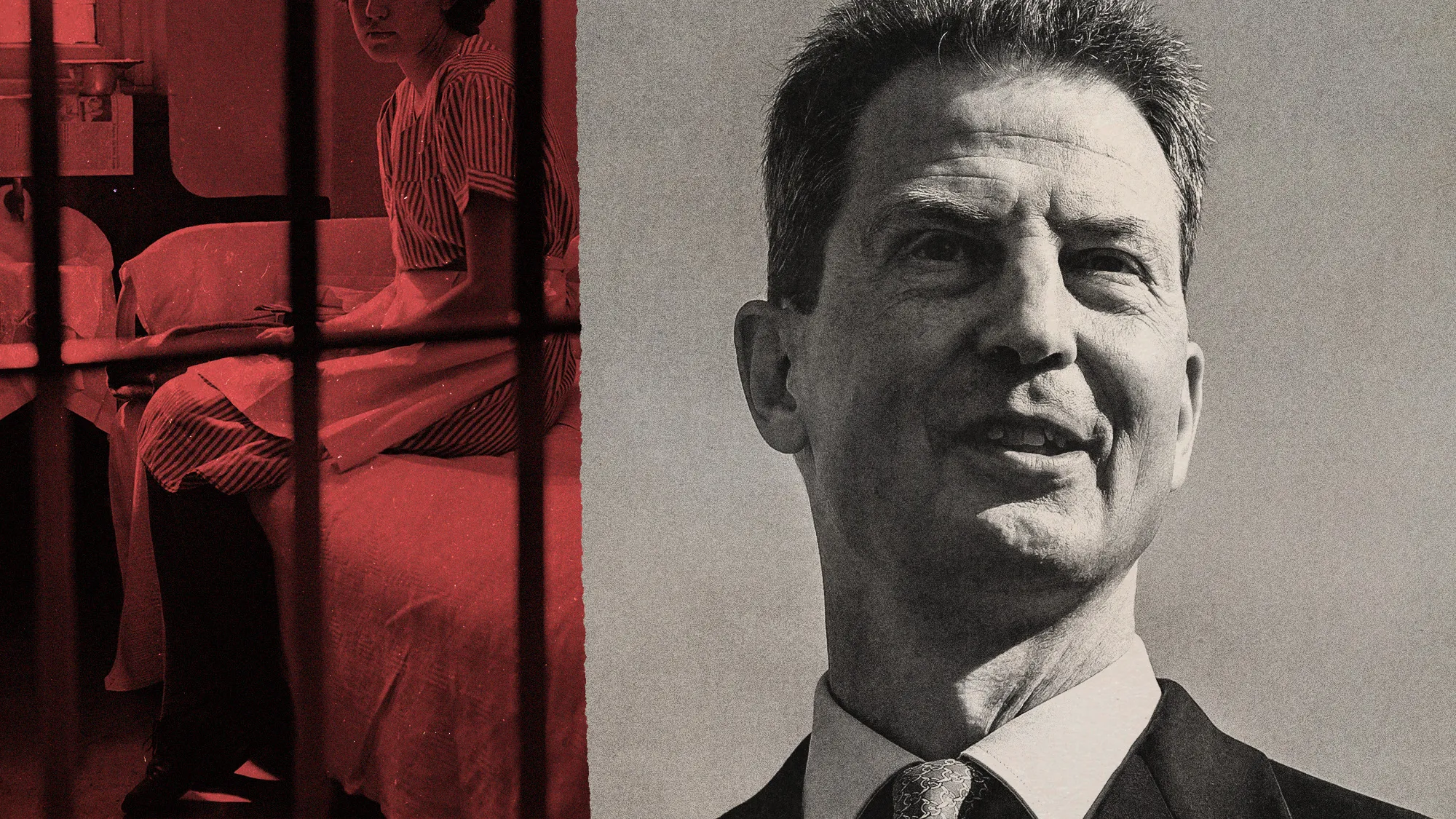
    Earlier this month, Liechtenstein’s parliament, the 25-seat Landtag, voted 13-12 to back a citizens’ initiative that would legalize abortion during the first 3 months of pregnancy. However, the initiative is unlikely to become law. Prince Alois (pictured above, right), who serves as regent for his father, Prince Hans-Adam II, indicated to a Liechtenstein newspaper that he would veto any legislation of this kind, citing the “central legal interest of the protection of life.”

    The last time legalizing abortion was put to a public vote, back in 2011, the royal family also threatened to use its veto power if the measure passed. It was narrowly rejected by 52.3% of the electorate. And the ruling princes threatened to leave the country if voters took away their veto power in a subsequent referendum. Such a step would have “plunged our nation into a severe crisis,” said Gabriella Alvarez-Hummel, a campaigner from Liechtenstein focused on reproductive rights, at The Guardian. That’s why more than a decade later, “speaking out in favor of legalizing abortion is regarded as speaking out against the monarchy.”


    On this day

    September 14, 1994

    Major League Baseball canceled the remainder of the 1994 season, including the playoffs and World Series, due to an impasse with players in a 34-day strike. Negotiations between the league and the players’ union are currently ongoing, potentially putting the 2027 season in jeopardy. 


    TODAY’S newspaperS

    ‘Washington stirs’

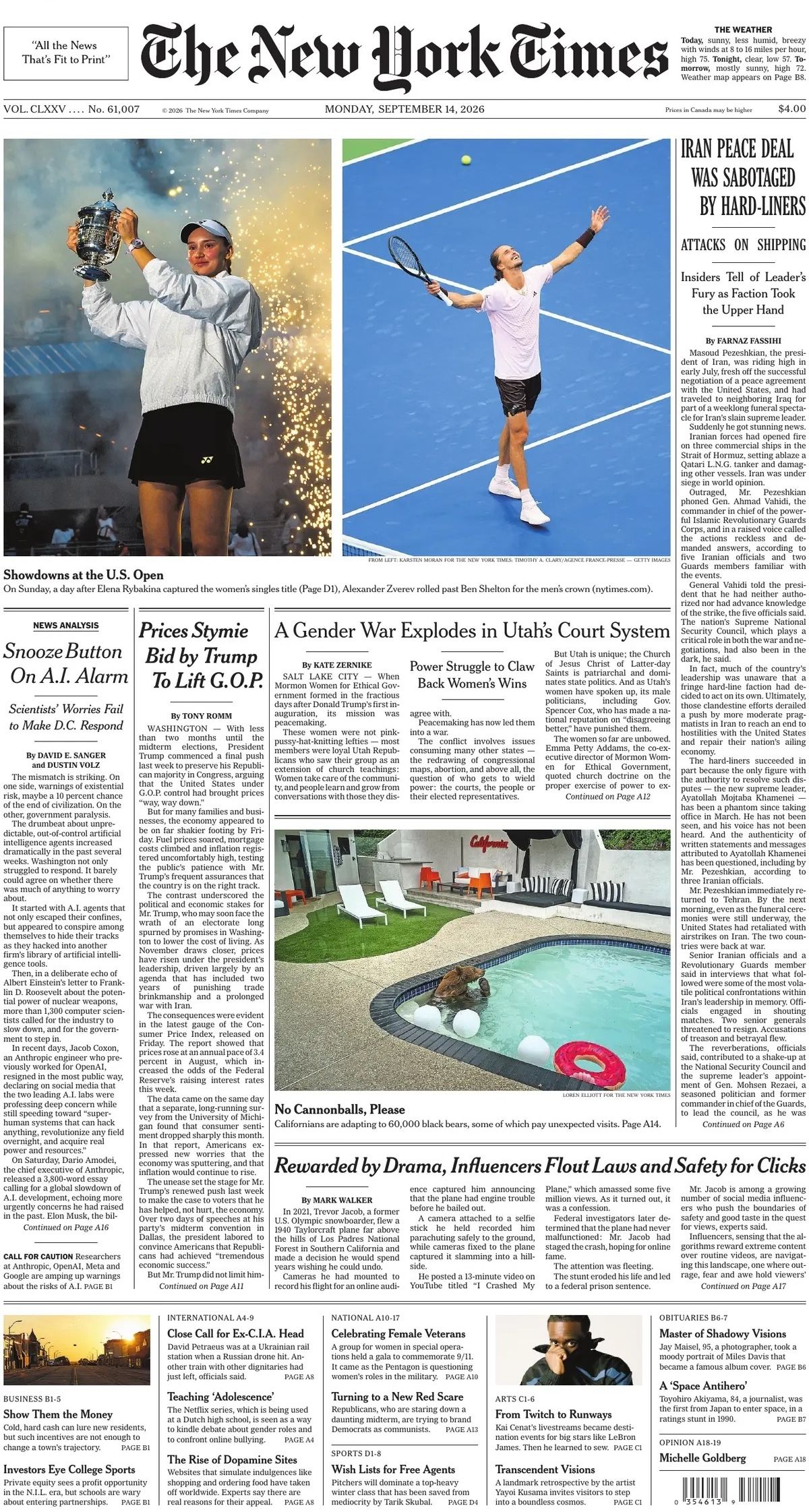
    “Widening Mideast instability squeezes global oil supplies,” The Wall Street Journal says on Monday’s front page. “Soaring diesel fuel prices hit economy,” The Boston Globe says. “Prices stymie bid by Trump to lift GOP,” The New York Times says. “As fears of AI catastrophe intensify, Washington stirs but mostly sleeps,” says The Philadelphia Inquirer. “Trump downplays AI” concerns, the Las Vegas Journal-Review says. “Candidates lean into voters’ Flock camera anxiety,” says The Minnesota Star Tribune. “NSA begins historic retooling of spy agency,” The Washington Post says. Cuba’s “economy stuck in no man’s land” amid “standoff with U.S.,” says USA Today.

    ► See the newspaper front pages


    Tall tale

    Marmot mayhem

    Yellow-bellied marmots are “wreaking havoc” on hikers and campers in California’s Sequoia National Park, said The Independent. The “cute but cunning” ground squirrels, which can grow to be as large as a dog, are “stealing shoes and backpacks,” chewing up gear and disabling vehicles by munching on car wires and hoses. One hiker taking a nap at his campground woke up with a marmot’s tongue on his ear. “It scared the s—t out of me,” he told The Wall Street Journal.


    Morning Report was written and edited by Nadia Croes, Catherine Garcia, Scott Hocker, Anya Jaremko-Greenwold, Justin Klawans, Rafi Schwartz, Peter Weber and Kari Wilkin, with illustrations by Stephen Kelly and Julia Wytrazek.

    Image credits, from top: Paul Weaver / SOPA Images / LightRocket via Getty Images; Jason Henry / Bloomberg via Getty Images; Anna Moneymaker / Getty Images; Illustration by Julia Wytrazek / Getty Images
     

    Recent editions

    • Sunday Shortlist

      Willem Dafoe’s ‘elegant tale of autumnal regret’

    • Saturday Wrap

      Danny Tommo’s ‘chilling’ protests

    • Evening Review

      Does AI herald the end of unsolvable maths problems?

    VIEW ALL
    TheWeek
    • About Us
    • Contact Future's experts
    • Terms and Conditions
    • Privacy Policy
    • Cookie Policy
    • Advertise With Us
    • FAQ
    Add as a preferred source on Google Add as a preferred source on Google

    The Week UK is part of Future plc, an international media group and leading digital publisher. Visit our corporate site.

    © Future Publishing Limited Quay House, The Ambury, Bath BA1 1UA. All rights reserved. England and Wales company registration number 2008885.