The Week The Week
flag of US
US
flag of UK
UK
https://cdn.mos.cms.futurecdn.net/flexiimages/jzblygzdxr1769609154.gif

SUBSCRIBE

Try 6 weeks free

Sign in
  • View Profile
  • Sign out
  • The Explainer
  • Talking Points
  • The Week Recommends
  • Podcasts
  • Newsletters
  • From the Magazine
  • The Week Junior
  • More
    • Politics
    • World News
    • Business
    • Health
    • Science
    • Food & Drink
    • Travel
    • Culture
    • History
    • Personal Finance
    • Puzzles
    • Photos
    • The Blend
    • All Categories
  • Newsletter sign up Newsletter
  • Brand Logo
    US bomber withdrawal, Brazil election and Japan’s US Marine arrest

     
    TODAY’S IRAN WAR story

    All US bombers quit UK air base amid attack warnings

    What happened
    The U.S. over the weekend pulled its 12 B-1 bombers out of RAF Fairford, the U.S.-run British air base being used to stage bombing strikes on Iranian targets. “All U.S. bombers” at Fairford “are redeploying to their home stations in the United States,” U.S. European Command acknowledged yesterday in a statement that did not provide a reason for the move. The “rushed” and “highly unusual” withdrawal came after “commanders received new threats about an Iran-backed plot” against the base, The New York Times said, citing two U.S. officials.

    Who said what
    The new information was “part of the same threat warnings that surfaced three weeks ago,” ahead of last week’s foiled possible attack on Fairford, “but specific details and a sense of urgency spiked in the past 24 hours," the Times said. The “sudden pullout of the bombers” was “ deemed so urgent” that some of them “left while aerial refueling aircraft were still being scrambled to support their flights.”

    The disrupted alleged plot to attack Fairford remained “shrouded in mystery” after Britain released the six suspects on bail last week, The Wall Street Journal said. “Some U.K. officials question the level of sophistication of the planned attack.” One official told the Times that the men arrested outside the base were “unwitting chumps.”

    What next?
    U.S. F-35 and F-15E fighters remain stationed at RAF Lakenheath in Britain, with refueling tankers at the nearby RAF Mildenhall. The U.S. also “still maintains a sizable presence in the Middle East,” The Associated Press said. A third aircraft carrier strike group and other warships carrying a combined 9,000 troops are en route to the region, the Pentagon said last week.


    TODAY’S INTERNATIONAL story

    Brazil’s Lula and Bolsonaro son head to runoff election

    What happened
    Leftist Brazilian President Luis Inácio Lula da Silva and right-wing Sen. Flávio Bolsonaro yesterday advanced to a runoff election after neither candidate got 50% of the vote. With almost all votes counted, Lula had 45% and Bolsonaro, the son of jailed former President Jair Bolsonaro, had a better-than-forecast 47%. 

    Who said what
    Bolsonaro, 45, is “widely considered to be a less magnetic stand-in for his father,” who lost to Lula in 2022 and was sentenced to 27 years in prison for conspiring to violently overturn that defeat, Politico said. Recent polls missed the “strength of right-wing sentiment” in Brazil, The Wall Street Journal said, “fueled by anger over violent street crime, the growing political clout of evangelical Christians and frustration” among higher-income Brazilians over taxes and the economy.

    Lula, 80, is “popular with women, Catholics and lower-income voters who credit him with reducing poverty and inequality,” The New York Times said. But to “turn the race around” in the second round, he will have to win over the millions of voters who “stayed home or spoiled their ballots.”

    What next?
    Brazilian voters yesterday “elected an overwhelmingly right-wing Congress,” Politico said, so the result of the Oct. 25 runoff “might turn out to be less consequential than it first appears,” whoever wins.


    TODAY’S CRIME Story

    Japan arrests US Marine on murder, theft charges

    What happened
    Japanese officials yesterday said a U.S. Marine has been arrested on the southern island of Okinawa on suspicion of murdering and robbing a woman in a hotel room. Lance Cpl. Devin Jacob Ballard, 20, denied killing Anna Yagi, 39, and taking her wallet and backpack, Okinawa police said. Security camera footage captured a man they believe to be Ballard entering the hotel with Yagi on Saturday and leaving alone with her belongings. 

    Who said what
    The killing “reignites long-standing tensions over the U.S. military’s presence” on Okinawa, which “hosts over half of the more than 50,000 U.S. military personnel stationed in Japan,” The Washington Post said. The island, about 60 miles from Taiwan, is “viewed by Tokyo and Washington as key ​in deterring potential military aggression from China,” Reuters said.

    “Okinawans have long complained about noise, pollution and crime related to U.S. bases,” especially the “repeated occurrence of sexual crimes,” The Associated Press said. This latest case is “complicating ties between Japan’s central government” and the local prefecture as Prime Minister Sanae Takaichi pushes to “further fortify” the Japanese military presence on Okinawa “and work more closely with the U.S. military.”

    What next?
    Takaichi said the “heinous crime is extremely regrettable,” and her government had “lodged a strong protest with the U.S. side, while firmly demanding maximum cooperation with the investigation.”


    It’s not all bad

    Citadel CEO Ken Griffin is donating $2 billion to launch a Carnegie Mellon University campus in Miami, “part of the largest-ever individual gift toward higher education,” said The Wall Street Journal. Pittsburgh’s Carnegie Mellon is known for its computer science, robotics and artificial intelligence programs, and the new 35-acre campus in Miami’s Wynwood neighborhood will focus on “technology and innovation.” Griffin explained his donation as part of an effort to establish South Florida as a global hub for business and technology.


    Under the radar

    Microgrids: the latest response to natural disasters

    With climate change making natural disasters more frequent and severe, some consumers are turning to smaller off-grid electric networks to generate power in the event of a catastrophe. These “microgrids” are becoming popular in numerous vulnerable areas of the U.S.

    A microgrid is a small power network that “generates, stores and consumes electricity in one relatively confined space,” often comprising solar panels connected to on-site battery storage, said National Geographic. They are being embraced by homeowners and small businesses, and many “connect to their local utility and draw power from that grid if they don’t produce enough on a given day.”

    These electrical systems are appearing in stormy areas like North Carolina, where solar versions are helping “prepare for disasters like Hurricane Helene, which devastated the region two years ago,” said NPR. Microgrids are also “popping up in public spaces” where people “often gather after storms.” Currently, the U.S. has more than 5,000 microgrids in operation, according to the research firm Wood Mackenzie.

    Some lawmakers have made efforts to increase microgrid use. Sen. Peter Welch (D-Vt.) introduced a bill to “boost the adoption of microgrids across the country as the nation’s transmission system becomes increasingly strained by growing energy demand and extreme weather events,” said Politico’s E&E News.

    Welch’s bill would provide $700 million for microgrid development. It would also encourage regulators to “streamline the interconnection process for localized, independent grids,” said E&E, while “providing technical assistance to utilities and governments working on grid resilience projects.”


    On this day

    October 5, 1947

    President Harry Truman delivered the first televised Oval Office address, urging a nation still reeling from World War II to limit buying certain foods needed for his Marshall Plan to aid war-torn Europe. Truman broadcast all subsequent White House speeches, a practice that presidents continue today.


    TODAY’S newspaperS

    ‘Mighty US consumer’

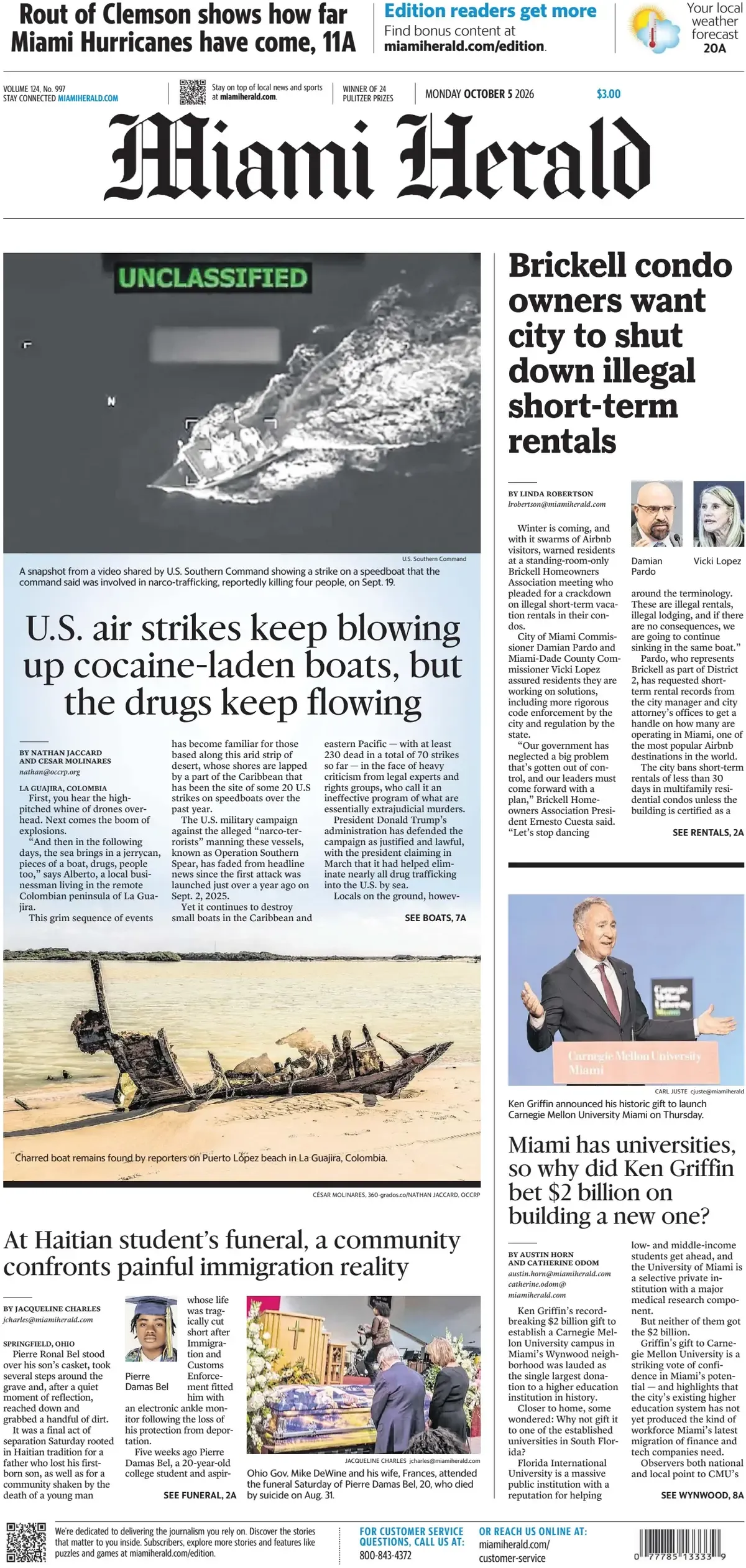
    “Mighty U.S. consumer powers through inflation, fuels growth,” The Wall Street Journal says on Monday’s front page. “U.S.-Iran peace deal remains elusive,” says USA Today. “Trump visits to red states signal midterm worry,” says the Los Angeles Times. “Younger voters swing away from president,” The Oklahoman says. “Anti-Trump voters could hold key to Wisconsin governor race,” the Milwaukee Journal Sentinel says. “Trump promotes data centers during Ohio rally,” The Minnesota Star Tribune says. “Trump: ‘Pretend I’m running’ and GOP wins,” says The Columbus Dispatch. “U.S. airstrikes keep blowing up cocaine-laden boats, but the drugs keep flowing,” the Miami Herald says. “U.S. teens get guns to cartels” in Mexico, says The New York Times. “2 dead, 35 hurt in shooting,” The Atlanta Journal-Constitution. Christa Pike “‘critically ill’ after botched execution,” says The Sacramento Bee. 

    ► See the newspaper front pages


    Tall tale

    Cirque du chat

    A troupe of agile felines, The Amazing Acro-Cats, is touring through December. For decades, troupe ringmaster Samantha Martin has performed the “acrobatic and musical extravaganza” with her rescue cats — an “unusual casting choice” for an art form “built on teamwork, rigorous discipline and congeniality,” said The Washington Post. The acro-cats’ salaries, fresh-cooked seafood and poultry, are “deposited into their bellies.”


    Morning Report was written and edited by Nadia Croes, Scott Hocker, Anya Jaremko-Greenwold, Justin Klawans, Rafi Schwartz, Peter Weber and Kari Wilkin, with illustrations by Stephen Kelly and Julia Wytrazek.

    Image credits, from top: David Bown / Getty Images; Julia Ju / Anadolu via Getty Images; Jinhee Lee / SOPA Images / LightRocket via Getty Images; Rachel Woolf / The Washington Post / Getty Images
     

    Recent editions

    • Sunday Shortlist

      Sky’s ‘delicious’ new divorce drama

    • Saturday Wrap

      Germany’s ‘zombie chancellor’

    • Evening Review

      Energy bills: what can the government actually do?

    VIEW ALL
    TheWeek
    • About Us
    • Contact Future's experts
    • Terms and Conditions
    • Privacy Policy
    • Cookie Policy
    • Advertise With Us
    • FAQ
    Add as a preferred source on Google Add as a preferred source on Google

    The Week UK is part of Future plc, an international media group and leading digital publisher. Visit our corporate site.

    © Future Publishing Limited Quay House, The Ambury, Bath BA1 1UA. All rights reserved. England and Wales company registration number 2008885.