The Week UK
flag of US
US
flag of UK
UK
https://cdn.mos.cms.futurecdn.net/flexiimages/jzblygzdxr1769609154.gif

SUBSCRIBE

Start your trial today

Sign in
  • View Profile
  • Sign out
  • The Explainer
  • Talking Points
  • The Week Recommends
  • Podcasts
  • Newsletters
  • From the Magazine
  • The Week Junior
  • More
    • Politics
    • World News
    • Business
    • Health
    • Science
    • Food & Drink
    • Travel
    • Culture
    • History
    • Personal Finance
    • Puzzles
    • Photos
    • The Blend
    • All Categories
  • Newsletter sign up Newsletter
  • Brand Logo
    California clemency, arch block and Paraguay impeachment

     
    TODAY’S CAPITAL PUNISHMENT story

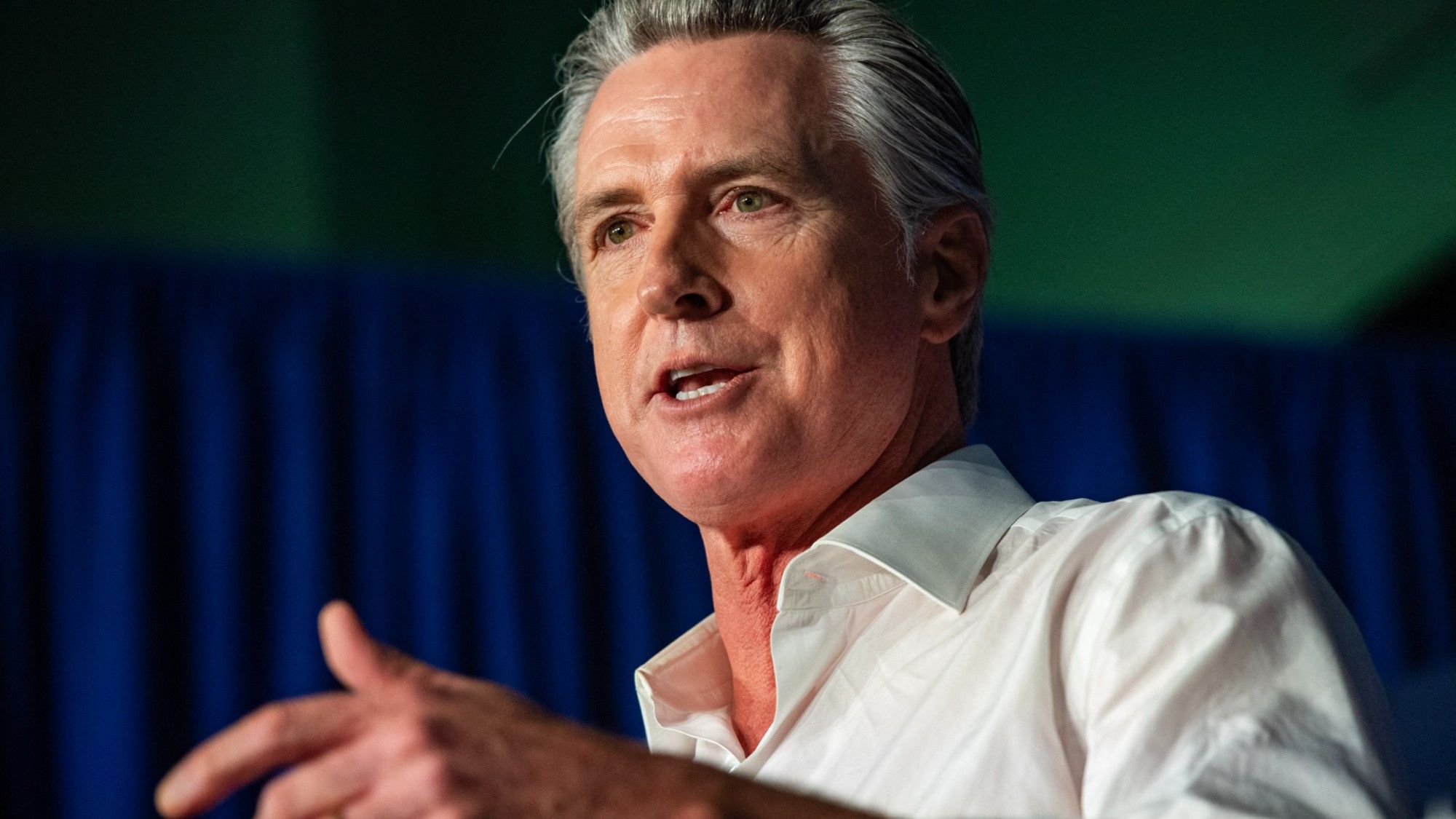
    Newsom commutes 548 California death sentences

    What happened
    Outgoing Gov. Gavin Newsom (D) yesterday commuted the sentences of all 548 California death row inmates to life in prison without possibility of parole. Under California law, the state Supreme Court must approve the commutations for the 382 inmates convicted of multiple felonies. It’s the largest single act of clemency in American history, and if all the commutations go through, it will reduce the U.S. death row population by nearly 30%, according to the Death Penalty Information Center. 

    Who said what
    “State-sanctioned killing is incompatible with California’s values,” Newsom said in an open letter. When he placed a moratorium on capital punishment in 2019, Newsom cited his “40-year moral journey informed by his Irish Catholic faith,” The Sacramento Bee said. Californians voted to uphold the death penalty in 2012 and 2016, but public support for executions has “waned nationwide in recent years.” 

    The ACLU lauded Newsom’s decision as a “historic step toward ending the death penalty in California and across the country.” But Florida, Alabama and Indiana all put inmates to death yesterday, an “unusual trio of executions” that included Florida’s 19th of the year, The Associated Press said. California has executed 13 people since 1976, the last in 2006.

    What next?
    The mass commutation was one of Newsom’s final acts before he leaves office in January and “considers a run for president,” The New York Times said. Even if “motivated by personal conviction,” the act could “make him a more compelling candidate” to Democratic primary voters, but would also open him to “attacks in a general election.” Incoming Gov. Xavier Becerra (D) has committed to maintaining the moratorium. 


    TODAY’S WHITE HOUSE story

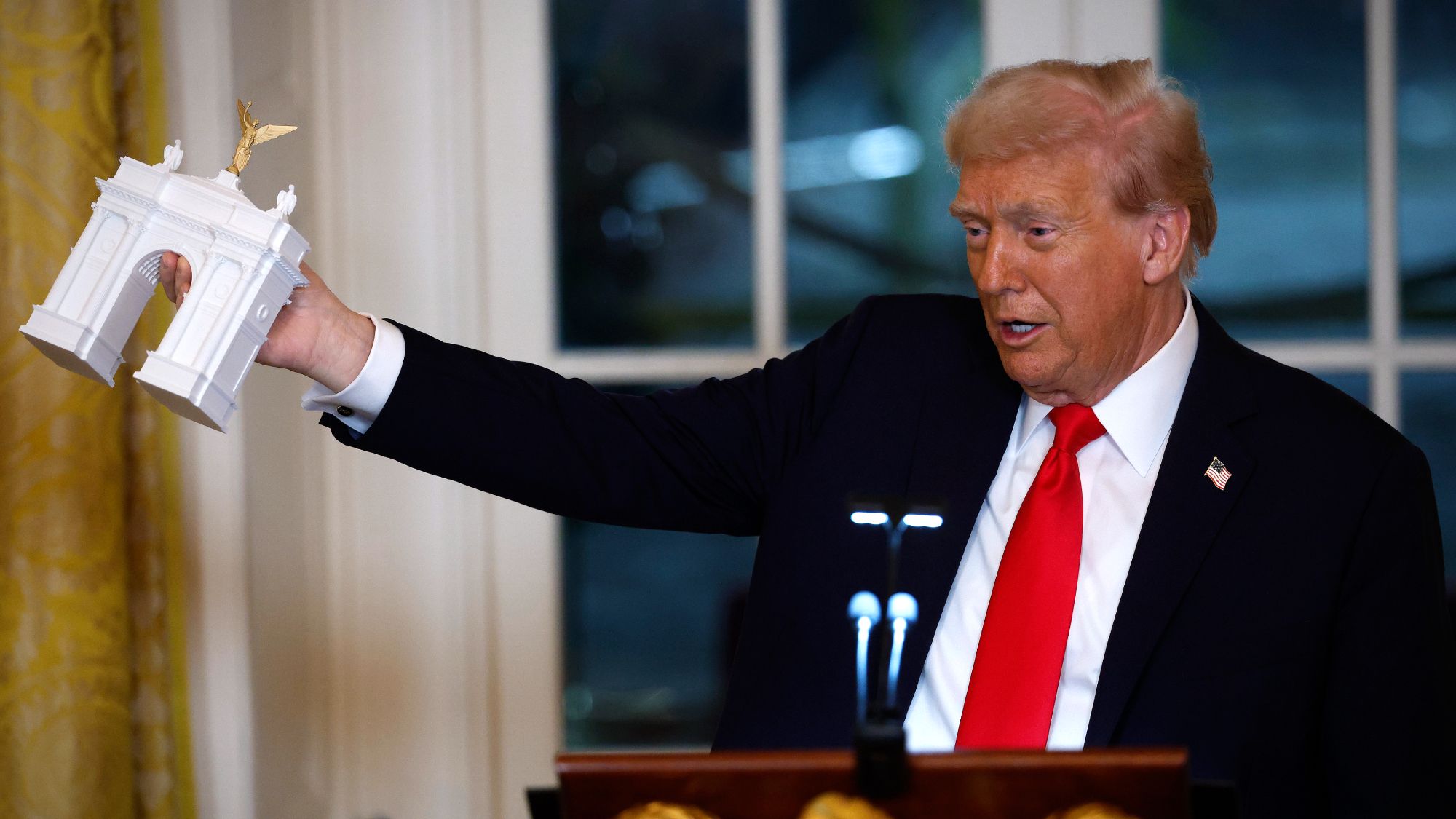
    Judge blocks Trump’s newly approved arch

    What happened
    A federal judge last night blocked the White House from starting construction on President Donald Trump’s 250-foot triumphal arch outside Arlington National Cemetery, less than an hour after a Trump-packed review board gave the project final approval. U.S. District Judge Tanya Chutkan imposed a 14-day restraining order while she considers consolidated legal challenges from Vietnam veterans, an architectural historian, Virginia and the District of Columbia. The administration had planned to break ground shortly after getting the green light from the National Capital Planning Commission, which came in a 8-4 vote after 8-plus hours of overwhelmingly anti-arch testimony.

    Who said what
    Chutkan said the plaintiffs were “likely” to prove the arch requires congressional approval the administration hasn’t sought, and Virginia and D.C. would bear “certain” harm and “significant unrecoverable costs.” Her ruling “temporarily stalled progress on one of the president’s favorite projects, which Democrats have threatened to kill” in the next Congress, The New York Times said. 

    “Our most revered presidents earned their place of honor,” Rep. Jared Huffman (D-Calif.) said at yesterday’s commission hearing. “They didn’t try to bestow it on themselves with gaudy tributes.”

    What next?
    When Congress flips to Democratic control in January, Trump’s efforts to remake D.C. are “sure to face far more roadblocks,” The Associated Press said, including spending freezes, stringent oversight and House-backed lawsuits.


    TODAY’S INTERNATIONAL Story

    Bank collapse topples Paraguay’s president

    What happened
    Paraguayan President Santiago Peña yesterday submitted his resignation following the collapse of a major digital bank with ties to him and his government. But lawmakers refused Peña’s offer, and the House instead voted unanimously to impeach him. Several Ueno Bank executives were arrested yesterday, and Attorney General Emiliano Rolón Fernández announced three criminal investigations, some involving allegations about Peña and other government officials. Central bank president Carlos Carvallo, a former Ueno executive appointed by Peña, resigned earlier this week. 

    Who said what
    After Peña’s 2023 election, Ueno grew rapidly from an obscure financial firm to a bank serving 60% of Paraguay’s adults and administering about $850 million in public funds. Peña owned a stake in Ueno’s parent company until last year. After regulators found that the bank had “nowhere near” the legally required “level of capital to sustain its losses,” the central bank seized it on Tuesday, The Washington Post said. The collapse triggered a “political crisis and street protests” as Paraguayans rushed to access frozen accounts and pension payments.

    What next?
    Peña said on social media he would exercise his “right to self-defense” in Senate impeachment proceedings today. Opposition senators are demanding he be “removed from office,” The Associated Press said, “arguing that allowing him to resign would preserve his eligibility to become a senator for life,” shielding him from potential prosecution. 


    It’s not all bad

    A plant compound called triptolide may force cancer cells to drop their resistance to tumor-fighting drugs called DNMT inhibitors, according to a study in the journal Nature. Extracted from the thunder god vine, triptolide “jams the shredder” the cancer cells use to break down the drugs, study author Vasan Yegnasubramanian said in a news release, allowing the treatments to “work as they are supposed to” against many cancers.


    Under the radar

    Climate change has stopped the next ice age

    Earth has had five major ice ages in its geographic history — and we should be experiencing another one right now, according to Columbia University scientists. But global carbon emissions appear to have stopped the Earth’s glaciation, and researchers are unsure if it will ever return.

    About 2,000 years ago, the Barnes Ice Cap, covering part of Canada’s Baffin Island, began growing. This marked the beginning of an ice age — which generally lasts millions of years — but in the 1960s, the expansion started reversing course, according to a study published in the journal Science. “Everything was normal, the next glaciation was about to happen,” study author Nicolás Young said in a news release. “And yet it stopped.”

    The ice cap’s retreat coincided with rising summer temperatures driven by human-caused climate change. Reconstructing the history of the Barnes Ice Cap, researchers found that the Earth’s climate had “warmed enough” that the glacier “lost more ice in the summer than it added in winter,” Columbia said in the release. The ice cap’s edges have “retreated an average of 4 meters [13 feet] per year since the 1980s,” which “coincides with a period of rapidly increasing carbon emissions” that’s causing “ice to go into retreat worldwide,” said Wired.

    Avoiding an ice age may seem like a good development, but it’s also a disruption. These findings are a “powerful example of how we have jolted the system,” said Young. Climate models suggest the Barnes Ice Cap will likely be gone entirely in the future. And when it is, “what has been an extremely natural and predictable phenomenon is now gone.”


    On this day

    November 6, 1789

    Pope Pius VI appointed Maryland-born Fr. John Carroll as the first Catholic bishop in the newly formed United States of America. Carroll, later elevated to archbishop, also founded Georgetown University. Nearly 250 years later, Chicago-born Robert Francis Prevost was elected Pope Leo XIV, becoming the first American pontiff. 


    TODAY’S newspaperS

    ‘Biggest loser’

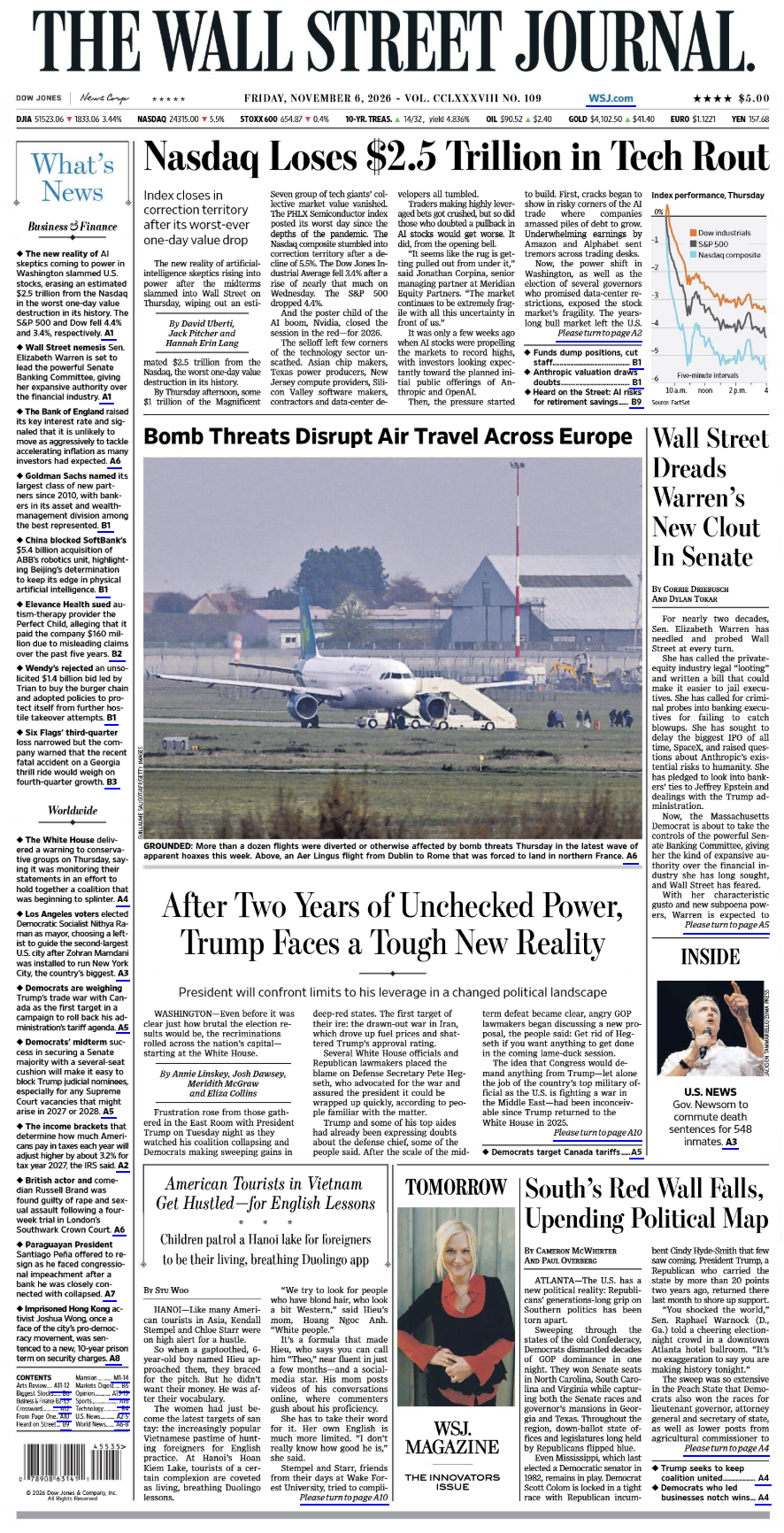
    “Nasdaq loses $2.5 trillion in tech rout,” The Wall Street Journal says on Friday’s front page. “Election turns richest man into the biggest loser,” says The Boston Globe. “Trump team saw collapse coming days before the vote,” but “unpopularity of war and president was too much to overcome,” The New York Times says. “Moderate Democrats increase their clout” while Minnesota “GOP says it paid price for standing by Trump,” The Minnesota Star Tribune says. “Maybe 2020 denial ends” with Democrats’ Georgia “sweep,” The Atlanta Journal-Constitution says. Harmeet Dhillon “quits as head of DOJ’s civil rights office” in “first shakeup at the agency since midterm Republican wipeout,” The Washington Post says. Nithya Raman defeats incumbent Karen Bass “to become next mayor of Los Angeles,” says the Los Angeles Times.

    ► See the newspaper front pages


    Tall tale

    Orange is the new blue

    Two California sheriff’s departments have taken an “in-your-face” approach to addressing pedestrian safety, said The Modesto Bee: dressing as bright orange traffic cones. To test driver awareness, deputies decked out in oversized cone garb step into crosswalks. Motorists who failed to yield were quickly pulled over. In the two cities that tested the cone suits, law enforcement officers nabbed seven drivers for pedestrian violations and two others for DUIs.


    Morning Report was written and edited by Nadia Croes, Scott Hocker, Anya Jaremko-Greenwold, Justin Klawans, Devika Rao, Rafi Schwartz, Peter Weber and Kari Wilkin, with illustrations by Stephen Kelly and Julia Wytrazek.

    Image credits, from top: Joseph Prezioso / AFP/ Getty Images; Kevin Dietsch / Getty Images; Laura Fioravanti / AP Photo; Illustration by Stephen P. Kelly / Getty Images
     

    Recent editions

    • Evening Review

      Supermarket freezer hacks: is the UK next?

    • Morning Report

      Democrats vow to use majorities to check Trump

    • Evening Review

      The end of Trumpism?

    VIEW ALL
    TheWeek
    • About Us
    • Contact Future's experts
    • Terms and Conditions
    • Privacy Policy
    • Cookie Policy
    • Advertise With Us
    • FAQ
    Add as a preferred source on Google Add as a preferred source on Google

    The Week UK is part of Future plc, an international media group and leading digital publisher. Visit our corporate site.

    © Future Publishing Limited Quay House, The Ambury, Bath BA1 1UA. All rights reserved. England and Wales company registration number 2008885.