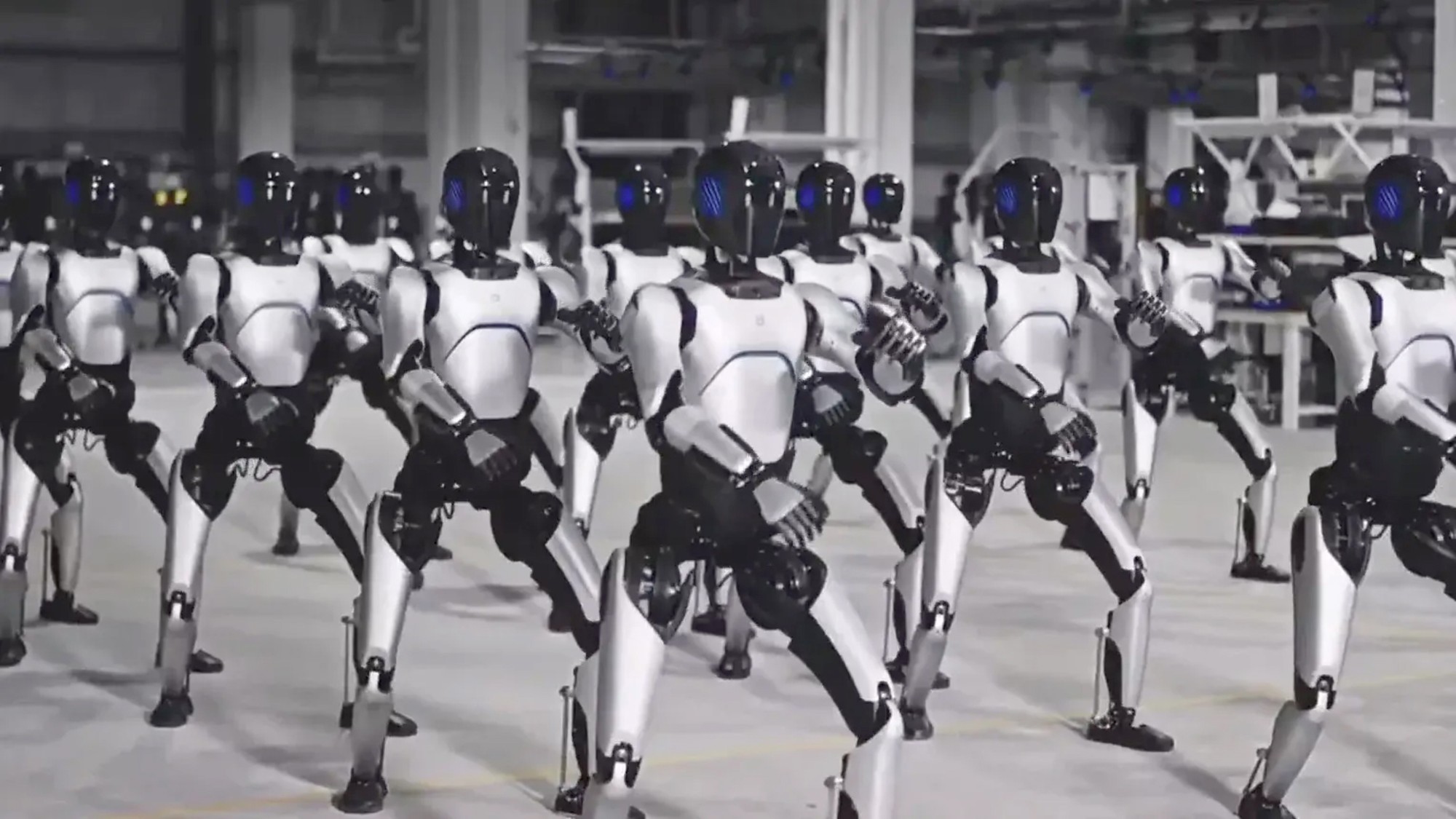
Advances in tech and AI are producing android machine workers. What will that mean for humans?
What is in the pipeline?
Humanoid robots that can obey commands, make decisions, and deftly perform manual tasks have long been a sci-fi fantasy. Now they are becoming reality. Artificial intelligence, coupled with advances in robotics, has the potential to give humanoid robots unprecedented power to analyze, “think,” and learn. Tech evangelists say these robots will have a transformative impact on workplaces and even in our homes, and not in distant decades but in the next few years. Elon Musk believes robots will be “the biggest product ever in history.” His Tesla robot Optimus can already climb stairs and carry 45-pound objects, and he says Tesla will deliver a million units a year by 2030. By 2035, Citigroup predicts, some 1.3 billion robots will be in operation, both in industrial settings and in households, nursing homes, and construction sites. “By the 2040s,” said Adam Dorr, research director at the analytics firm RethinkX, “there will be almost nothing a robot can’t do better and cheaper than a human.”
Where are robots used now?
China already has more than 2 million of them working in factories, and the U.S. is rushing to catch up. In workplaces across America, robots are lifting boxes, transporting goods, even flipping burgers. At a Spanx warehouse outside Atlanta, humanoid bots pluck baskets of clothes from wheeled bots and set them on conveyor belts. To unpack trucks in several facilities, the shipping company DHL uses wheeled Stretch robots from Boston Dynamics, which can lift 50-pound boxes using flexible arms covered in vacuum suction cups. Just one can unload nearly 600 cases per hour, nearly double what humans can do. BMW just finished a pilot program in Spartanburg, S.C., where robot tasks included loading sheet metal parts into a welder. Even small firms are getting in on the action. Greg LeFevre is CEO of Raymath, a metal-fabrication company in Troy, Ohio. His factory is using 13 robot arms, supervised by his human employees, and he says the machines can work around the clock and can execute tricky aluminum welds “anywhere from two to six times faster” than a person. But it’s the nation’s second-largest private employer, Amazon, that is taking the biggest leap.
What is Amazon doing?
It has a million robots working in various capacities and says some 75% of its global deliveries are assisted by robotics. At its 3-million-square-foot “next generation” facility in Shreveport, La., some 1,000 robots of various shapes and sizes shuttle pallets across floors, pluck items from storage bins, and load packages onto carts. Citing internal documents, The New York Times reported last month that Amazon is on track to replace some 600,000 jobs with robots in the coming years, even with sales projected to double by 2033. Its transformation will be closely watched, said Daron Acemoglu, an MIT professor who studies automation. “Once they work out how to do this profitably, it will spread to others too.”
What other uses do robots have?
Robot enthusiasts say the next frontier after warehouses and factories will be homes. The California robotics firm 1X Technologies is taking $20,000 preorders for its Neo robots, with expected delivery next year. The 5-foot, 6-inch humanoids—which currently require remote human operators to joystick them around but will eventually be autonomous—will not just clean toilets and load dishwashers. They’ll also be able to share jokes and engage in “lively, natural conversations,” says the firm. CEO Bernt Bornich believes users will rely on them for both cleaning and companionship. “I don’t think it’s another person, and it’s not a pet,” he said. “It’s something else.”
Will we all be out of work?
There’s no question robots will take away some jobs, but the net effect is a matter of debate. Tech CEOs are quick to say that in fact new higher-skilled jobs will be created—like the position of robot wrangler—and that robots will largely fill dull jobs that most people don’t want. The bots unloading DHS trucks, for example, do “the most hated job in a warehouse,” said Marc Theermann of Boston Dynamics. But some scientists say the robot revolution is still far off, because the machines still have significant physical limitations. Those who think android plumbers and cooks will soon proliferate should “reset expectations,” said Ken Goldberg, a roboticist at University of California, Berkeley. For one thing, it’s proved very hard to endow them with the dexterity to manipulate objects, such as “pick up a wine glass or change a light bulb,” he said. “No robot can do that.”
But are those breakthroughs coming?
Robot evangelists say yes. They say robots are learning so quickly that their advent will inevitably lead to labor-market upheaval. Kavin, a 27-year-old who helps train AI robots to fold clothes in India, says the humanoids aren’t perfect. “Sometimes the robot’s arms throw the clothes,” he says. “Sometimes it scatters the stack.” But he says they’re improving to the point where soon, “they’ll be able to do all the jobs, and there will be none left for us.” Anticipating pushback over mass layoffs, Amazon is reportedly developing plans to mitigate the fallout through community outreach, and other companies are commissioning studies on possible impacts. “We’re basically going to live in a world,” says Brett Adcock, CEO of Figure AI, “where any physical labor is a choice.”