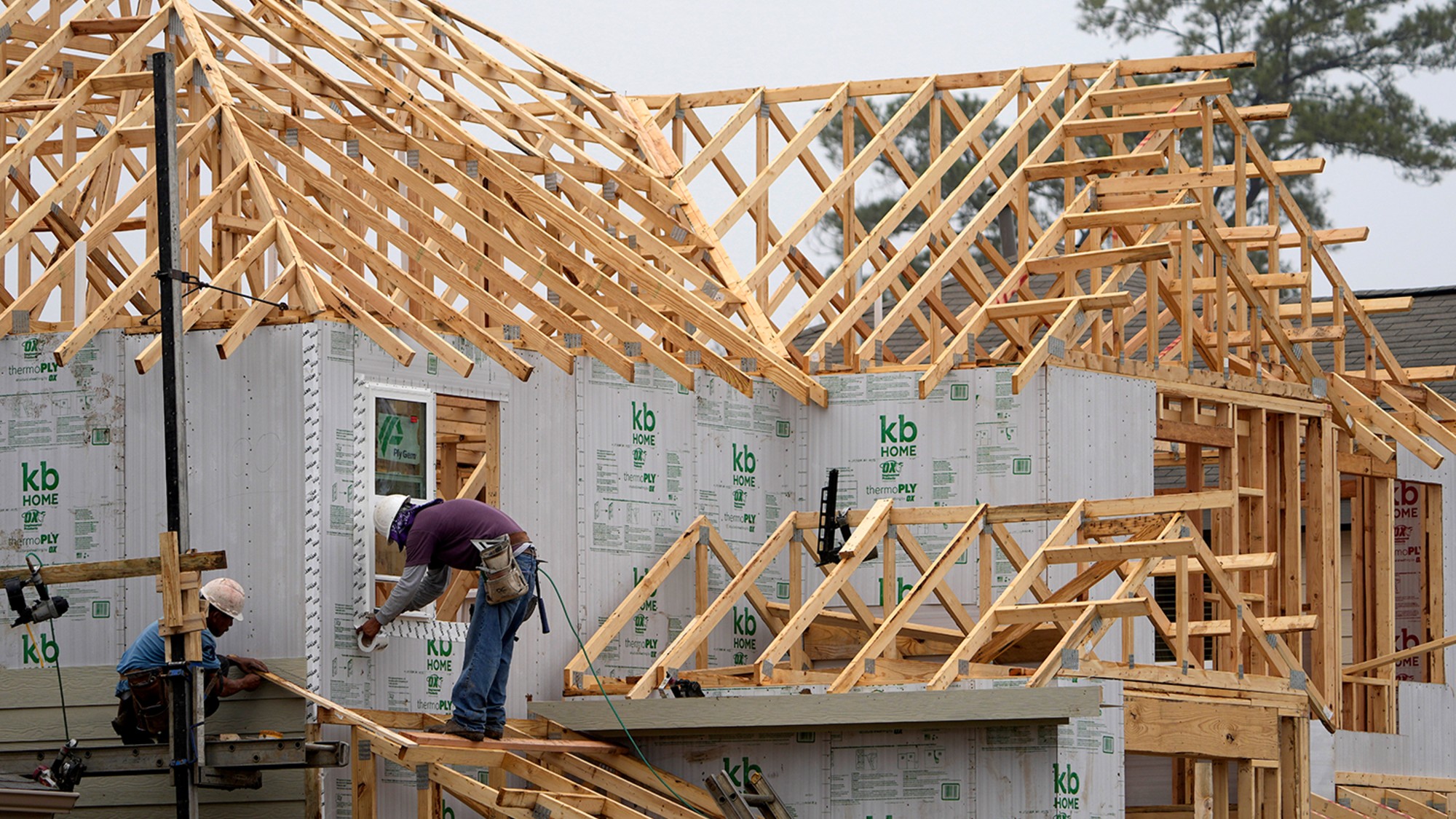
A movement that wants to rip up red tape and build, build, build is gaining ground in liberal circles.
What is ‘abundance’ liberalism?
Popularized by the 2025 book Abundance by journalists Ezra Klein and Derek Thompson, it’s the idea that Democrats need to increase the supply of everything, from housing to mass transit projects, renewable energy sites to new vaccines. Abundance theorists like Klein and Thompson—along with other centerleft authors and intellectuals such as Yoni Appelbaum, Jerusalem Demsas, and Marc J. Dunkelman—say that in the 1970s and ’80s, progressives began pumping out rules and regulations intended to constrain business and stop development from running roughshod over vulnerable communities and the environment. But these anti-growth policies are now causing active harm, they argue, by slowing private sector investment in housing and energy, limiting the labor force by requiring professional licenses for everyone from hairstylists to auctioneers, and preventing the government from building essential infrastructure. Instead of delivering progress, these rules have made much of the U.S. stagnant and unaffordable and amplified distrust in the kind of government action needed to tackle those same problems. “A government too hamstrung to serve the public good,” writes Dunkelman, “will fuel future waves of conservative populism.” The remedy advocated by Thompson and Klein, and a growing number of Democratic lawmakers, is to rally behind “a liberalism that builds.”
How do they propose doing that?
By slashing red tape, untangling bureaucratic webs, and making it harder to file anti-development lawsuits. The abundance movement says such steps are needed to fix the nation’s housing shortage—the U.S. is short at least 2 million homes—which is adding to the wider affordability crisis. Especially in blue towns and cities, zoning laws, historic preservation ordinances, minimum lot sizes, and complaints from NIMBY (“not in my backyard”) neighbors can make it maddeningly difficult to build apartments, multifamily residences, and even small starter homes. Such restrictions partly explain why blue states like New York and California are losing residents, while regulation-light red states such as Texas and Florida are gaining them—a population shift that could shrink Democrats’ Electoral College apportionment by the 2032 election. In 2023, nearly 67,000 permits for new residential housing units were approved in the Dallas metropolitan area. In metro New York, which has three times the population, only 40,000 permits were signed off.
What about infrastructure?
Klein and Thompson praise Democrats’ embrace of big government projects, but say the party too often prioritizes process over outcomes, leaving it with nothing to show voters. They point to a 2021 bill signed by then– President Joe Biden that provided $42 billion to expand broadband internet access in rural America. Three years later, the program had not connected a single household, in part because the law required states that accepted funding to make sure providers planned for climate change, hired locally, and reached out to unionized workforces. To show what can be achieved when Democrats focus on output, they highlight Pennsylvania Gov. Josh Shapiro’s 2023 declaration of a state of emergency after a bridge collapse on a critical highway. The declaration allowed the bridge to be rebuilt with union labor but without the normally mandated months of planning, consultation, and safety and corruption reviews. The highway reopened in just 12 days. “The process Shapiro used would typically be illegal,” write Klein and Thompson. “What does that say about the typical process?” Still, many on the left argue it would be a mistake for Democrats to adopt the abundance ideology.
Why do they oppose the movement?
Sen. Bernie Sanders (I-Vt.) says abundance is a distraction from “the major crisis facing American society”: the economic and political power wielded by billionaires. Meanwhile, Sen. Elizabeth Warren (D-Mass.) argues that abundance is being used by “wealthy donors and other corporate-aligned Democrats” to make the party “more favorable to big businesses.” Union leaders have also pushed back, fearing that an abundance agenda would upend hard-fought wage and training standards, while other critics say an “abundant” future would be one in which local communities have no voice. “A liberalism that builds,” said Marshall Steinbaum, an economist at the University of Utah, “boils down to the idea that people can’t be trusted.” But former president Barack Obama—who put Abundance on his 2025 reading list—warns that a Democratic Party that doesn’t build will be one consigned to irrelevance. If progressives “want to deliver for people and make their lives better,” they have “to figure out how to do it,” he said.“I don’t want to know your ideology, because you can’t build anything. It does not matter.”
Has abundance produced any results?
So far, the debate is mostly academic. But there are signs that abundance is beginning to influence policy. A group of center-left and center-right lawmakers in the House last year formed the Build America Caucus, which is aimed at reforming the permitting process and reducing regulatory slowdowns. And New York City Mayor Zohran Mamdani, a Democratic Socialist and close ally of Sanders, has given a nod to the abundance agenda. We have to “actually deliver on the very ideas that we are so passionate about,” Mamdani said in an interview with Thompson. The movement’s biggest wins have been achieved in California, where Gov. Gavin Newsom—who gave copies of Abundance to the heads of his state’s legislature—last year signed two bills that reined in the California Environmental Quality Act, a 1970 law that was routinely used to stymie development, especially of affordable housing. “We eliminated one of the three or four major barriers to sustainable housing progress in the state of California,” said Matt Lewis, the communications director for California YIMBY. “It’s a really big deal.”