Sign up to get Today’s Best Articles in your inbox
Join 350,000+ subscribers and keep yourself informed with a selection of
The Week’s most interesting, enlightening and entertaining stories - plus daily puzzles.
You are now subscribed
Your newsletter sign-up was successful
Want to add more newsletters?
An account already exists for this email address, please log in.
U.S. calls on Houthis to release embassy employees detained in Yemen
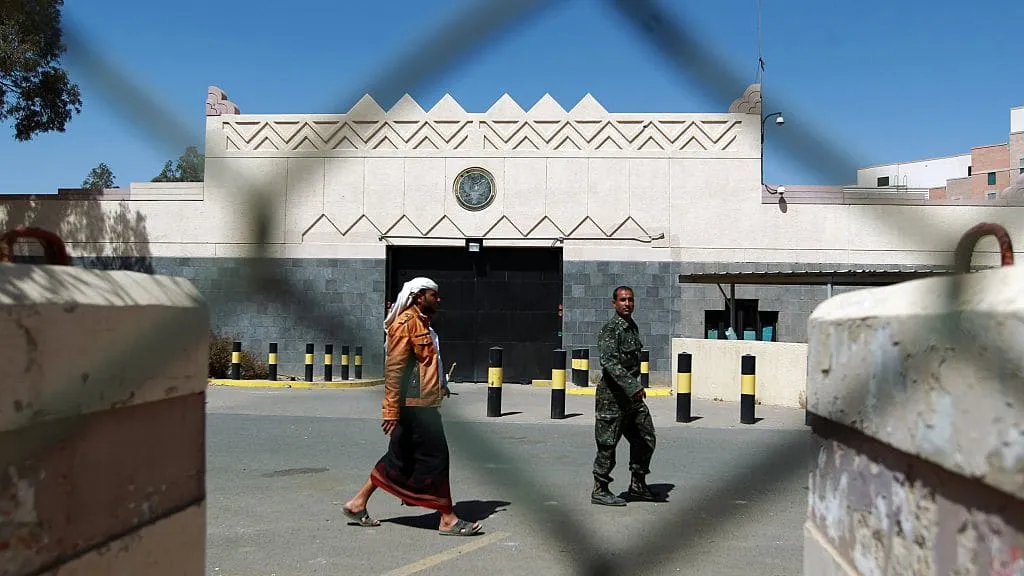
Iran-backed Houthi rebels breached the compound in Sanaa, Yemen, that houses the closed U.S. Embassy, and detained several Yemeni employees.
A "majority" have since been released, a spokesperson for the State Department said on Thursday, and the United States is engaged in "unceasing" diplomatic efforts to free the rest. The U.S. is also calling on the Houthis to "immediately" vacate the compound and "return all seized property."
A State Department official told The Washington Post the detained Yemeni employees work security and were guarding the exterior of the compound. Because of Yemen's civil war, the United States transferred its embassy operations in 2015 to Riyadh, Saudi Arabia. The Saudis oppose the Houthi rebels, and launched a military intervention in Yemen in an attempt to push them back and keep Iran from expanding its influence in the region.
The Week
Escape your echo chamber. Get the facts behind the news, plus analysis from multiple perspectives.
Join more than 350,000 subscribers and keep yourself informed with a selection of The Week’s most interesting, enlightening and entertaining stories - plus daily puzzles.
Join more than 350,000 subscribers and keep yourself informed with a selection of The Week’s most interesting, enlightening and entertaining stories - plus daily puzzles.
Yemen is the poorest country in the Middle East, and the ongoing conflict has led to an enormous humanitarian crisis. The United Nations said in October that two-thirds of the population relies on humanitarian aid, but agencies are "starting to run out of money." The country has to import almost everything, Al Jazeera reports, and there isn't enough food, clean water, or medicine, with Yemenis also having to worry about COVID-19 and cholera outbreaks. Since the start of the civil war in 2014, the U.N. estimates that 233,000 people have died because of the conflict.
Sign up to get Today’s Best Articles in your inbox
A free daily email with the day’s biggest news and analysis – and the best features from TheWeek.com
Catherine Garcia has worked as a senior writer at The Week since 2014. Her writing and reporting have appeared in Entertainment Weekly, The New York Times, Wirecutter, NBC News and "The Book of Jezebel," among others. She's a graduate of the University of Redlands and the Columbia University Graduate School of Journalism.