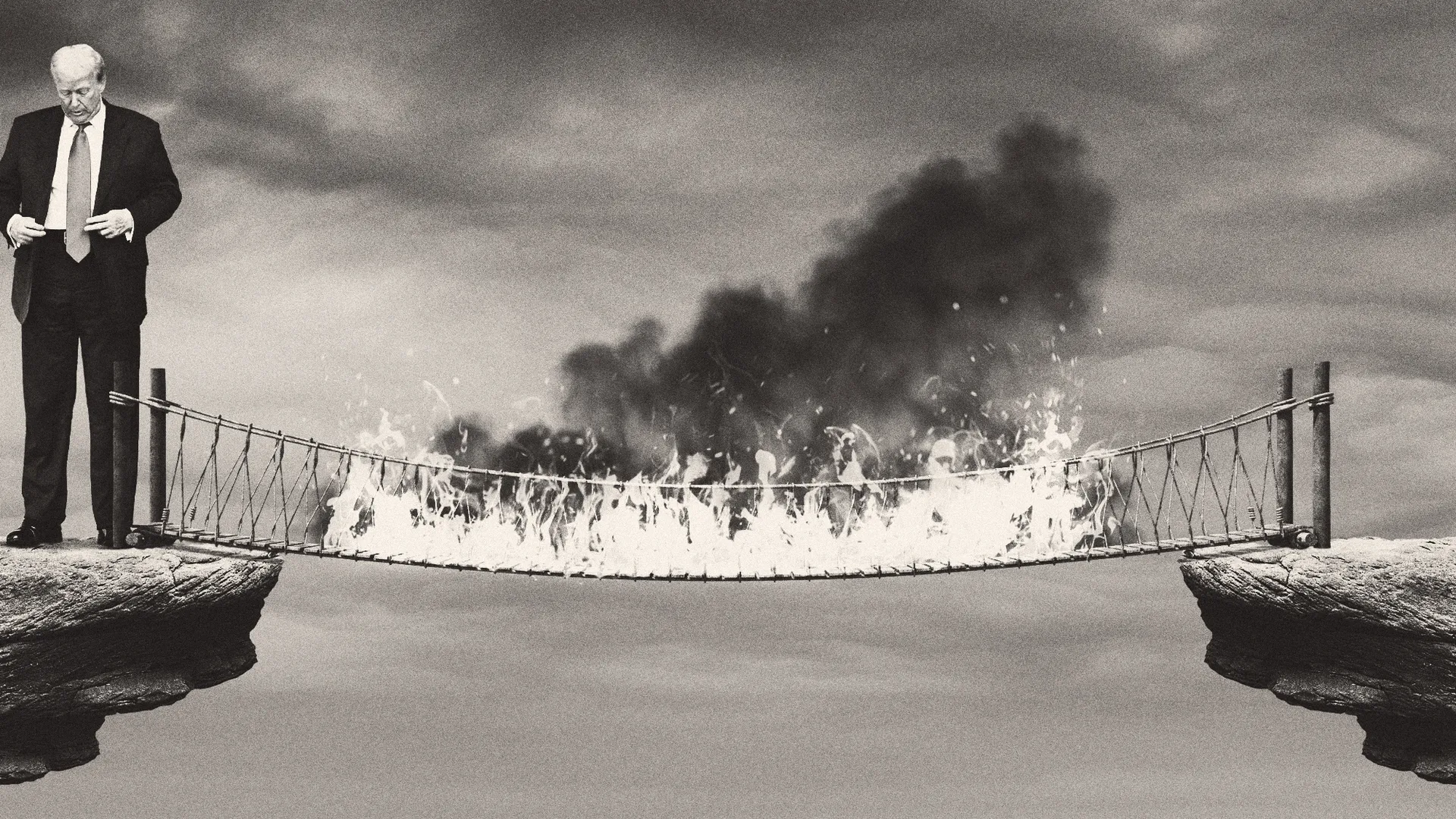
“Dear American friends, Europe is your closest ally, not your problem,” Polish prime minister Donald Tusk posted on X. “Unless something has changed.”
Tusk was reacting to the new US National Security Strategy, which has landed in European capitals at the weekend “like a bucket of cold water”, said The Wall Street Journal. Hailed by Russia as aligning “in many ways” with “our vision”, the explosive 30-page document criticises the “unrealistic expectations” of “European officials” backing Ukraine. It also castigates the EU for “censorship of free speech”, praises the “growing influence of patriotic” political parties, and warns of the “civilizational erasure” of Europe.
Signalling a more isolationist approach to Donald Trump’s foreign policy, the document declares “the days of the United States propping up the entire world order like Atlas are over”.
The Week
Escape your echo chamber. Get the facts behind the news, plus analysis from multiple perspectives.
SUBSCRIBE & SAVE
Sign up for The Week's Free Newsletters
Join more than 350,000 subscribers and keep yourself informed with a selection of The Week’s most interesting, enlightening and entertaining stories - plus daily puzzles.
Join more than 350,000 subscribers and keep yourself informed with a selection of The Week’s most interesting, enlightening and entertaining stories - plus daily puzzles.
Latest Videos FromThe Week US
This “grenade” of a policy paper will have stunned European leaders by revealing “the depth of ideological vehemence within the White House”, said Ishaan Tharoor in The Washington Post.
The “pointed criticisms” of Europe, cast as “tough love advice”, stand in marked contrast to the document’s “approach to traditional US rivals”, said Daniel Michaels, David Luhnow and Max Colchester in The Wall Street Journal. Russia “isn’t mentioned a single time as a possible threat to US interests” and China, North Korea and the Middle East receive surprisingly little attention.
European leaders should “assume that the traditional trans-Atlantic relationship is dead,” Katja Bego from the Chatham House think tank told the paper. It’s “the mother of all wake-up calls for Europe”, historian Timothy Garton Ash added. “It essentially declares outright opposition to the European Union. It’s J.D. Vance’s notorious speech in Munich but on steroids and as official US policy.”
EU foreign policy chief Kaja Kallas has sought to downplay European concerns, conceding that “some” of the US criticism is “true”. Europe “has been underestimating its own power towards Russia,” she told a panel at the Doha Forum in Qatar this weekend. “We should be more self-confident.”
What next?
Since Trump’s return to the White House, “European leaders have kept up a remarkable performance of remaining calm amid his provocations, so far avoiding an open conflict that would sever transatlantic relations entirely”, said Tim Ross on Politico. But for centrists like Keir Starmer, Emmanuel Macron and Friedrich Merz, “the new Trump doctrine poses a challenge so existential that they may be forced to confront it head-on”.
But there’s a fundamental contradiction at the heart of Trump’s document. “By underplaying – and refraining from even referencing – the conventional threat Russia poses to transatlantic security”, it does nothing to “empower those nations that are working to take on greater defence responsibilities”, said Torrey Taussig, a director at the Scowcroft Center for Strategy and Security, on Atlantic Council.
Instead, this strategy paper “seeks to embolden” Europe’s “nationalist and populist parties”, who would probably “cut defence budgets and downplay the conventional threats”. In this sense, the document is an “own goal that undermines the administration’s stated objectives” of “shifting the burden of defence onto the shoulders of European allies”.