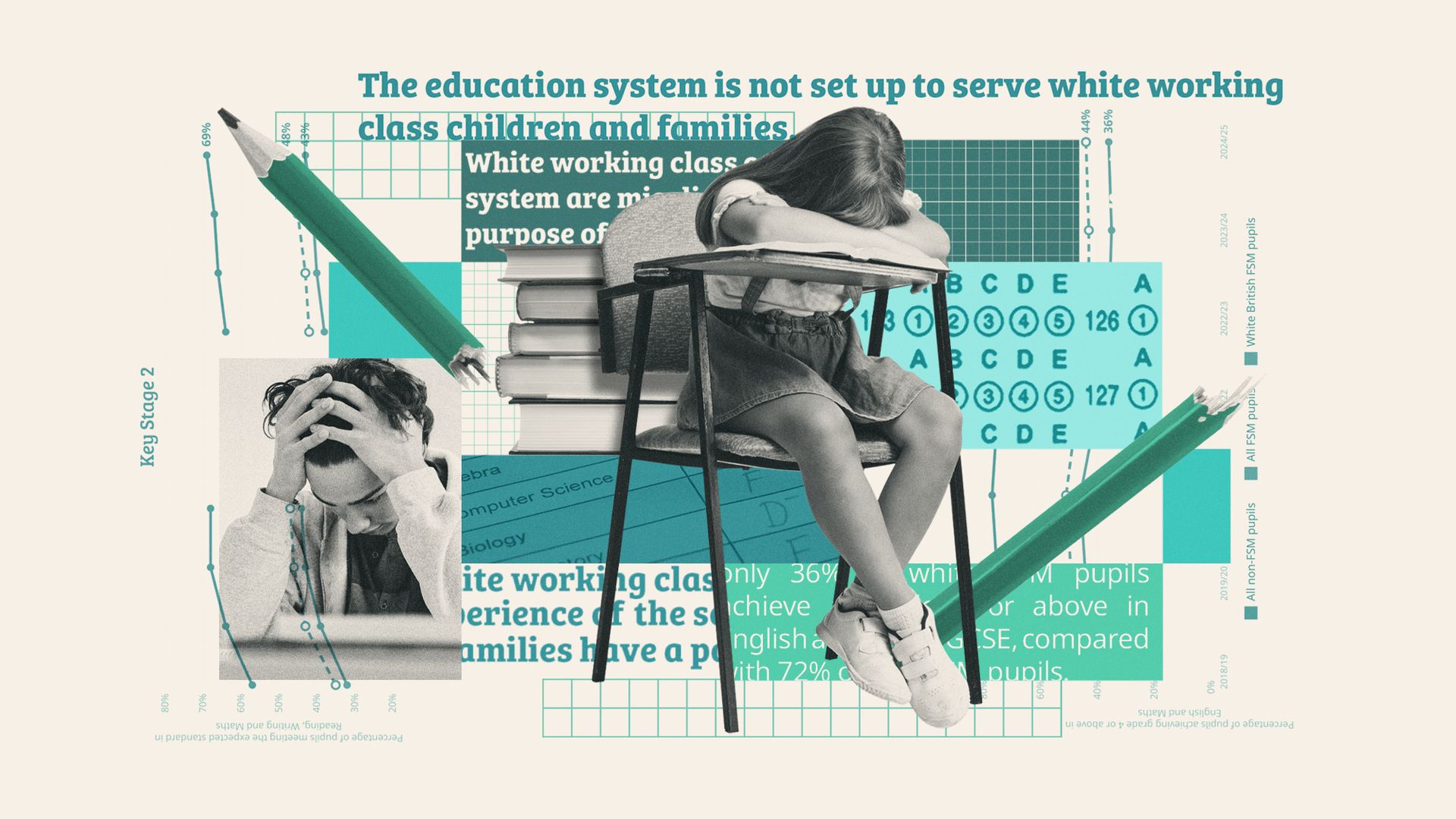
The education system is “not set up to serve white working-class children and families”, an independent inquiry has found. And this has created a “white working-class disadvantage gap”.
The Inquiry into White Working Class Educational Outcomes, found that, by the end of secondary school, just 36% of white pupils who receive free school meals in English schools achieve a Grade 4 or above in English and Maths GCSE, compared with 72% of pupils who don’t receive free school meals.
What did the commentators say?
“Behaviour, disengagement and absenteeism” seem to be the most significant factors for low attainment, said Channel 4’s social affairs editor Jackie Long on the TV channel’s Substack. But the “intersection between geography, culture, opportunity and aspiration” has yet to be “fully unravelled by the inquiry”. “There will be no quick fix.”
Nigel Farage and the political right have “overreached” by blaming the Equality Act and the “proliferation of critical race theory” in British institutions, said Rakib Ehsan of the Policy Exchange think tank on UnHerd. There is an “endemic” problem, facilitated by a “broader economic malaise of regional and class disparity, de-industrialisation” and “lack of secure local employment”.
The narrative that white working-class boys have been neglected by the system is “set like concrete”, said Terri White in Prospect. But “what about our white working-class lasses?” While white working-class girls still marginally outperform their male counterparts (by 38% to 35%) at GCSE level, the girls’ numbers have “dropped dramatically” over the past six years.
Education has become “increasingly politicised”, and white boys are seen as a “problem”, said Joanna Williams on Spiked. They have been let down by a political class that has done little to provide “well paid, meaningful employment”, and have been ignored by a schooling system that “prioritises therapeutic interventions over discipline and high standards”. “All children deserve better.”
What next?
Possible solutions raised by the inquiry include free transport for under-21s, a “crackdown on excessive screen use”, and high-performing schools taking in “more white working-class children”, said Nicola Woolcock in The Times. Communities should also “provide significantly greater access to sport, arts, culture, volunteering, outdoor activity and employer engagement, backed by sustained long-term funding”.
|