The Week The Week
flag of US
US
flag of UK
UK
https://cdn.mos.cms.futurecdn.net/flexiimages/jacafc5zvs1692883516.jpg

SUBSCRIBE & SAVE

Less than $3 per week

Sign in
  • View Profile
  • Sign out
  • The Explainer
  • The Week Recommends
  • Newsletters
  • Cartoons
  • From the Magazine
  • The Week Junior
  • Student Offers
  • More
    • Politics
    • World News
    • Business
    • Health
    • Science
    • Food & Drink
    • Travel
    • Culture
    • History
    • Personal Finance
    • Puzzles
    • Photos
    • The Blend
    • All Categories
  • Newsletter sign up Newsletter
  • WeekDay AM: 10 Things you need to know this morning
    Hopeful traders, invasive mushrooms, and an Aussie sprinting sensation

     
    today’s markets story

    Stocks climb as investors bet on Iran war de-escalation

    What happened
    US equities climbed to a new high yesterday, with the S&P 500 finishing above the 7,000 mark after a gain of roughly 0.8%. The index has now recovered from its recent downturn and is trading at about 2% above the levels seen before hostilities between the US and Iran began in late February. Asian markets also climbed overnight, tracking Wall Street. The rally comes despite the ongoing disruption to oil flows and elevated energy prices that have dampened the broader economic outlook.

    Investors appear encouraged by signs that diplomatic efforts may resume after recent talks ended without agreement, and by indications that the conflict could be nearing its conclusion. Strong corporate earnings have also underpinned the upbeat sentiment, helping equities advance even as geopolitical risks persist.

    Who said what
    “The market is trading assuming we have seen the worst of the conflict,” said Stefano Pascale of Barclays. However, Christine Lagarde, president of the European Central Bank, cautioned that “there is a tendency by some to assume that it’s business as usual”.

    “The mere posture towards peace has helped to placate the stock market,” said Joe Rennison in The New York Times. Since the ceasefire took hold last week, “investors have noted a shift in tone by the Trump administration that reflects a desire to end the conflict soon”.

    What next?
    Investors are “looking to the positives in the Iran war”, according to the BBC. But with the International Monetary Fund warning that continued energy market disruption could weaken growth, push up inflation and increase recession risks, it’s “unclear how long this market positivity can last”.


    today’s education story

    Universities challenge loan repayment demand

    What happened
    Nine universities have launched legal action against the government over a requirement that students quickly repay loans issued for certain courses. About 22,000 students in England have been told that funding they received was wrongly approved and must be returned.

    Who said what
    The dispute centres on weekend degree programmes that have been reclassified as distance learning. These types of courses are “not eligible for maintenance support”, said youth news site The Tab. Many affected students are close to graduating and were “shocked” to learn that their funding status had changed, said the BBC’s education editor Branwen Jeffreys.

    Universities claim that the move has been taken with “minimal notice” and is causing “serious financial distress”. Bath Spa University vice-chancellor Georgina Andrews said it “punished those who are the most vulnerable”. National Union of Students vice president Alex Stanley said trust had been “broken” and urged ministers to halt the “immediate clawback”.

    What next?
    The courts will determine the legality of the reclassification. Meanwhile, regulators and ministers face pressure to shield students from unexpected financial hardship.


    Today’s international story

    Australian mining mogul ordered to share riches

    What happened
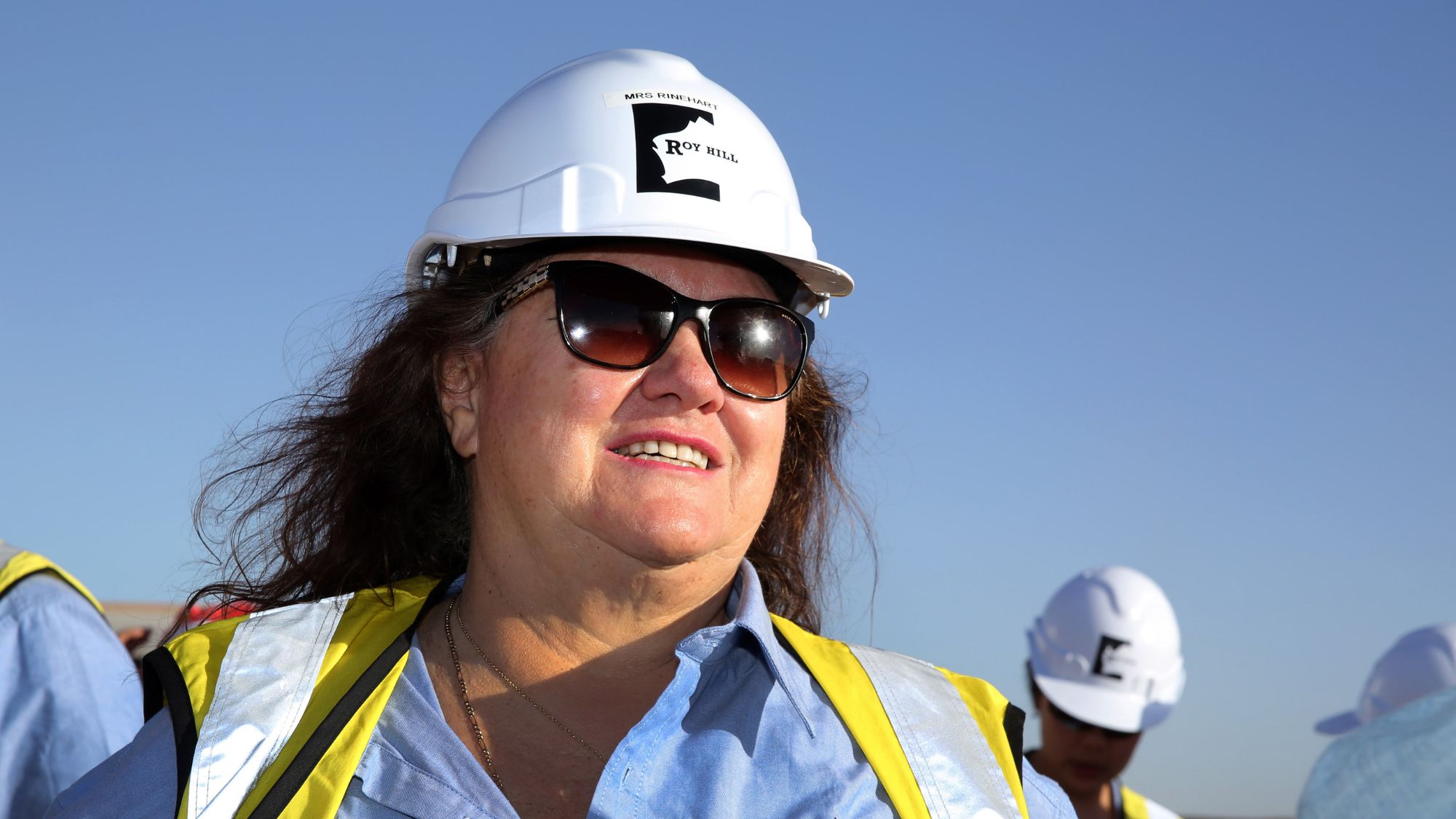
    Australia’s wealthiest person, mining magnate Gina Rinehart, has been ordered to pay hundreds of millions of dollars to two rival mining families following a dispute over historic contract agreements dating from the 1960s.

    After a more than 15-year legal battle, a Supreme Court judge has ruled that Rinehart (pictured above) must pay past and future royalties to the heirs of her father’s business partners Peter Wright and Don Rhodes.

    Who said what
    The “epic” Western Australian Supreme Court case had become a “titanic battle between two of the state’s richest mining clans”, said Kishor Napier-Raman in The Sydney Morning Herald. The legal fees alone are expected to cost “more than $100 million” (£53 million).

    Though the “blockbuster” ruling will “hardly make a dent” in Rinehart’s estimated AUD$38 billion (£20.1 billion) fortune, it has “pitted family against family and siblings against each other”, said Andrea Mayes at ABC News. Rinehart’s two eldest children had also made a claim for a significant share of royalties and mining rights, which was dismissed.

    What next?
    The amount due to both companies will be established in a separate trial at a later date.


    It’s not all bad

    Researchers have discovered that sperm whales communicate in ways strikingly similar to human speech, using structured clicks that function like an “alphabet” and even mimic vowel sounds. The findings, from Project Ceti, suggest that whales share complex, layered communication systems once thought to be unique to humans. Scientists say the breakthrough could one day help us understand and perhaps even converse with one of the ocean’s most intelligent and social species.


    under the radar

    Invasive fungus mushrooms across North America

    The golden oyster mushroom was brought to the US from Asia during the 2000s mostly because it “can grow quickly, which was a boon as it’s considered one of the most delicious mushrooms a forager can find”, said news site Vice. But what was once deemed a benefit has turned out to be a threat. The bright yellow mushroom’s ability to reproduce quickly has caused it to spread across the continent, making it notoriously invasive. The species has already been found in 25 states.

    The fungus is “invisible for most of the year, living as mycelium, fungal strands within wood”, according to the BBC. In the spring it “sends out its fruiting body”, which is “what we would recognise as the mushroom itself”. The “huge yellow clusters cascade out of logs and trees, each mushroom itself producing millions of microscopic airborne spores”. Although the golden oyster mushroom “isn’t yet posing a significant risk to Western forests, it is taking hold in the Northeast and Midwest”, said climate site The Cool Down.

    When the mushroom is present in a forest, the “fungal community composition significantly changes, and fungal species richness significantly decreases”, said a study published last year in the journal Current Biology. Trees colonised by the fungus have “about half the fungal biodiversity as trees without the golden oyster”, Aishwarya Veerabahu, a mycologist at the University of Wisconsin-Madison and lead author of the study, told the BBC.

    To prevent the fungus from overtaking forests everywhere, “continued research, management efforts anchored in social theory and collaborative conversations about microbial endemism” will be necessary, said the study. “The cultivation of local species or development of sporeless mushroom strains could also mitigate risks.”


    on this day

    16 April 2009

    Usain Bolt was named Sportsman of the Year in the Laureus World Sports Awards. This week 18-year-old Australian sprint sensation Gout Gout bettered Bolt’s best 200m time at the same age, setting a national record in the process.


    Today’s newspapers

    ‘Chinese satellites’

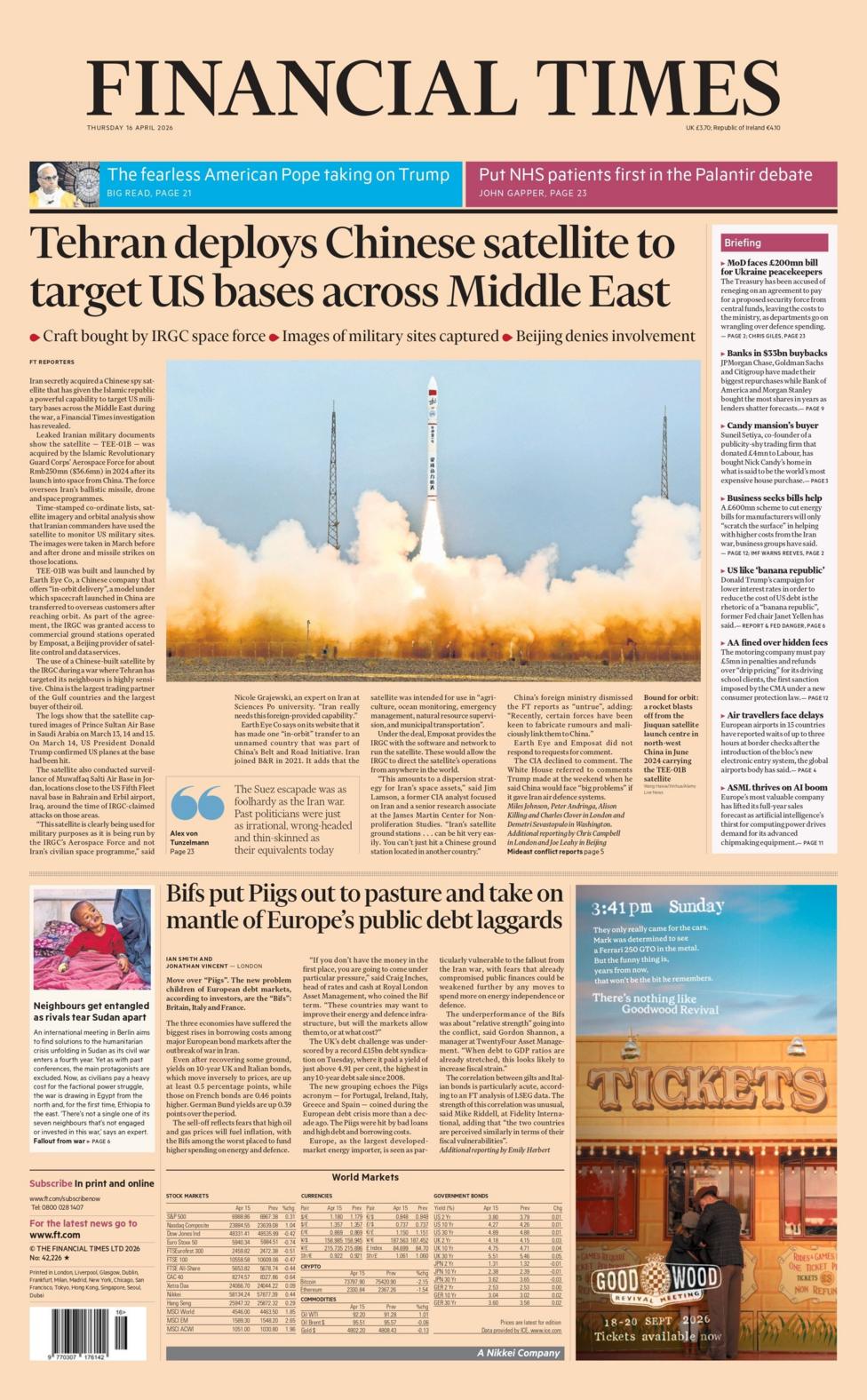
    Iran has used “Chinese satellites to target US bases” across the Middle East, says the Financial Times. A “summer of shortages” could hit the UK’s supermarket shelves, says The Times, as the Iran war affects production of food and other goods. The Guardian reports that “big oil makes extra $30m every hour during conflict” as oil giants enjoy a “bonanza”. There is “no hiding place” as Keir Starmer “hauls tech giants to No 10” to “demand safeguards for kids”, says The Mirror. “That’s Carma”, puns The Sun, after Transport Secretary Heidi Alexander’s car was a victim of a pothole. 

    See the newspaper front pages


    tall tale

    Cybernetic swine sentry

    A humanoid robot named Edward Warchocki has gone viral after footage emerged of him driving away three wild boars from a car park in Warsaw. Hurtling after the animals, he stops and waves as they reach a wooded area. “I’m herding the wild boars into the forest,” the robot’s X account posted alongside the video. Something of a cult celebrity, the Unitree G1 robot has previously met with Poland’s minister of finance and economy, Andrzej Domański, and regularly engages with people on Warsaw’s streets.


    Morning Report was written and edited by Arion McNicoll, Will Barker, Devika Rao, Ross Couzens and Chas Newkey-Burden, with illustrations by Julia Wytrazek.

    Image credits, from top: Angela Weiss / AFP / Getty Images; View Pictures / Universal Images Group / Getty Images; Philip Gostelow / Bloomberg / Getty Images; Illustration by Julia Wytrazek / Getty Images.

    Morning Report and Evening Review were named Newsletter of the Year at the Publisher Newsletter Awards 2025
     

    Recent editions

    • Morning Report

      US hosts rare Israel-Lebanon talks

    • Evening Review

      Dems consider impeachment

    • Morning Report

      Swalwell, Gonzales quit House before expulsions

    VIEW ALL
    TheWeek
    • About Us
    • Contact Future's experts
    • Terms and Conditions
    • Privacy Policy
    • Cookie Policy
    • Advertise With Us
    • FAQ
    Add as a preferred source on Google Add as a preferred source on Google

    The Week is part of Future US Inc, an international media group and leading digital publisher. Visit our corporate site.

    © Future US, Inc. Full 7th Floor, 130 West 42nd Street, New York, NY 10036.