The Week The Week
flag of US
US
flag of UK
UK
https://cdn.mos.cms.futurecdn.net/flexiimages/jacafc5zvs1692883516.jpg

SUBSCRIBE & SAVE

Less than $3 per week

Sign in
  • View Profile
  • Sign out
  • The Explainer
  • The Week Recommends
  • Newsletters
  • Cartoons
  • From the Magazine
  • The Week Junior
  • Student Offers
  • More
    • Politics
    • World News
    • Business
    • Health
    • Science
    • Food & Drink
    • Travel
    • Culture
    • History
    • Personal Finance
    • Puzzles
    • Photos
    • The Blend
    • All Categories
  • Newsletter sign up Newsletter
  • Saturday Wrap, from The Week
    The meningitis response, a robot revolution, and Netanyahu’s gamble in Iran

     
    controversy of the week

    Meningitis: was the response too slow?

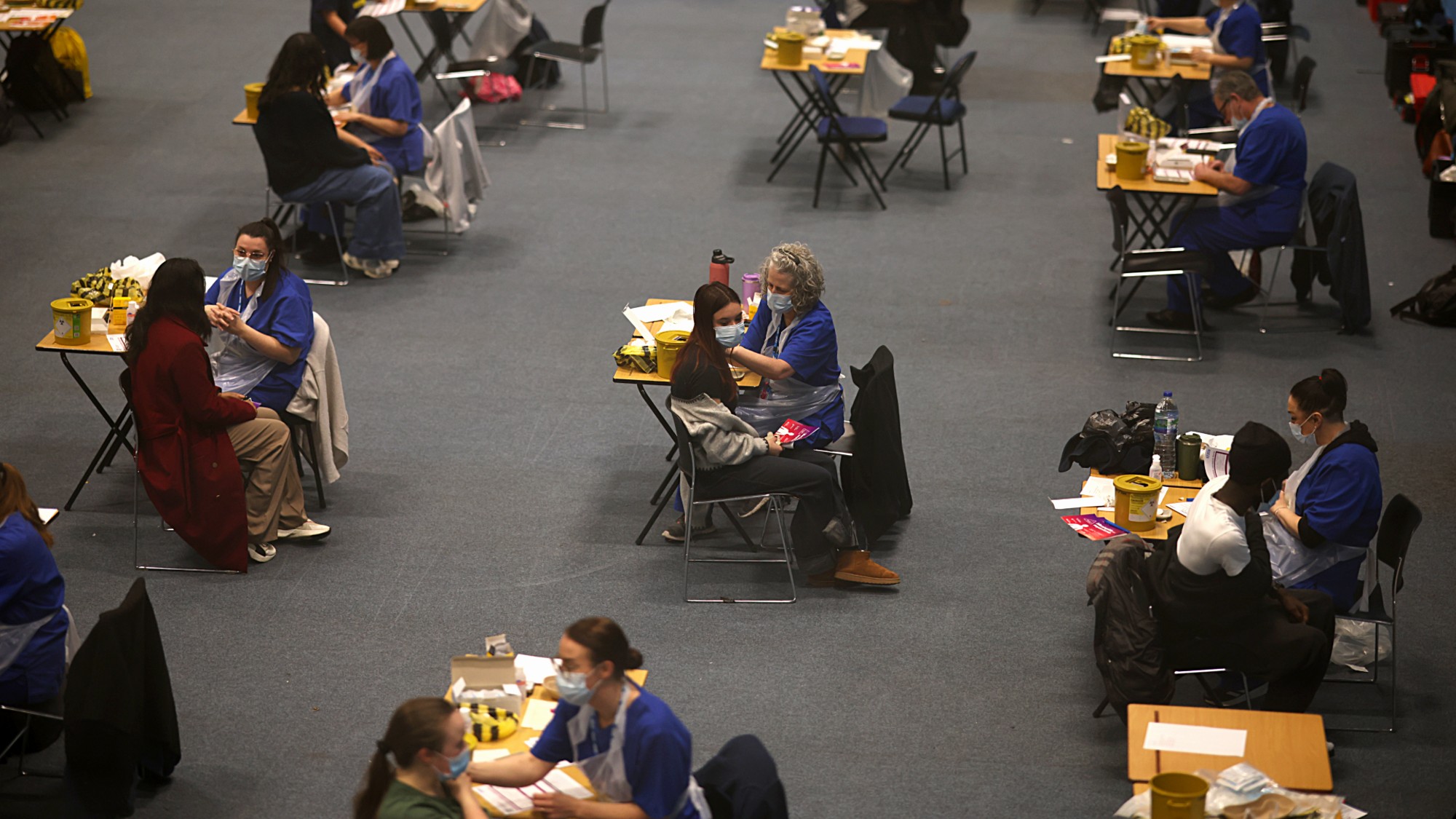
    The thousands of people who crowded into Club Chemistry in Canterbury on the nights of 5, 6 and 7 March had no idea they were attending meningitis super-spreader events, said Lara Wildenberg in The Times. But it is now clear that as these youngsters shared drinks and vapes, kissed and danced, MenB was passing between them. On 13 March, the UK Health Security Agency (UKHSA) was notified by a hospital in Kent of a confirmed case of meningitis in a patient who had been admitted two days earlier. It started contact tracing, but local students were told nothing and so continued to mix. On 14 March, hospitals reported a surge in admissions of young people with symptoms of meningitis, and on the campus of the University of Kent the mood shifted as a video clip of a student being wheeled away by paramedics circulated on WhatsApp. Finally, on Sunday 15 March, the UKHSA issued a public alert and launched a “full-scale response”. Over the next few days, thousands of people were given preventative antibiotics and MenB vaccines.

    By the end of last week, there had been 20 confirmed cases of MenB, said The Guardian. All the patients had been hospitalised, and two had died: an unnamed student aged 21, and Juliette Kenny, 18, a local sixth-former. But with no cases reported since, health authorities are cautiously optimistic that the outbreak – the worst in the UK in a generation – has peaked.

    MenB can kill within hours of symptoms becoming apparent, said Laura Donnelly in The Telegraph, but these symptoms are easily mistaken for those of flu – or even a bad hangover. So why were students not alerted earlier? What troubles me is that so few youngsters are vaccinated for this terrifying disease, said Camilla Tominey in the same paper. Aged 13 or 14, children are jabbed for other forms of meningitis, and since 2015, babies have been given MenB jabs. For everyone else, the only option is to get the jab privately (if they can – stocks are very low). There are reasons for this, said BBC News. Although a quarter of adolescents carry the meningococcal B bacteria, it is very rare that it causes disease. The vaccine does not offer long-term protection: babies have it to protect them during infancy, when they are most vulnerable. And it doesn’t stop transmission, or work on all forms of MenB. Even so, there have long been calls for teenagers to be offered MenB jabs, and ministers have promised to review the policy. But even if teenagers are vaccinated, they won’t be totally safe, or safe for ever – so being alert to the symptoms of meningitis will remain vital.


    Briefing of the week

    The robot revolution

    The robotics industry is advancing by leaps and bounds in China

    Why the recent interest?
    On 16 February, up to 677 million viewers around the world watched the Chinese New Year Spring Festival Gala, the state-run Chinese media’s annual showpiece. The stars of the show were a troupe of humanoid robots built by Hangzhou-based Unitree Robotics, which put on an amazing display of choreographed martial arts – running, jumping, high-kicking, doing backflips – alongside child performers. The broadcast underlined China’s ascendancy in the new field of robotics and in hi-tech manufacturing, fields that were previously dominated by American, Japanese and European companies. Two Chinese firms, Unitree and Agibot, have more than 50% of the global market share in humanoid robots; they shipped around 11,000 units last year. You can buy either company’s basic model for around $20,000. 

    What can such robots actually do?
    They can perform amazing feats of mobility, autonomous navigation and manipulation: from high-energy stunts to household tasks such as pouring water and wiping counters. Retail robots made by Galbot, another big Chinese company, sell consumer items and process payments in promotional kiosks. As yet, however, few humanoid robots do any real work. Elon Musk has claimed that Tesla’s robot, Optimus, would be a catch-all assistant: butler, housekeeper, childminder and PA. In reality, in the short term they may be rolled out for use in Tesla’s factories, doing repetitive tasks such as material handling, or quality inspection – though even that is not certain. Most analysts agree that the technology to produce a general-purpose autonomous humanoid robot isn’t there yet, and won’t be for many years. 

    And what are their limitations?
    Robots are good at performing tasks of limited complexity, in a predictable physical environment: a robot vacuum cleaner, say, or even a robo-taxi, operates according to clearly drawn rules and protocols, and uses a limited number of controls. They can also, like Unitree’s dancing robots, follow complex pre-programmed scripts. The difficulty comes when they have to interact with an unpredictable physical world. Even simple tasks – emptying a dishwasher or using a door handle – mean interpreting a large amount of data about the physical world, and manipulating objects carefully. So far, robots have proved only 30%-50% as good as humans at basic tasks such as carrying boxes. The industry hopes to be able to solve this in part by using artificial intelligence: “physical AI”, as it is known. But even that poses serious difficulties. 

    What are the difficulties?
    The hope is that machines can learn to navigate the physical world the way ChatGPT learnt to navigate language: by absorbing vast reams of data. The difference is that there is no equivalent of the internet for robots to train on. They have to be trained by teleoperation, where humans guide a robot to do a precise task – a kung-fu kick, say – thousands of times, using motion-capture technology. There are shortcuts: robots can be trained in virtual environments. But it’s still very much a work in progress. A robot carer or plumber is still many years away 

    Physical AI: robotic intelligence
    “The ChatGPT moment for robotics is here,” the chipmaker Nvidia’s chief executive Jensen Huang announced in January. Huang is credited with inventing the term “physical AI”, meaning artificial intelligence systems that operate in and interact with the physical world rather than existing only in software or digital form. The theory is that robots should be able to perceive the environment, reason with the power of a large language model, act accordingly, and then learn from the outcome of that action – leading industrial robotics from blind automation to intelligent interaction. The result would be robots that can use existing tools, working in spaces originally designed for humans, correctly interpreting human instructions, and handling items they have never seen before. Nvidia is a world leader in this field. It provides the “digital playgrounds” where almost every cutting-edge robot is trained, providing virtual simulations of the real world. Among the leading “physical AI” robot makers are: Boston Dynamics, whose bots are set to be used in Hyundai’s factories this year; Figure AI, backed by OpenAI and Microsoft; and Tesla. Elon Musk claims that his robots will be making more robots on production lines this year; many insiders doubt this.



    It must be true… I read it in the tabloids

    Two candidates by the names of Hittler and Zielinski were pitted against each other in a French mayoral election last weekend. Antoine Renault-Zielinski, a far-right candidate, and no relation to Ukraine’s president, took on Charles Hittler, 75, no relation to the dictator, in Arcis-sur-Aube, a northern town of 2,800 people. However, Zielinski lost to Hittler, the centre-right incumbent who has held the mayoralty since 2020, who said that he had always resisted changing his name, despite a lifetime of teasing. “I kept [it] to show that not everyone with that name is an idiot,” he said. “It depends what you make of it.”


    VIEWPOINT

    Talking about AI

    “At an 80th birthday party at the weekend, I met an academic who was evasive about his field. When he finally disclosed ‘computer science’, I asked him why he hadn’t wanted to say, and he replied: ‘Because I cannot have one more conversation about AI.’ I don’t want to have another conversation about AI either. From the metaphysical (“This is the end of the human creativity”) to the deeply credible (“This is the end of the service industry”), to the cheerleading (“AI will cure cancer”), nobody’s opinion, utopian or dystopian, seems to keep up with the thing itself – so everything has the laggy, outdated feeling of a BBC Radio 4 afternoon play about AI.” 

    Zoe Williams in The Guardian


    talking point

    Benjamin Netanyahu’s gamble in Iran

    Israel and the US went into this war together, said Katy Balls in The Sunday Times. But as the conflict drags on, some members of Maga’s “isolationist wing” are starting to complain that Israel “led” the US into it, in pursuit of its own agenda. US Secretary of State Marco Rubio lent credence to that theory some weeks ago, when he said that the US had struck Iran because Washington “knew that there was going to be an Israeli action” that would prompt a retaliation. And only last week Tulsi Gabbard, the US intelligence chief, told Congress that Iran had abandoned its pursuit of nuclear weapons, undermining any claim that Iran posed an “imminent threat”.

    It is pretty clear that it posed no such threat, said Donald Macintyre in The Independent – and it is well known that Benjamin Netanyahu had been trying to persuade the US to join in such a war for 25 years: successive US presidents blocked it. But that doesn’t mean that Trump was lured into a war by Israel, even if he sometimes finds it convenient to claim that the Israelis are acting without his knowledge.

    For Netanyahu, this war is not just about destroying a hostile regime, said Emma Graham-Harrison in The Guardian. This autumn, he will face his first electoral test since the 7 October attacks. For the past two years, his poll ratings have been “stubbornly below levels that would return him to power”. Victory for Israel in this conflict – which has the support of 90% of Israelis – would do much to turn that around. But in going to war with Iran, the PM is gambling with his country’s long-term security, said Gideon Rachman in the Financial Times. For decades, the single biggest guarantee of that security has been the “strong bipartisan support” Israel commands in the US. “But the Netanyahu government’s actions – first in Gaza and now in Iran – are draining that support away.” If this war turns into a costly “quagmire”, it’s “entirely conceivable” that both the Democratic and Republican candidates in the 2028 presidential race will propose curtailing support for Israel – an outcome that would be a “strategic disaster for the Israelis”.


    It wasn’t all bad

    The Lake District house where William Wordsworth lived from 1813 until his death in 1850 has been bought by a trust set up in his name. Rydal Mount, near Ambleside, was acquired by one of the poet’s descendants in the late 1960s, who opened it as a museum. However, visitor numbers had dwindled and, unable to afford its upkeep, the family put the house on the market for £2.5 million – raising fears that it would be bought by a private individual, for use as a home. Instead, it has been acquired by the Wordsworth Trust, with help from the Julia Rausing Trust and the Charlotte Aiken Trust.


    People

    Harry Enfield

    Harry Enfield describes himself as “a frightful leftie”, but that doesn’t stop the comedian from having right-wing friends, he told Michael Odell in The Times. He is chummy with David Cameron and on good terms with William Hague (though Hague is said to have inspired his snivelling character Tory Boy). “I have all kinds of friends because I’m about mischief rather than malice,” he says. “I’m not horrible to anyone, whereas more right-on comics are.”

    In the 1980s, he lived in a squat and was a Marxist. These days, he rails at monetarism and is dispirited by rich people he knows who only worry about getting more money. “I’m not one of them,” he says. “I pay all my tax and I don’t employ clever accountants to get around it.” Even so, some of his views have got him into trouble with other lefties. Years ago, after he defended fox hunting, the Pretenders singer Chrissie Hynde wrote him a letter denouncing him as “the sperm of the devil”. She had been his childhood crush. “I still had a plectrum she threw in the crowd when I saw her in 1978,” he says. “So I sent it back to her and wrote, ‘I have loved you since I was a boy and have kissed every word of your letter. Please send more hate mail.’” They are friends now. “Anyway, I am not pro-fox hunting,” he clarifies. “I just don’t like meat eaters who want to ban it while ignoring the fate of the animals they eat.”


    Image credits, from top: Dan Kitwood / Getty Images; Wang Jiang / VCG / Getty Images; Alexi J. Rosenfeld / Getty Images; David M. Benett / Dave Benett / Getty Images
     

    Recent editions

    • Morning Report

      The TSA funding fight endgame

    • Evening Review

      Big changes at the DHS

    • Morning Report

      Iran denies Trump peace

    VIEW ALL
    TheWeek
    • About Us
    • Contact Future's experts
    • Terms and Conditions
    • Privacy Policy
    • Cookie Policy
    • Advertise With Us
    • FAQ
    Add as a preferred source on Google Add as a preferred source on Google

    The Week is part of Future US Inc, an international media group and leading digital publisher. Visit our corporate site.

    © Future US, Inc. Full 7th Floor, 130 West 42nd Street, New York, NY 10036.