The Week The Week
flag of US
US
flag of UK
UK
https://cdn.mos.cms.futurecdn.net/flexiimages/jacafc5zvs1692883516.jpg

SUBSCRIBE & SAVE

Less than $3 per week

Sign in
  • View Profile
  • Sign out
  • The Explainer
  • The Week Recommends
  • Newsletters
  • Cartoons
  • From the Magazine
  • The Week Junior
  • Student Offers
  • More
    • Politics
    • World News
    • Business
    • Health
    • Science
    • Food & Drink
    • Travel
    • Culture
    • History
    • Personal Finance
    • Puzzles
    • Photos
    • The Blend
    • All Categories
  • Newsletter sign up Newsletter
  • Brand Logo
    TSA funding, Olympic trans ban and Anthropic victory

     
    TODAY’S NATIONAL story

    Senate funds DHS after Trump’s TSA pay promise

    What happened
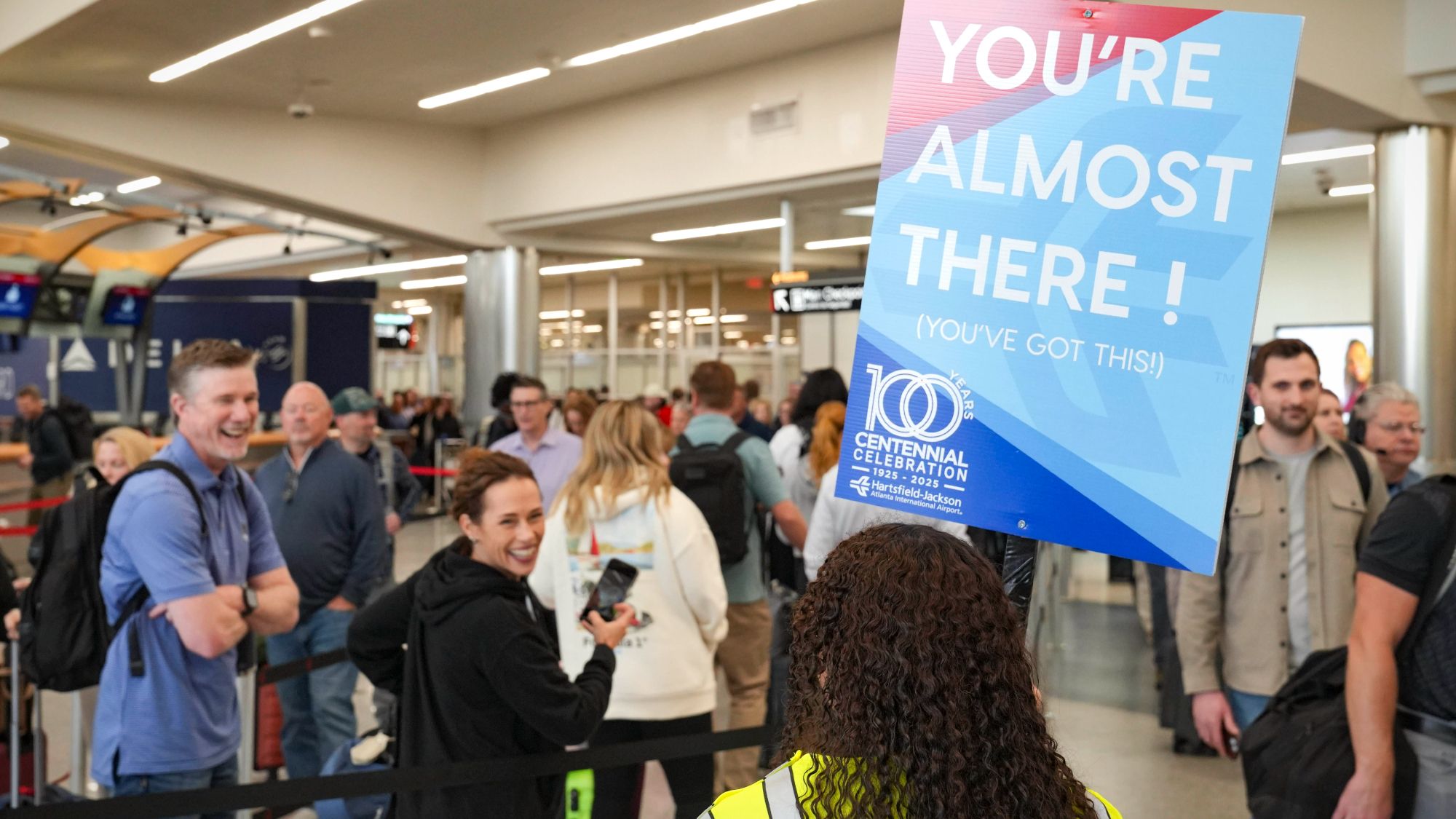
    President Donald Trump yesterday said he would sign an executive order directing Homeland Security Secretary Markwayne Mullin to “immediately pay our TSA Agents” in order to “quickly stop” the “Chaos at the Airports.” After Trump’s announcement on social media, the Senate passed a bill early this morning to fund the TSA and all other DHS agencies except those responsible for immigration enforcement. Pressure had been building for action as air travelers face long lines at some airports amid TSA callouts and resignations.

    Who said what
    Trump did not say how he would pay the 50,000 TSA agents on the verge of missing their second full paycheck since DHS funding expired Feb. 14. But CNN, citing two people familiar with the plans, said the president would use “funding from the sweeping legislation he signed last year known as the ’One Big, Beautiful Bill.’”  

    Trump “appeared eager to claim credit” for steering some of his DHS “slush fund” to the TSA, The New York Times said, but “no executive order, emergency or otherwise, would be required to access those funds,” and “it was not clear why he had waited more than five weeks” to pay the agents. “My question is if he can do it, why didn’t he do it before?” Max Stier, CEO of the Partnership for Public Service, said to CNN.

    Republicans had “lobbied Trump” in recent days to “take executive action to pay TSA agents,” The Wall Street Journal said, citing a senior administration official. But the president was “initially opposed to the idea, believing Democrats were getting the blame for chaos at airports.” Democrats had repeatedly pushed to fund just the TSA as negotiations over ICE policies continued. The bill passed today by unanimous consent would fund all DHS agencies except ICE and Border Patrol, and did not include any of the reforms sought by Democrats.

    What next?
    The DHS bill “next goes to the House,” which is “expected to consider it” today before Congress leaves for a two-week Easter break, The Associated Press said. Republicans are “now expected to try to pass the immigration-enforcement funding through a process called budget reconciliation,” the Journal said. But “any reconciliation bill,” Axios said, “faces a perilous path in both chambers,” especially if it includes “$200 billion for the Pentagon tied to Iran.” 


    TODAY’S SPORTS story

    IOC bans trans athletes from women’s Olympic events

    What happened
    The International Olympic Committee yesterday announced that transgender women athletes will be barred from competing in women’s events starting with the 2028 Olympics in Los Angeles. The announcement ends “months of speculation” over how the governing body would address one of the “most contentious issues facing global sports,” The New York Times said. It was the IOC’s “most consequential” decision since Kirsty Coventry (pictured above) took over as the organization’s first woman president last June. 

    Who said what
    “Eligibility for any female category event” at any IOC event is ”now limited to biological females,” the IOC said in a statement. Any athlete who wants to compete in a women’s category must take a mandatory one-time gene test to determine if they have a Y chromosome. “We know that this topic is sensitive,” Coventry said. But the “science” conducted by the IOC’s “medical experts” shows that “biological males” have inherent physical advantages, and “at the Olympic Games, even the smallest margins can be the difference between victory and defeat.” 

    Critics warned that the new policy “extends beyond transgender athletes and could subject all women competitors to invasive scrutiny,” Advocate said. The “potential” for “increased ‘gender policing’ of all female athletes” is “unwelcome,” said Outsports. The French Olympic Committee said the genetic tests “raise major ethical and scientific concerns” and also “practical difficulties,” since French “bioethics laws and the civil code” prohibit their use.

    What next?
    The IOC’s policy is “widely expected to be adopted by international sports federations and become a universal rule for competitors in female elite sports,” Reuters said. But it also “can — and likely will — be challenged at the Court of Arbitration for Sport,” The Associated Press said. Any challenge would examine the “science underpinning IOC research which was not published” yesterday.


    TODAY’S TECH Story

    Judge sides with Anthropic in Pentagon military AI fight

    What happened
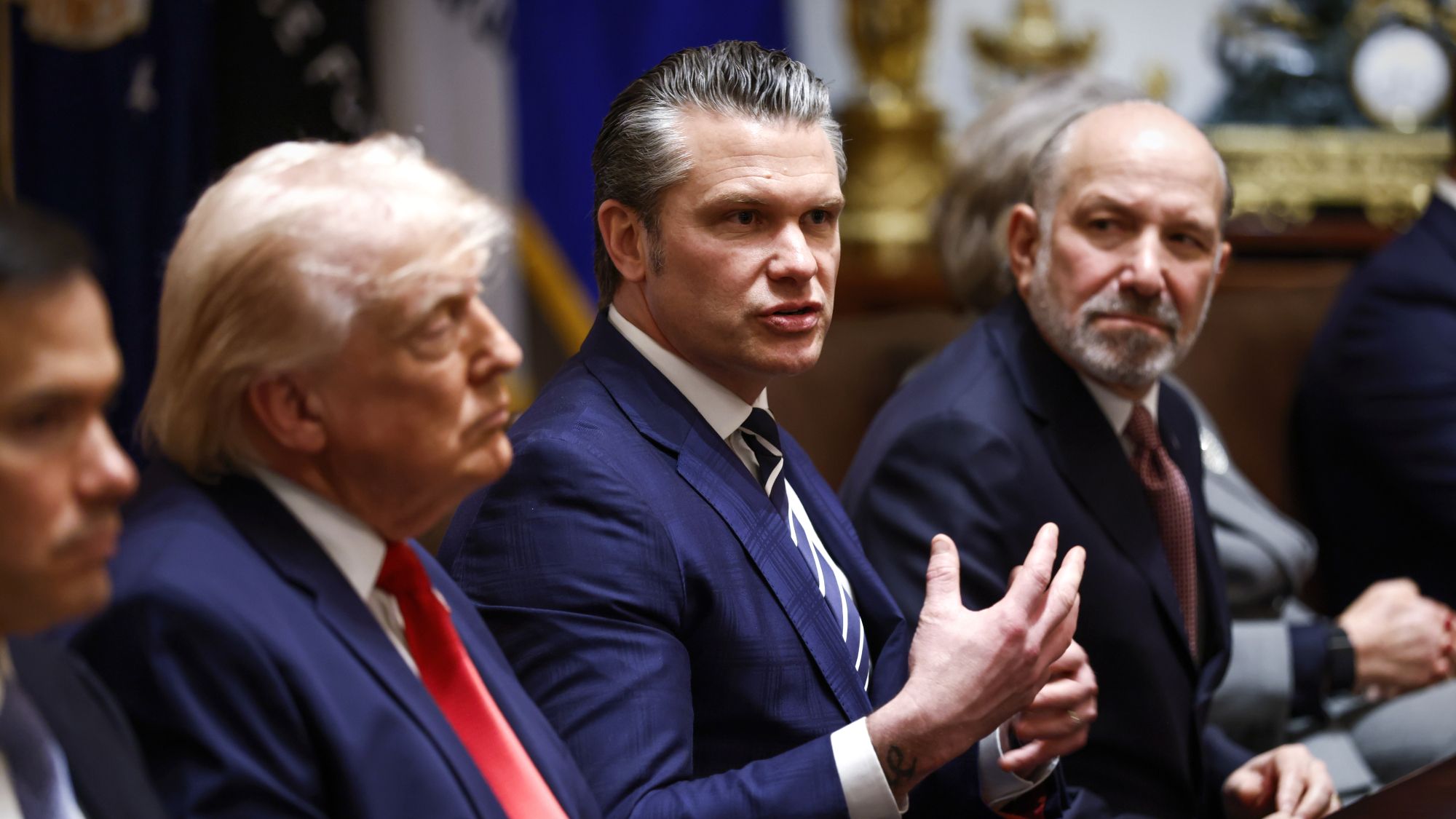
    A federal judge in California yesterday temporarily blocked the Pentagon from labeling Anthropic a “supply chain risk,” a designation that effectively blacklisted the AI company from U.S. government contracts. U.S. District Judge Rita Lin said the “broad punitive measures” imposed by Defense Secretary Pete Hegseth (pictured above) likely violated Anthropic’s due process and free speech rights. 

    Who said what
    The ruling was a “clear victory” for Anthropic in its “bitter power struggle with the Defense Department over the use of its Claude system by the military,” The Washington Post said. During negotiations for a $200 million contract, Anthropic wanted to keep safeguards against using its AI on autonomous weapons and surveilling Americans, and the Pentagon rejected any limits imposed by a private contractor. When the dispute became public, Hegseth blacklisted Anthropic using an “obscure government-procurement statute aimed at protecting military systems from foreign sabotage,” Reuters said. 

    “Nothing in the governing statute supports the Orwellian notion that an American company may be branded a potential adversary and saboteur of the U.S. for expressing disagreement with the government,” Lin wrote in her 43-page ruling. If the Pentagon had real national security concerns, it “could just stop using Claude.”

    What next?
    Lin paused her ruling for seven days to give the Pentagon a chance to appeal. The outcome of the case and a similar challenge pending in Washington, D.C., have broad “implications for AI use in war,” The New York Times said. While the Trump administration has said it would “transition away” from Anthropic’s AI, the Post said, Claude is “deeply embedded in the military’s systems” and the Pentagon “has been continuing to use it in support of its bombing campaign in Iran.” 


    It’s not all bad

    An unexpected, and much-welcomed, gorilla baby boom is happening inside Virunga National Park in the Democratic Republic of the Congo, with two sets of mountain gorilla twins discovered in two months. Such twin births are incredibly rare, so this is an “extraordinary event,” said Jacques Katutu, Virunga’s head of gorilla monitoring. Park rangers found the newer set of twins — a male and female — in a high-altitude rainforest. The pair found in January, both males, are now 11 weeks and healthy.


    Under the radar

    The scramble to aid pets abandoned after ICE raids

    As immigration raids continue in cities across the U.S., ICE agents often leave behind forgotten victims: pets. These animals get stranded when their owners are caught up in raids; others may be abandoned when undocumented immigrants choose to self-deport. 

    The exact number of animals left behind following ICE raids is likely impossible to quantify. Some cities, though, have been able to report data on these abandoned animals.

    In Minnesota, St. Paul Animal Services “recorded a 38% increase in stray, seized and relinquished cats and dogs in January 2026 compared with January 2025,” said The New York Times, the uptick occurring during ICE’s Operation Metro Surge in the Twin Cities. Other cities have similar stories: In Tampa Bay, the nonprofit Mercy Full Project took in “record numbers of abandoned pets linked to families leaving the U.S. from the recent immigration crackdown,” said Fox 13.

    Pet owners taken by ICE are “likely not given the opportunity to make arrangements for their cats and dogs,” said pet lifestyle company Kinship. Sudden separations are “traumatic for both the animals and the people who love them, and they underscore how critical preparedness and community awareness are,” Rachel Mairose, the executive director of rescue organization The Bond Between, told Kinship.

    Providing assistance for these animals “often begins with helping neighbors, friends or family members understand the proper steps, like first contacting animal control,“ said Kinship. Shelters are taking in some of these deportation castaways, but people nationwide are also volunteering to foster “pets that had been left behind by former neighbors,” said the Times.


    On this day

    March 27, 1964

    A magnitude 9.2 earthquake struck Alaska’s Prince William Sound region, killing 139 people and causing millions of dollars in property damage. The ruptured fault lines jolted as much as 60 feet, and some areas of Alaska were permanently elevated 30 feet. It remains the strongest earthquake ever recorded in North America and the second-strongest in the world.


    TODAY’S newspaperS

    ‘War exit unclear’

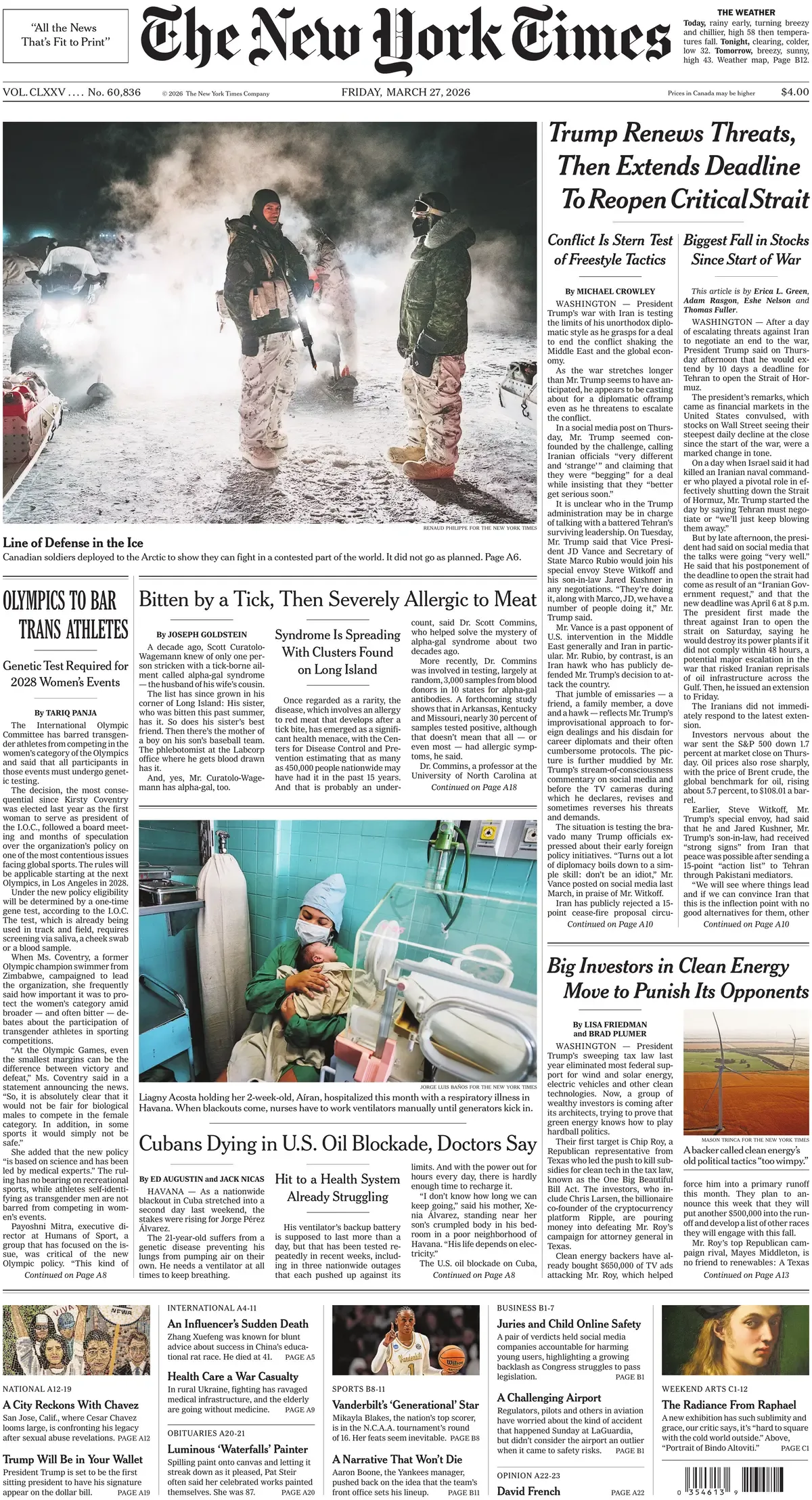
    “Trump renews threats, then extends deadline to reopen critical strait,” The New York Times says on Friday’s front page. “Conflict pushes Nasdaq down into correction” as Dow “poised for worst month since 2022,” The Wall Street Journal says. “War exit unclear,” the Los Angeles Times says. “Deaths of Cuban patients blamed on U.S. blockade,” The Minnesota Star Tribune says. “GOP rallies for unity,” The Dallas Morning News says. “Crush of travelers keeps airports clogged,” The Atlanta Journal-Constitution says. “Far fewer migrants moving to big cities,” The Washington Post says. “Bay Area exodus still hasn’t reversed,” says the San Francisco Chronicle. “Area population growth leads nation,” says the Houston Chronicle. 

    ► See the newspaper front pages


    Tall tale

    Bad influence

    The British retailer Argos is facing criticism for selling a wooden “influencer kit” for toddlers, with a tripod, camera, microphone, tablet and smartphone. Argos says the $20 kit is designed to “cultivate storytelling skills and creativity through career role play.” But children’s advocates argue there is something “a bit off” about kids pretending to be adult influencers, said The Guardian. The toy set is made by Rini, a brand that also markets cosmetic face masks for young children.


    Morning Report was written and edited by Nadia Croes, Catherine Garcia, Scott Hocker, Anya Jaremko-Greenwold, Justin Klawans, Rafi Schwartz, Peter Weber and Kari Wilkin, with illustrations by Stephen Kelly and Julia Wytrazek.

    Image credits, from top: Megan Varner / Getty Images; Leon Neal / Getty Images; Will Oliver / EPA / Bloomberg via Getty Images; Illustration by Julia Wytrazek / Getty Images
     

    Recent editions

    • Evening Review

      Big changes at the DHS

    • Morning Report

      Iran denies Trump peace

    • Evening Review

      The federal debt balloons

    VIEW ALL
    TheWeek
    • About Us
    • Contact Future's experts
    • Terms and Conditions
    • Privacy Policy
    • Cookie Policy
    • Advertise With Us
    • FAQ
    Add as a preferred source on Google Add as a preferred source on Google

    The Week is part of Future US Inc, an international media group and leading digital publisher. Visit our corporate site.

    © Future US, Inc. Full 7th Floor, 130 West 42nd Street, New York, NY 10036.