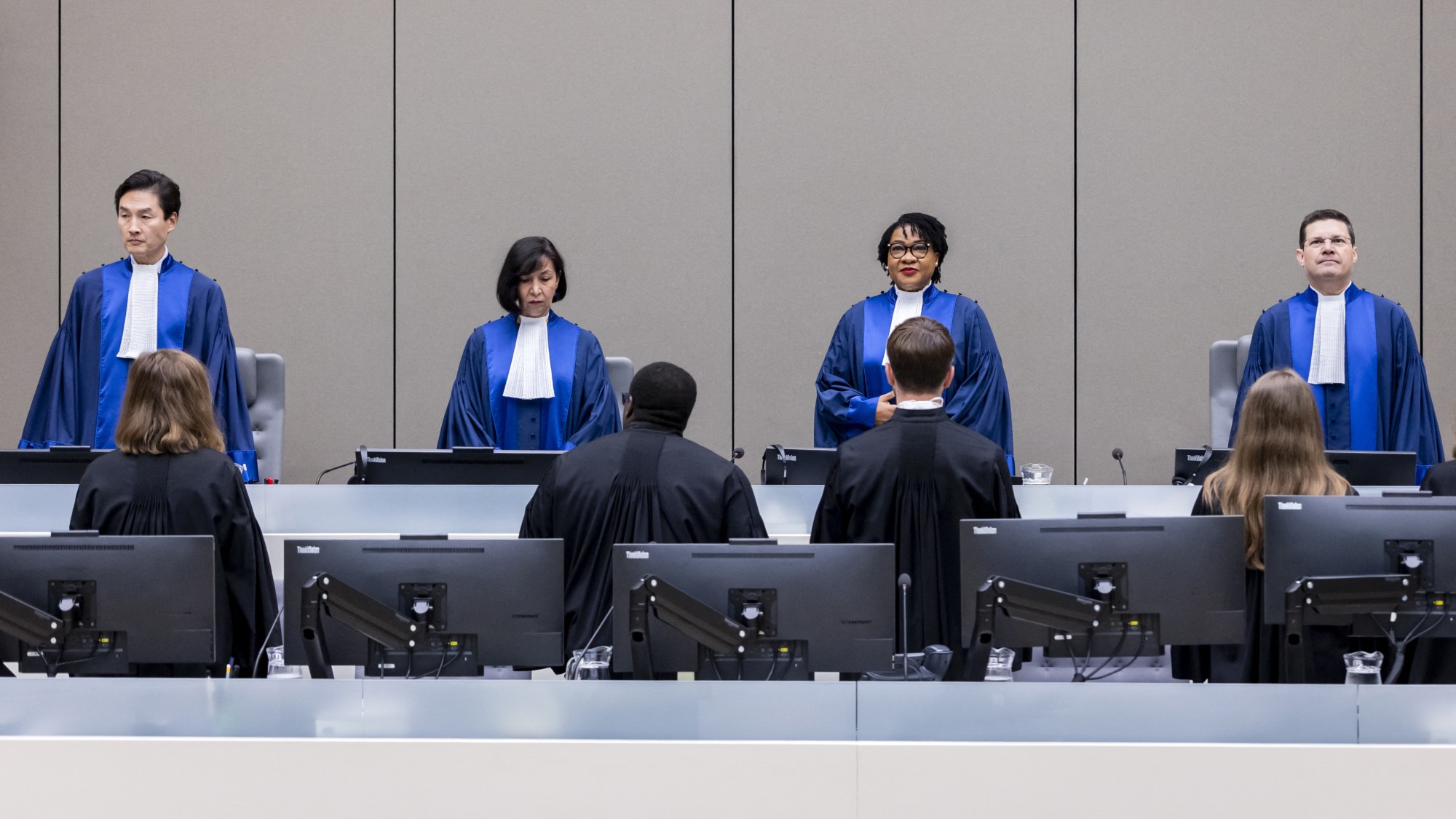
The Trump administration has imposed further sanctions on the International Criminal Court. Why?
What’s going on?
Last month, new US sanctions on the ICC began to take effect. All US-linked companies that provide services to the court face penalties; it has had to find European alternatives to US software, and end its relationship with insurance company Axa, which does business in the US.
The latest measures were announced on 9 October, but sanctions had already been imposed by the US on ICC officials: in Donald Trump’s first term (in response to an ICC probe into the actions of US soldiers in Afghanistan); and in 2025, after the court issued arrest warrants for Israeli Prime Minister Benjamin Netanyahu and former defence minister Yoav Gallant, over suspected war crimes in Gaza.
The US regards this as an overextension of its authority. US Secretary of State Marco Rubio called the ICC a “rogue court”, and said that if US allies did not rein it in, America would “continue its campaign to dismantle the ICC, brick by brick”.
What exactly is the ICC?
It’s not part of the UN, though it was created by the Statute of Rome, at the UN General Assembly there in 1998. The International Criminal Tribunal for the former Yugoslavia and the International Criminal Tribunal for Rwanda provided blueprints for the ICC.
Describing itself as the “court of last resort”, the ICC, based in The Hague in the Netherlands, exercises its power only when states are “unwilling or unable” to investigate serious crimes against international law. The Rome Statute lists crimes it can prosecute: genocide; crimes against humanity; war crimes; crimes of aggression; and offences against its own legal processes (i.e. perjury or contempt).
There are 125 member states, but many others do not recognise its authority. More than 40, including China and India, never signed the treaty. Dozens of others, such as the US, Israel and Russia, signed the treaty but never ratified it.
What is its jurisdiction?
Usually, it can only exert authority over citizens of its member states or when a crime has been committed on member-state soil. For instance, although Russia is not an ICC state party, Vladimir Putin has been indicted for crimes committed in Ukraine, which has accepted the jurisdiction of the court since 2014. Palestine followed in 2015, allowing warrants to be served on Israeli ministers.
Although the ICC respects the primacy of member states’ courts, it can step in if it deems they are failing. But it has no police or army: signatory states are obliged to enforce its rulings; and since the world’s three most militarily powerful nations are not members, this limits its powers.
Why is it criticised?
For many reasons. Its proceedings are slow: since its first case in 2006, there have been only 34 cases before the court, and 15 convictions. These have been disproportionately focused on less powerful countries. The first ICC investigation against a citizen from outside the African continent did not take place until 2016; and the court continues to struggle with its image as the enforcer of “white man’s justice”. The US human rights lawyer Reed Brody complained in 2024 that it had “never indicted a Western official”, preferring to focus on “powerless outcasts, or opponents of the West such as Vladimir Putin”.
However, on the occasions when it has indicted Western allies, or investigated crimes potentially committed by Western nations, it is criticised for having a “globalist” left-wing agenda.
Why did the US never sign up?
President Clinton signed the treaty, but did not submit it to the Senate for ratification. Given the global deployment of US troops and the frequency of its use of force, the fear was that the ICC would make US officials and soldiers vulnerable, and would reduce its freedom of military action. The US has long rejected the ICC’s claim to jurisdiction over its citizens when they are in the territory of treaty states. President George W. Bush signed into law the American Service-Members’ Protection Act in 2002, declaring that it would take “all means necessary” to protect US military personnel and officials from ICC jurisdiction.
However, until recently the US has selectively supported investigations, for instance into war crimes in Darfur and during the Syrian civil war, and – under President Biden – into Russian atrocities in Ukraine.
Why is Trump so opposed to the ICC?
It is part of his wider war on multilateral institutions, which has seen the US withdraw from the Paris climate agreement and the World Health Organization. The latest sanctions, however, seem to have had a particular trigger: they came hours after the Nobel Peace Prize was awarded to one of the ICC’s former judges. South African judge Navi Pillay, currently at the UN’s International Court of Justice in The Hague, was awarded the prize for lifelong contributions to international justice. The prize, said the Norwegian Nobel Committee, was a “message to those who are attacking, undermin[ing] ... the international rules-based system”.
Where does this leave the ICC?
Sanctions mean officials cannot enter the US, or use US-affiliated credit cards or use Microsoft platforms. Staff say that the sanctions have not hindered the court’s work, but this seems improbable. The EU, whose states are heavily committed to the ICC, has given clear support, saying that US attacks on the court and its officials are “simply not acceptable”.
The EU last month awarded the court the Sakharov Prize for Freedom of Thought, commending its “important work in upholding international law and justice”. The campaign against it is likely to “further cement the reputation of the United States as an unhinged, domineering hegemon”, said Stewart Patrick of the Carnegie Endowment for International Peace. But opposition to the ICC is practically a consensus position on the US right.
Running the court of last resort
The ICC employs more than 900 staff from roughly 100 countries, and conducts proceedings in English and French. It has 18 judges, selected from member states, and a separate office of the prosecutor. (Until July, the chief prosecutor was a UK lawyer, Karim Khan, who was ousted following accusations of sexual misconduct.) The ICC is funded from mandatory annual contributions from member states – the UK is among the largest contributors – alongside voluntary donations; its budget for 2026 is just under €200 million.
The court has its own detention centre within a Dutch prison outside The Hague, used for holding those awaiting trial. There are currently six inmates. Its most high-profile recent detainee is the former president of the Philippines, Rodrigo Duterte, who in March was arrested on charges of crimes against humanity committed during his 2011-19 “war on drugs” campaign. Those convicted are usually sent to prisons in other member states. Norway currently holds the Ugandan former child soldier Dominic Ongwen, found guilty in 2023 on 61 counts of war crimes and crimes against humanity. The Malian militant Ahmad al-Mahdi, convicted by the court of damaging monuments in Timbuktu, was imprisoned in the UK.