The Week US
https://cdn.mos.cms.futurecdn.net/flexiimages/jacafc5zvs1692883516.jpg

SUBSCRIBE & SAVE

Less than $2.50 per week

flag of US
US
flag of UK
UK
Sign in
  • View Profile
  • Sign out
  • Newsletter sign up Newsletter
    • The Explainer
    • The Week Recommends
    • Newsletters
    • Cartoons
    • From the Magazine
    • The Week Junior
    • More
      • Politics
      • World News
      • Business
      • Health
      • Science
      • Food & Drink
      • Travel
      • Culture
      • History
      • Personal Finance
      • Puzzles
      • Photos
      • The Blend
      • All Categories
    Brand Logo
    Nvidia scrutiny, Huang’s return and another Dem shocker

     
    TODAY’S NATIONAL story

    Trump’s vouching for Huang, chip export role scrutinized

    What happened
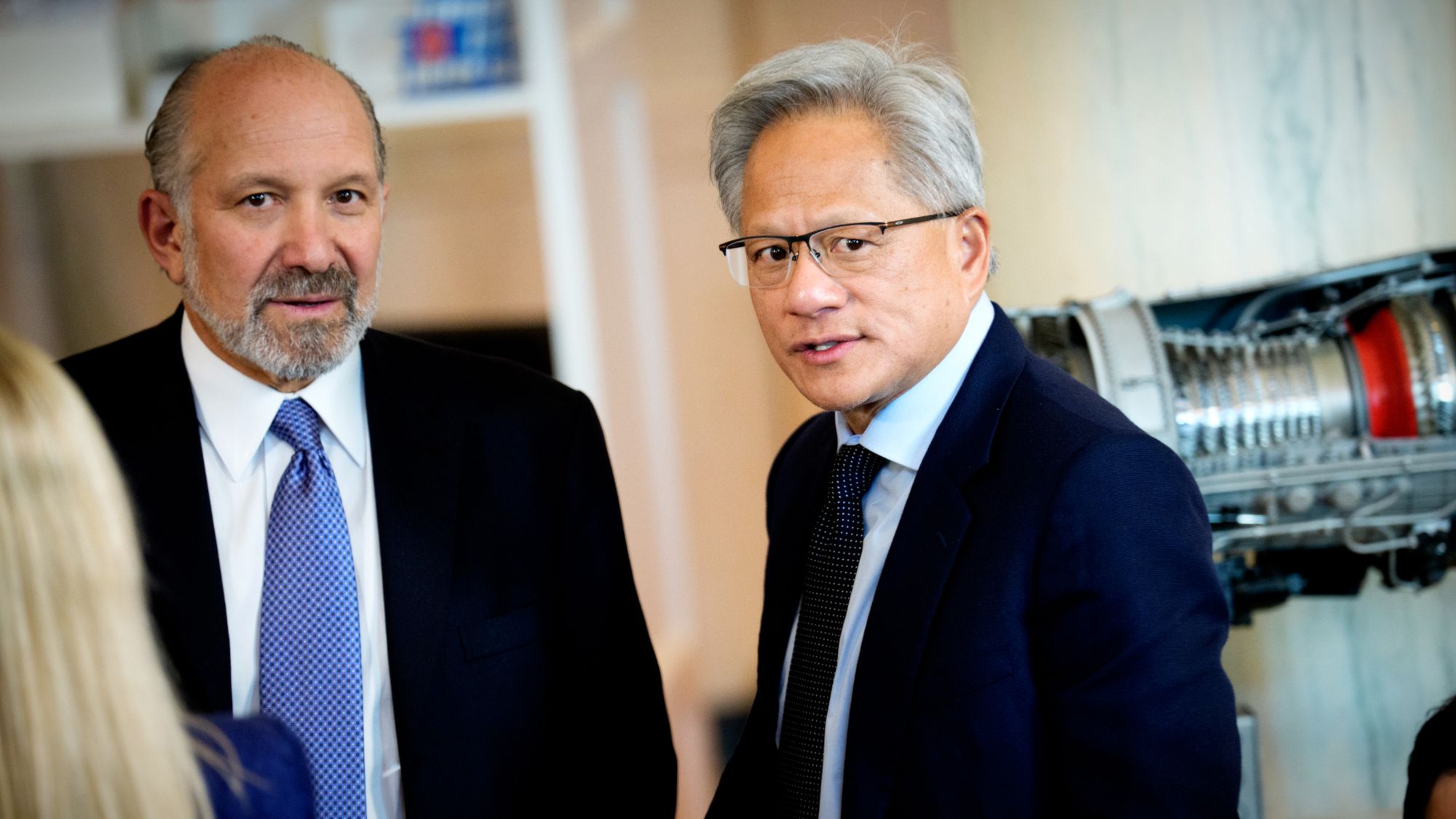
    Attorney General Todd Blanche yesterday declined to confirm President Donald Trump’s assurances to Nvidia’s board that a Justice Department investigation had cleared reinstated CEO Jensen Huang of posing a national security risk. The DOJ “did a pretty good investigation” that “exonerated” Huang, Trump told CNBC on Monday. At a “contentious” press conference yesterday, Blanche “bristled” at questions on the steps he took to clear the Nvidia CEO, The Washington Post said, and “downplayed the idea” the Huang “had faced any investigation.” 

    Huang illegally shipped “extremely advanced chips to China,” Senate Minority Leader Chuck Schumer (D-N.Y.) said yesterday on social media. That’s like “selling rocket engines to the Soviets during the Space Race.”

    Who said what
    Commerce Secretary Howard Lutnick added Megaspeed, the Singapore data center at the heart of the Huang espionage scandal, to his department’s export blacklist on Monday, after “months of entreaties” by other Cabinet heads to “crack down harder on chip exports to China,” Semafor said. Lutnick also beefed up his personal security detail with specially trained Bureau of Industry and Security agents “who might otherwise have prevented the smuggling of AI chips to China,” apparently driven by a “desire to have a detail comparable to that of other Cabinet members,” The Atlantic reported yesterday.

    What next?
    Blanche yesterday told reporters he had “no reason” to “say Nvidia is anything but a good corporate citizen,” though a future investigation could “lead to different results.” He was “evasive,” but “others in the administration were non-existent when it came to vouching for Trump’s assurances,” Aaron Blake said at CNN, “which reinforces what a massive risk both Trump and Nvidia just took” in reinstating Huang. 


    TODAY’S TECH story

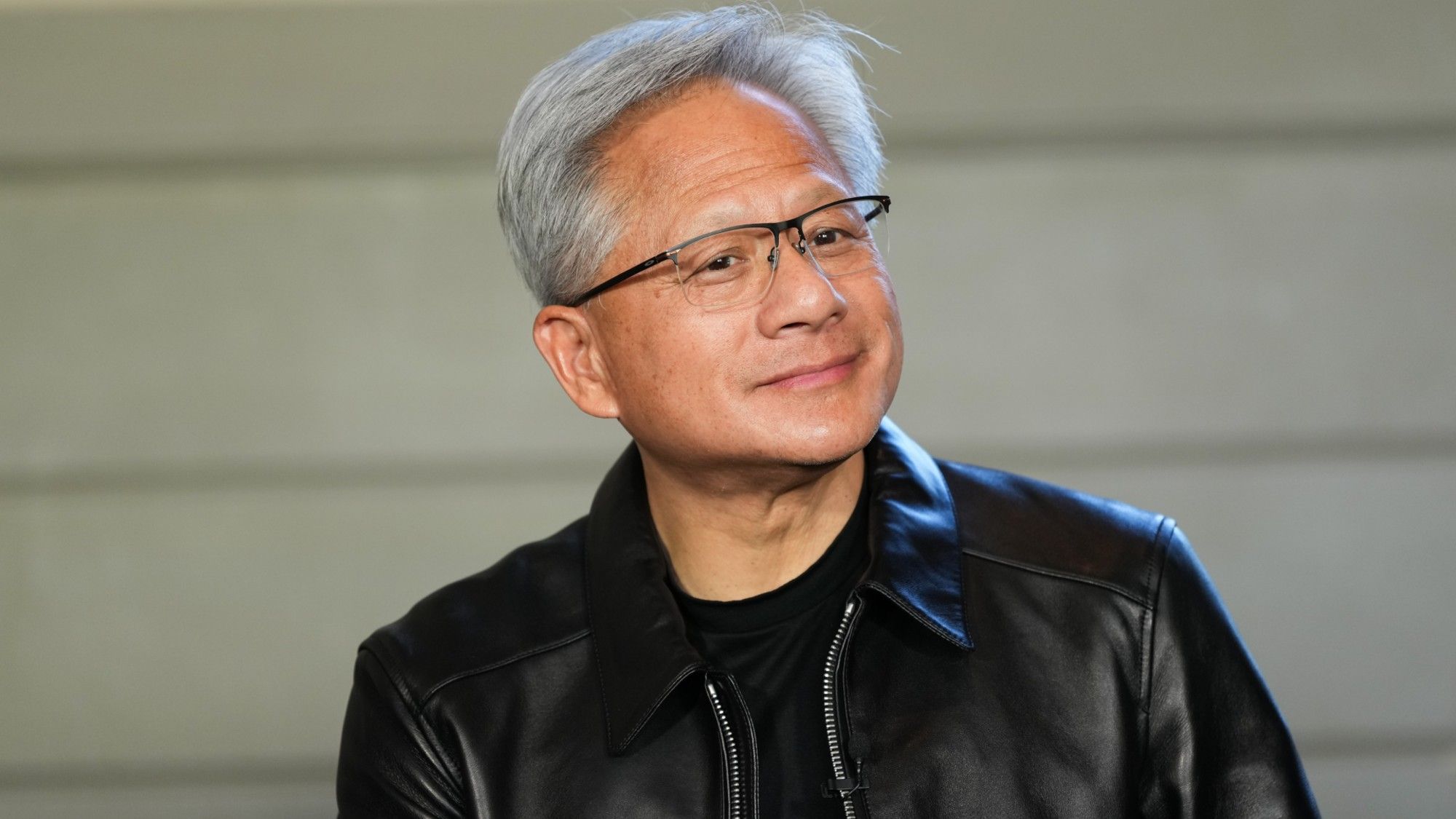
    Huang returns to Nvidia with apologies, disclosures

    What happened
    In his first companywide meeting since being reinstated, Jensen Huang yesterday said it was his value to Nvidia, not the intervention of President Donald Trump, that got him his CEO job back. The hourlong meeting “cemented” Huang’s return “after two head-spinning weeks,” The New York Times said. He apologized for what he called his “terrible mistakes” and for violating Nvidia’s code of conduct, but that “somber” beginning shifted into a “defiant airing of grievances.”

    Who said what
    Huang said he goes to therapy for 90 minutes every day, “and it’s been helping me a lot.” He also said the “rumors” that he was brought back because he’s a “tech bro” with a “super nice jacket” who’s “above the law,” or “because the highest levels of our government wanted me back,” were “completely untrue.” Trump “really loves our company” and “gloats about Nvidia,” Huang said, but the board “evaluated the entire situation” and “gathered facts” and “performed their duty as they should have.” The board said Monday that its outside “investigation into Huang’s behavior” would continue, The Wall Street Journal said.

    What next?
    Huang may have been “chastened,” but his “preview of what the new Nvidia will look like” was “a lot like the old one,” the Journal said. His actions and lack of transparency “⁠could still entangle ​him and the company in costly investigations” by state and federal regulators and Congress, said Reuters.


    TODAY’S ELECTION Story

    Dems win 259th House seat, ‘biggest upset’ of midterms

    What happened
    Democrat Victoria Broderick (pictured above) narrowly defeated eight-term Rep. Scott DesJarlais (R-Tenn.) in Tennessee’s 4th Congressional District, The Associated Press projected yesterday. DesJarlais beat Broderick, a 34-year-old tech support worker, by 43 percentage points in 2024. He conceded last week. Broderick’s 0.18-point victory gives Democrats 259 seats in the House, their biggest majority since 1992.

    Who said what
    Tennessee Republicans made the 4th District slightly more competitive this year in a gerrymander designed to sweep the state’s nine House seats. But “even accounting for the new boundaries, Tennessee’s 4th is the most Republican-leaning seat won by a Democrat this year,” C.J. Robinson said at The New York Times. Democrat Scott Colom scored a “stunning” victory in Mississippi’s Senate race, but Broderick’s win is the “biggest upset” of the midterms. Forecasting models put her odds of victory “at less than 1%,” and prediction markets “were only slightly more generous.” The Cook Political Report rated the race as “Solid Republican.” 

    What next?
    Three House races have yet to be called. Two in Louisiana will be decided in a runoff election next month and Minnesota’s 1st District is headed to a Nov 30 recount, with Democrat Jake Johnson leading Rep. Brad Finstad (R) by 0.1 points. If Johnson pulls off the win, Robinson said, it would “make our list” of the “Top 10 most surprising victories” this year.


    It’s not all bad

    Chronic traumatic encephalopathy (CTE) could soon be diagnosed with a blood test. The degenerative disease, caused by repeated head trauma, is currently identified only by autopsy. However, elevated levels of a certain protein in the blood may be a CTE biomarker, according to two studies. The findings are a “watershed moment for the field,” said neuropathologist Michael Buckland to Scientific American. A diagnosis in living people “opens the door for clinical trials to start finding treatments for the disease.”


    Under the radar

    An ED pill may slow Alzheimer’s progression

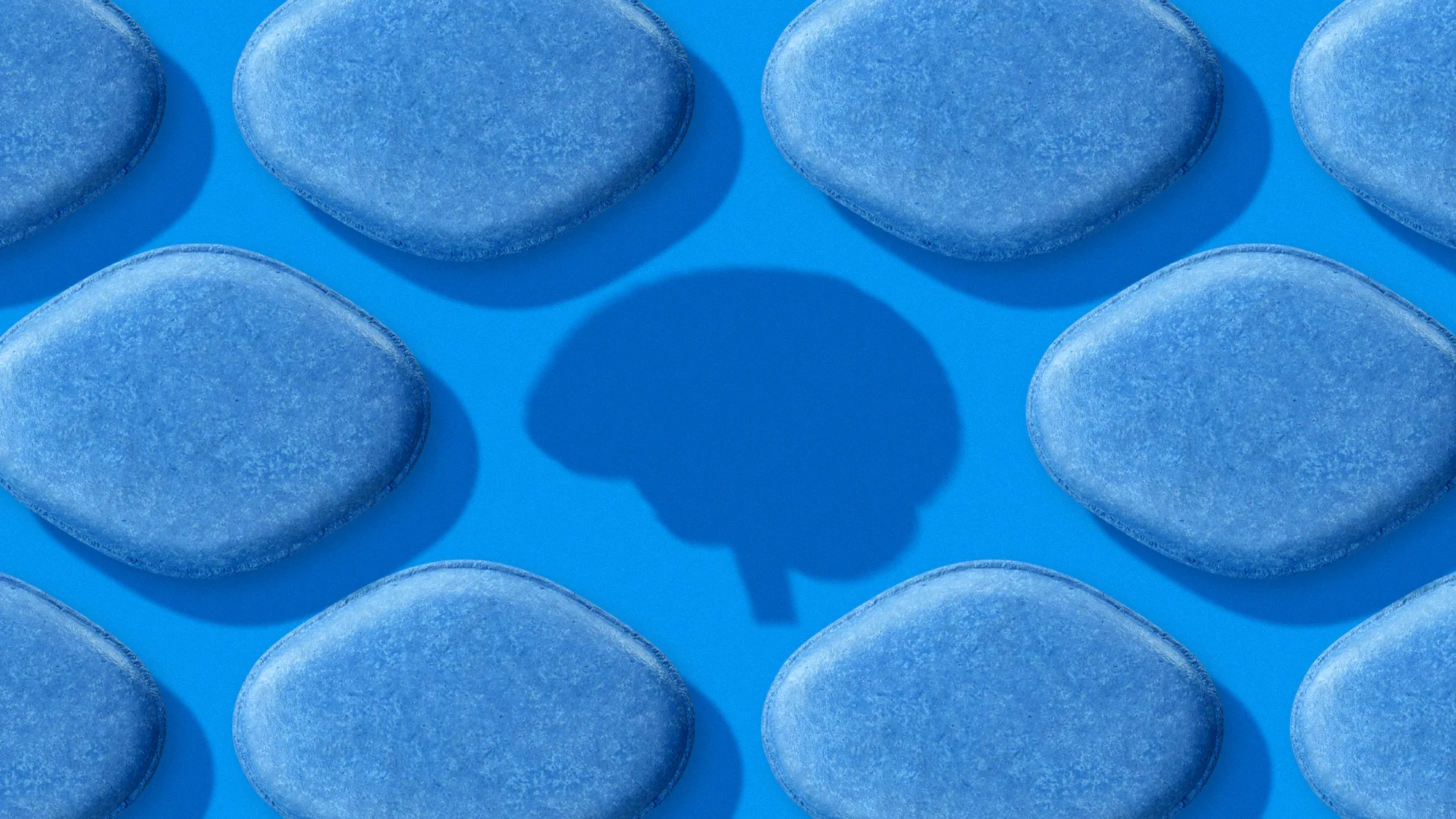
    A medication for erectile dysfunction could help fight Alzheimer’s disease. Researchers are optimistic about the drug and its possibilities for opening new treatment pathways.

    The drug AR1001, which is similar to Viagra, was able to “effectively slow down people’s decline in memory and thinking by nearly a third,” said Richard Oakley, the associate director for research and innovation at the Alzheimer’s Society, in a statement. The side effects were “mostly mild to moderate” during a yearlong clinical trial of more than 1,500 people with early Alzheimer’s disease. While the results were promising, the benefits occurred almost entirely among people who “weren’t already taking other dementia drugs,” said The Washington Post.

    ED drugs work by “blocking an enzyme that normally breaks down a chemical messenger” called cGMP, said University of Sheffield neuroscience PhD candidate Rahul Sidhu at The Conversation. Obstructing the enzyme “allows cGMP to build up, helping the muscles around blood vessels relax” and widen, “allowing more blood to flow through them.” 

    The chemical messenger also “helps brain cells communicate with each other,” said Sidhu. And “increasing its levels could help brain cells survive and maintain the connections they need to share information,” which could also assist in treating Alzheimer’s.

    Despite the mixed results across patients, this is an “encouraging development in Alzheimer’s research,” Sheona Scales, the director of research at Alzheimer’s Research U.K., told The Guardian. The clinical trial “reinforces the importance of exploring different approaches to tackling this complex disease.”


    On this day

    November 25, 1957

    President Dwight Eisenhower suffered what White House doctors later described as a “mild” stroke during a Cabinet meeting, leaving the 67-year-old president with noticeably impaired speech. The incident contributed to the 1967 adoption of the 25th Amendment, which codified the process for assuming presidential power when the commander in chief is incapacitated. 


    TODAY’S newspaperS

    ‘Abrego Garcia gives up’

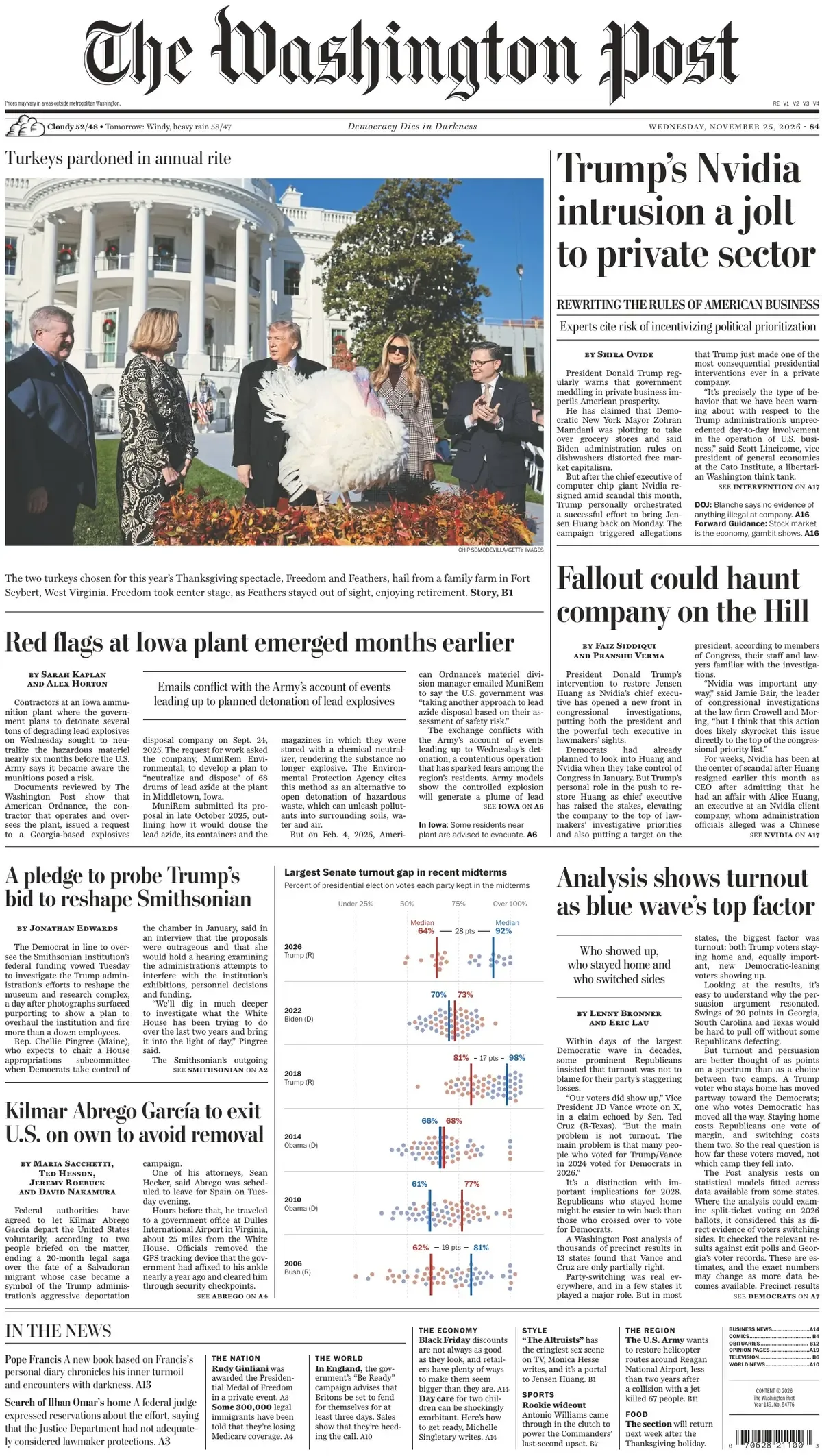
    “Abrego Garcia gives up 20-month battle to remain in the U.S.,” voluntarily leaves for Spain, The New York Times says on Wednesday’s front page. “China’s Huawei is found guilty of fraud charges in U.S. trial,” The Wall Street Journal says. “Trump’s Nvidia intrusion a jolt to private sector,” The Washington Post says. “Lawmakers focus their aim on Huang, Trump,” says The Philadelphia Inquirer. “Stock trading ban in Congress on table,” The Boston Globe says. “Investigation of Omar spans entire life,” The Minnesota Star Tribune says. “Iowans hunker down ahead of detonation,” the Chicago Tribune says. “Stress can be a side dish at Thanksgiving,” says USA Today, “but there are ways to lower the heat on family disagreements.”

    ► See the newspaper front pages


    Tall tale

    Delusions of clan-deur

    A Frenchman in a kilt who smashed the glass enclosure housing Scotland’s famous Stone of Destiny claims he has an ancestral right to the rock used to crown Scottish and English monarchs for centuries. Arnaud Harixcalde Logan, 36, admitted in Perth Sheriff Court that he hammered at the glass in Perth Museum, causing more than $11,800 in damage. But he said the Stone of Scone, as it’s also known, was stolen from the Logan clan and it’s his “birthright” to sit on it.


    Morning Report was written and edited by Nadia Croes, Scott Hocker, Anya Jaremko-Greenwold, Justin Klawans, Devika Rao, Rafi Schwartz, Peter Weber and Kari Wilkin, with illustrations by Stephen Kelly and Julia Wytrazek.

    Image credits, from top: Andrew Harnik / Getty Images; Erik Flyg / Bloomberg / Getty Images; Anna Moneymaker / Getty Images; Illustration by Stephen P. Kelly / Shutterstock
     

    Recent editions

    • Evening Review

      Defeating measles once again

    • Morning Report

      Trump engineers Huang’s restoration

    • Evening Review

      How Huang landed back on top

    VIEW ALL
    TheWeek
    • About Us
    • Contact Future's experts
    • Terms and Conditions
    • Privacy Policy
    • Cookie Policy
    • Advertise With Us
    • FAQ
    Add as a preferred source on Google Add as a preferred source on Google

    The Week US is part of Future US Inc, an international media group and leading digital publisher. Visit our corporate site.

    © Future US, Inc. Full 7th Floor, 130 West 42nd Street, New York, NY 10036.